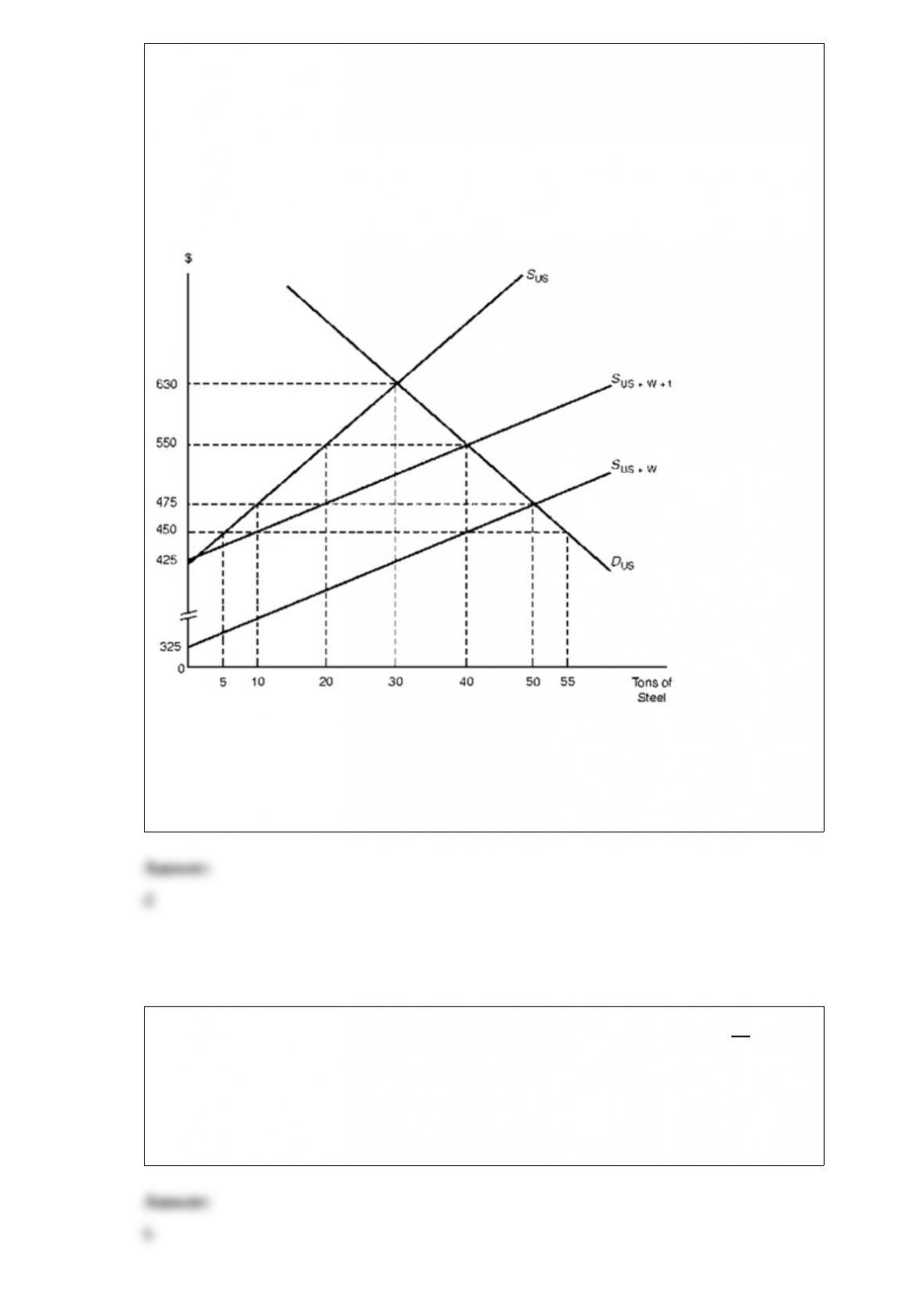
1) assume the united states is a large consumer of steel that is able to influence the
world price. its demand and supply schedules are respectively denoted by du.s. and su.s.
in figure 4.2. the overall (united states plus world) supply schedule of steel is denoted
by su.s.+w.
figure 4.2. import tariff levied by a “large” country
referring to figure 4.2, the tariff’s deadweight welfare loss to the united states totals:
a.$450
b.$550
c.$650
d.$750
2) given a two-country and two-product world, the united states would enjoy all the
attainable gains from free trade with canada if it:
a.trades at the u.s. rate of transformation
b.trades at the canadian rate of transformation
c.specializes completely in the production of both goods
d.specializes partially in the production of both goods
3) it is generally agreed that the smoot-hawley act of 1930 led to improvements in u.s.
exports and an overall increase in u.s. output and employment.
a.true
b.false
4) when products from high-cost suppliers within a customs union replace imports from
a low-cost nation that is not a member of the customs union, there exist(s):
a.dynamic welfare losses
b.dynamic welfare gains
c.trade creation
d.trade diversion
5) when a country realizes a deficit on its current account:
a.its net foreign investment position becomes positive
b.it becomes a net demander of funds from other countries
c.it realizes an excess of imports over exports on goods and services
d.it becomes a net supplier of funds to other countries
6) if a nation has an open economy, it means that the nation allows private ownership of
capital.
a.true
b.false
7) when a deficit nation borrows from the international monetary fund, it purchases
with its currency the foreign currency required to help finance the payments deficit.
a.true
b.false
8) all welfare effects of a regional trading agreement are static.
a.true
b.false
9) the united auto workers union attempted to win the approval of legislation that would
moderate the practice of foreign sourcing on the part of american auto manufacturers.
which of the following best represents this legislation?
a.voluntary export quotas
b.trigger price mechanism
c.tariff quotas
d.local content laws
10) which of the following is not considered an “owned” reserve?
a.national currencies
b.gold
c.special drawing rights
d.oil facility
11) in 1999 the united states revoked the normal-trade-relations (most-favored-nation)
status it provided china in retaliation for china’s suppression of human rights.
a.true
b.false
12) by the mid-1980s, the united states had evolved from the status of a net-creditor
nation to a net-debtor nation in its balance of international indebtedness.
a.true
b.false
13) in figure 2.4 one car can be produced at a cost of
a.one and two-thirds tons of wheat
b.two and one-third tons of wheat
c.three fifths tons of wheat
d.three sevenths tons of wheat
14) according to the marshall-lerner condition, currency depreciation has no effect on a
country’s trade balance if the elasticity of demand for its exports plus the elasticity of
demand for its imports equals:
a.0.1
b.0.5
c.1.0
d.2.0
15) if a tariff and an import quota lead to equivalent increases in the domestic price of
steel, then:
a.the quota results in efficiency reductions but the tariff does not
b.the tariff results in efficiency reductions but the quota does not
c.they have identical impacts on how much is produced and consumed
d.they have identical impacts on how income is distributed
16) countervailing duties may be imposed:
a.in response to a foreign export subsidy
b.in response to a foreign antidumping tariff
c.to promote exports of domestic companies
d.to promote imports of domestic consumers
17) international trade in goods and services is sometimes used as a substitute for all of
the following except:
a.international movements of capital
b.international movements of labor
c.domestic production of the same goods and services
d.domestic production of different goods and services