How does the construction of a market demand curve for a private good differ from that
for a public good?
A) There is no difference; in both cases the demand curve is determined by adding up
the price each consumer is willing to pay for each quantity of the good.
B) There is no difference; in both cases the demand curve is determined by adding up
the quantities demanded by each consumer at each price.
C) The market demand curve for a private good is determined by adding up the
quantities demanded by each consumer at each price but the market demand curve for a
public good is determined by adding up the price each consumer is willing to pay for
each quantity of the good.
D) The market demand curve for a private good is determined by adding up the price
each consumer is willing to pay for each quantity of the good but the market demand
curve for a public good is determined by adding up the quantities demanded by each
consumer at each price.
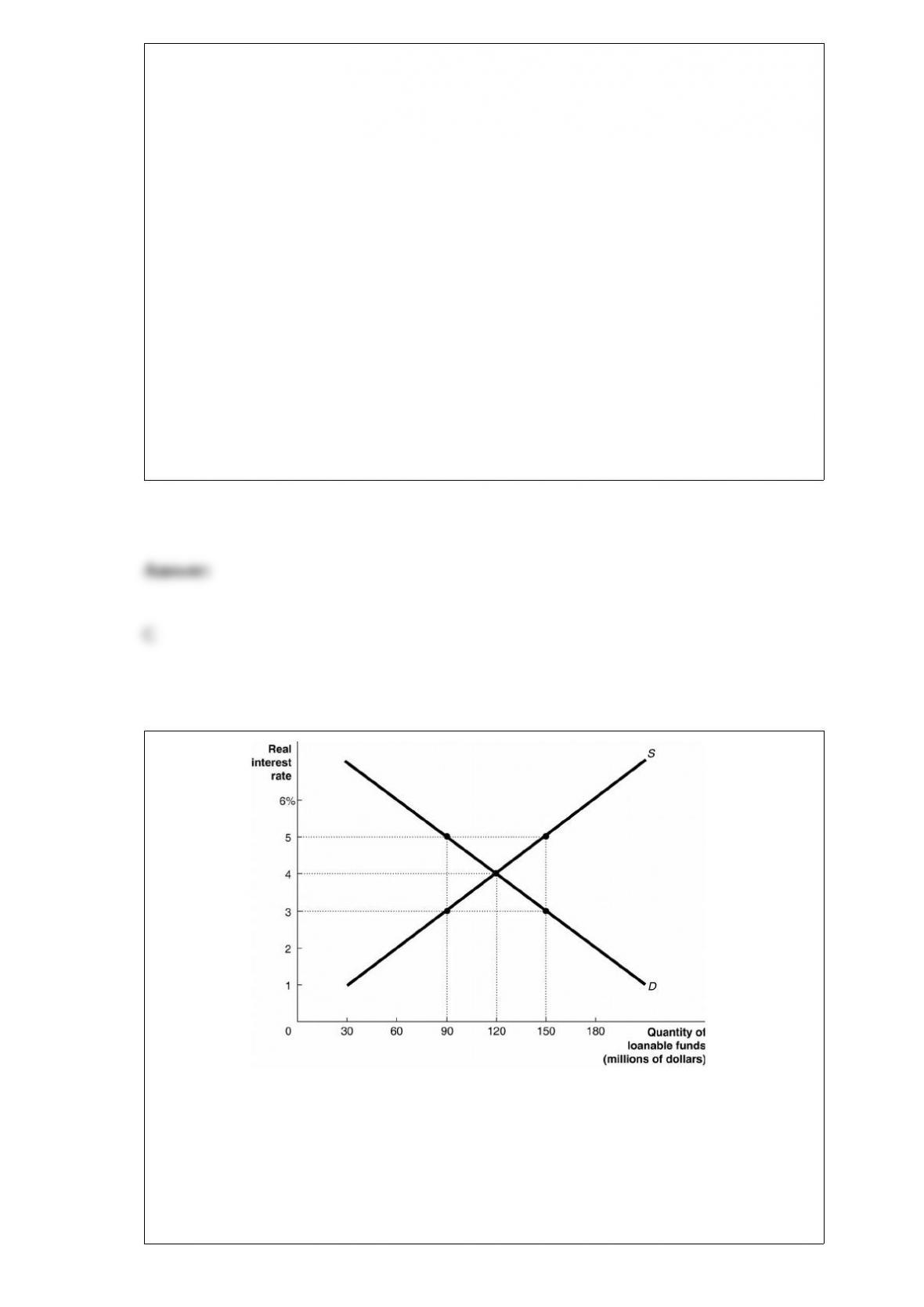
Figure 10-6
The loanable funds market is given in the figure above. If the current real interest rate is
5 percent, which of the following is true?
A) The loanable funds market is in equilibrium.
B) There is a surplus of loanable funds in the market.

C) There is a shortage of loanable funds in the market.
D) The quantity of loanable funds being demanded in the market is less than $90
million.
Following the recession of 2007-2009, the employment-population ratio
A) remained virtually unchanged for the next 36 months.
B) was even lower four years after the end of the recession.
C) began to slowly increase back to its pre-recession level.
D) began to quickly increase back to its pre-recession level.
Without technological advancement, how can a nation achieve economic growth?
A) by producing more high-value goods and fewer low-value goods
B) through an increase in supplies of factors of production
C) by producing more low-value goods and fewer high-value goods
D) by decreasing the size of the labor force
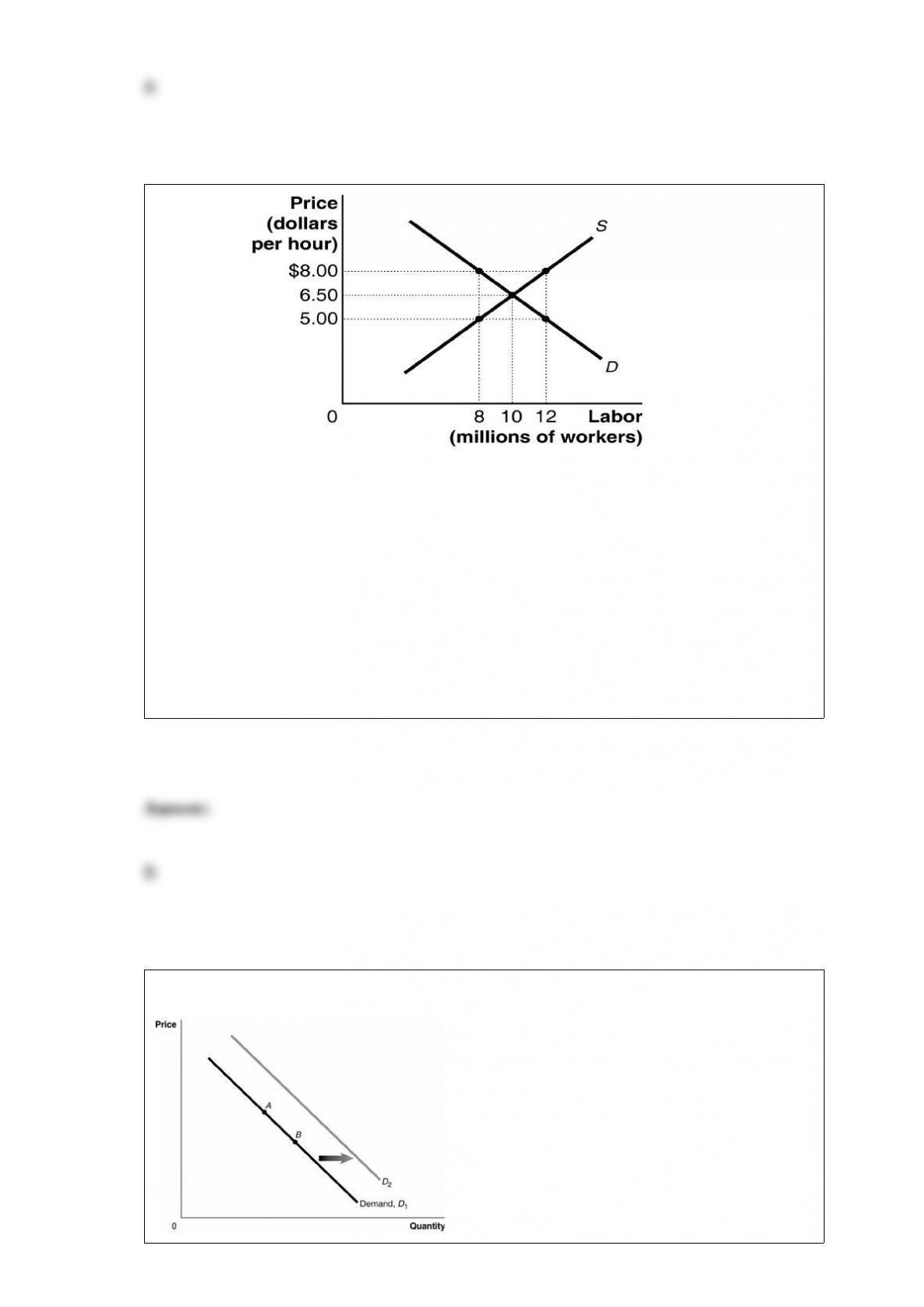
Figure 20-1
Based on the graph of the labor market above, if a minimum wage of $8 per hour is
imposed, which of the following will result?
A) The quantity of labor demanded by firms will rise.
B) The quantity of labor demanded by firms will fall.
C) The unemployment rate will fall.
D) Both A and C will occur.
Figure 3-1

A decrease in taste or preference would be represented by a movement from
A) A to B.
B) B to A.
C) D1 to D2.
D) D2 to D1.
Which of the following criteria would make gold a poor medium of exchange?
A) Its value depends on its purity, and its purity is not easy to visibly identify.
B) durability so that value is not lost by spoilage
C) value relative to its weight so that amounts large enough to be useful in trade can be
easily transported
D) divisibility because different goods are valued differently
During which of the following time periods did inflation remain above 5 percent every
year?
A) 1990 through 1999
B) 1973 through 1982
C) 1968 through 1971
D) 1958 through 1962
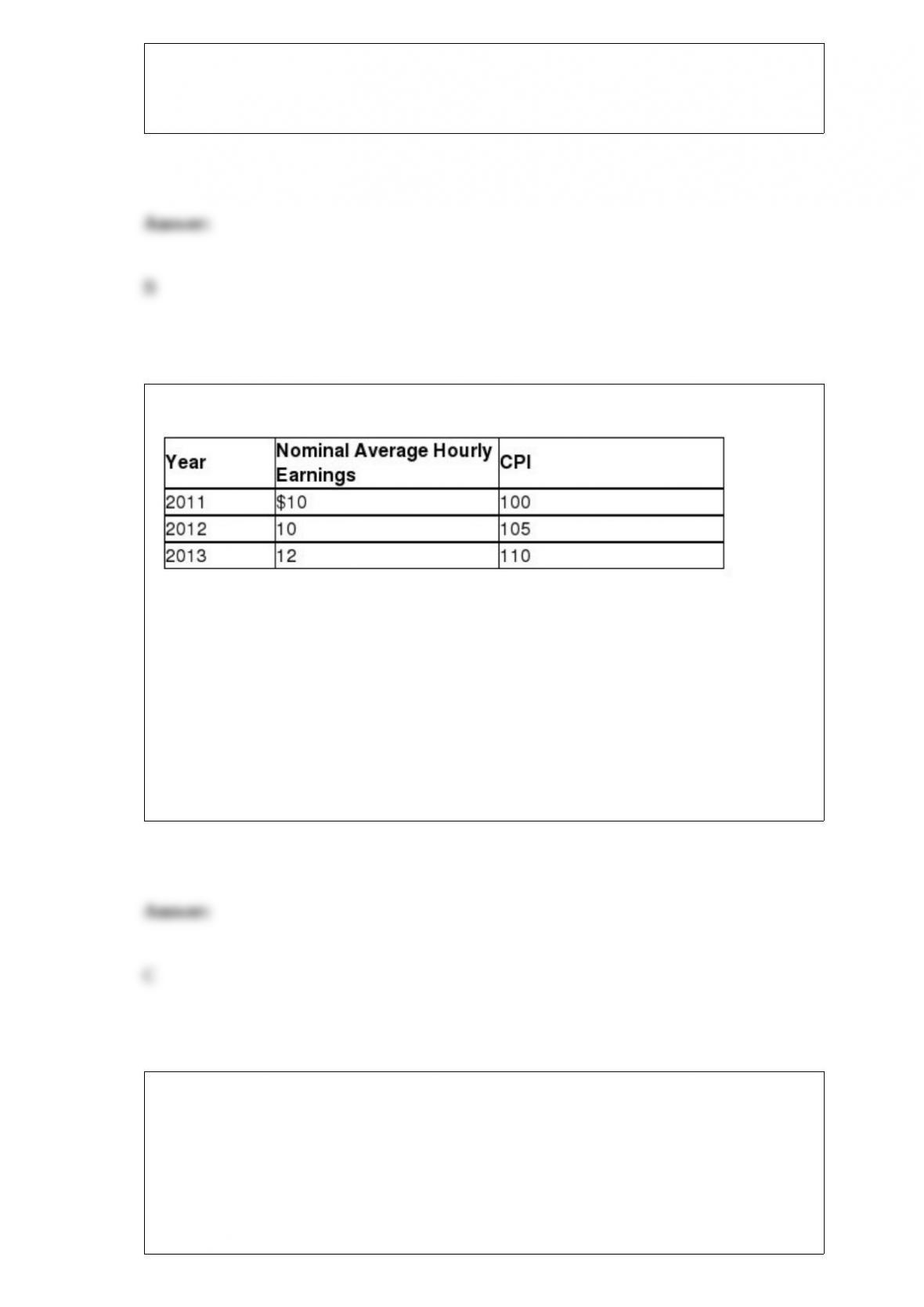
Table 20-15
Looking at the table above, real average hourly earnings in 2011 were
A) $9.
B) $9.52.
C) $10.
D) $12.63.
The short-term unemployment arising from the process of matching workers with jobs
is called
A) frictional unemployment.
B) structural unemployment.

C) cyclical unemployment.
D) seasonal unemployment.
E) unnatural unemployment.
The demand curve for a public good is also called the
A) total welfare curve.
B) marginal social benefit curve.
C) total social benefit curve.
D) total willingness-to-pay curve.
Figure 4-7
The figure above represents the market for iced tea. Assume that this is a competitive
market. If the price of iced tea is $3,
A) the quantity supplied is greater than the economically efficient quantity.
B) the quantity demanded is economically efficient but the quantity supplied is
economically inefficient.
C) economic surplus is maximized.
D) too many consumers want to buy iced tea.
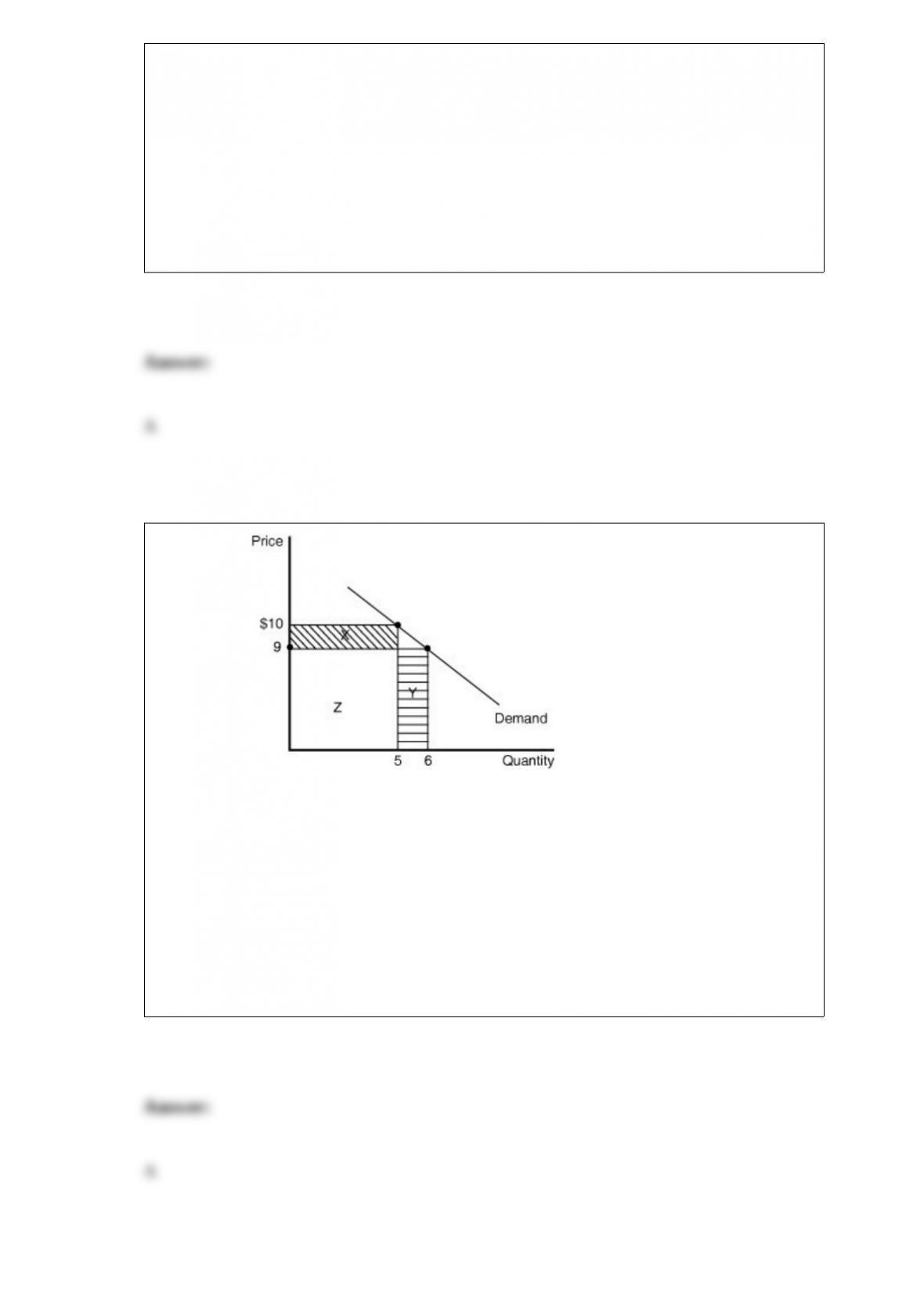
Figure 13-3
What is the marginal revenue of the sixth unit of output?
A) $4
B) $5
C) $9
D) $54

An increase in the expected inflation rate will
A) shift the short-run Phillips curve to the right.
B) shift the short-run Phillips curve to the left.
C) reduce the inflation rate.
D) reduce the unemployment rate.
Which of the following helps to explain why the supply curve of labor is upward
sloping?
A) The supply curve of labor is a derived supply curve; since the output supply curve is
upward sloping, so is the labor supply curve.
B) As the wage rate rises, the income effect causes the quantity of labor supplied to
increase.
C) The substitution effect of a price change makes a good more expensive relative to
other goods.
D) As the wage rate rises, the opportunity cost of leisure rises.
Which of the following describes the Soviet Union’s economy through most of the
second half of the 20th century?
A) The Soviet economy grew rapidly in the latter half of the 20th century.
B) The Soviet economy increased capital per worker very slowly from 1950 through

1980.
C) The Soviet economy grew slowly because of the slow rate of technological change.
D) The Soviet economy grew because it added labor through immigration policy in the
1950s.
In a small Asian country, it is estimated that changing the level of capital from $8
million to $12 million will increase real GDP from $5 million to $6 million. If the
number of hours worked in the labor force does not change, what does this information
tell you about the slope of the per-worker production function in this range?
A) The slope is -4.
B) The slope is 1/4.
C) The slope is 4.
D) The slope is 8.
Figure 3-2

A decrease in the price of inputs would be represented by a movement from
A) A to B.
B) B to A.
C) S1 to S2.
D) S2 to S1.