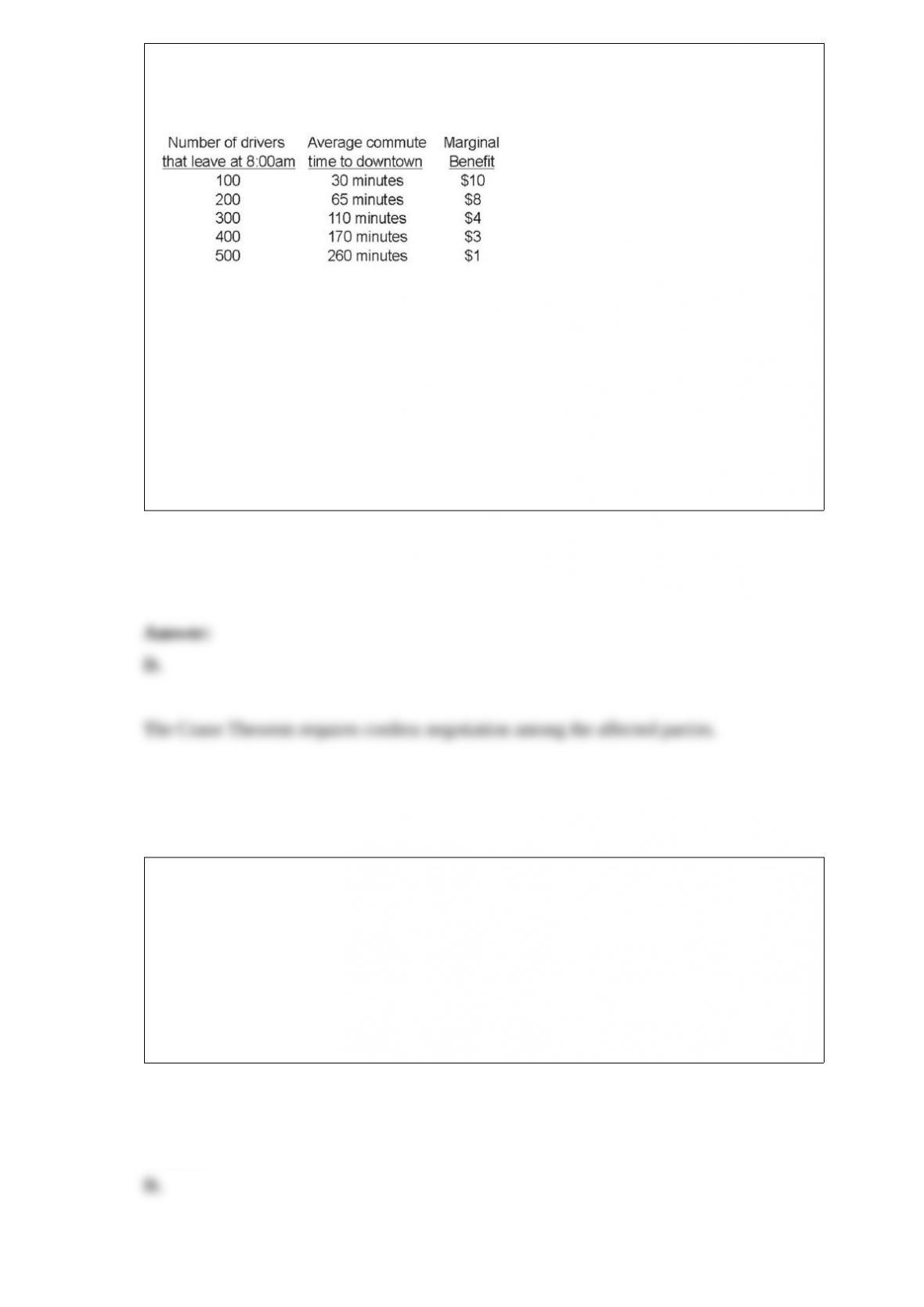
The following data show the relationship between the number of drivers who leave for
work at 8:00 am, their average commute times, and their marginal benefit associated
with the commute times.
Refer to the information given above. An argument for imposition of a toll rather than
using a negotiated solution of the type suggested by the Coase Theorem is that:
A. this is not an externality problem.
B. government needs additional revenues.
C. the external cost is not well defined.
D. private negotiations among 500 drivers is impractical.
Which of the following is an asset of a family?
A. Student loan
B. Mortgage
C. Unpaid credit card balance
D. Checking account balance
You own a pizza shop called “Pizzas’R’ Us”. Currently you are paying your cooks an
hourly wage of $20. You sell a medium pizza for $10. By hiring more cooks, you can
increase your pizza production as shown in the following table.
If you operate one hour every day, what is the marginal benefit of hiring the 3rd cook?
A. $10
B. $20
C. $30
D. $40
In the case of ______, the invisible hand fails to generate the efficient outcome because
buyers and sellers only take their self-interests into account.
A. either an external cost or an external benefit
B. only an external cost
C. only an external benefit
D. unregulated markets
Suppose Jordan and Lee are trying to decide what to do on a Friday. Jordan would
prefer to see a comedy while Lee would prefer to see a documentary. One documentary
and one comedy are showing at the local cinema. The benefit they receive from seeing
the films either together or separately are shown in the payoff matrix. Both Jordan and
Lee know the information contained in the payoff matrix. They purchase their tickets
simultaneously, ignorant of the other’s choice.
Refer to the figure above. Suppose a timing element is added to the game, and that
Jordan buys a ticket first. While Lee did not see which ticket Jordan bought, Lee does
know the values in the payoff matrix and that Jordan has purchased first. Assuming that
Jordan and Lee are both self-interested, Lee can infer:
A. that Jordan bought a ticket for the documentary.
B. that Jordan did not exploit the first-mover advantage.
C. that Jordan bought a ticket for the comedy.
D. that Jordan’s threat to buy a ticket for the comedy is not credible.
In the Keynesian cross diagram, the vertical intercept of the expenditure line equals
______ and the slope of the expenditure line equals _____.
A. induced expenditures; autonomous expenditures

B. autonomous expenditures; induced expenditures
C. planned spending; unplanned spending
D. autonomous expenditures; the mpc
Your classmates from the University of Chicago are planning to go to Miami for spring
break, and you are undecided about whether you should go with them. The round-trip
airfares are $600, but you have a frequent-flyer coupon worth $500 that you could use
to pay part of the airfare. All other costs for the vacation are exactly $900. The most
you would be willing to pay for the trip is $1400. Your only alternative use for your
frequent-flyer coupon is for your trip to Atlanta two weeks after the break to attend your
sister’s graduation, which your parents are forcing you to attend. The Chicago-Atlanta
round-trip airfares are $450.
If the Chicago-Atlanta round-trip air fare is $350, should you go to Miami?
A. No, there is a loss of $50.
B. No, there is a loss of $100.
C. Yes, there is economic surplus of $50.
D. Yes, there is economic surplus of $400.

The M2 measure of money consists of the sum of:
A. savings deposits, small time deposits, and money market mutual funds.
B. currency, checking and savings deposits, and small time deposits.
C. currency, checking and savings deposits.
D. M1, savings deposits, small time deposits, and money market mutual funds.
Lane and Riley are the only two residents in a neighborhood, and they share the same
driveway. They would like to have the driveway paved. The value of the paved
driveway is $1500 to Lane and $1000 to Riley. Irrespective of who pays for the paving
both people will benefit from it.
Relative to the two-person scenario described, if a large number of people share the
driveway, the joint purchase of paving is _______ and the ________ emerges.
A. impossible; tragedy of the commons
B. less costly; maximum economic efficiency
C. more likely to be accomplished; free-rider problem
D. more difficult; free-rider problem
Refer to the figure above. If the firm chooses to operate, to profit maximize, the firm
will choose to produce __________ units and charge a price of __________.
A. 3.5; $33.50
B. 7; $19.30
C. 3.5; $22.50
D. 3.5; $5
As a result of a war in the country of Omega, refugees flee to the country of Alpha to
seek employment. Holding other factors constant, the influx of refugees will ______ the
real wage in Alpha and ______ employment in Alpha.
A. increase; increase
B. increase; decrease
C. decrease; decrease
D. decrease; increase
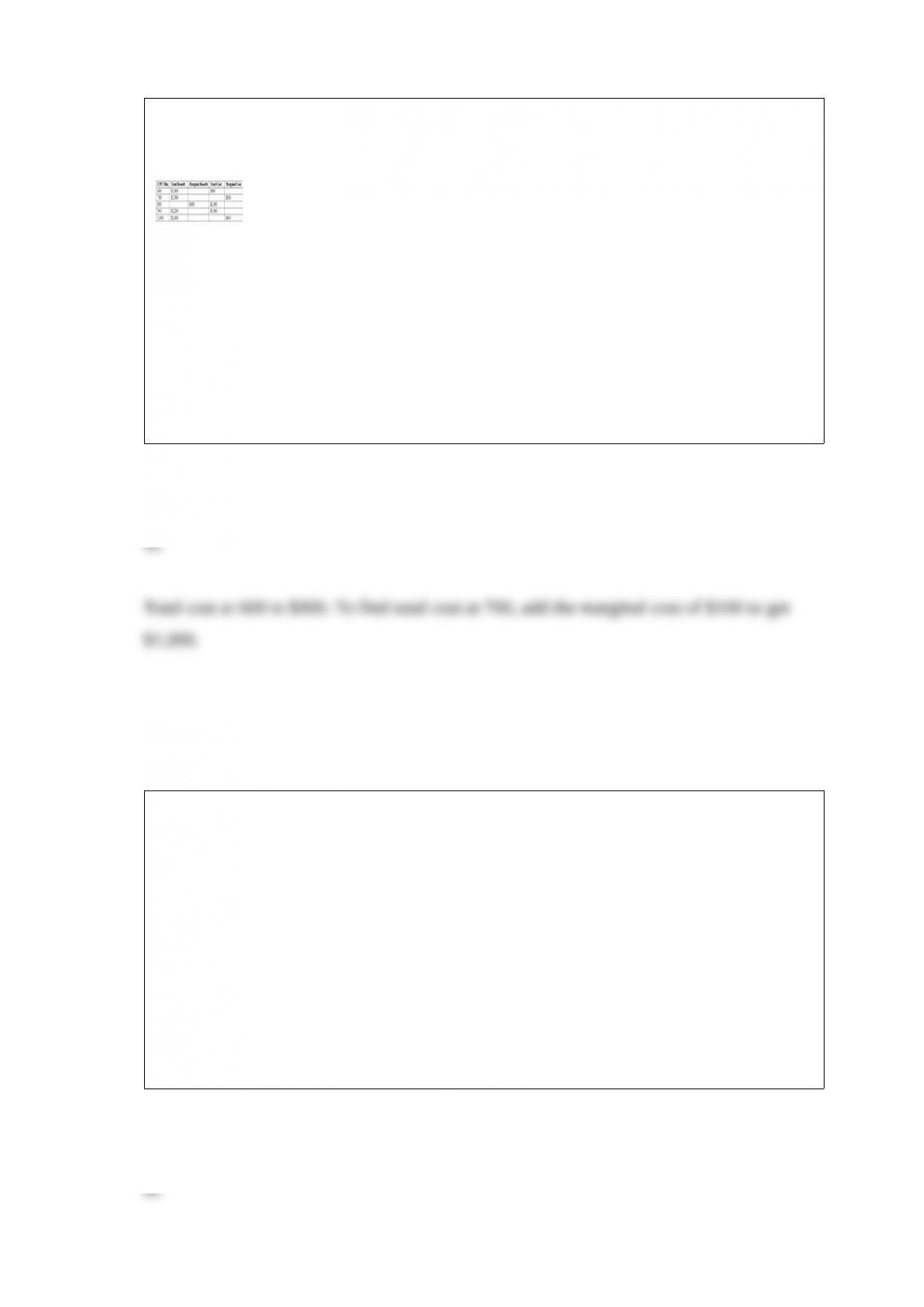
The following table shows the relationship between the speed of a computer’s CPU and
the benefits and costs. Assume that all other features of the computer are the same, i.e.,
CPU speed is the only source of variation.
The total cost of a 700 Mhz computer is:
A. $1,000.
B. $900.
C. $200.
D. $100.
The purchasing power parity theory is not a good explanation of nominal exchange rate
determination in the short-run because:
A. there is no evidence that low inflation is associated with less rapid nominal exchange
rate depreciation.
B. most nominal exchange rates are fixed and foreign exchange markets do not bring
the supply and demand for currencies into equilibrium.
C. most goods and services are traded internationally and are standardized.
D. many goods and services are not traded internationally and not all
internationally-traded goods are standardized.

If the share of population employed in two countries is the same, average living
standards will be higher in the country with:
A. the smaller population.
B. the larger population.
C. higher average labor productivity.
D. lower average labor productivity.
Suppose that there are just two firms in a small market.
Acme Manufacturing’s Total Costs equal $100 + $3 × Quantity.
Generic Industries’ Total Costs equal $500 + $3 × Quantity.
Refer to the information given above. If each firm is producing the same quantity:
A. Acme has lower average total costs than Generic.
B. Acme’s average total costs are equal to Generic’s variable costs.
C. Acme has higher average total costs than Generic.
D. at some levels of output, Acme’s average total costs are less than Generic’s, but at
some levels of output, Generic’s average costs are less than Acme’s.
Which of the following is not true of labor unions?
A. They seek to increase members’ wages.
B. They seek to increase medical benefits paid to members.
C. They bargain for safer working conditions.
D. They encourage management to take steps to maximize profits.
Hyperinflation is:
A. frequently experienced in the United States.
B. very erratic inflation.
C. an extremely high rate of inflation.
D. an extremely low rate of inflation.
If there is a floor on wages created by a minimum wage, union contracts, or other
factors, then a decline in the marginal productivity of low-skilled workers will ______
the demand for low-skilled workers and ______ the number of unemployed workers.
A. increase; increase
B. increase; decrease
C. decrease; decrease
D. decrease; increase
An outcome is socially optimal if it:
A. follows from a market equilibrium.
B. follows from collective action.
C. leaves no money on the table.
D. maximizes total economic surplus.
Suppose that this graph describes the current labor market for high school teachers:
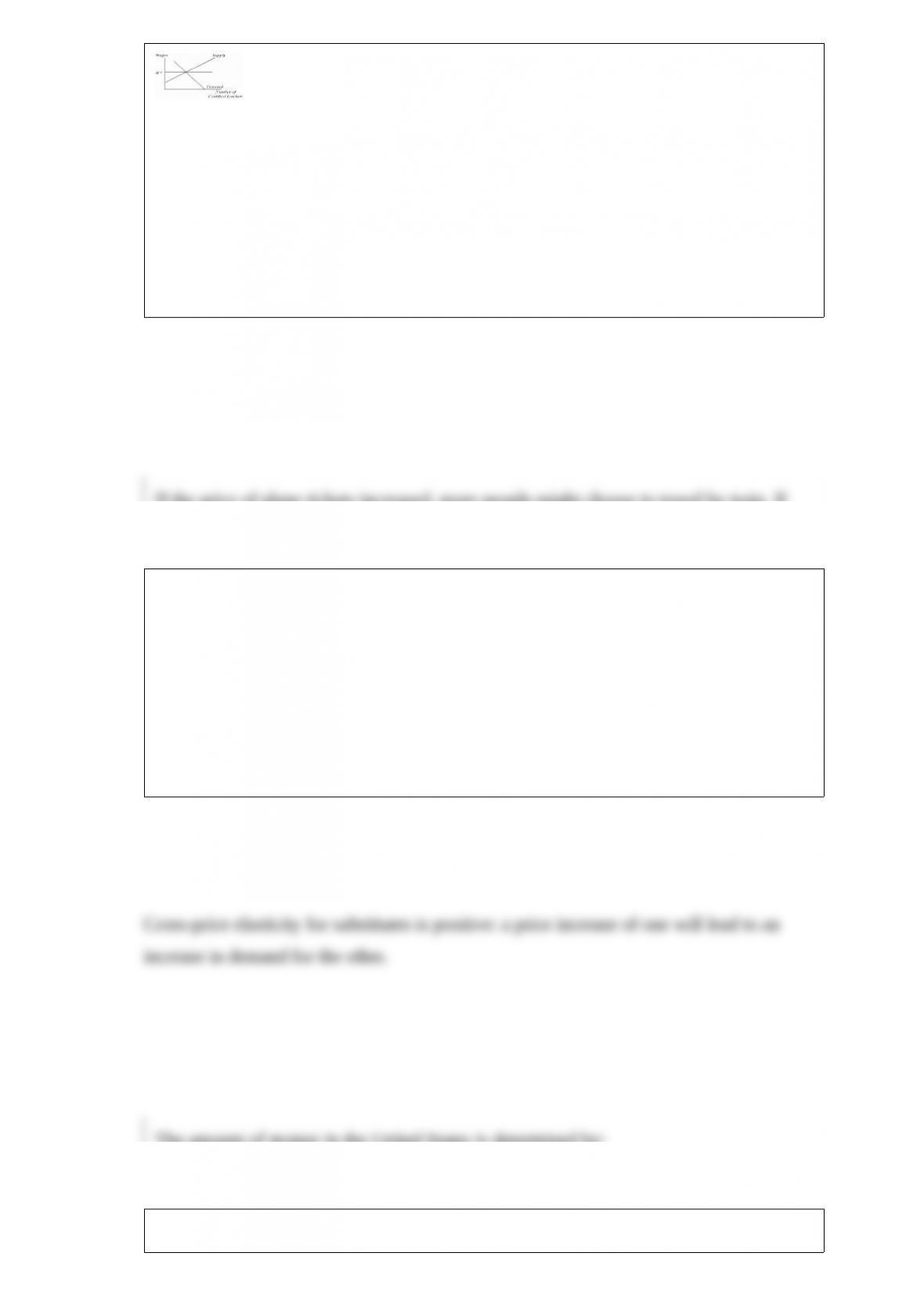
Suppose supply were to shift to the left. Why might that happen?
A. Distance learning and computer technology replace human teachers.
B. Women enter the workforce in greater numbers.
C. Immigration by families with children increase the need for more teachers.
D. More attractive employment opportunities become available in health careers.
If the price of plane tickets increased, more people might choose to travel by train. If
this happened, you would know that:
A. plane tickets are now an inferior good.
B. the cross-price elasticity between plane tickets and train tickets is positive.
C. the cross-price elasticity between plane tickets and train tickets is negative.
D. plane tickets and train tickets are complements.
The amount of money in the United States is determined by:
A. the Federal Reserve.
B. the combined behavior of commercial banks and the public, as well as actions of the
Federal Reserve.
C. the public.
D. the combined behavior of commercial banks and the public.
In 1929, the CPI equaled 0.171 and in 1930, the CPI equaled 0.167. These data provide
evidence of a period of:
A. inflation.
B. deflation.
C. trade deficit.
D. expansion.
The Federal Reserve consists of ______ regional Banks, ______ governors on the
Board of Governors, and ______ voting members of the Federal Open Market
Committee.
A. 7; 12; 12
B. 12; 7; 12
C. 12; 7; 19
D. 14; 7; 21
Which of the following statements is NOT true about specialization?
A. Total economic output is larger due to specialization.
B. After specialization, worker skills are better matched with tasks.
C. Specialization focuses experience and increases comparative advantage.
D. The variety of tasks associated with a particular job grows over time due to
specialization.
Real GDP per person in the United States was $9,864 in 1950. Over the next 48 years, it
grew at a compound annual rate of 2.0%. If, instead, real GDP per person had grown at
an average compound annual rate 2.5%, then real GDP per capita in the United States in
1998 would have been approximately ______ larger.
A. $2,370

B. $6,750
C. $12,530
D. $25,520
If the price of motel rooms increases by 10% while the prices of other goods and
services increase by 5% on average, the relative price of motel rooms has:
A. increased.
B. decreased by 5%.
C. decreased by 10%.
D. remained constant.
The tendency for marginal utility to decline as consumption increases beyond some
point is called
A. the law of demand
B. the law of diminishing marginal utility
C. the rational spending rule
D. utility maximization
The duration of a recession is from:
A. peak to trough.
B. trough to peak.
C. peak to peak.
D. trough to trough.
The scarcity principle indicates that:
A. no matter how much one has, it is never enough.
B. compared to 100 years ago, individuals have less time today.
C. with limited resources, having more of “this” means having less of “that”.
D. because tradeoffs must be made, resources are therefore scarce.