The disagreement between A. C. Pigou and Ronald Coase arose because
a. Pigou argued that the government should ban all externality-generating activities,
while Coase thought that taxes and subsidies should be used instead.
b. Coase argued that the government should ban all externality-generating activities,
while Pigou thought that taxes and subsidies should be used instead.
c. Pigou argued that the government should use taxes and subsidies to adjust for
externalities, while Coase proposed a market solution to the externality problem.
d. Coase argued that the government should use taxes and subsidies to adjust for
externalities, while Pigou proposed a market solution to the externality problem.
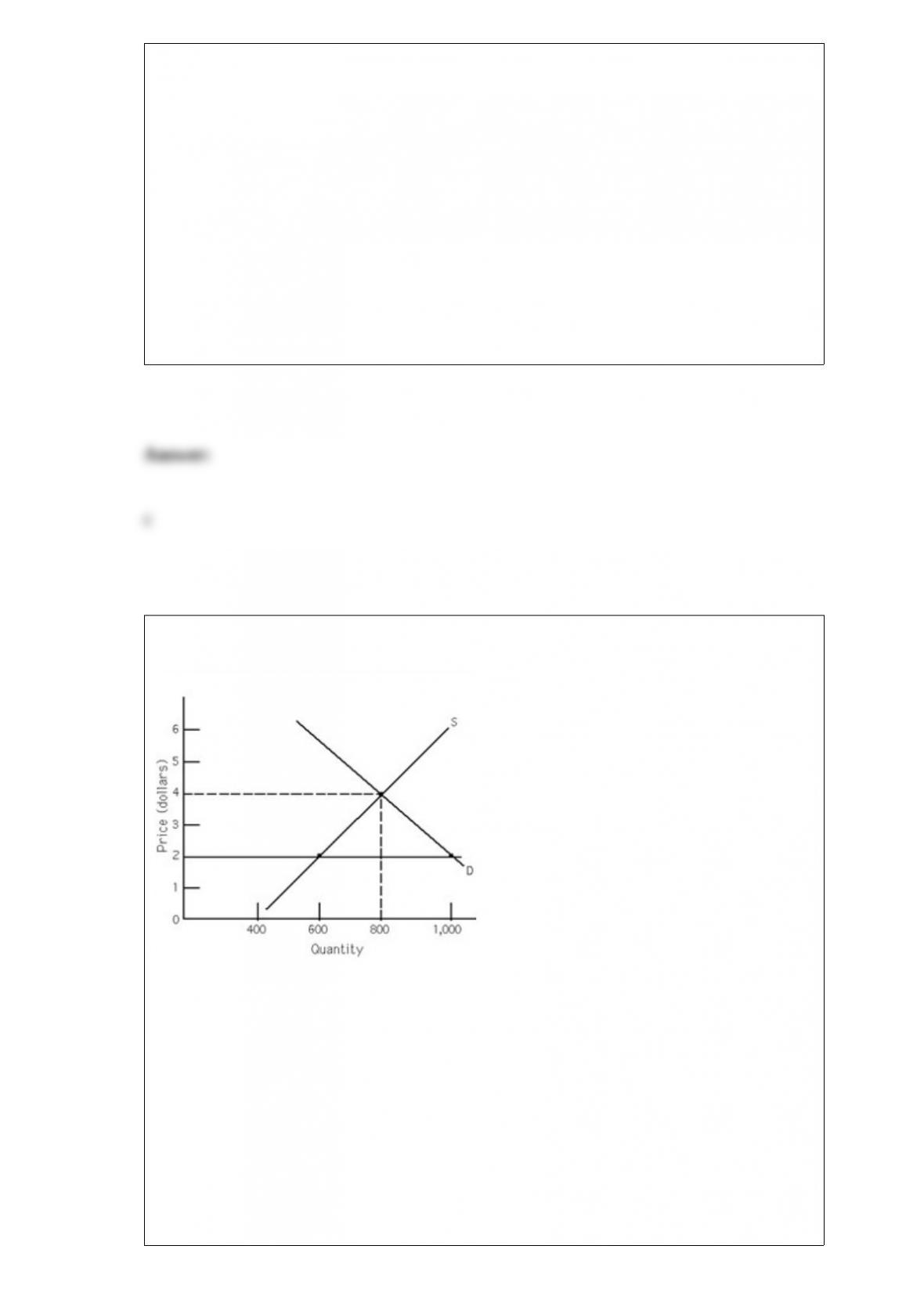
Exhibit 4-2
represents the orange juice market. The horizontal line at $2 shows a price ceiling
imposed by the government. Which of the following statements is true at this price?
a. At the price ceiling the surplus equals 400 units.
b. At the price ceiling the shortage equals 400 units.
c. At the price ceiling the surplus equals 300 units.
d. At the price ceiling the shortage equals 200 units.

e. none of the above
If the cross elasticity of demand is +2.0, this means that
a. the percentage change in quantity demanded of a product is 2 times the percentage
change in price of some other product.
b. if quantity demanded of a product fell by 1 percent, price of another product would
fall by 2 percent.
c. if price of one product was raised by 2 percent, quantity demanded of another product
would fall by 2 percent.
d. if price of one product was raised 2 percent, quantity demanded of another product
would rise 2 percent.
e. the percentage change in quantity demanded of a product is 2 times the percentage
change in the price of that product.
Exhibit 38-1
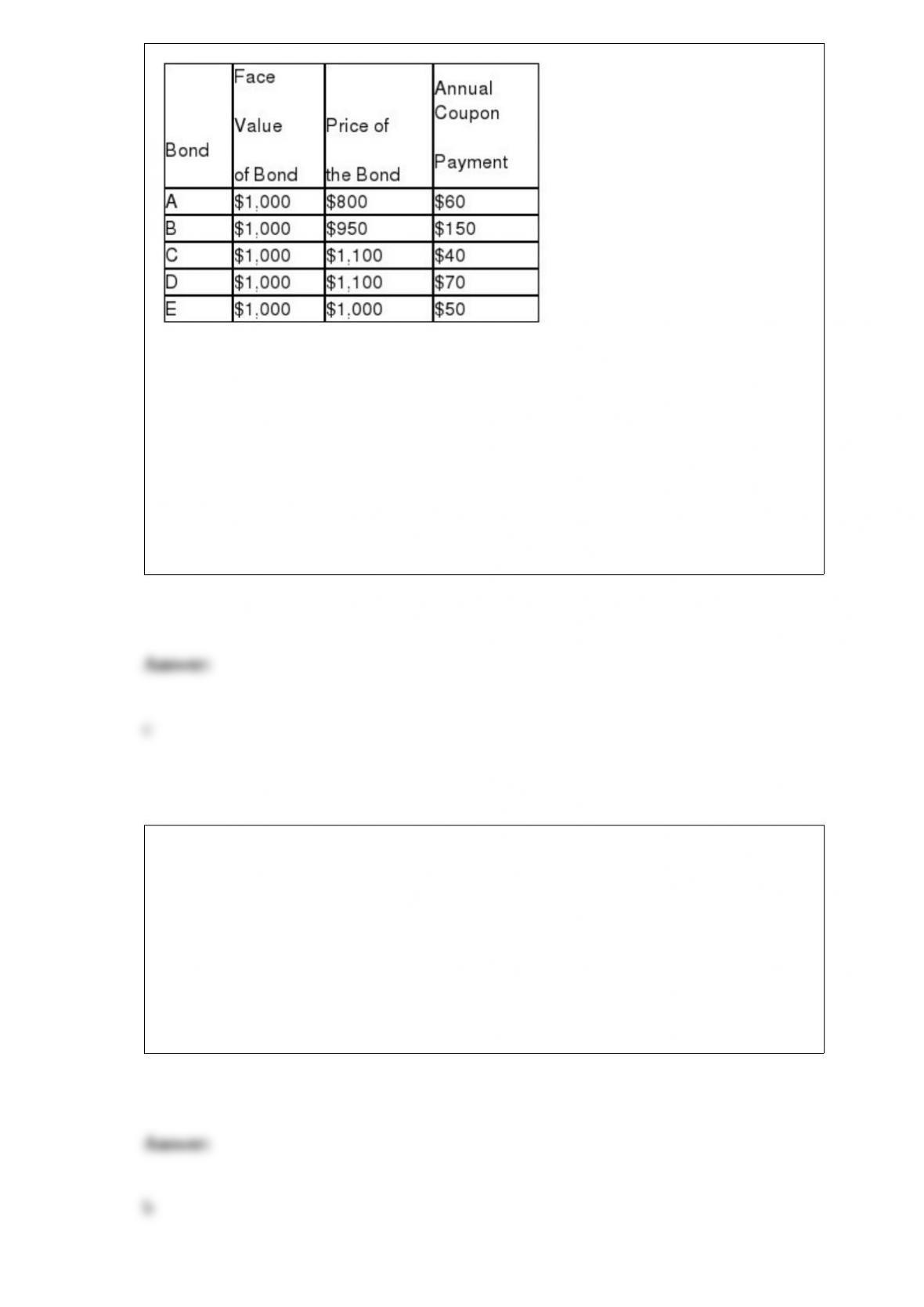
The coupon rate for bond B is
a. 0.09 percent.
b. 16.7 percent.
c. 9.5 percent.
d. 11 percent.
The nominal interest rate is determined
a. by the Federal Reserve system.
b. in the loanable funds market.
c. by the U.S. Treasury.
d. by the average rate of change in the price of capital goods.

Which of the following is not an assumption of oligopoly?
a. There are few sellers.
b. There are few buyers.
c. Firms produce and sell either homogeneous or differentiated products.
d. There are significant barriers to entry.
e. b and c
Pure economic rent can exist only when a factor has a demand curve that is perfectly
inelastic.
a. True
b. False
Economic rent is
a. the payment a renter pays his or her landlord.
b. payment in excess of fixed costs.
c. payment in excess of opportunity costs.

d. the same as interest if we are discussing a capital good purchase.
e. none of the above
“If you hadn’t gone to dinner with your friends, you would have stayed home and
watched television.” It follows that
a. watching television is the opportunity cost of having dinner with your friends.
b. the price of having dinner with your friends is more than the price you would have
had to pay to watch television.
c. the opportunity cost of having dinner with your friends is lower than the opportunity
cost of watching television.
d. it is less costly to watch television than to have dinner with your friends.
A minimum wage law (that sets the minimum wage above the equilibrium wage) can be
expected to
a. clear the market for unskilled workers.
b. increase the number of unskilled workers employed.
c. increase the number of firms in those industries where the law is effective.
d. reduce the number of unskilled workers employed and/or reduce the number of hours
worked by unskilled workers.
e. all of the above