
1) The marginal-cost curve intersects the average-total-cost curve at the minimum point
of the marginal-cost curve.
a.True
b.False
2) In which of the following games is it clearly the case that the cooperative outcome of
the game is good for the two players and bad for society?
a.Two oil companies own adjacent oil fields over a common pool of oil, and each
company decides whether to drill one well or two wells.
b.Two airlines dominate air travel between City A and City B, and each airline decides
whether to charge €high€ airfare or a €low€ airfare on flights between those two cities.
c.Two superpowers decide whether to build new weapons or to disarm.
d.In all of the above cases, the cooperative outcome of the game is good for the two
players and bad for society
3) If the total cost curve gets steeper as output increases, the firm is experiencing
a.diseconomies of scale.
b.economies of scale.
c.diminishing marginal product.
d.increasing marginal product.
4) Which of the following statements is correct?
a.For all firms, marginal revenue equals the price of the good.
b.Only for competitive firms does average revenue equal the price of the good.
c.Marginal revenue can be calculated as total revenue divided by the quantity sold.
d.Only for competitive firms does average revenue equal marginal revenue.
5) For a profit-maximizing competitive firm, the value of marginal product curve is
a.always rising.
b.falling only when marginal product is rising.
c.the labor supply curve.
d.the labor demand curve.
6) The combination of President Obama’s strategies and the Federal Reserve’s reaction
to the deep economic downturn in the US in 2008 and 2009
a.intended to reduce unemployment.
b.may lead to excessive inflation over time.
c.resulted in higher taxes and an increased supply of money.
d.Both a and b are correct.
7) Suppose that a worker in Cornland can grow either 40 bushels of corn or 10 bushels
of oats per year, and a worker in Oatland can grow either 20 bushels of corn or 5
bushels of oats per year. There are 20 workers in Cornland and 20 workers in Oatland.
Which of the following statements is true?
a.Both countries could gain from trade with each other.
b.Neither country could gain from trade with each other because Cornland has an
absolute advantage in both goods.
c.Neither country could gain from trade with each other because neither one has a
comparative advantage.
d.Oatland could gain from trade between the two countries, but Cornland definitively
would lose.
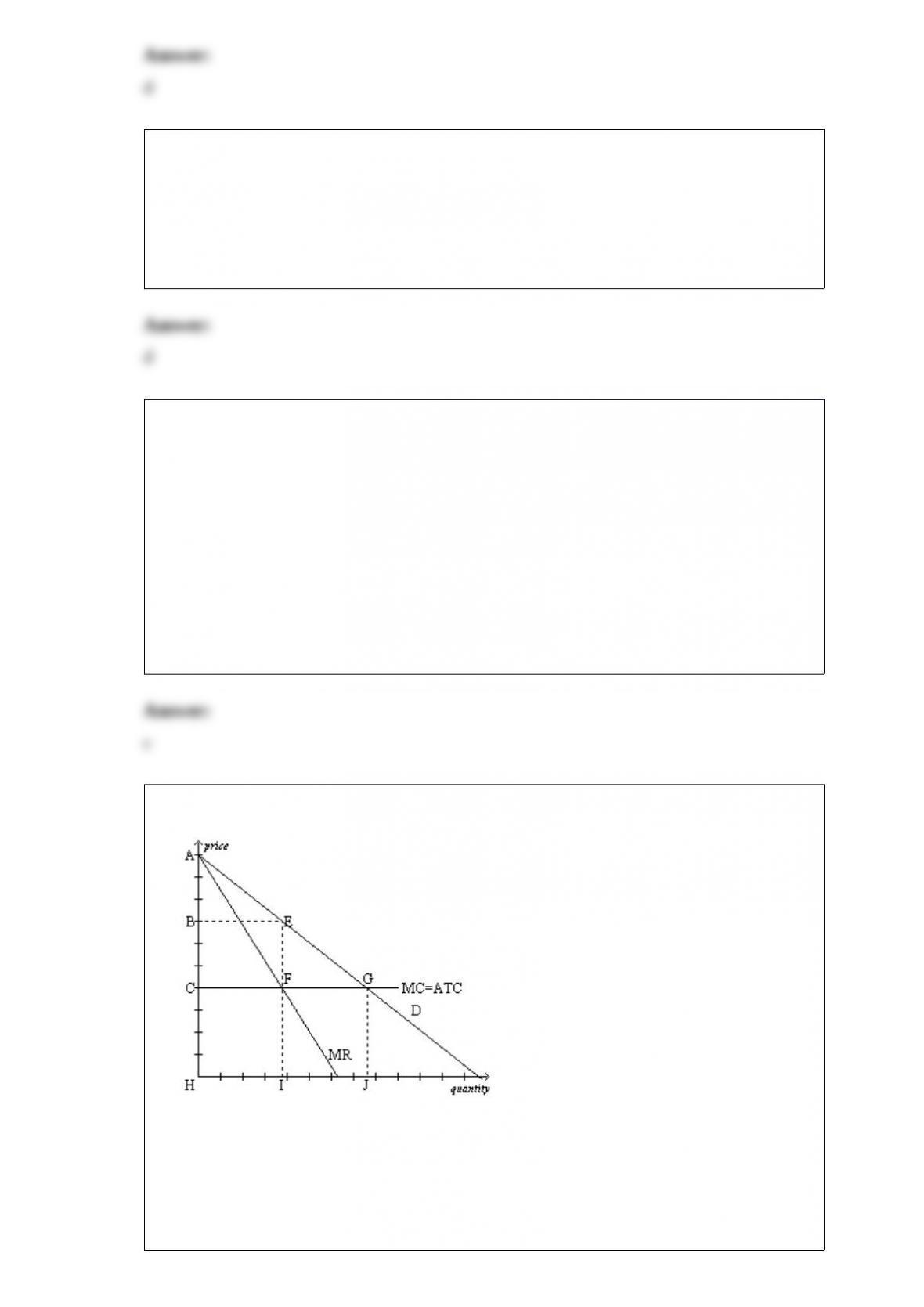
8) Figure 15-17
If this firm were able to perfectly price
discriminate, which of the following areas would represent the profit to this perfectly
discriminating monopolist?
a.ABE
b.BCFE
c.EFG

d.ACG
9) The rules established under the General Agreement on Tariffs and Trade (GATT) are
enforced by an international body called the World Trade Organization (WTO).
a.True
b.False
10) What would happen to the equilibrium price and quantity of latt©s if the cost to
produce steamed milk, which is used to make latt©s, increased, and scientists
discovered that latt©s cause heart attacks?
a.Both the equilibrium price and quantity would increase.
b.Both the equilibrium price and quantity would decrease.
c.The equilibrium price would decrease, and the effect on equilibrium quantity would
be ambiguous.
d.The equilibrium quantity would decrease, and the effect on equilibrium price would
be ambiguous.
11) In conducting their research, economists often substitute historical events and
historical episodes for
a.theories and observations.
b.laboratory experiments.
c.models.
d.assumptions.
12) Ryan sells 200 plastic ball point pens at $0.50 each. His total costs are $25. His
profits are
a. $25.
b. $75.
c. $100.
d. $175.

13) The goal of industrial policy should be that
a.industries yielding the largest positive externalities should receive the biggest
subsidies.
b.any industry that produces negative externalities should be heavily taxed.
c.any production process that produces negative externalities should be shut down.
d.all industries that produce positive externalities should be equally subsidized.
14) Which of the following programs to alleviate poverty would be most favored by
philosopher Robert Nozick and why?
a.A negative income tax because it would maximize the minimum income of members
of society.
b.An Earned Income Tax Credit (EITC) because a policy that rewards the working poor
would be the most just.
c.An in-kind transfer program because it would maximize the total utility of all
members of society.
d.None of the programs would be favored because each of them forcibly redistributes
income that was fairly, if not equally, earned.