
Market economies tend to grow more quickly than centrally-planned economies.
If nominal GDP is less than real GDP, then the GDP deflator will be greater than 100.
In face of a negative supply shock, the Fed may avoid a rise in unemployment only if it
is willing to increase the rate of inflation.
Some researchers have been unable to find evidence of increasing returns to human
capital.
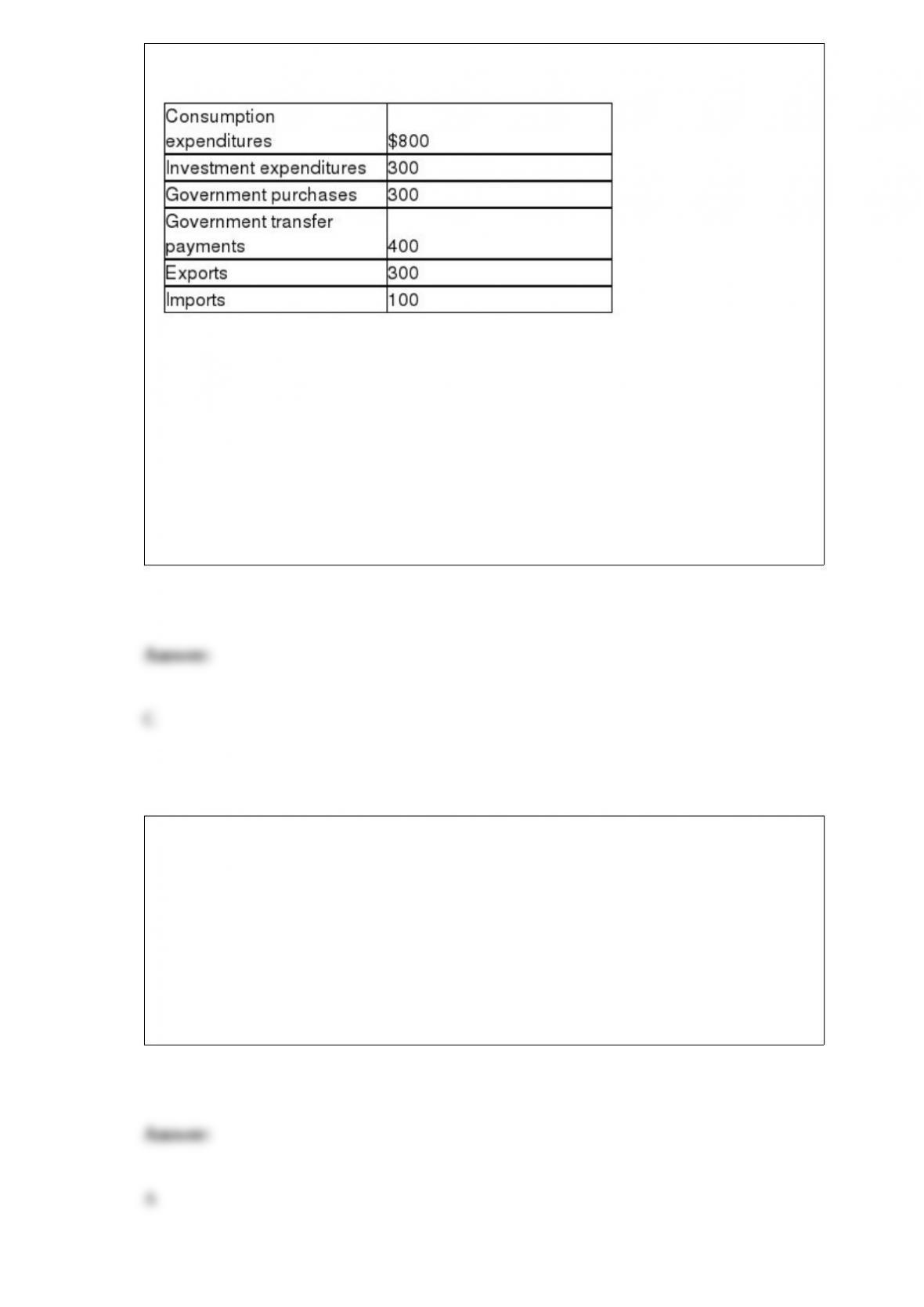
Table 8-4
Refer to Table 8-4. Consider the data above (in billions of dollars) for an economy:
Gross domestic product (in billions of dollars) for this economy equals
A) $2,200.
B) $2,100.
C) $1,600.
D) $1,400.
Lack of investment in strong education and health care systems
A) causes a deterioration in human capital and a decline in labor productivity.
B) causes a decline in physical capital and a decline in labor productivity.
C) increases human capital and cause a decline in labor productivity.
D) causes a deterioration in human capital and an increase in physical capital.

Suppose real GDP is $12.1 trillion and potential GDP is $12.6 trillion. To move the
economy back to potential GDP, Congress should
A) lower taxes by an amount less than $500 billion.
B) raise government purchases by $500 billion.
C) raise government purchases by more than $500 billion.
D) lower taxes by $500 billion.
E) lower government purchases by $500 billion.
Donnie’s Donuts incurs $450,000 per year in explicit costs and $200,000 in implicit
costs. The bakery earns $800,000 in revenues and has $2 million in net worth. Based on
this information, what is the accounting profit for Donnie’s Donuts?
A) $150,000
B) $350,000
C) $600,000
D) $1.2 million
According to the short-run Phillips curve, which of the following would result in low
rates of unemployment?

A) weak increases in aggregate supply
B) a lower inflation rate
C) weak increases in aggregate demand
D) a higher inflation rate
Adverse selection will occur in a market as a result of
A) asymmetric information.
B) moral hazard.
C) the sale of “lemons.”
D) rational ignorance.
Although based in the United States, McDonald’s is a global company with more than
________ of its sales coming from outside of the United States.
A) one-fourth
B) one-third
C) one-half
D) two-thirds

An increase in the price level results in a(n) ________ in household consumption
spending and a(n) ________ in investment spending.
A) increase; decrease
B) increase; increase
C) decrease; decrease
D) decrease; increase
Economic efficiency is achieved when there is a market outcome in which the marginal
benefit to consumers of the last unit produced is equal to its marginal cost of production
and
A) economic surplus plus consumer surplus equals producer surplus.
B) consumer surplus plus producer surplus is maximized.
C) economic surplus is minimized.
D) the difference between consumer surplus and producer surplus is maximized.
Suppose there has been an increase in investment. As a result, real GDP will ________
in the short run, and ________ in the long run.
A) increase; increase further
B) increase; decrease to its initial value
C) decrease; decrease further
D) decrease; increase to its initial level
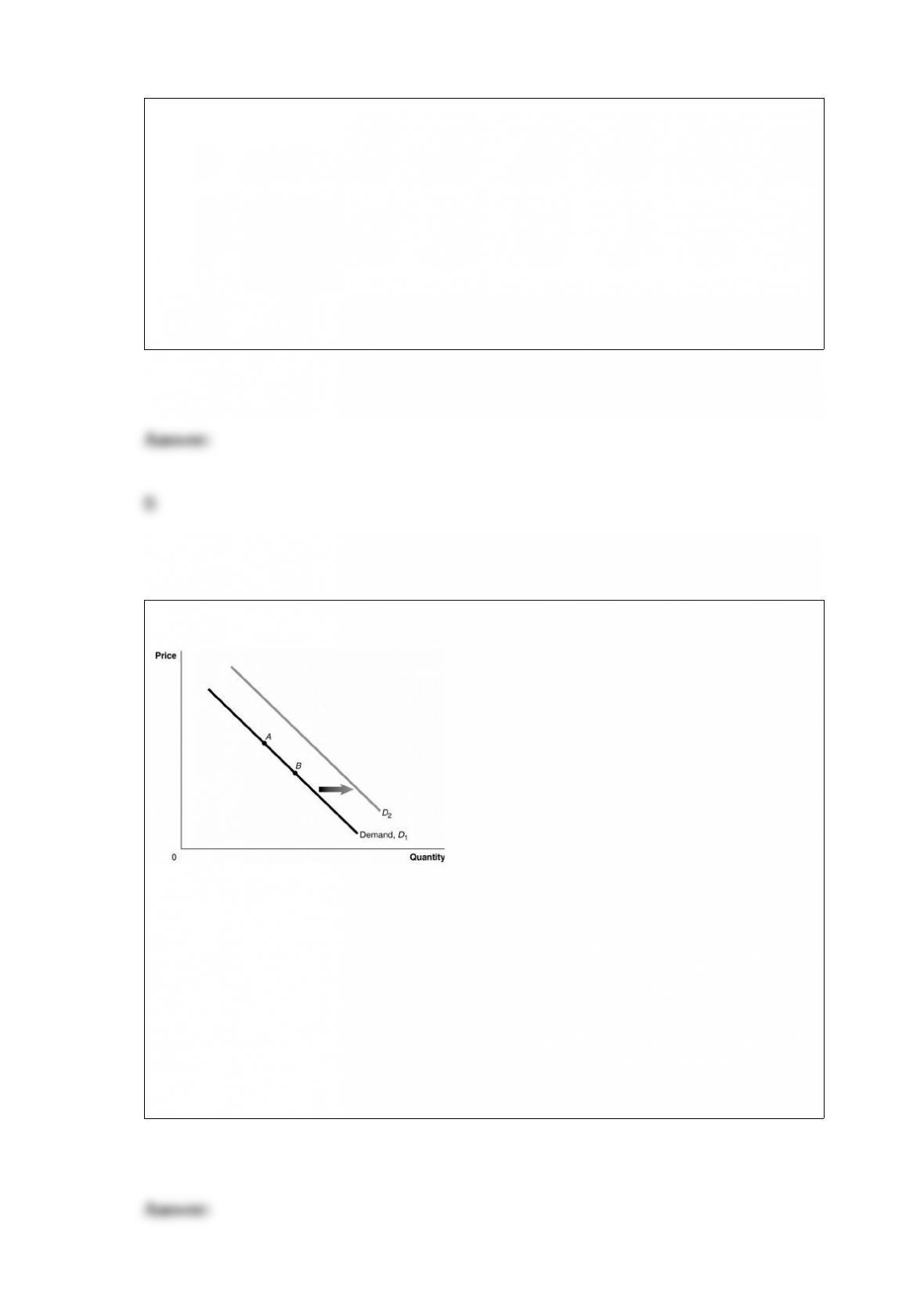
Figure 3-1
Refer to Figure 3-1. An increase in the price of a complement would be represented by
a movement from
A) A to B.
B) B to A.
C) D1 to D2.
D) D2 to D1.

Consumption is $5 million, planned investment spending is $8 million, government
purchases are $10 million, and net exports are equal to $2 million. If GDP during that
same time period is equal to $27 million, what unplanned changes in inventories
occurred?
A) There was an unplanned increase in inventories equal to $2 million.
B) There was no unplanned change in inventories.
C) There was an unplanned decrease in inventories equal to $2 million.
D) There was an unplanned decrease in inventories equal to $19 million.
Which of the following tools of monetary policy is used least often?
A) open market operations
B) setting the required reserve ratio
C) setting the discount rate
D) acting as a lender of last resort
If the Fed decided to reverse its policy actions implemented during the heart of the
recession, the Fed would be acting to try to prevent

A) a decrease in unemployment.
B) an increase in unemployment.
C) an increase in deflation.
D) an increase in inflation.
Which of the following best explains why productivity growth in the United States has
been faster than in other leading industrialized nations?
A) There are fewer government regulations in the United States regarding the way firms
can hire and fire workers.
B) The financial systems of foreign countries are generally more efficient than those in
the United States.
C) European countries have more flexible policies regarding the number of hours
employees are permitted to work.
D) Job mobility in the United States is more restricted than it is in many foreign
countries.
If the consumption function is defined as C = 7,250 + 0.8Y, what is the autonomous
level of consumption expenditure?
A) $5,800
B) $7,250
C) $9,062.50
D) $9,700
Use the equations for public and private saving to demonstrate how total saving in the
economy equals investment.
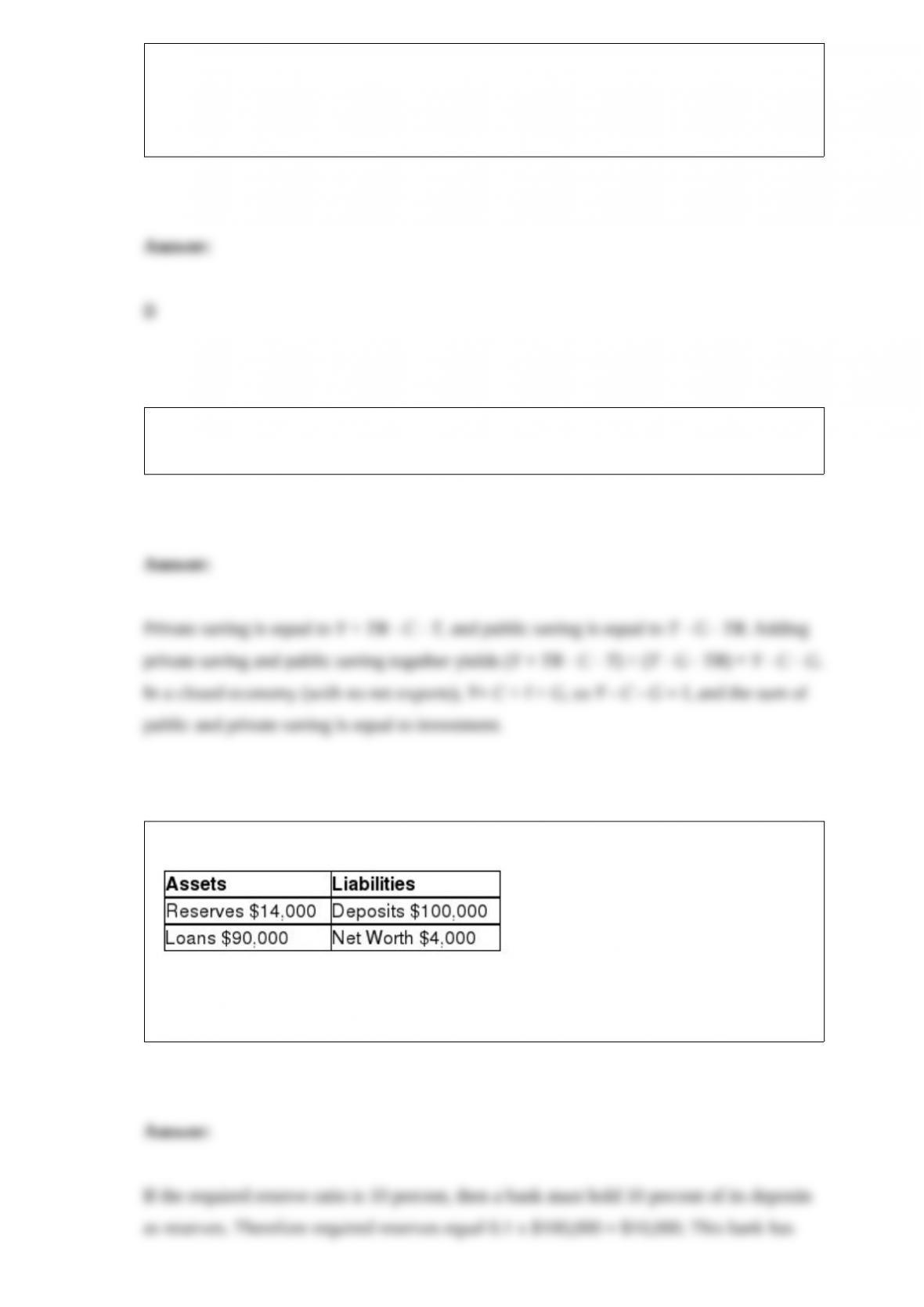
Suppose a bank has the following balance sheet:
If the required reserve ratio is 10 percent, how much excess reserves does the bank
have? What is the maximum amount that the bank can expand its loans?
Would you expect to see higher or lower growth rates for countries that start out with a
relatively low level of real GDP per capita? Explain using the concept of “catch-up” and
support your answer with a graph.
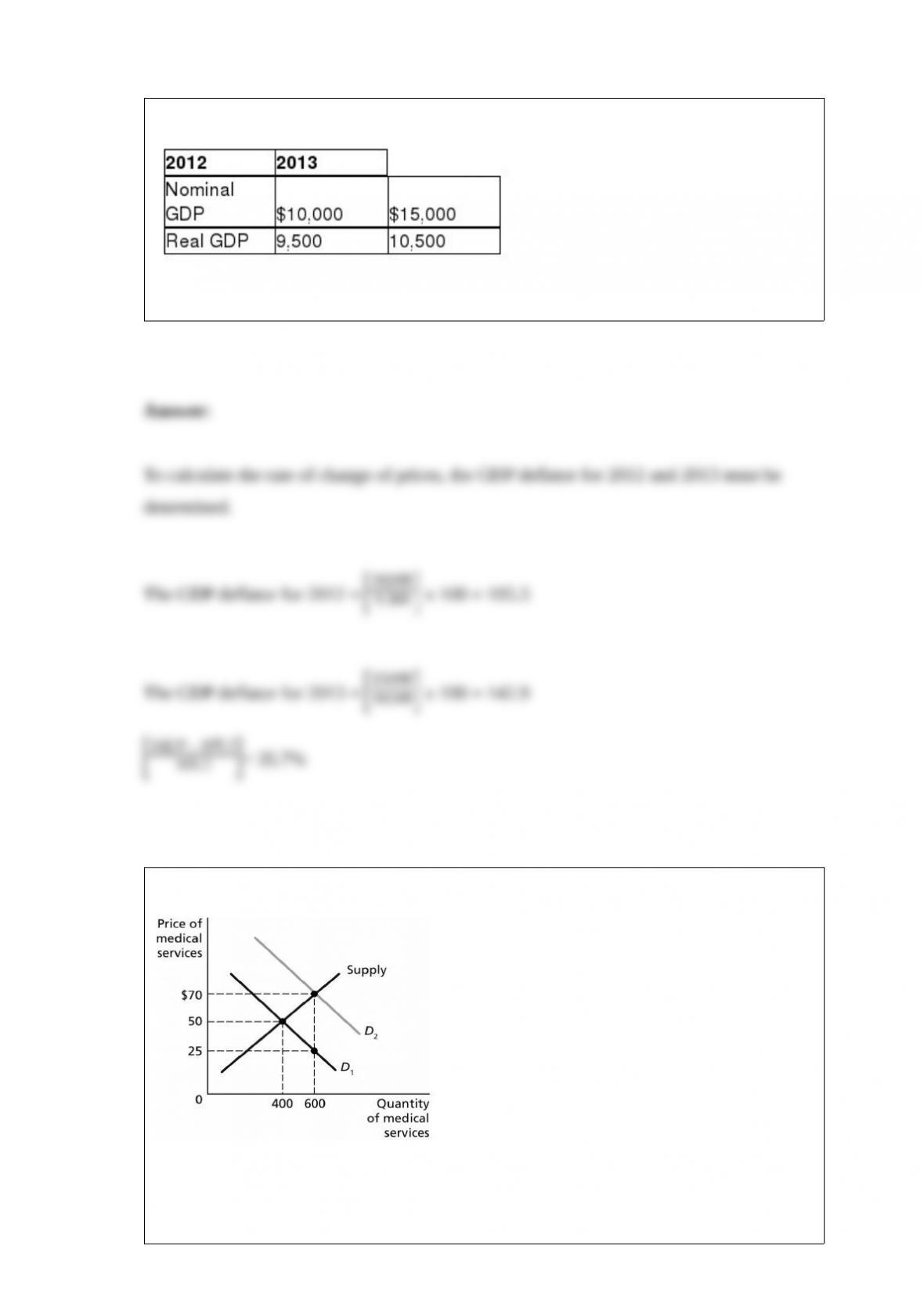
Table 8-25
Refer to Table 8-25. Given the following information, calculate the rate of increase in
the price level from 2012 to 2013. Use the percent change in the GDP deflator.
Figure 5-4
Figure 5-4 represents the supply and demand for medical services with and without a
third-party payer.
Refer to Figure 5-4. Answer the following questions:
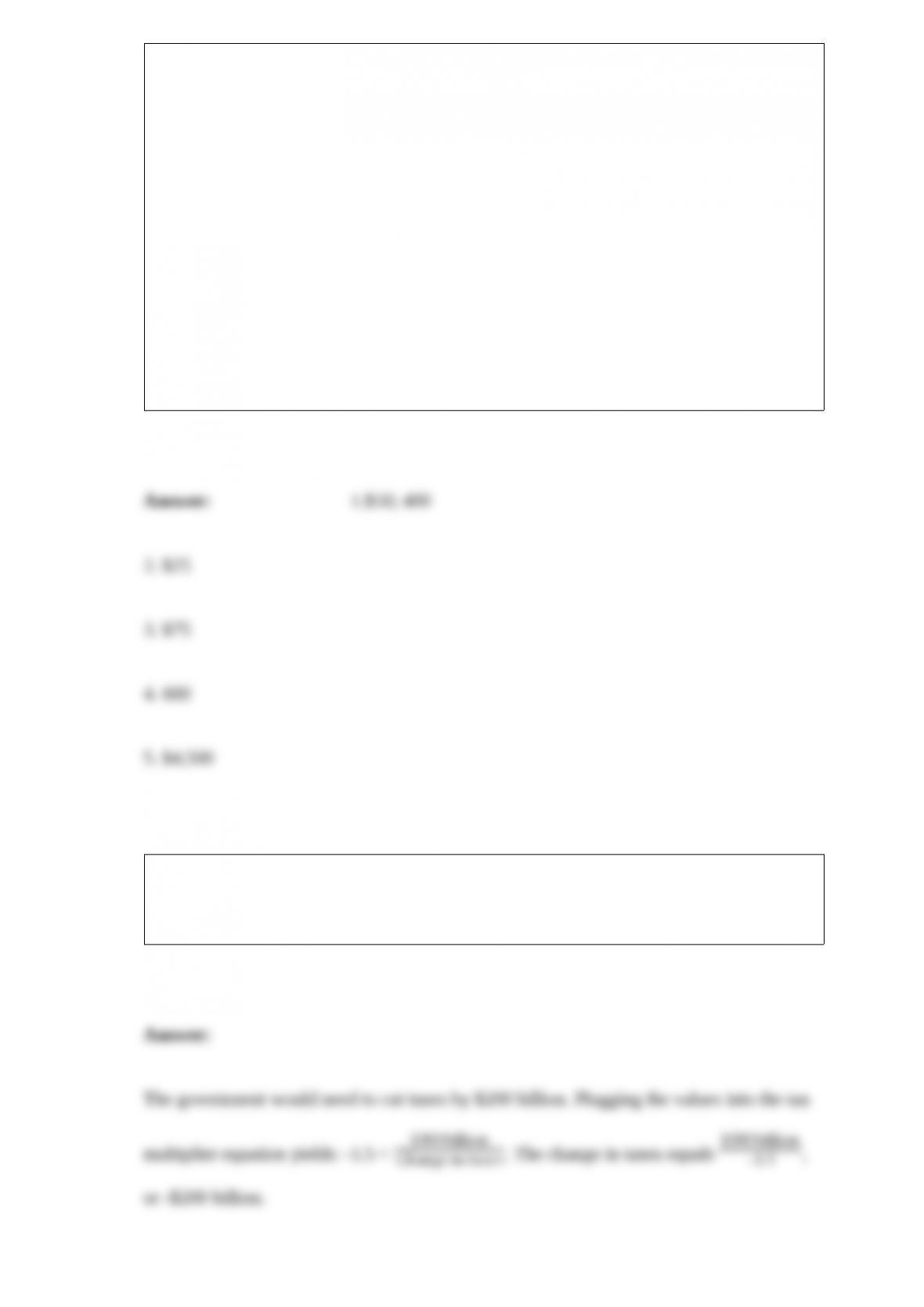
1. What would be the equilibrium price and quantity if consumers had to pay the full
price of medical services?
2. With insurance acting as a third-party payer, what price will consumers pay for
medical service?
3. With insurance acting as a third-party payer, what price will doctors receive for
medical service?
4. With insurance acting as a third-party payer, what will be the equilibrium quantity of
medical services?
5. With insurance acting as a third-party payer, what will be the value of the deadweight
loss?
If real GDP is $300 billion below potential GDP and the tax multiplier equals -1.5, then
how much would the government need to change taxes to bring the economy to
equilibrium at potential?

Japan experienced periods of deflation € a declining price level € during the 1990s.
During a deflationary period, which would be higher: nominal GDP or real GDP? Why?
Assume that the base year of choice is prior to the deflationary period.