
Refer to Exhibit 2-6.Which graph depicts the result of a decrease in the unemployment
rate?
Exhibit 2-6
a. (1)
b. (2)
c. (3)
d. (4)
e. none of the above
The foreign exchange market is the market where
a. goods and services of different countries are exchanged.
b. currencies of different countries are exchanged.
c. transportation services for foreign goods are contracted.
d. either a or c
e. none of the above
Which of the following statements is consistent with the Coase theorem?
a. In the case of zero transaction costs, a property rights assignment (made by a court)
will be undone if it benefits the relevant parties to undo it.
b. In the case of zero transaction costs, the resource allocative outcome will be the same
no matter who is assigned the property right.
c. Taxes can do what property rights assignments cannot.
d. The market can solve all negative externality problems.
e. a and b
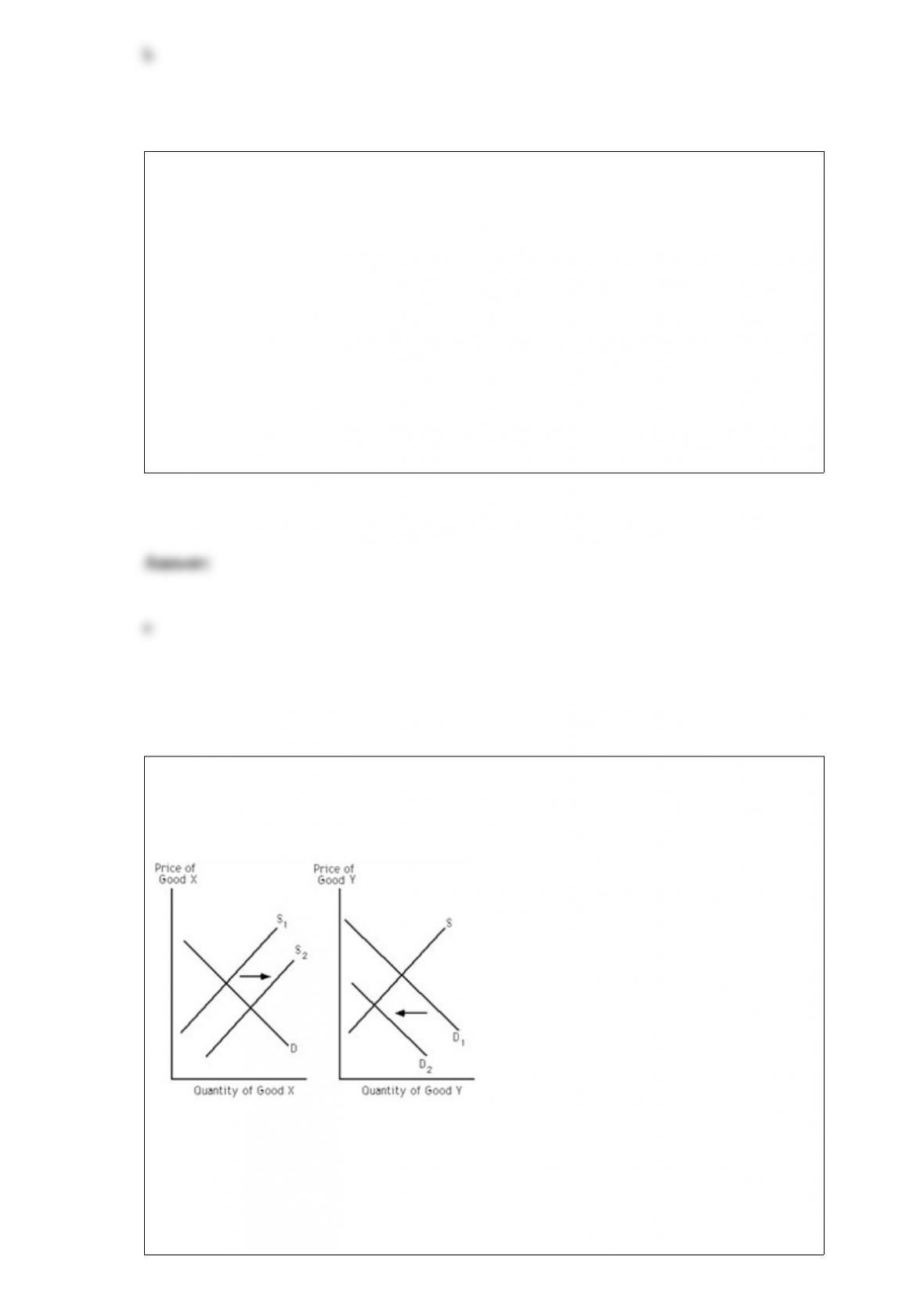
Refer to Exhibit 20-4. As a consequence of the depicted change in the supply of X, the
demand curve for Y shifted from D1 to D2. It follows that
Exhibit 20-4
a. X and Y are substitutes.
b. X and Y are complements.
c. X and Y are inferior goods.
d. demand for Y is price elastic

Given that frozen yogurt and ice cream are substitutes, a shift in preferences in favor of
yogurt would be predicted to do all of the following EXCEPT
a. raise the equilibrium price of frozen yogurt.
b. increase the quantity supplied of frozen yogurt.
c. increase the supply of ice cream.
d. increase the demand for frozen yogurt.
Public choice is concerned with
a. relative prices.
b. government decision making.
c. marketing techniques.
d. consumer surveying.

The traditional view of labor unions is that they enhance worker productivity because
the workers feel more secure in their jobs and because there is a low turnover rate in
union firms.
a. True
b. False
A change in price will lead to a change in __________ and to a change in __________,
while a change in preferences will lead to a change in __________ and a change in the
prices of relevant resources will lead to a change in __________.
a. quantity supplied; demand; income; supply
b. demand; quantity supplied; supply; quantity demanded
c. quantity supplied; supply; quantity supplied; demand
d. quantity supplied; quantity demanded; demand; supply
e. quantity supplied; quantity demanded; supply; demand
The short run is
a. a period of time in which all inputs are fixed.
b. a period of time in which all inputs are variable.

c. a period of time in which some inputs are fixed.
d. always less than a year.
e. a and d
Suppose Smith wants one iPhone no matter what the price is between $0 and $350,
Jones wants one iPhone no matter what the price is between $0 and $200, and Griffith
wants one iPhone no matter what the price is between $0 and $450.In this case, each
individual buyer’s demand curve will be __________________ and the market demand
curve will be __________________.
a. downward sloping; vertical
b. vertical; downward sloping
c. vertical; vertical
d. downward sloping; downward sloping
In a situation where two goods can be produced by two different people, it is possible
for one person to have a comparative advantage in the production of both goods and the
other person to have the comparative advantage in the production of neither good.
a. True
b. False

Which of the following statements is false?
a. The shift factors for the supply curve are: income, preferences, prices of related
goods, the number of buyers, and expectations of future price.
b. A change in (own) price changes the quantity supplied of a good.
c. A change in demand is graphically represented by a shift in the demand curve.
d. A change in quantity demanded is represented by a movement along a given demand
curve.
An advance in technology commonly refers to the ability to produce
a. the same output with a smaller quantity of resources.
b. more output with a fixed quantity of resources.
c. more output with a greater quantity of resources.
d. both a and b
e. both b and c
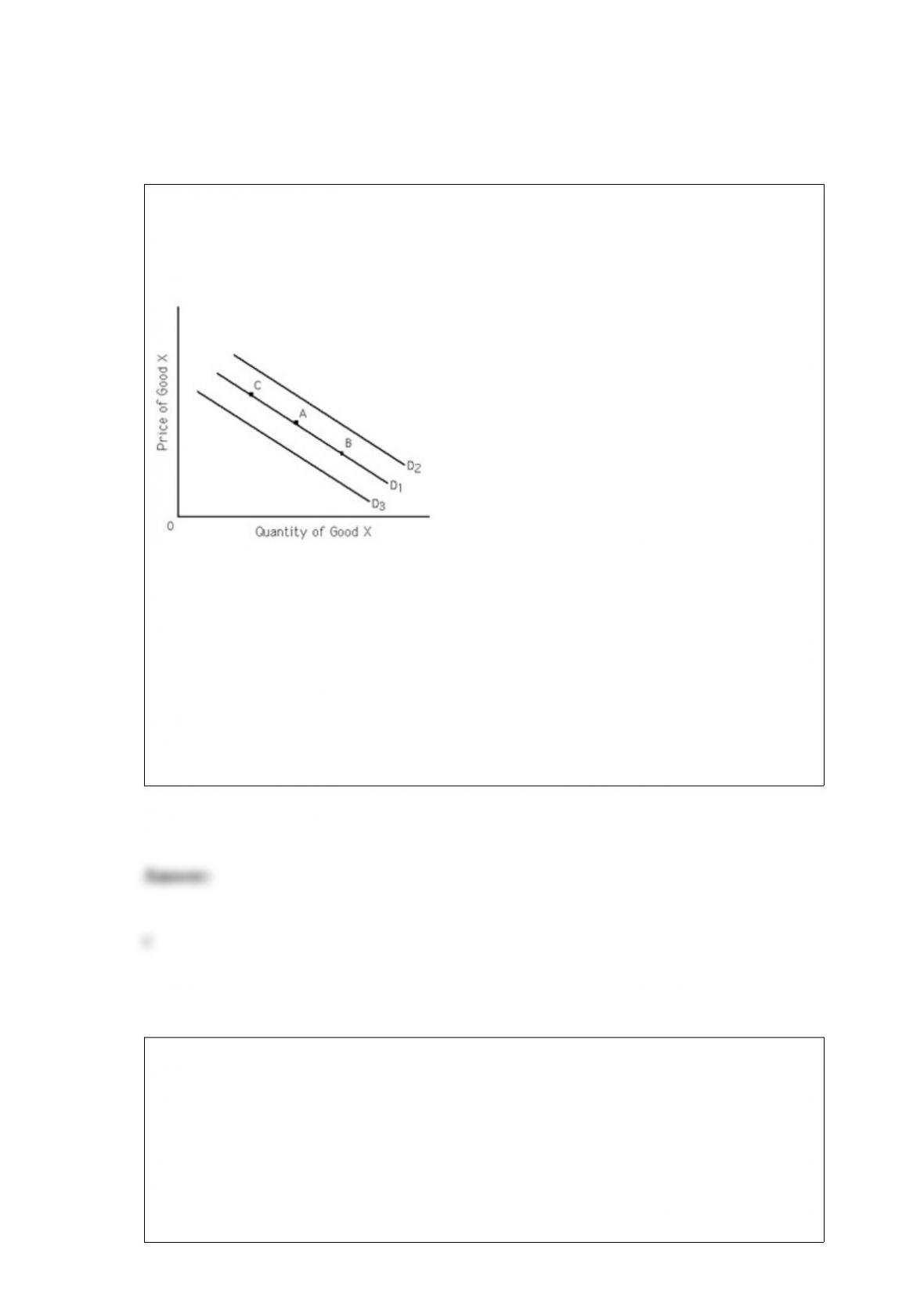
Refer to Exhibit 3-6. If an increase in the price of good Y causes the demand for good X
to shift from D1 to D2, goods X and Y are
Exhibit 3-6
a. normal goods.
b. inferior goods.
c. substitutes.
d. complements.
e. neutral goods.
Suppose a bank makes a $1,000 loan to you at 5 percent interest when the expected and
actual inflation rate are zero percent. Before you pay back the $1,000 principal and $50
interest, the inflation rate increases to 10 percent. Does anyone lose from this situation?
a. Nobody loses, because the terms were set before the inflation rate increased, and
once the terms are set, inflation does not affect the situation.
b. You lose, because the dollars that you have borrowed are worth more the higher the

inflation rate.
c. The banker loses, because you will be paying back the loan with dollars that are
worth less than the dollars you borrowed.
d. Both the banker and you lose, for the reasons in answers b and c.
e. There is not enough information to answer the question.
At one time, monopolies were granted to people who were in the favor of kings and
queens.
a. True
b. False