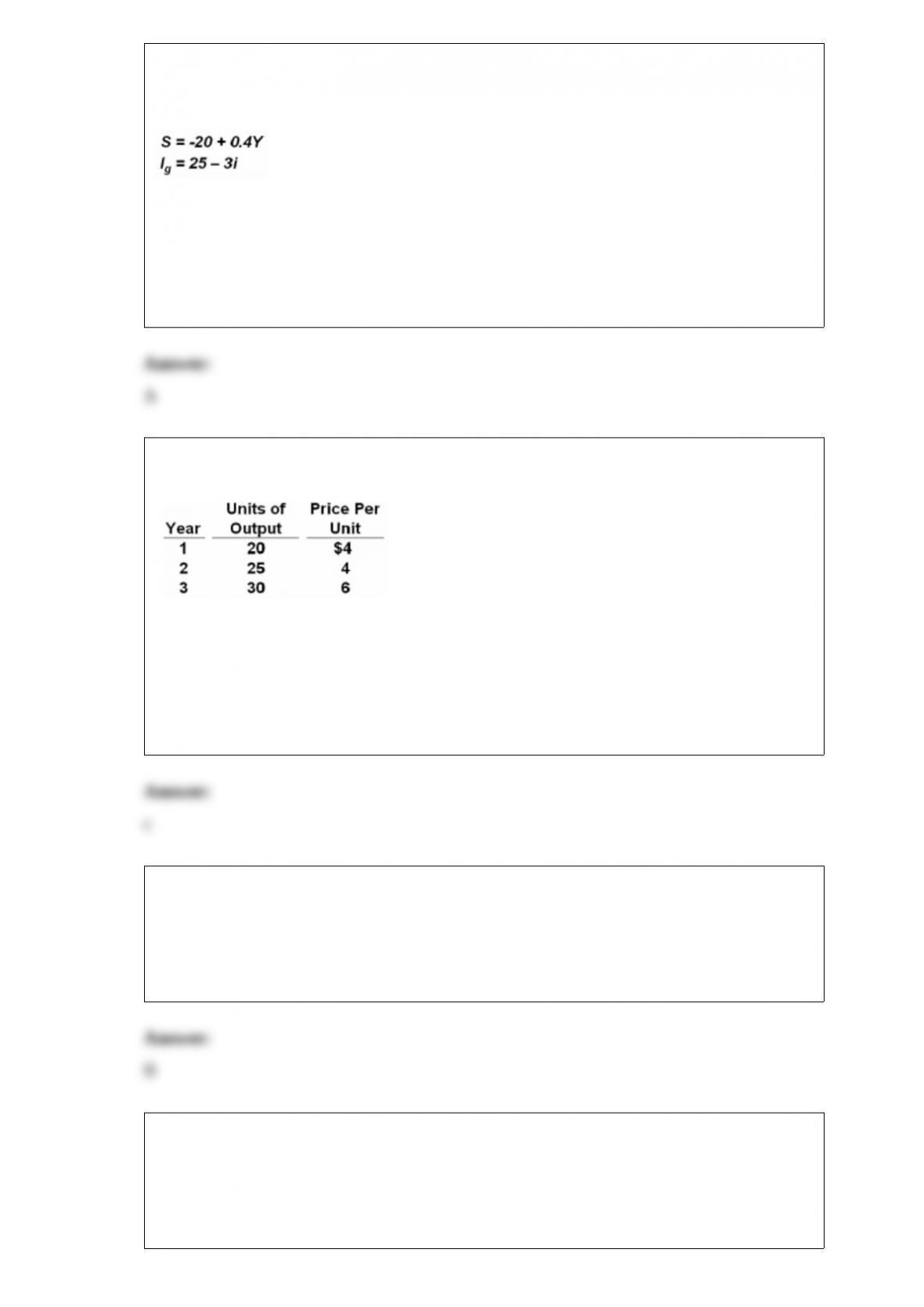
1) (Advanced analysis) Answer the next question(s) on the basis of the following
information for a private closed economy.
where S is saving, Ig is gross investment, i is the real interest rate, and Y is GDP.
Refer to the above information. If the real interest rate is 5 percent, investment will be:
A.$10 and the equilibrium GDP will be $75.
B.$15 and the equilibrium GDP will be $100.
C.$10 and the equilibrium GDP will be $120.
D.$15 and the equilibrium GDP will be $180.
2) assume an economy that is producing only one product. output and price data for a
three-year period are as follows. answer the next question(s) on the basis of these data.
refer to the above data. if year 2 is chosen for the base year, in year 3 nominal gdp and
real gdp, respectively, are:
a.$180 and $30.
b.$30 and $5.
c.$180 and $120.
d.$120 and $100.
3) The fact that people prefer present consumption to future consumption results in:
A.a downsloping demand for loanable funds curve.
B.an upsloping supply of loanable funds curve.
C.a downsloping supply of loanable funds curve.
D.an upsloping demand for loanable funds curve.
4) The immediate primary cause of the swing from Federal budget surpluses between
1998 and 2001 to a budget deficit in 2002 was:
A.the tax cuts of 2001.
B.spending increases relating to the war in Afghanistan.
C.the recession of 2001.
D.the acceleration of inflation in 2001 and 2002.
5) cross elasticity of demand measures how sensitive purchases of a specific product are
to changes in:
a.the price of some other product.
b.the price of that same product.
c.income.
d.the general price level.
6) In 2006, the United States’ current account deficit reached a new high of:
A.$811 billion.
B.$917 billion.
C.$1.2 trillion.
D.$2.3 trillion.
7)
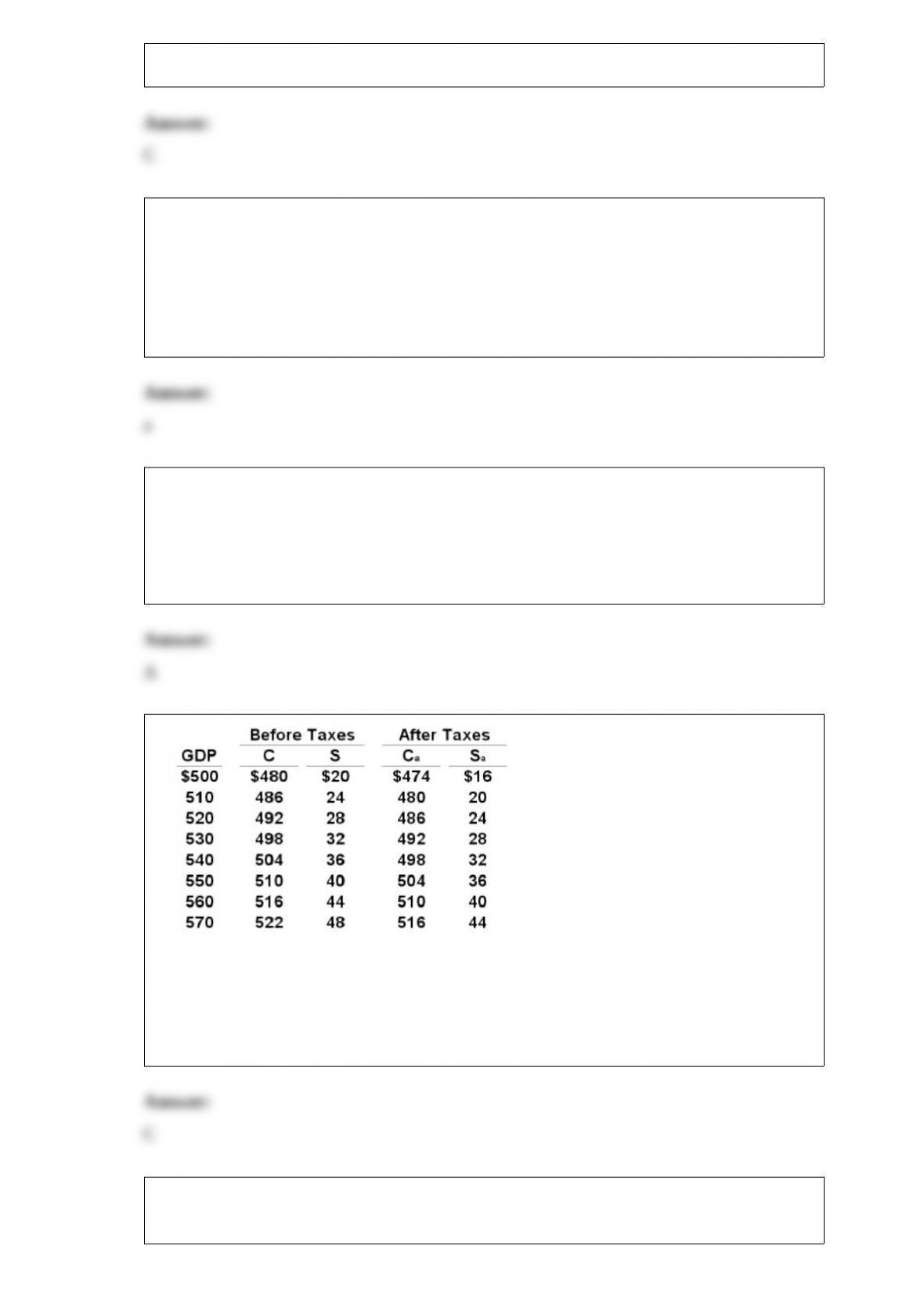
The tax in the above economy is a:
A.10 percent proportional tax.
B.lump-sum tax of $20.
C.lump-sum tax of $10.
D.progressive tax.
8) the accompanying table that shows average total costs (atc) for a manufacturing firm
whose total fixed costs are $10:
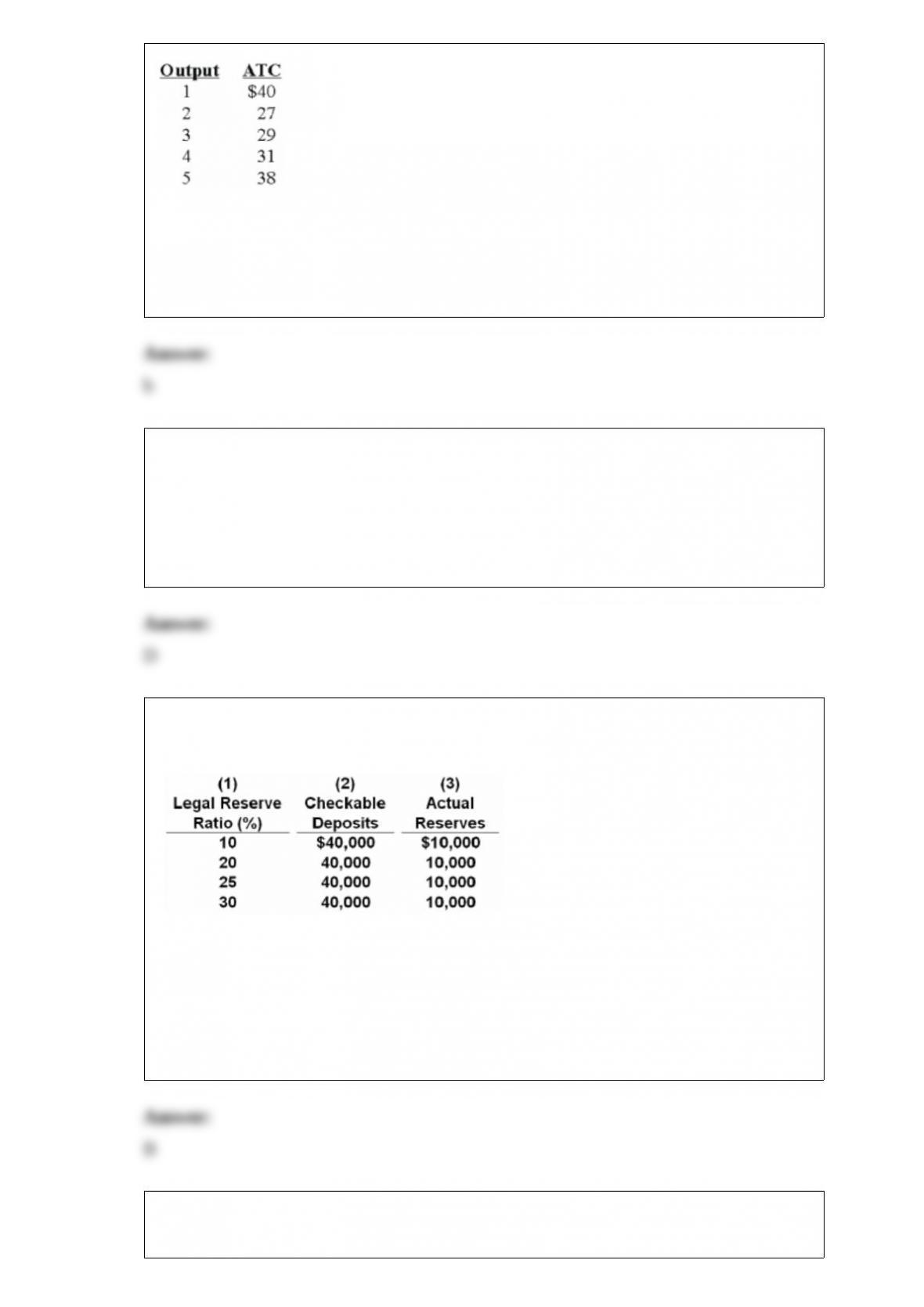
refer to the above data. the average variable cost of 4 units of output is:
a.$33.50.
b.$28.50.
c.$19.00.
d.$21.00.
9) The term “growing income inequality” implies that the:
A.poor are getting poorer in both a relative and an absolute sense.
B.Lorenz curve is shifting toward the diagonal.
C.diagonal is shifting toward the Lorenz curve.
D.top quintile of income receivers is getting relatively more of the total income than
before and the bottom quintile is getting relatively less.
10) The following table for a commercial bank or thrift:
Refer to the above table. When the legal reserve ratio is 10 percent, the money creating
potential of this single bank is:
A.$0.
B.$6,000.
C.$30,000.
D.$60,000.
11) The next three questions refer to the information in the following table.
(a)What would price and quantity be if the market were closed to international trade?
What would the domestic and foreign quantity supplied be if it were open to
international trade and the world price was $2?
(b)If the world price was $2 and a tariff of $1 were placed on the product, what would
be the total revenues going to domestic producers, foreign producers (after-tax), and the
government? Explain.
(c)Given a world price of $2, what would be the difference in the total revenue received
by foreign producers with a $1 per unit tariff compared with a quota of 200 units?
12) If you deposit a $50 bill in a commercial bank that has a 10 percent legal reserve
requirement the bank will:
A.have $45 of additional excess reserves.
B.be capable of lending an additional $500.
C.be capable of lending an additional $
D.have $50 of required reserves.