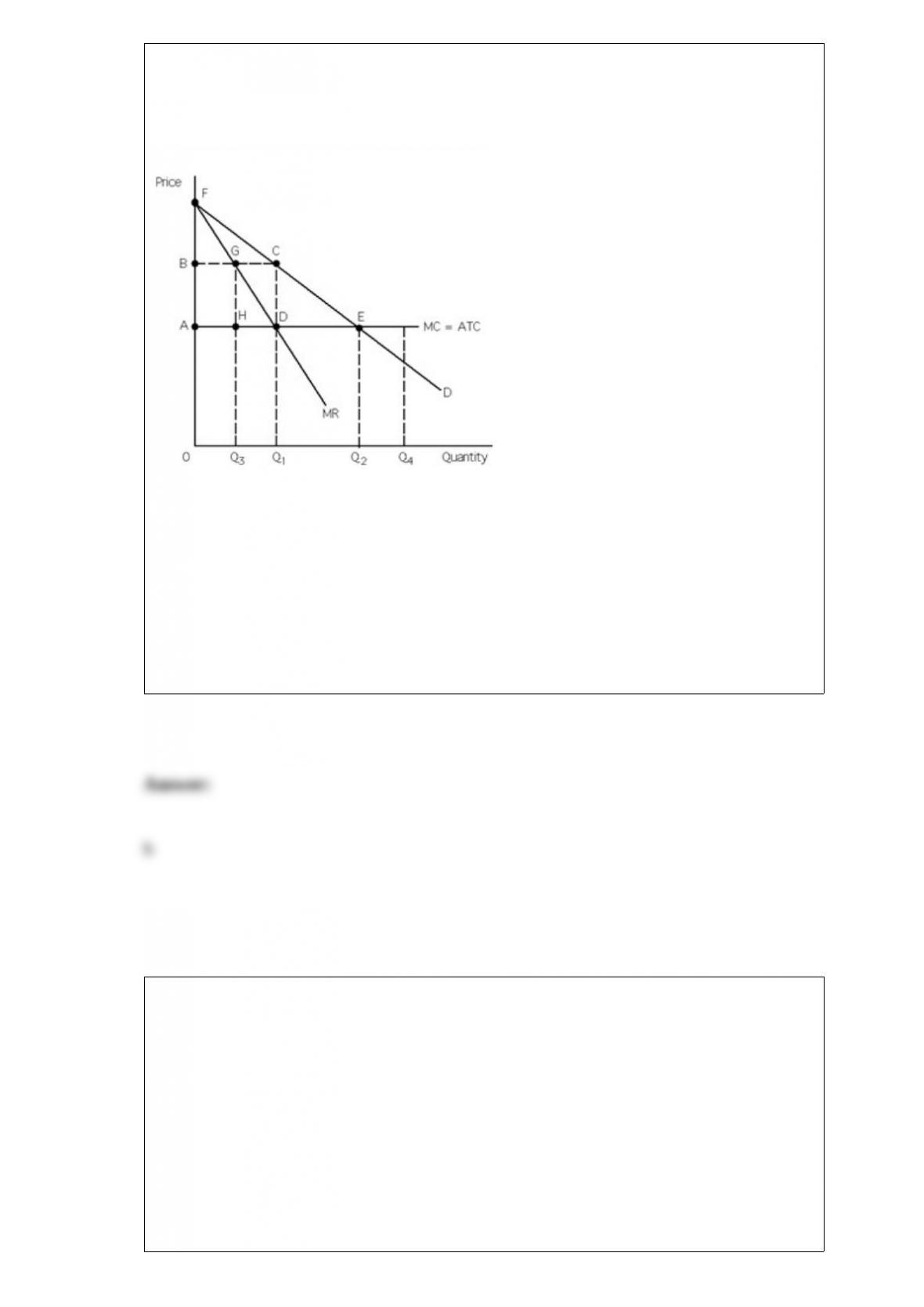
Refer to Exhibit 24-10. The profit-maximizing single-price monopolist will produce
which quantity of output?
Exhibit 24-10
a. Q2
b. Q1
c. Q3
d. Q4
e. none of the above
Resource X is necessary to the production of good Y. If the price of resource X falls,
a. the supply curve of Y shifts leftward.
b. the supply curve of Y shifts rightward.
c. the supply curve of Y is unaffected.
d. there is a movement down the supply curve of Y.
e. there is a movement up the supply curve of Y.
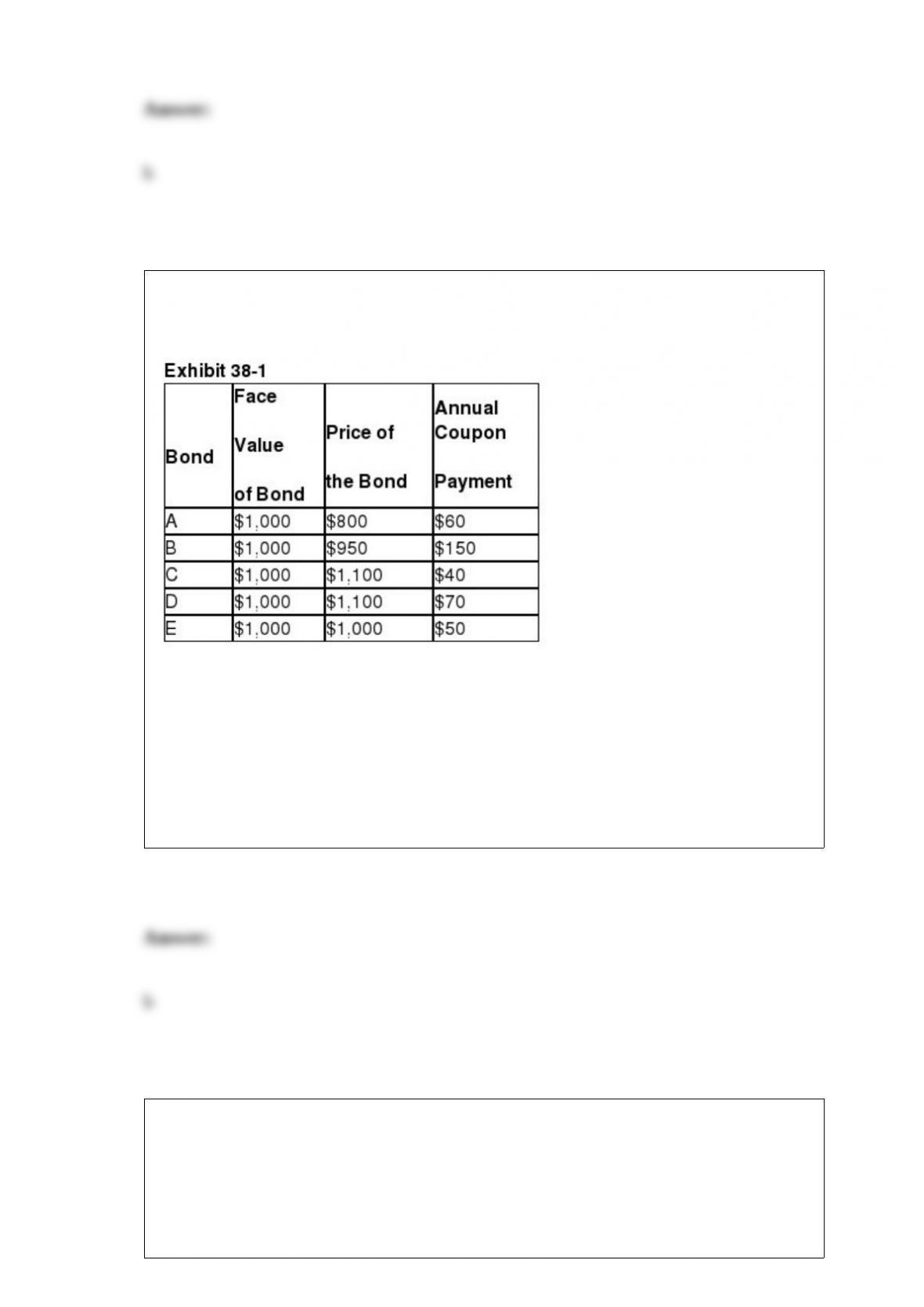
Refer to Exhibit 38-1. The coupon rate for bond C is
a. 0.25 percent.
b. 11 percent.
c. 3.6 percent.
d. 100 percent.
There are more white persons in the United States living below the poverty line than
African- American persons living below the poverty line.
a. True
b. False

As the price of a good falls from $5 to $3, the quantity supplied of the good falls from
550 units to 400 units. Price elasticity of supply is
a. 0.95.
b. 1.20.
c. 1.58.
d. 0.63.
Research by economists Autor, Dorn, and Hanson revealed that during the period 1990
to 2007, U.S. regions that faced more competition from Chinese imports had
_____________ unemployment rates and ______________ wages than U.S. regions
that faced less competition from Chinese imports.
a. lower; higher
b. higher; lower
c. lower; lower
d. higher; higher

If a U.S. company operates within a competitive environment and chooses to offshore
part of its production process, the resulting change in the firm’s costs should shift the
______________ curve for its product ___________________, thus _____________
the price of the product being produced.
a. supply; leftward; lowering
b. supply; rightward; raising
c. demand rightward; raising
d. supply; rightward; lowering
Which of the following is not an assumption of the theory of monopolistic competition?
a. There are many sellers and buyers.
b. Each firm produces and sells a slightly differentiated product.
c. There is easy entry.
d. There is easy exit.
e. All firms face the same cost conditions.
In the prisoner’s dilemma, each prisoner would be best off if
a. both confess.
b. one confesses but the other does not.
c. one confesses, regardless of what the other does.
d. neither confesses.
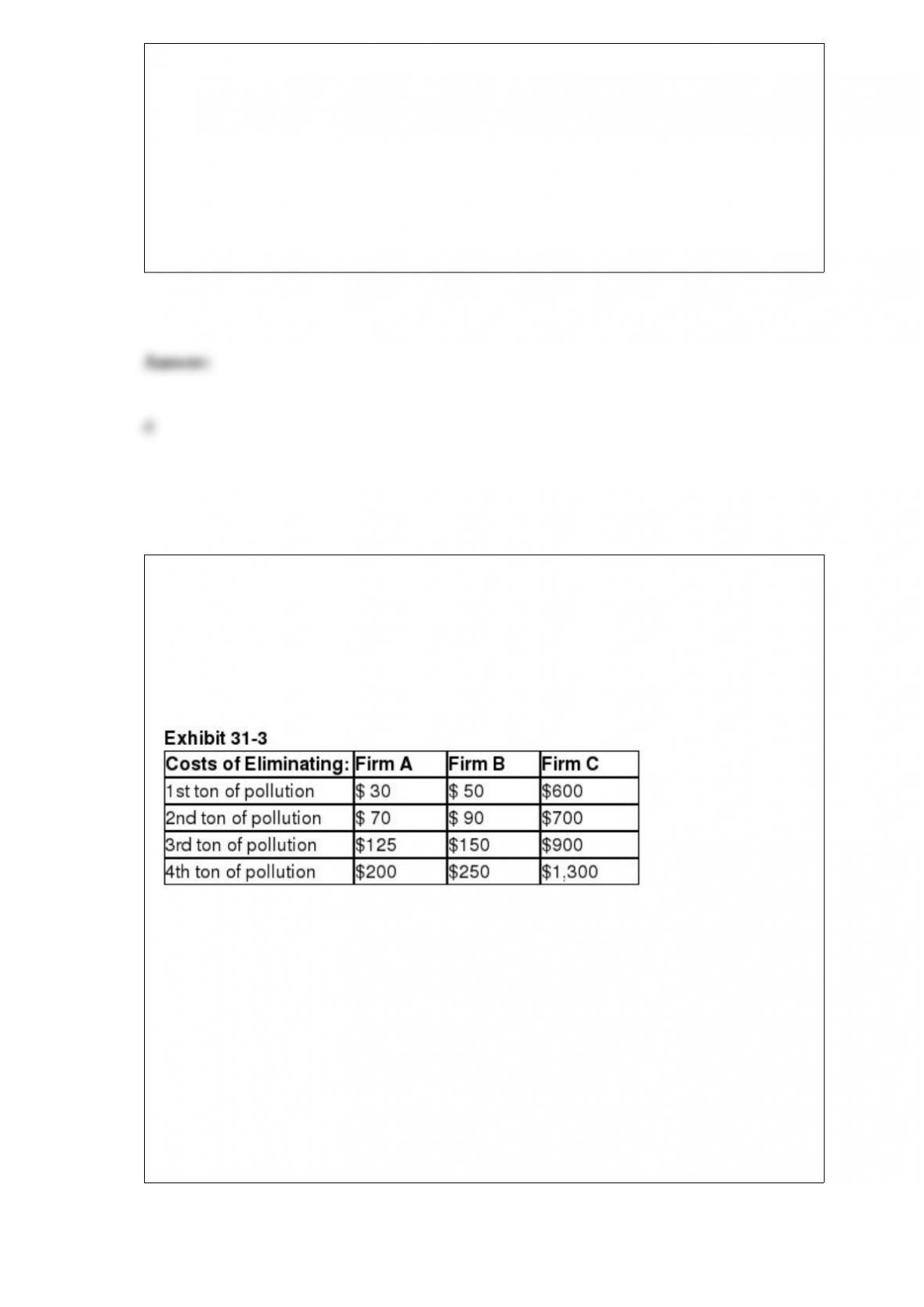
Refer to Exhibit 31-3. Suppose that Firms A, B, and C are the only polluters in the state
and that each emits 4 tons of pollution into the atmosphere. To cut the level of pollution
the government imposes an emission tax of $300 per ton of pollution.As a result of this
tax, Firm A would _________________, firm B would ____________________ and
firm C would __________________.
a. not reduce any of its pollution; not reduce any of its pollution; reduce all 4 tons of its
pollution
b. reduce all 4 tons of its pollution; only reduce 1 ton of its pollution; not reduce any of
its pollution
c. reduce all 4 tons of its pollution; reduce all 4 tons of its pollution; not reduce any of
its pollution
d. not reduce any of its pollution; reduce 3 tons of its pollution; reduce all 4 tons of its
pollution

If quantity demanded is completely unresponsive to changes in the price of good XYZ,
then demand for good XYZ is
a. inelastic.
b. unit elastic.
c. elastic.
d. perfectly elastic.
e. perfectly inelastic.
A firm in a monopolistic competitive market will produce a level of output at which
a. P < MR.
b. P = MR.
c. P > MR.
d. P = MC.

Firm A has a higher labor cost-total cost ratio than Firm B. If both firms employ the
same type of labor, and the wage rate rises by $1, then Firm A’s product price will most
likely ____________ than Firm B’s product price.
a. rise by more
b. fall by more
c. fall by less
d. rise by less
Under the target price system,
a. supply is restricted.
b. consumers must pay the target price.
c. payments are made to the government when the price paid by consumers rises above
the target price.
d. farmers are paid a deficiency payment if the market price for their goods is below the
target price.
e. a and c

Price elasticity of demand is the ratio of the
a. absolute change in quantity demanded to the absolute change in price.
b. absolute change in price to the absolute change in quantity demanded.
c. percentage change in quantity demanded to the percentage change in price.
d. percentage change in price to the percentage change in quantity demanded.