
Replacing the personal income tax with a consumption tax would:
A) favor wealthy and high income individuals.
B) favor poor and low income individuals.
C) increase overall federal revenues from taxation.
D) favor all taxpayers equally, regardless of their personal wealth.
The policy of running deficits and only gradually increasing taxes later to service the
debt is referred to as
A) crowding out.
B) tax-smoothing.
C) generational accounting.
D) Ricardian equivalence.
If an economy’s marginal propensity to consume is 0.6 and the marginal propensity to
import is 0.1, then an increase in government spending of $1,000 will increase income
by:
A) $1,250.
B) $1,667.
C) $2,000.
D) $2,500.
Suppose the required reserve ratio is 10%. A $10 million deposit allows commercial
banks to create a maximum total of ________ in deposits.
A) $10 million
B) $1 million
C) $11 million
D) $100 million
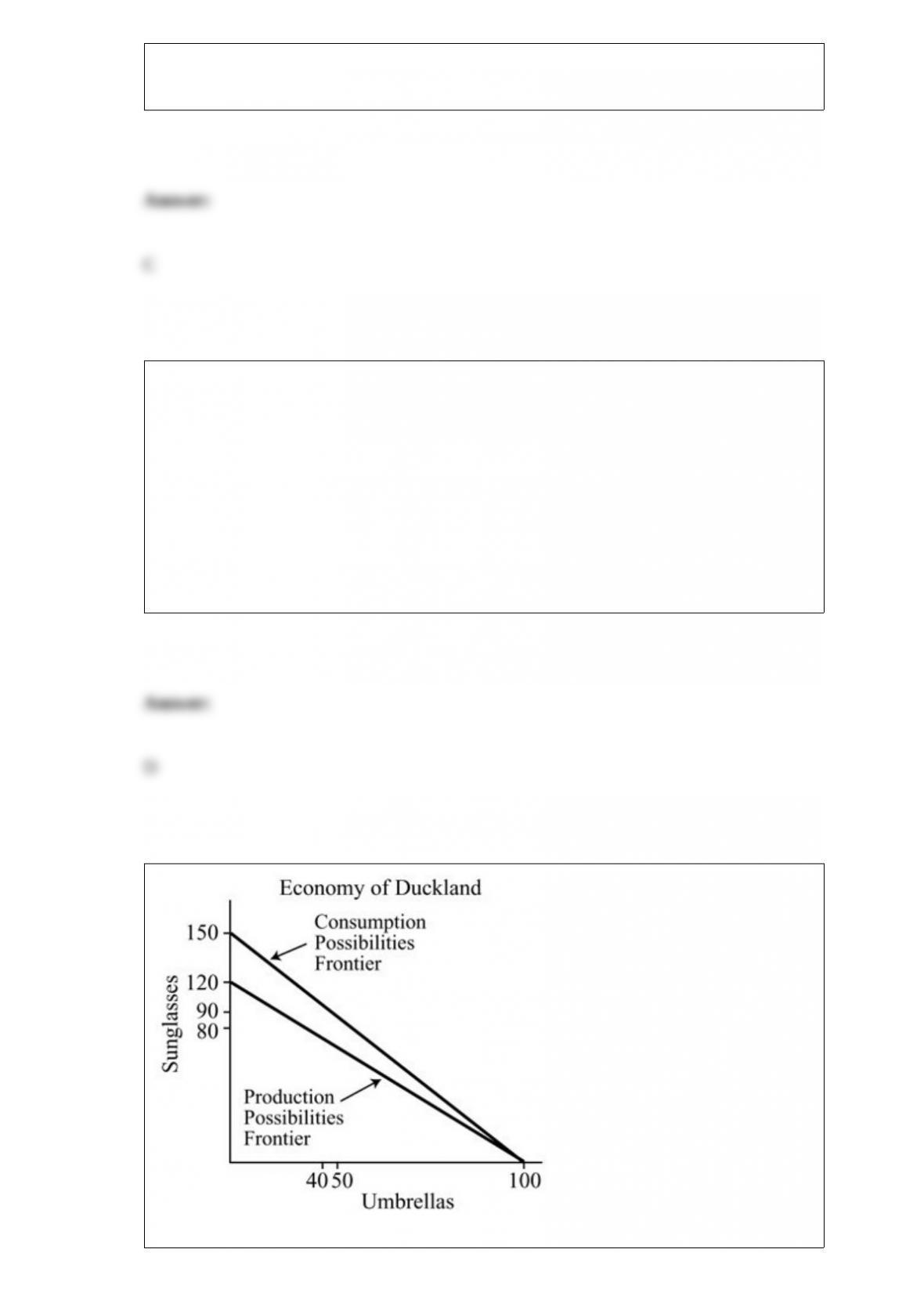
Figure 18.1 Refer to Figure 18.1. In autarky, the maximum amount of umbrellas that

Duckland can produce is:
A) 50.
B) 100.
C) 150.
D) 40.
Gross Domestic Product (GDP):
A) includes all goods and services sold in a given period.
B) excludes sales of all final goods and services.
C) includes sales of raw materials.
D) excludes used car sales because no new production takes place.
Table 6.11 Refer to
Table 6.11. If 1999 is the base year, then the inflation rate (i.e., the growth rate of the
price index) between 1999 and 2000 is:
A) zero percent.

B) 121.7 percent.
C) 2.17 percent.
D) 17.8 percent.
Unemployment insurance:
A) is a temporary cushion to the economic hardships caused by unemployment.
B) is a permanent substitute for income lost as a result of unemployment.
C) is usually higher than the income that the unemployed worker lost.
D) is available only to workers above the age of 55.
Which of the following statements is true?
A) In an open economy, the larger a nation’s marginal propensity to consume, the
smaller the multiplier.
B) In an open economy, the smaller a nation’s marginal propensity to import, the
smaller the multiplier.
C) In an open economy, the larger a nation’s marginal propensity to export, the smaller
the multiplier.
D) In an open economy, the larger a nation’s marginal propensity to import, the smaller
the multiplier.

The purchase of a foreign asset by a U.S. resident is a
A) deficit item on the current account.
B) surplus item on the current account.
C) deficit item on the financial account.
D) surplus item on the financial account.
An increase in the number of discouraged workers will cause the:
A) unemployment rate to decrease and the labor force to decrease.
B) unemployment rate to decrease and the labor force to increase.
C) unemployment rate to increase and the labor force to decrease.
D) unemployment rate to increase and the labor force to increase.
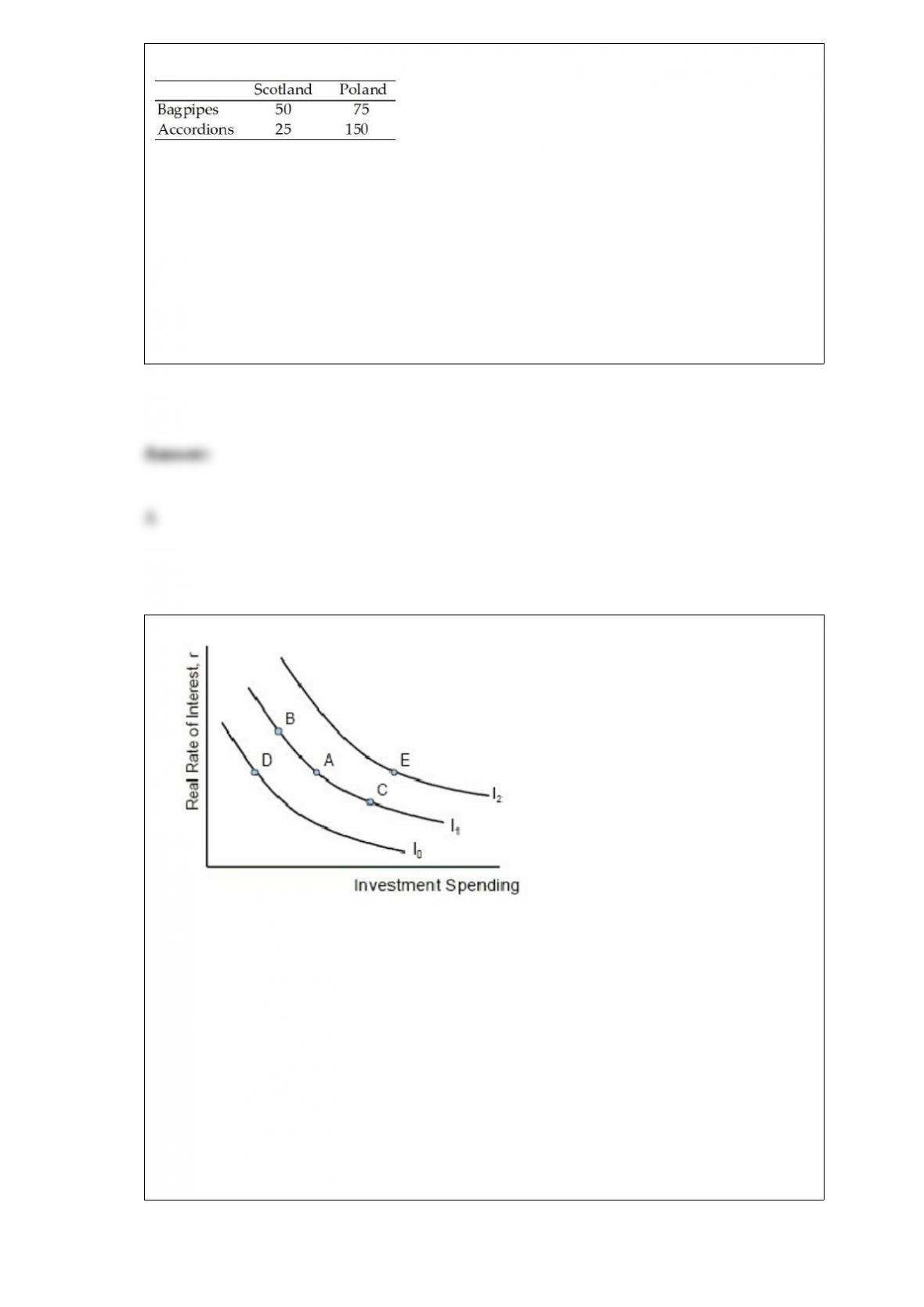
Daily Output of Scotland and Poland
Table 18.1 Refer to Table 18.1. If Scotland produces 50
bagpipes, how many accordions can they produce for the rest of the day?
A) zero
B) 25
C) 50
D) 1/2
Figure 12.1
Refer to Figure 12.1. Which of the following causes a movement from Point A to Point
C?
A) an increase in the interest rate
B) positive growth in the GDP
C) negative growth in the GDP
D) a decrease in the interest rate

Which of the following statements is true?
A) Free trade will benefit all workers in a nation equally.
B) As a result of specialization some workers will be displaced and harmed in the short
run by free trade.
C) Free trade leads to lower wages for all workers in both nations.
D) Specialization will result in a decline in an industry and none of those workers will
be able to find other jobs.
Economists believe that the CPI overstates actual price changes by as much as
________ to ________ percent each year.
A) 1; 2
B) 2; 3
C) 0.5; 1
D) 0.5; 1.5

A country’s currency appreciates relative to a foreign currency if:
A) it takes more foreign currency to buy the home currency.
B) the country’s GDP increases faster than the foreign country’s GDP.
C) the prices of goods in the home country increases faster than in the foreign country.
D) All of the above are correct.
The ________ curve shows a(n) ________ relationship between the real wage and the
number of workers who are willing to work.
A) labor demand; positive
B) labor demand; direct
C) labor supply; positive
D) labor supply; inverse
Recall the Application about the possibility of increases in health-care expenditures
crowding out consumption or investment spending to answer the following question(s).
In 1950, health-care expenditures in the United States were 5.2 percent of GDP; by
2000, this share had risen to 15.4 percent. Driving these increases were several factors:
increasing relative prices of health care compared to other goods, a larger population of
the elderly, and increased longevity. Since 1950, the average life span has increased by
1.7 years per decade.
According to the Application, economists Charles I. Jones and Robert E. Hall suggest

that normal economic growth will cause health-care expenditures to be approximately
what percent of GDP by the mid-century?
A) 18
B) 30
C) 62
D) 78
In the expanded circular flow diagram, the government supplies
A) goods and services to the product market.
B) factors of production to the factor market.
C) goods and services to households.
D) factors of production to firms.
Political scientists and economists argue that truly autonomous central banks that are
subject to minimal political influence are more likely to be:
A) more credible in their fight against inflation.
B) more credible in their attempts in reviving a troubled economy.
C) less credible in their fight against inflation.

D) less credible in their fight against unemployment.