
Diminishing marginal returns occur only in the long run.
Average fixed costs rise continuously as the quantity of output rises.
A good is nonrival in consumption if it is not practical to exclude people who don’t pay
for it from enjoying its benefits.
Recent work in neuroscience shows that different regions of the brain are involved in
the valuation of the benefits and costs of possible actions.

One implication of asymmetric information in the insurance market is that many low
cost consumers who are not eligible for a group plan will carry individual insurance.
Consumer surplus increases as the price of a good decreases.
Large industries that employ most of the available resources tend to have constant costs
in the long run.
On the ‘supply side” of a market, producers indicate to consumers what they are willing

to sell, in what quantity and at what price.
When one person benefits from national defense, he or she reduces the benefit to others.
Governments sometime create an excess supply of a product by setting a minimum
price that is greater than the equilibrium price, resulting in a permanent excess supply
of the product. This is known as a price ceiling.
Recall the Application about the free-agent market for professional baseball
pitchers to answer the following question(s).
Recall the Application. Free-agent baseball pitchers who switch teams spend a
relatively long time on the disabled list compared to those who do not switch teams.

The marginal product of an input is equal to the change in total product resulting from a
one-unit increase in the quantity of that input.
Recall the Application about how having car insurance affects driving behavior to
answer the following
question(s).
Recall the Application. The theory of moral hazard suggests that uninsured drivers drive
less carefully than insured drivers.
All topics concerning taxes are within the realm of macroeconomics.

Tie-in sales refers to the business practice of charging different prices to different
groups of consumers based on their willingness-to-pay.
A production possibilities curve shows the combinations of products which can be
produced in an economy which is fully employing and efficiently using its productive
resources.
As more firms leave an industry the market price will increase.

The cross elasticity of demand between natural gas and electricity is 1.1. Therefore,
electricity and natural gas must be substitutes.
In the past few centuries, choices have led to a substantial decline in the standards of
living around the globe.
Imports are products produced in the home country and sold in another country.
A pie chart show the relationship between two variables.

The higher the Herfindahl-Hirschman Index, the more firms there are in a market.
Firms that make their customers better off get more repeat business and make earn more
profits.
The opportunity cost of going to a particular college is not the same for everyone.
Public goods are land, labor, and capital resources provided by households in return for
payments from the government.

Given percentage change in supply and the price elasticity of supply, percentage change
in equilibrium price is zero if demand curve is perfectly inelastic
A seller’s willingness to accept is the minimum amount he or she is willing to accept as
payment for a product, and is equal to the marginal cost of production.
If perfectly competitive firms are earning positive economic profits in the short run,
then in the long run other firms will enter the market.

Diminishing marginal returns imply that marginal cost is falling.
A firm’s short-run supply curve is its marginal cost curve above its average variable cost
curve.
Recall the Application. The happy hour combination of higher demand and lower prices
is in accordance with the model of perfect competition.
If they could reach agreement two firms in a two firm industry facing the advertising
dilemma would agree not to advertise.

A prior agreement solves the prisoners’ dilemma for prisoners held separately.
One possible benefit from a merger is that the new firm could consolidate production,
marketing, and a administrative operations, leading to lower the production average
costs.
If a typical consumer is willing to pay $3,000 for a plum and $1,000 for a lemon, and
there is a 50% chance of getting a lemon, the typical consumer is willing to pay $2,000
for a used car.

Every good or service that comes from the government is automatically considered a
public good.
For a perfectly competitive firm, price always equals marginal revenue.
The substitution effect of a price change implies that as the price of a good falls, people
are likely to buy less of the good whose price has fallen.
A government policy that keeps the price of guitar strings above its equilibrium level
will increase total surplus.

The self-interest theory of government explains one motivation for limitations on taxes
and government spending.
Recall the Application. According to a recent study, about ________ percent of
rent-controlled apartments in New York City are mismatched.
A) 20
B) 40
C) 60
D) 80
If average total cost > average variable cost > price, a profit maximizing firm in a
perfectly competitive market should:

A) continue to produce its current output level.
B) shut down in the short run.
C) increase its output level to minimize its loss.
D) none of the above
Recall the Application. If the decrease in price of illegal drugs is due to equal changes
in demand and supply, the equilibrium quantity of drugs:
A) will increase.
B) will decrease.
C) will not change.
D) may or may not change.
Which of the following characteristics is shared by both monopolistically competitive
markets and monopoly markets?
A) free entry
B) identical products across sellers

C) Firms face downward sloping demand curves.
D) Firms are price takers.
Which of the following explains the impact of technological advances on the wage gap
between less skilled workers and highly skilled workers?
A) Advances in technology have increased the demand for higher education degrees
and widened the wage gap between the two groups.
B) Advances in technology have increased the productivity of less skilled workers and
thus narrowed the wage gap between the two groups.
C) Advances in technology have increased the demand for less skilled workers and
highly skilled workers alike, and thus the wage gap between the two groups remains
unchanged.
D) none of the above
Figure 15.2 depicts a one-mile stretch of beach with 100 swimmers distributed evenly
along the beach. There are two ice cream vendors – 1 and 2 – on the beach selling an
identical product. Assume that each swimmer buys only one ice cream cone and that
they prefer to buy ice cream from the nearer vendor. If vendor 1 is at B while vendor 2
is at D, vendor 1 will sell ________ ice cream cones while vendor 2 sells ________ ice
cream cones.

A) 45; 55
B) 50; 50
C) 55; 45
D) 60; 40
Kevin’s Golf-a-Rama sells golf balls in a perfectly competitive market. At its current
level of golf ball production, Kevin has marginal costs equal to $1, and AVC is rising. If
the market price of golf balls is $2, Kevin should:
A) decrease the level of golf ball production.
B) continue producing the current level of production.
C) increase the production of golf balls.
D) shut down and produce no golf balls.
Suppose Johnson’s Rubber Factory belches black smoke into the air over the city of
Bellowsville. If the city of Bellowsville attempts to internalize the external costs
associated with the production of rubber with a pollution tax, we can expect:
A) the price of rubber not to change.
B) the price of rubber to increase.
C) the quantity of rubber demanded to increase.
D) no change in the quantity of rubber demanded.
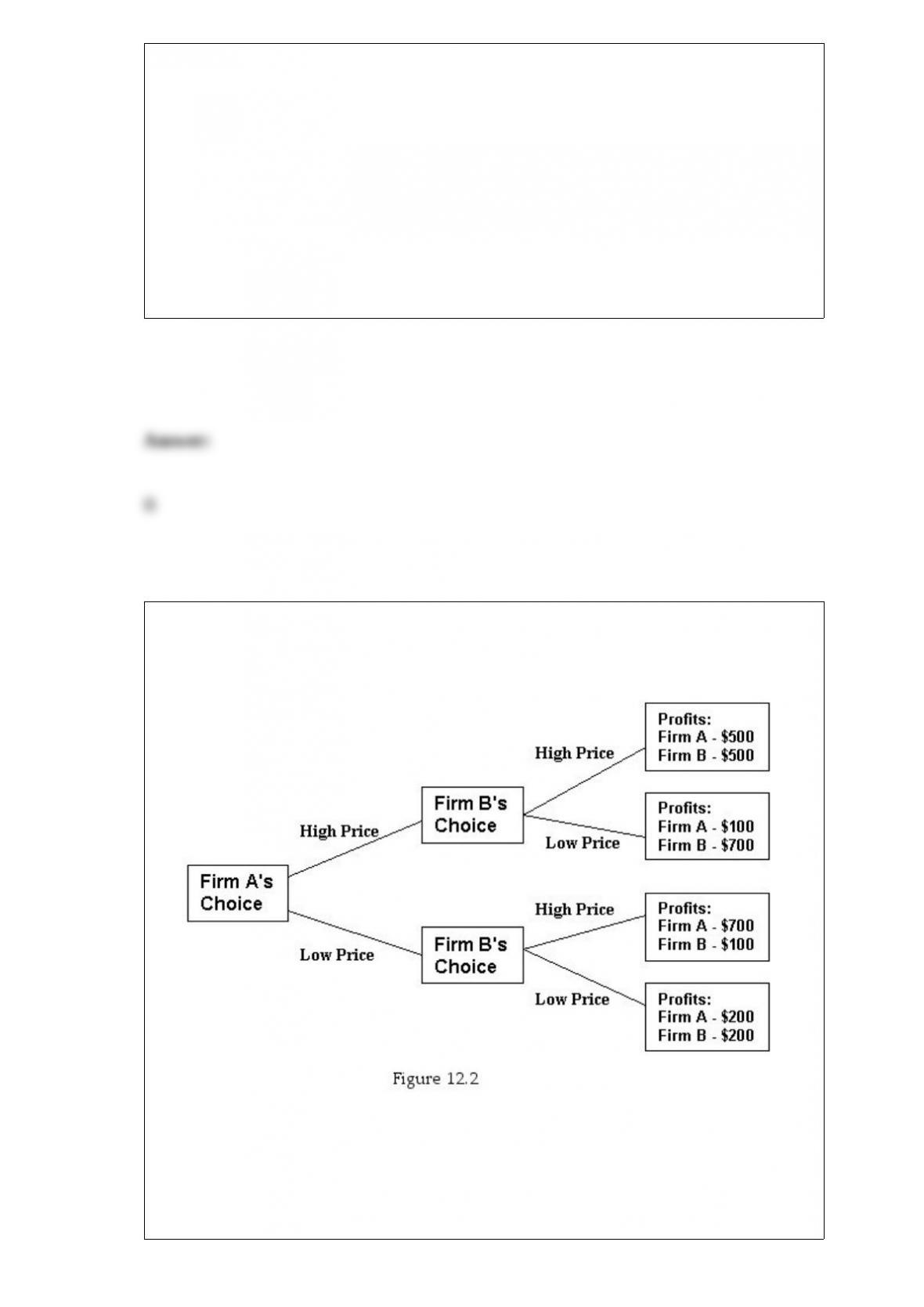
Refer to Figure 12.2. If A adopts a strategy of price fixing then the best choice for A is
to choose the ________ price and the best choice for B is to choose the ________ price.
A) high; high
B) high; low

C) low; high
D) low; low
A carbon tax placed on a fossil fuel:
A) is a pollution tax based on the carbon content of the fuel.
B) is a form of marketable pollution permit.
C) is often used in conjunction with command-and-control carbon policies.
D) will not change the price of the fossil fuel taxed.
The time and invested funds involved in starting a lawn-cutting business address the
economic concept of:
A) the marginal principle.
B) opportunity cost.
C) the real-nominal principle.
D) the principle of diminishing returns.

Public goods and services are:
A) generally paid for voluntarily by private individuals.
B) always produced and sold in the private market.
C) generally subject to quotas.
D) generally paid for with tax revenues.
The unionization rate of private sector workers is about:
A) 8.2%.
B) 12.5%.
C) 35.5%.
D) 37.7%.

Additional Application
A study done by a group from the Harvard School of Public Health in 1988 indirectly
supported the relationship between the price a consumer pays and the marginal utility
the consumer receives for medical services. The study claimed that the charges for
surgery were “too high” while charges for doctor consultations and office visits were
“too low.” An hour of a doctor’s time in surgery earned a great deal more than an hour
of consultation in the office. If more prevention through consultation could result in less
need for surgery, why should the fees for corrective medical surgery be so much greater
than the fees for diagnosis and prevention of medical problems? Therefore the Harvard
group recommended higher fees for consultation and lower fees for surgery. They
determined that such changes would more accurately reflect the value of each service.
Yet consumers willingly pay more for surgery than consultation. Why? Because the
marginal utility received from an hour of surgery is determined to be much greater than
the marginal utility from an hour of consultation. Consumers allocate their expenditures
with an awareness of the ratio of the marginal utility from a good or service to its price.
“Doctors’ Fees Called Out of Balance,” The Christian Science Monitor, September 29,
1988, p. 3.
Which of the following economically explains why consumers are willing to pay less
for a consultation than for a surgery?
A) Consumers receive more value from a consultation than a surgery.
B) Consumers receive less value from a consultation than a surgery.
C) Consumers are unable to determine the value from either service.
D) Consumers are unaware of the prices being charged for each of these services.
Figure 11.3 shows demands and costs for a monopolistically competitive firm. When
the firm’s demand curve shifts from to and to :
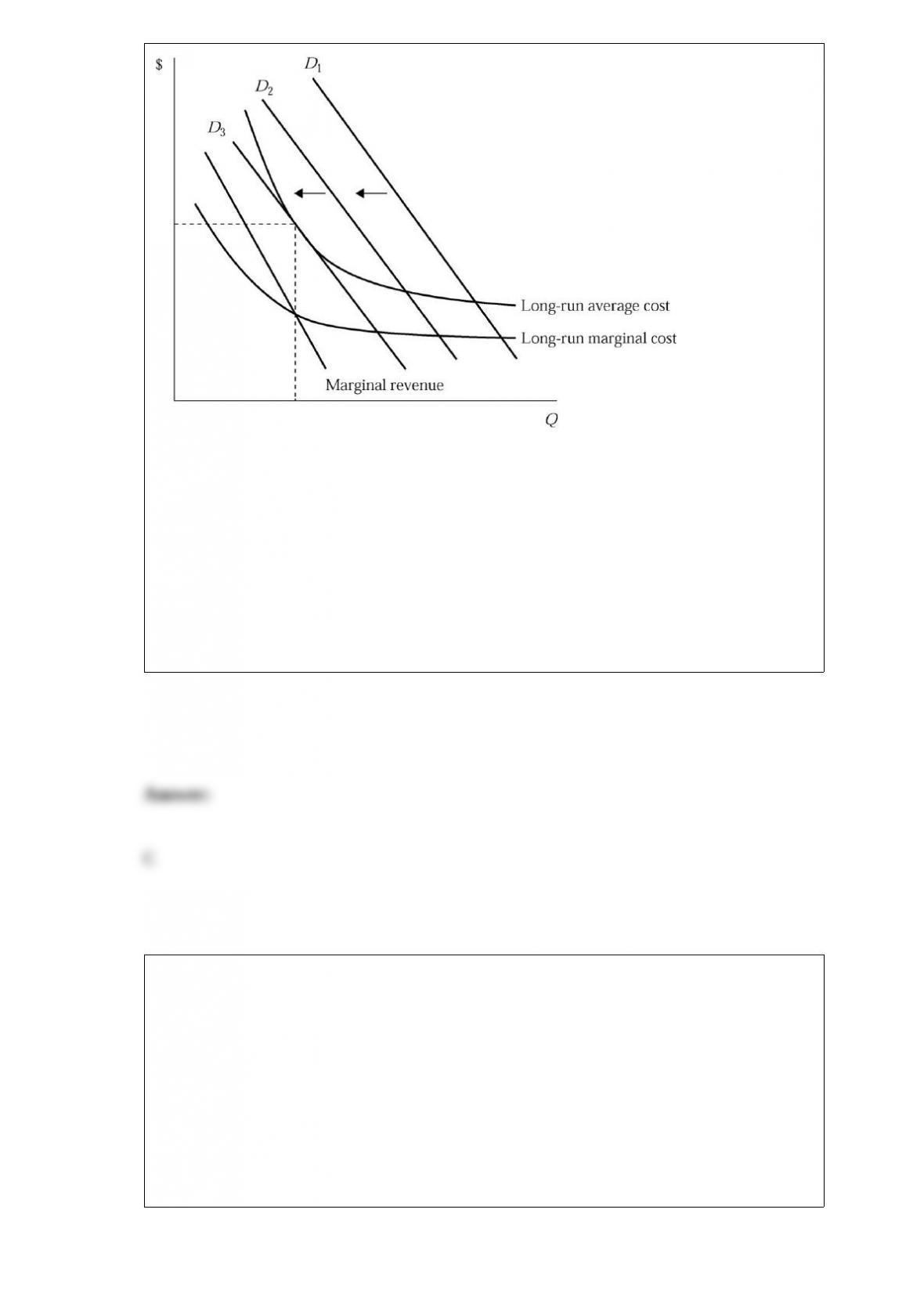
Figure 11.3
A) the firm’s economic profit remains the same.
B) the firm’s marginal revenue at the profit maximizing output level is decreasing.
C) the firm’s marginal cost at the profit maximizing output level is increasing.
D) the firm’s average cost at the profit maximizing output level is decreasing.
Recall the application about short-run supply curve for cargo. Why do the shipping
costs rise as shipping volume increases?
A) Docks become more crowded.
B) Fewer ships travel.
C) Docking fees go up.
D) Ships travel faster and use more fuel.

Consider two individuals, Nigel and Mia, who produce hair pins and bandanas. Nigel’s
and Mia’s hourly productivity are shown in Table 3.3.
Table 3.3
Which of the following is true?
A) Nigel has an absolute advantage in producing hair pins but not bandanas.
B) Nigel has an absolute advantage in producing bandanas but not hair pins.
C) Nigel has an absolute advantage in producing both goods.
D) Nigel does not have an absolute advantage in producing either good.
If a firm perceived that the other firm in an implicit pricing agreement dropped its price
in response to a change in market conditions, then its most likely response would be to:
A) match the other firm’s price.
B) engage in a price war.
C) raise price to punish the other firm.
D) keep its price the same.

In a perfectly competitive market, if price is less than average total cost, but greater
than average variable cost at the level of output where marginal cost equals marginal
revenue:
A) the firm is earning positive economic profit.
B) the firm is earning negative economic profit.
C) the firm should shut down.
D) We cannot determine whether the firm is earning positive or negative profits.
Refer to Figure 18.4. With a tariff, how much does the government collect for each
glove imported into Duckland?
A) $0

B) between $2 and $3
C) between $8 and $10
D) more than $10
From society’s point of view, a monopolist produces too little because price:
A) is less than marginal cost.
B) is less than average cost.
C) exceeds average cost.
D) exceeds marginal cost.
Suppose the price of a package of guitar strings is $5. If Mark’s marginal cost of
producing that package of guitar strings is $3, his producer surplus from that package of
guitar strings is:
A) $0.
B) $1.
C) $2.

D) $3.
A group of people has formed a house cleaning and yard maintenance business. The
number of houses or yards that they can clean or maintain in any given day is depicted
in Table 2.1. The opportunity cost of cleaning the third house in a day is:
Table 2.1
A) 1 yard maintained.
B) 2 yards maintained.
C) 3 yards maintained.
D) 15 yards maintained.

Table 2.3
What can be observed about the given resources?
A) Capital and labor are both fixed.
B) Capital is variable.
C) Capital is fixed.
D) Labor is fixed.
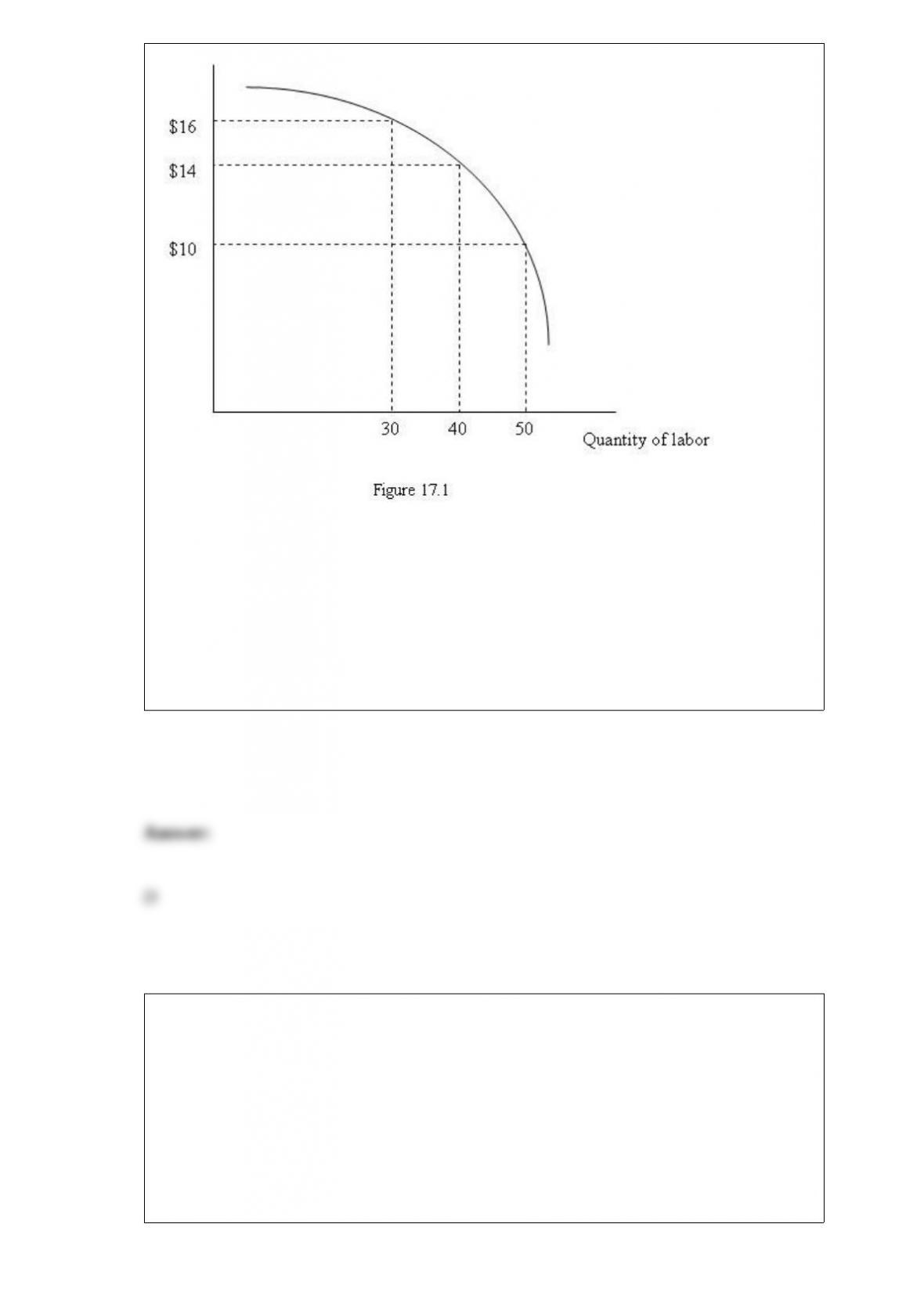
Figure 17.1 depicts a firm’s marginal revenue product curve. If the product price is $2,
what is the marginal product of the 30th hour of labor?
A) 5 units
B) 6 units
C) 7 units
D) 8 units
The demand curve that a monopolist faces is:
A) the market demand curve.
B) the same as the demand curve that faces a perfectly competitive firm.
C) not affected by changes in the prices of other goods.
D) generally flatter than the demand curve that faces a perfectly competitive firm.

When an increase in a firm’s scale of production leads to higher average costs it is
referred to as:
A) economies of scale.
B) constant returns to scale.
C) decreasing returns to scale.
D) diseconomies of scale.
Suppose two firms produce close substitutes such that reducing the price of one product
reduces the quantity demanded of the other. If those two firms merge:
A) they can earn higher profits by continuing to sell both products if the profit gained
from increased sales of one product are greater than the lost profits from reduced sales
of the other product.
B) they will eliminate the less profitable product and sell only one.
C) they will raise prices on both products.
D) they will be unable to earn higher profits because the two products will compete
against each other.

A market failure could be caused by:
A) competition.
B) imperfect information.
C) profit.
D) capitalism.
The production possibilities curve represents the set of all:
A) feasible combinations of goods that the economy can produce given that a nation’s
resources are fully employed.
B) factors of production that can be used to manufacture goods and services.
C) combinations of goods and services that can be used in the production of other goods
and services.
D) nonlinear forms of production in the economy.

What is the advertisers’ dilemma?
Toothpicks are sold in a perfectly competitive market. The market price is currently $3
per box of one hundred toothpicks. At its current level of production, a representative
firm in the toothpick industry is producing at a level of output such that long-run
average cost is $3.25 per box of one hundred toothpicks. Given this information, is the
toothpick industry in equilibrium? Explain.
If the price elasticity of supply is 1.2, then a 15% decrease in price will result in how
much of a percentage change in quantity supplied? Will quantity supplied increase or
decrease?

What is meant by the term “marginal change”?
When do consumers bear the larger share of a tax?
As the dollar prizes for professional golf tournaments have increased, professional
golfers have entered fewer tournaments per year. Is this type of behavior consistent with
utility maximization? Explain.

As manager of the only video rental store in town, you have noticed that on Thursday
through Sunday the demand for movie rentals is much less elastic than it is on Monday
through Wednesday. If you are currently charging $3 for a two-night rental, give an
example of a pricing policy that might increase your revenues compared to a
single-pricing strategy.
How is it possible that monopolistically competitive firms have market power and yet
cannot earn long-run profit?
Give an example of a tie-in sale.
Why would a firm be willing to operate at a loss?
The demand for tobacco is price inelastic. Suppose there is a drought that destroys a
large portion of the tobacco crop. What will happen in the market for tobacco? Will the
equilibrium price and quantity change? If so, how? What will happen to the total
revenue earned by tobacco farmers?
The price elasticity of demand for bagels is 1.7 and the price elasticity of supply of
bagels is 2.0. If the demand for bagels rises by 30%, what will happen to the price of
bagels?

What is the deadweight loss of a tax?
Comment on the following statement: “The socially optimal amount of pollution is
zero.”
Your boss, the mayor of a city, thought that she’d come up with a great way to raise city
revenue: increase the tax on gasoline in the city! However, she discovered that the city
was actually receiving less tax revenue after the gas tax increase than before. Incensed,

she declared that the economic policy prescription of taxing goods with inelastic
demand must be flawed. Comment.
What is the difference between an “individual demand curve” and a “market demand
curve”?
Explain why it was necessary to pass the Clayton Act when the Sherman Act had
already addressed the antitrust issue.