
Economic theory assumes that a firm’s goal is to:
A. earn an accounting profit.
B. earn an economic profit.
C. maximize its accounting profit.
D. maximize its economic profit.
Positive economic principles are those that:
A. are always correct.
B. are influenced by political ideology.
C. indicate how people should behave.
D. predict how people will behave.

Real wages increased in industrialized countries in the twentieth century because the
demand for labor:
A. increased more rapidly than the supply of labor increased.
B. increased more slowly than the supply of labor increased.
C. increased, while the supply of labor decreased.
D. decreased, while the supply of labor increased.
A labor contract provides for a first-year wage of $15 per hour, and specifies that the
real wage will rise by 2 percent in the second year of the contract. The CPI is 1.00 in
the first year and 1.09 in the second year. What dollar wage must be paid in the second
year?
A. $15.30
B. $16.09
C. $16.45
D. $16.68
As the dollar exchange rate, e, decreases, the quantity of dollars supplied in the foreign
exchange market ____, and the quantity of dollars demanded in the foreign exchange
market ____.
A. increases; increases

B. increases; decreases
C. decreases; increases
D. decreases; decreases
Following an adverse inflation shock, the economy will return to potential more rapidly
if:
A. inflationary expectations are anchored.
B. inflationary expectations change quickly in response to the shock.
C. the Fed has frequently accommodated higher inflation in the past.
D. the Fed has frequently raised its target inflation rate in the past.
Suppose that all workers value a 1 percent reduction in the workplace injury rate at
$1,000 per year. The cost of reducing the injury rate by 1 percent is $200 per year for
each worker. Firms currently pay $20,000 per year to workers, without any effort to
improve safety. If new firms began to offer workers $19,500 and a 1 percent reduction
in the injury rate, then the value to each worker of the new firms’ offer would be
______ compared to ______ at the existing firms.
A. $19,500; $20,000
B. $20,500; $20,000
C. $19,700; $19,800
D. $20,000; $20,000
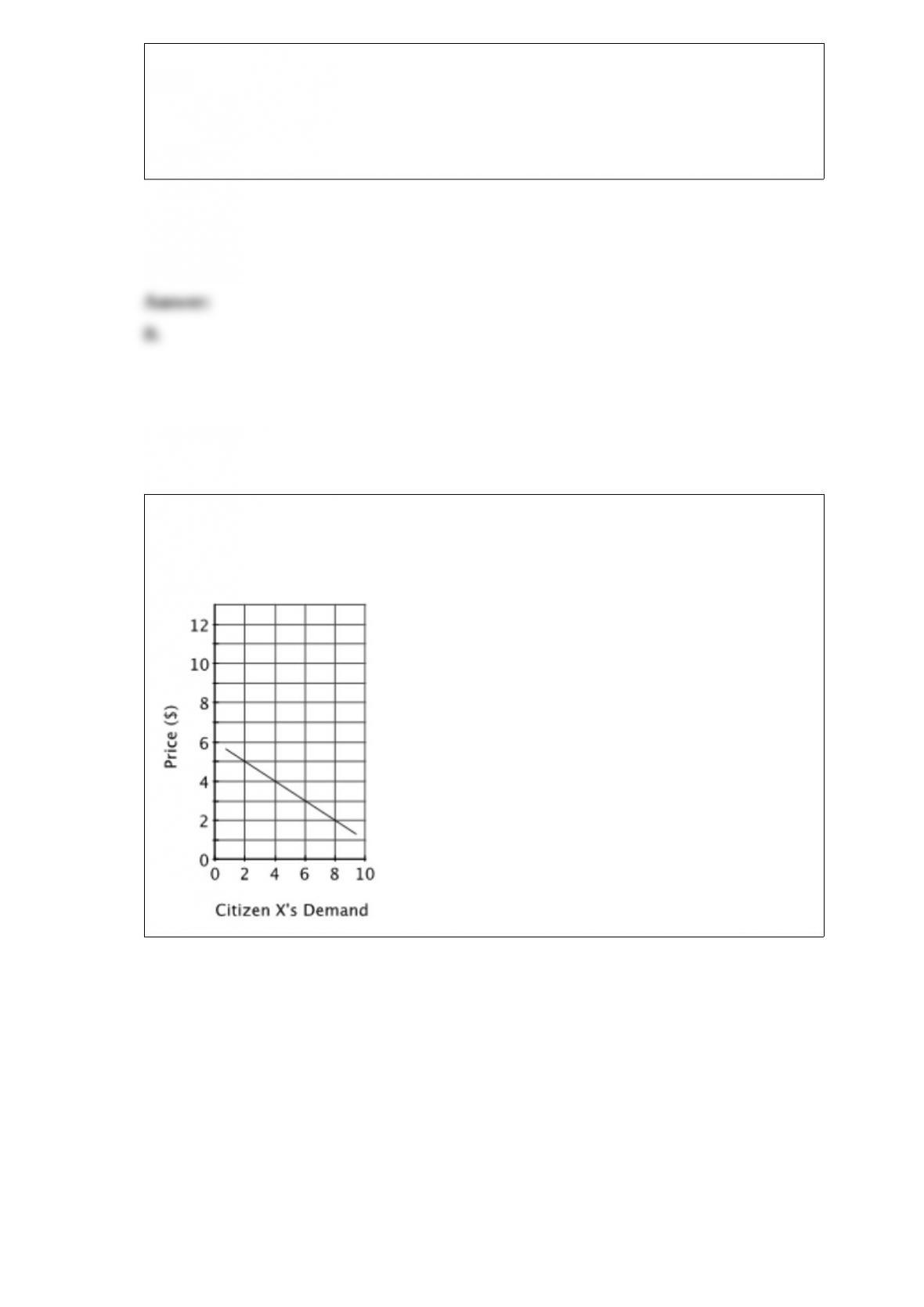
Consider a town with three residents. The residents’ demand curves for various acres of
a public park are shown below.
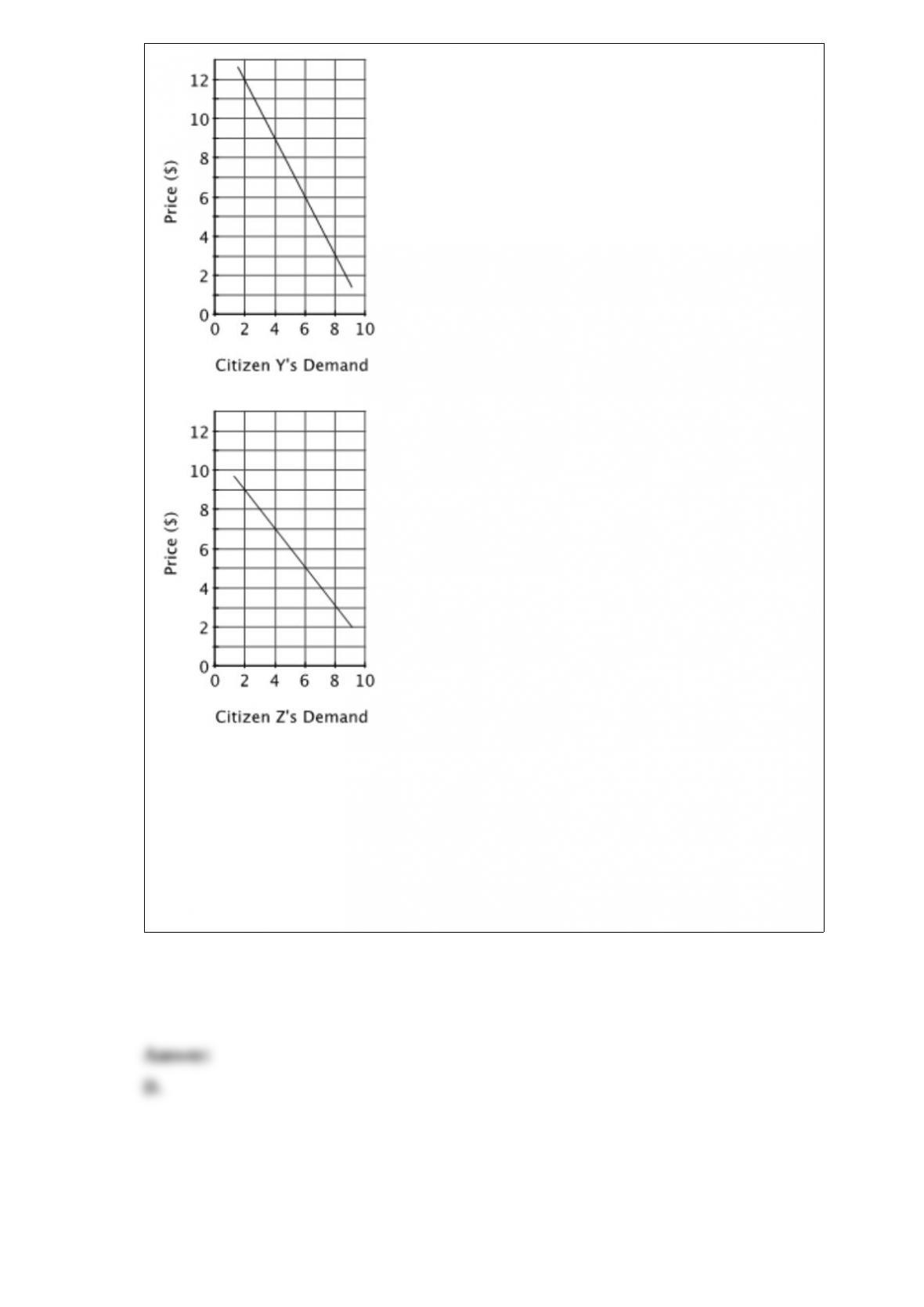
The public’s willingness to pay for the 2nd acre of parkland is ______.
A. $6.
B. $8.
C. $14.
D. $26.

Suppose the actual rate of unemployment is 4 percent. What is the natural rate of
unemployment if actual output equals potential output?
A. 0 percent
B. -4 percent
C. 2 percent
D. 4 percent
An imperfectly competitive firm faces a demand curve that is:
A. perfectly elastic.
B. more than perfectly elastic.
C. perfectly inelastic.
D. downward sloping.

The money demand curve will shift to the right if:
A. the nominal interest rate increases.
B. the nominal interest rate decreases.
C. the price level increases.
D. the price level decreases.
If all firms were to pay the same premium per worker into the workers’ compensation
system, then firms with high injury rates would pay premiums that:
A. exactly cover the claims generated by their workers
B. are too large to cover the claims generated by their workers.
C. are too small to cover the claims generated by their workers.
D. lead to the socially optimal level of workplace injuries.
Gertie saw a pair of jeans that she was willing to buy for $35. The price tag, though,
said they were $29.99. Therefore:
A. Gertie should not buy the jeans because they will be of lower quality than she
expected.

B. Gertie should not buy the jeans because the price is not equal to her reservation
price.
C. Gertie should buy the jeans because the price is less than her reservation price.
D. Gertie should buy the jeans because the price is more than her reservation price.
Suppose the figure below shows the demand curve, marginal revenue curve and
marginal cost curve for a monopolist.
When this monopolist maximizes its profit, consumer surplus equals the area:
A. ABJ.
B. ACN.
C. AELJ.
D. ACKJ.

Suppose that both the equilibrium price and quantity of ketchup fall. The most
consistent explanation for these observations is:
A. a decrease in demand for ketchup with no change in supply.
B. an increase in demand for ketchup with no change in supply.
C. an increase in demand for ketchup and a decrease in the supply of ketchup.
D. an increase in the supply of ketchup with no change in demand.
If 20% increase in the price of a good leads to a 60% decrease in the quantity
demanded, then what is the price elasticity of demand?
A. 30.
B. 3.
C. 1/3.
D. 1/6.
A price-taker faces a demand curve that is:
A. vertical at the market price.
B. upward sloping.
C. downward sloping.
D. horizontal at the market price.
Factors of production are the most likely to earn economic rent when they:
A. are used by many different firms.
B. cannot easily be duplicated.
C. are fixed in the short run.
D. have high reservation prices.

The second round increase in inflation following an adverse supply shock is the result
of:
A. shifts in potential output.
B. increases in the Federal Reserve’s target real interest rate.
C. decreases in the Federal Reserve’s target real interest rate.
D. increases in long-term inflationary expectations.
The table below shows how total donations, average donations, total labor costs and
average labor costs vary depending on the number of employees State U hires for its
fundraising activities.
The total value of donations raised by three employees is:
A. $43,899.
B. $45,000.
C. $48,911.
D. $51,963.

For two goods, coffee and scones, suppose that MU(coffee)/P(coffee) = 4 and
MU(scones)/P(scones) = 3. To maximize your total utility from these two goods, you
should purchase:
A. less coffee and more scones.
B. more coffee and fewer scones.
C. less coffee and fewer scones.
D. more coffee and more scones.
Since the ratio of marginal utility to price (i.e., marginal utility per dollar spent) is
higher for coffee than for scones, the consumer should buy more coffee and fewer
scones because the utility gained from spending an additional dollar on coffee will
exceed the utility lost from spending a dollar less on scones; hence, total utility will
rise.
In Econland autonomous consumption equals 700, the marginal propensity to consume
equals 0.80, net taxes are fixed at 50, planned investment is fixed at 100, government
purchases are fixed at 100, and net exports are fixed at 40. Autonomous expenditure
equals:
A. 990.
B. 940.
C. 900.
D. 890.

Which of the following workers is most likely to lose his/her job during a recession?
A. Construction worker
B. Baker
C. Farmer
D. Barber
Suppose Suzanne allocates her spending on apples and bananas according to the
rational spending rule. If the price of apples is less than the price of bananas, then at
Suzanne’s optimal consumption bundle, her marginal utility from apples will be:
A. less than her marginal utility from bananas.
B. greater than her marginal utility from bananas.
C. equal to her marginal utility from bananas.
D. equal to zero.

Unexpectedly high inflation ______ borrowers and ______ lenders.
A. helps; hurts
B. helps; helps
C. hurts; hurts
D. hurts; helps
A firm pays Pam $40 per hour to assemble personal computers. Each day, Pam can
assemble 4 computers if she works 1 hour, 7 computers if she works 2 hours, 9
computers if she works 3 hours, and 10 computers if she works 4 hours. Pam cannot
work more than 4 hours day. Each computer consists of a motherboard, a hard drive, a
case, a monitor, a keyboard, and a mouse. The total cost of these parts is $600 per
computer. What is the marginal cost of producing the computers that Pam can assemble
during her 2nd hour of work?
A. $1,800
B. $1,840
C. $4,200
D. $4,280

The small city of Pleasantville is considering building a public swimming pool that
costs $1,000. Each resident’s marginal benefit of the swimming pool is shown below. It
takes a 4/5 majority to pass any tax measure, and all residents must vote.
Building the swimming pool would ______ total economic surplus because ______.
A. decrease; the total cost of the pool is greater than the total social benefit of the pool
B. decrease; taxes would have to be collected to build the pool
C. increase; the total social benefit of the pool is greater than the total cost of the pool
D. increase; the cost of building the pool can be passed to users from other towns
The marginal product of the 14th worker is 8 and the firm sells its output for $4 per unit.
If labor is the only variable cost, then the value of the 14th worker’s marginal product is
A. $2.
B. $4.
C. $12.
D. $32.

If it is difficult, or costly, to prevent people who do not pay for a good from consuming
the good, then the good is a ______ good.
A. nonexcludable
B. pure public
C. private
D. nonrival
Cartel agreements are difficult to sustain because:
A. it’s a dominant strategy for each cartel member to cheat on the cartel agreement.
B. the collective payoff to all the cartel members is lower when they all abide by the
cartel agreement.
C. cartel members do not face the economic incentives inherent in a prisoner’s dilemma.
D. it’s usually easy to discover if one of the members has cheated.
At the midpoint of a straight-line demand curve, the price elasticity of demand is:
A. greater than one.
B. less than one.
C. equal to one.
D. zero.
Each of the following increases average labor productivity except:
A. more human capital.
B. more physical capital.
C. more central planning.
D. more natural resources.