
1) along a supply curve, product price and producer surplus are inversely related.
2) an economy will always operate at some point on its production possibilities curve.
3) A firm’s optimal amount of R&D occurs where the marginal benefit of this activity
exceeds marginal cost by the greatest amount.
4) the intense competition of free trade prevents the investment that generates economic
growth.
5) rational individuals may make different choices because their preferences and
circumstances differ.
6) The tax cut passed in 2001 by Congress and the Bush administration was
implemented to stop a recession.
7) wages and salaries are the largest source of household income.
8) a linear demand curve has a constant elasticity over the full range of the curve.

9) Critics of the minimum wage contend that higher minimums cause employers to
move up their labor demand curves, reducing employment of low-wage workers.
10) a ceiling price in a competitive market will result in persistent surpluses of a
product.
11) refer to the above diagram for a nondiscriminating monopolist. if the government
regulates the monopolist so that it charges the price that achieves allocative efficiency,
the monopolist will produce output q
12) the long-run supply curve for a decreasing-cost industry is downsloping.
13) A reduction in the collective discrimination coefficients of employers will increase
the wage rate of those discriminated against, but reduce their employment.
14) (Advanced analysis) Assume the consumption schedule for a private closed
economy is C = 40 + 0.75Y, where C is consumption and Y is gross domestic product.
The multiplier for this economy is:
A.3.
B.4.
C.5.
D.10.
15) The multiple by which the commercial banking system can increase the supply of
money on the basis of each dollar of excess reserves is equal to:
A.the reciprocal of the legal reserve ratio.
B.1 minus the legal reserve ratio.
C.the reciprocal of the income velocity of money.
D.1/MPS.
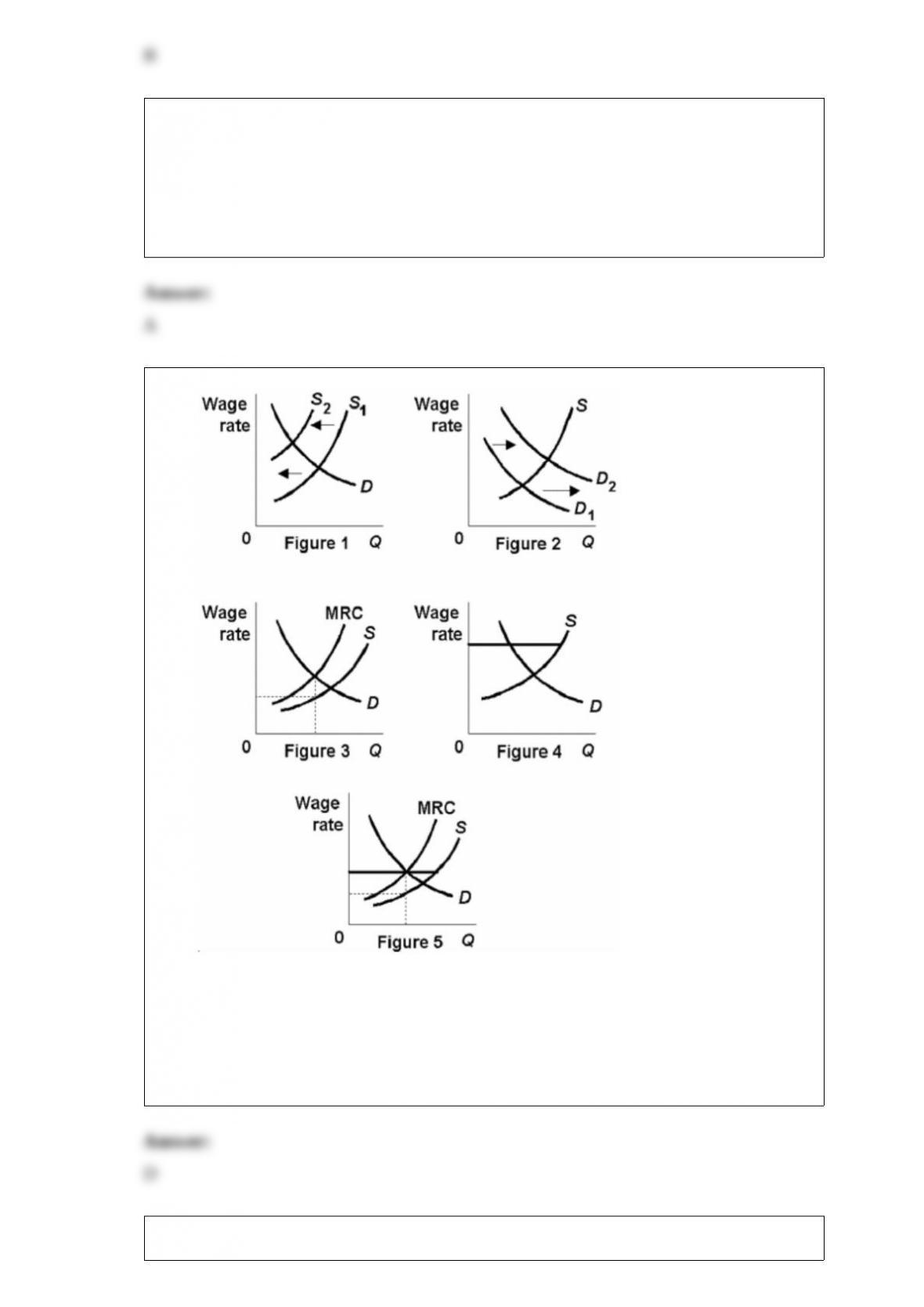
16)
Refer to the above labor market diagrams. The economic impact of occupational
licensing can best be demonstrated through Figure:
A.4
B.3
C.2
D.1
17) the scientific method is:
a.not applicable to economics, because economics deals with human beings.
b.also known as the economic perspective.
c.analysis that moves from broad generalizations called laws to theories and then to
hypotheses.
d.used by economists and other social scientists, as well as by physical scientists and
life scientists.
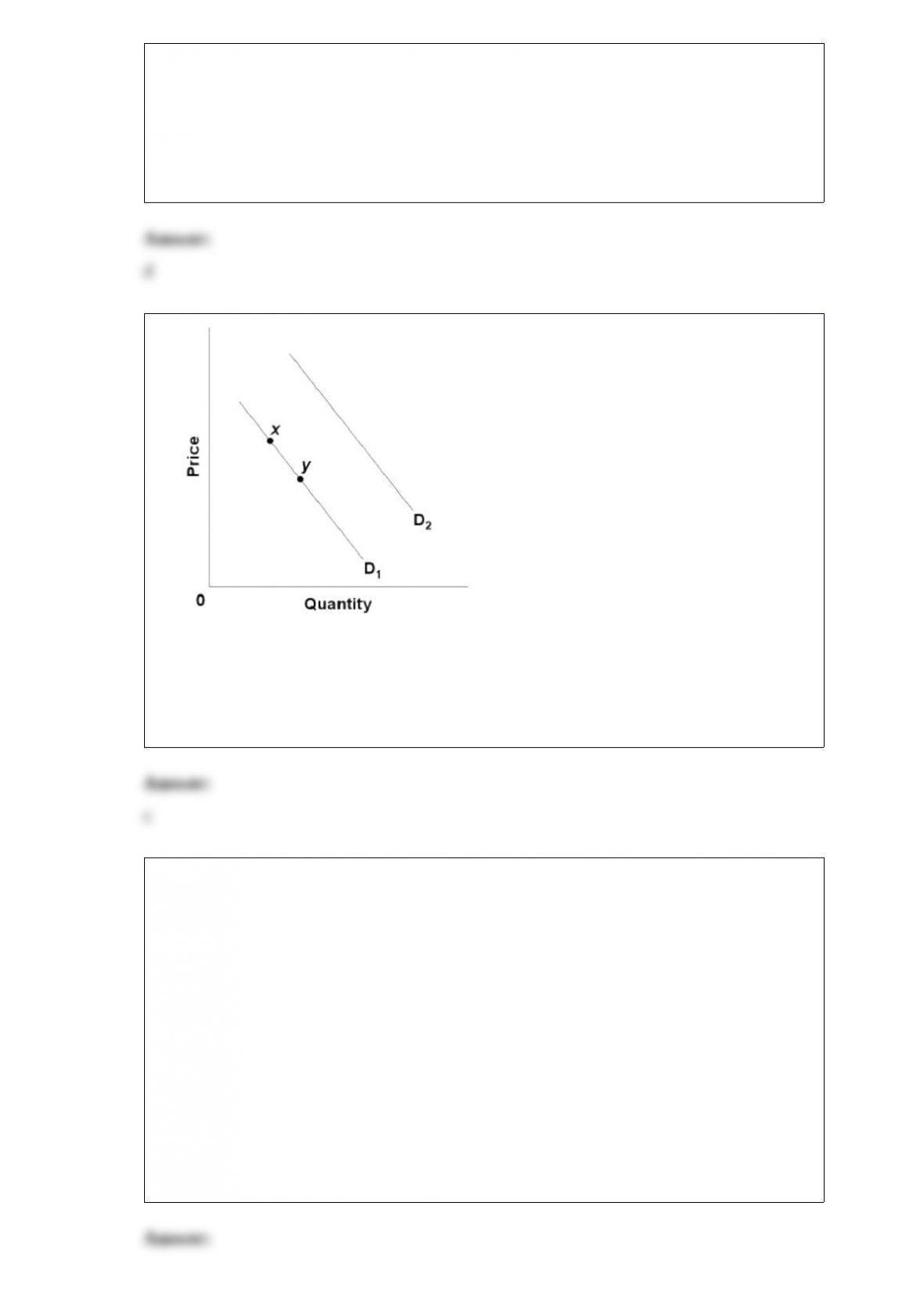
18)
refer to the above diagram. a decrease in demand is depicted by a:
a.move from point x to point y.
b.shift from d1 to d2.
c.shift from d2 to d1.
d.move from point y to point x.
19) assume that if the interest rate that businesses must pay to borrow funds were 20
percent, it would be unprofitable for businesses to invest in new machinery and
equipment so that investment would be zero. but if the interest rate were 16 percent,
businesses will find it profitable to invest $10 billion. if the interest rate were 12
percent, $20 billion would be invested. assume that total investment continues to
increase by $10 billion for each successive 4 percentage point decline in the interest
rate.
refer to the above information. which of the following is an accurate verbal statement of
the described relationship?
a.there is no regular or dependable relationship between business investment and the
interest rate.
b.the amount of business investment is unaffected by changes in the interest rate.
c.investment spending by businesses varies inversely with the interest rate.
d.investment spending by businesses varies directly with the interest rate.
20) preferred provider organizations (ppos):
a.charge a fixed amount per member, hire many of their own physicians, and provide
health services only to members.
b.require that their members give up the right to file medical malpractice suits.
c.are illegal in several states.
d.require physicians and hospitals to provide discounted prices for their services as a
condition for being included in the insurance plan.
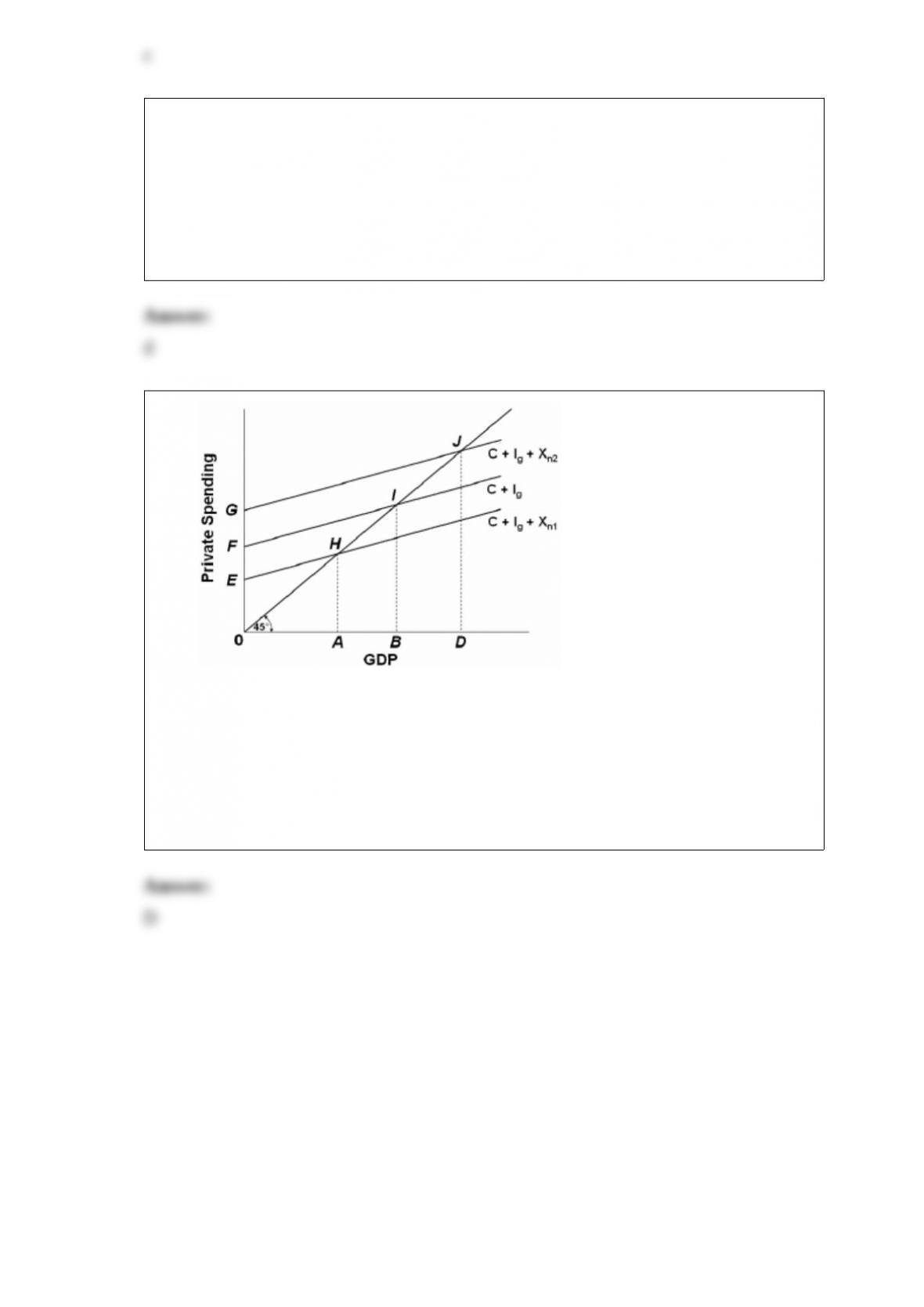
21)
Refer to the above diagram. If aggregate expenditures in this economy are (C + Ig +
Xn2), then the equilibrium levels of GDP and aggregate expenditures respectively will
be:
A.0A and 0E.
B.0B and 0F.
C.0A and AH.
D.0D and DJ.
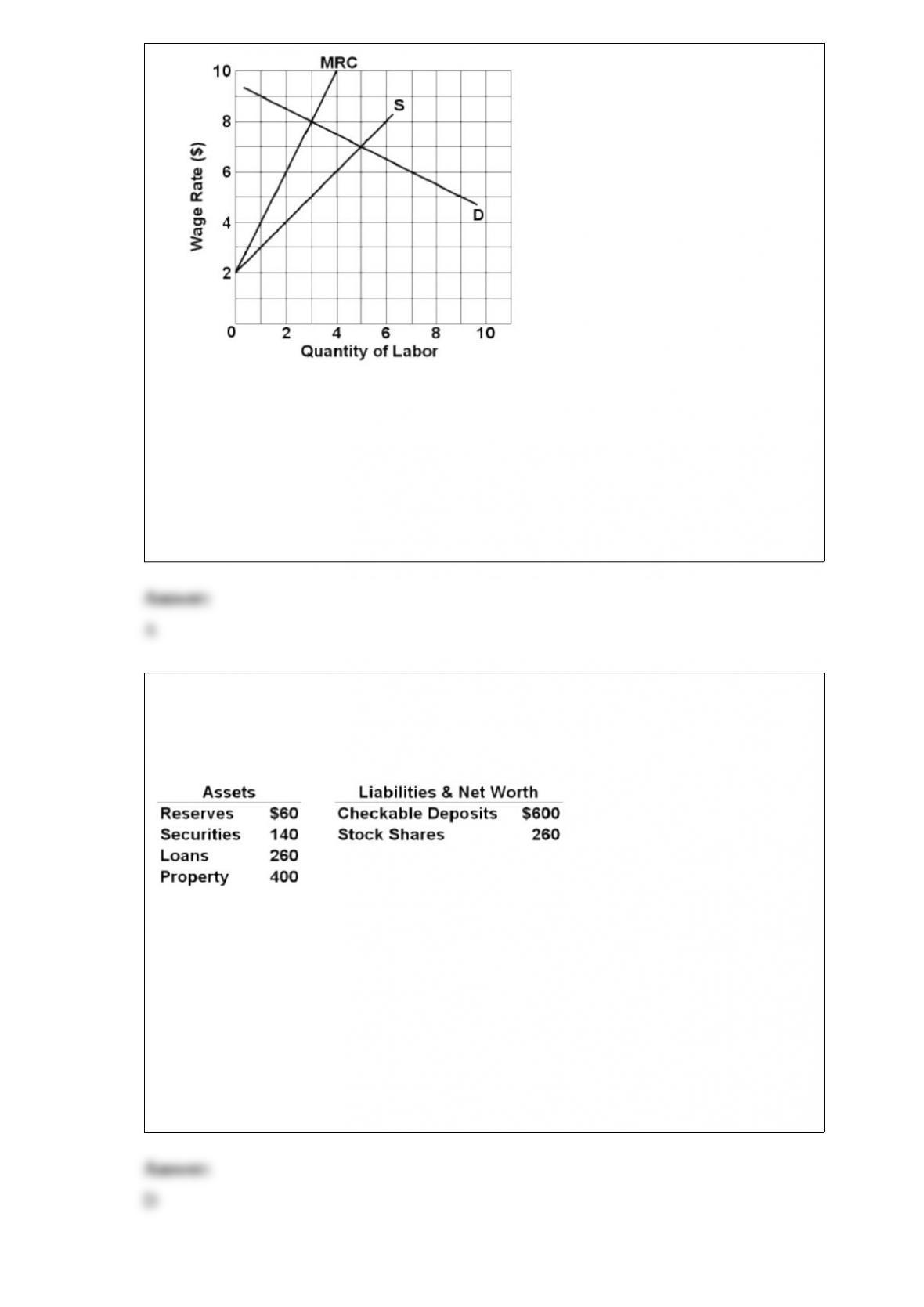
22)
Refer to the above labor market diagram where D is the labor demand curve, S is the
labor supply curve, and MRC is the marginal resource (labor) cost curve. If this were a
monopsonistic labor market, the equilibrium wage rate and level of employment would
be:
A.$5 and 3 respectively.
B.$6 and 4 respectively.
C.$7 and 5 respectively.
D.$8 and 3 respectively.
23) The following consolidated balance sheet of the commercial banking system.
Assume that the reserve requirement is 10 percent. All figures are in billions and each
question should be answered independently of changes specified in any preceding ones.
Refer to the above data. Suppose the Fed sold $10 billion of U.S. securities to the
banks. This would:
A.increase bank reserves to $70 billion, reduce bank-held securities to $130 billion, and
ultimately increase the money supply (checkable deposits) by $100 billion.
B.increase bank reserves to $70 billion, reduce bank-held securities to $130 billion, and
ultimately decrease the money supply (checkable deposits) by $100 billion.
C.reduce bank reserves to $50 billion, increase bank-held securities to $150 billion, and
ultimately increase the money supply (checkable deposits) by $100 billion.
D.reduce bank reserves to $50 billion, increase bank-held securities to $150 billion, and
ultimately decrease the money supply (checkable deposits) by $100 billion.
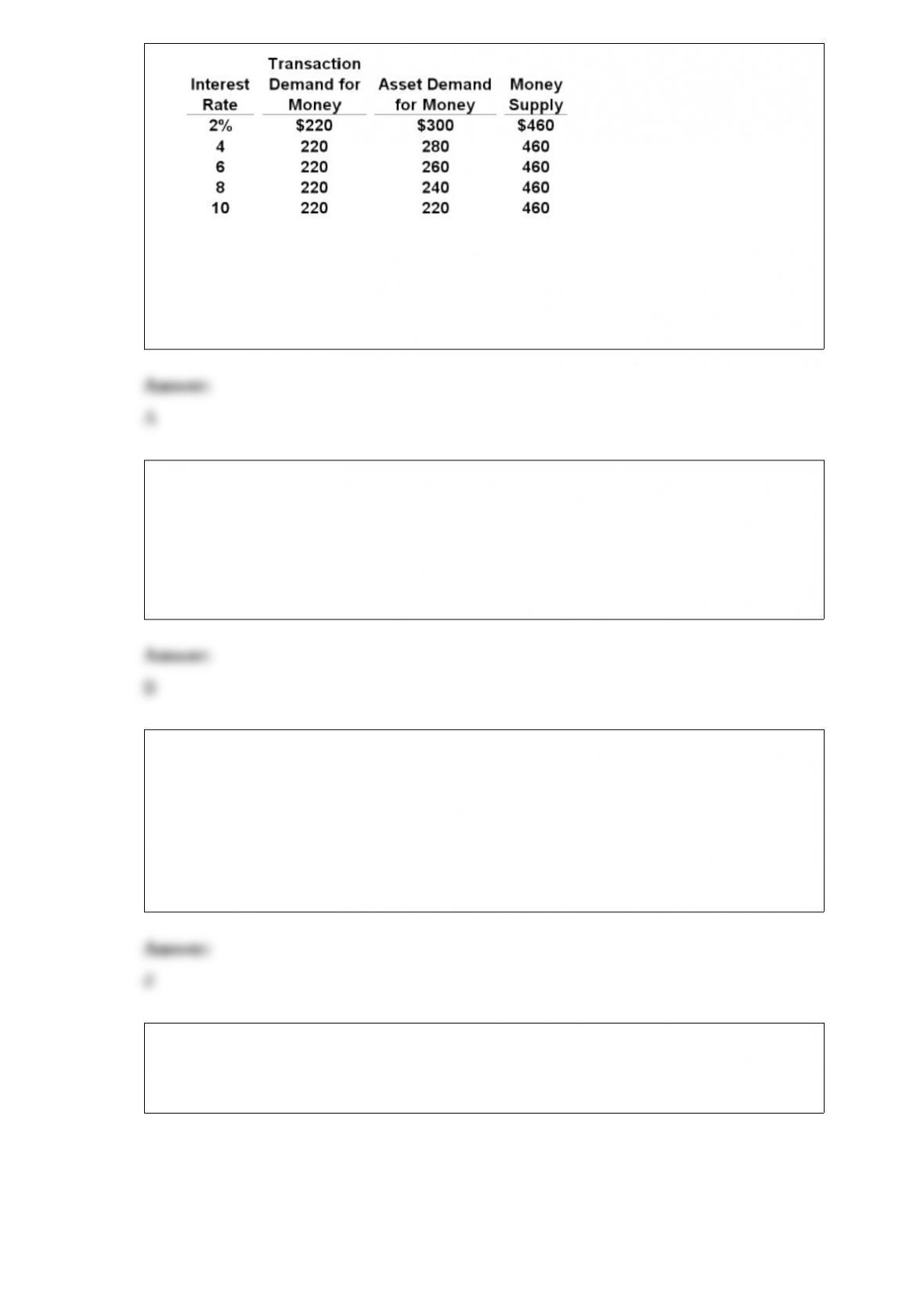
24)
The transactions demand for money in the above market for money would graph as a:
A.vertical line.
B.horizontal line.
C.line sloping downward and to the right.
D.line sloping upward and to the right.
25) Which of the following tactics is most associated with the demand-enhancement
union model?
A.Reducing the price of inputs that are substitutes for union workers.
B.Lobbying for increases in public expenditures on the product it is producing.
C.Restricting the number of workers allowed to work in the industry.
D.Increasing the price of products that are complements for the one it is producing.
26) which of the following statements is correct?
a.utility and usefulness are synonymous.
b.the marginal utility derived from successive units of a product tends to be similar for
all consumers.
c.because utility is not measurable, the utility-maximizing rule provides no useful
insights as to consumer behavior.
d.a product may yield utility, but not be functionally useful.
27) (Advanced analysis) Answer the next question(s) on the basis of the following data
for a private closed economy. The letters Y, C, S, and I are used to represent real GDP,
consumption, saving, and investment respectively.
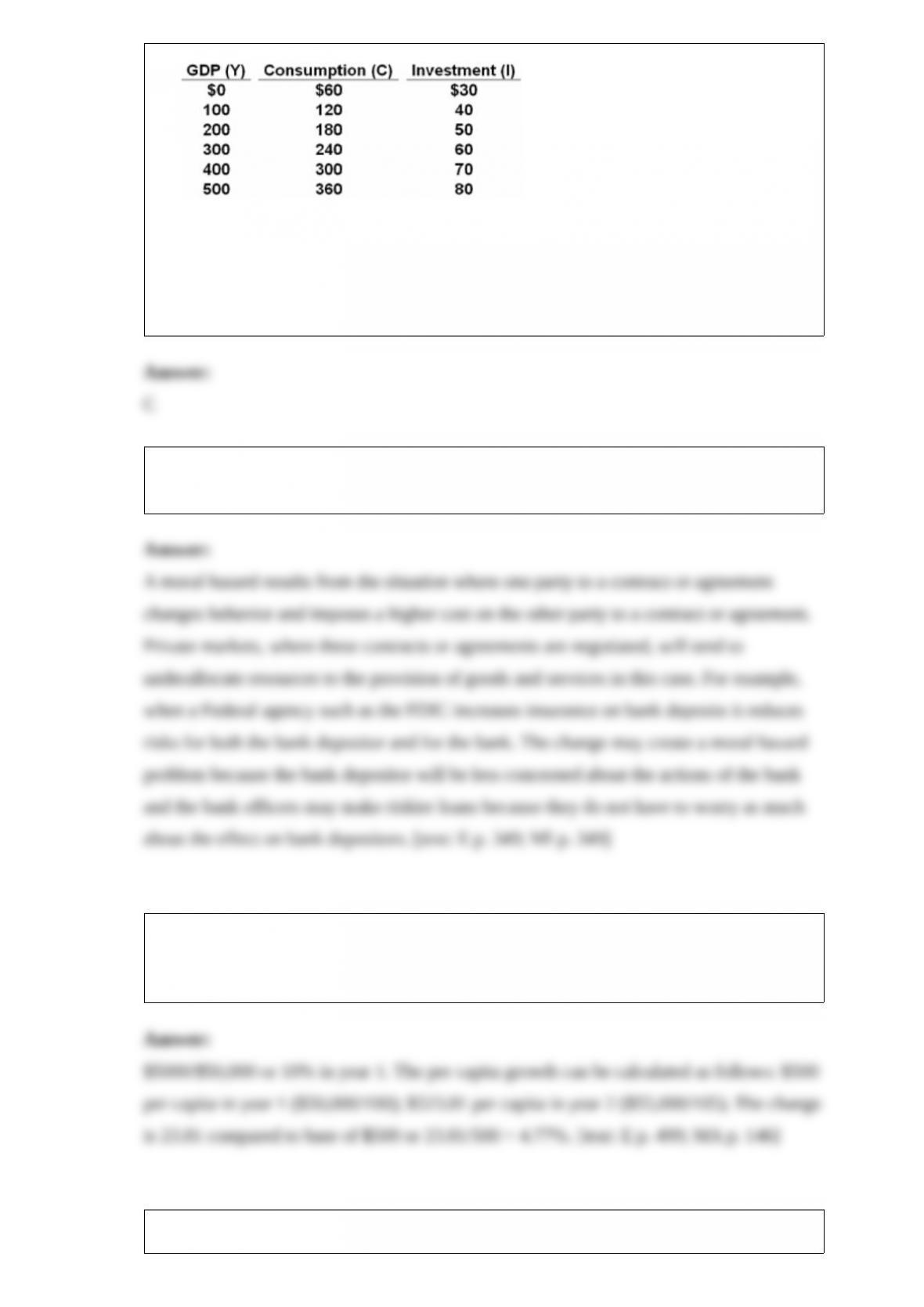
Refer to the above data. Equilibrium Y (= GDP) is:
A.$100.
B.$200.
C.$300.
D.$400.
28) What is meant by the term moral hazard? What is an example of a moral hazard
problem?
29) Suppose an economys real GDP is $50,000 in year 1 and $55,000 in year What is
the growth rate of its GDP? Assume that population was 100 in year 1 and 105 in year
What is the growth rate in GDP per capita?
30) What are the major components of the current account in the balance of payments?

How is the current account balance determined?
31) Define the two pure types of exchange-rate systems.
32) What effects do immigrants have on tax revenues and government spending in the
United States?
33) Compare and contrast the suitability of different market structure for fostering
technological advance.
34) Give the basic symbolic equations for the mainstream view of the economy.
Identify each symbol in the equation with a brief explanation. Using this equation, what
is one major explanation for instability in the economy from a mainstream perspective?
35) Describe the mainstream view of self-correction in the economy.
36) Explain the marginal revenue and marginal cost approach to profit maximization
and use it to describe profit, loss, and shut down situations for the purely competitive
firm.
37) In what fundamental way do the spending-taxation decisions of government differ
from the consumption-saving plans of households? Why is this difference significant?