
What does the PPI measure?
A) the average change in the prices paid for all goods produced in the economy over a
given year
B) the average of the prices received by producers of goods and services at all stages of
the production process
C) the level of production of goods and services generated in the economy in a given
year
D) the difference between the prices consumers pay for goods and services and the
prices producers pay for goods and services
An increase in aggregate expenditure has what result on equilibrium GDP?
A) Equilibrium GDP rises.
B) Equilibrium GDP is not affected by a decrease in aggregate expenditure.
C) Equilibrium GDP falls.
D) Equilibrium GDP may rise or fall depending on the size of the decrease in aggregate
expenditure relative to the initial level of GDP.
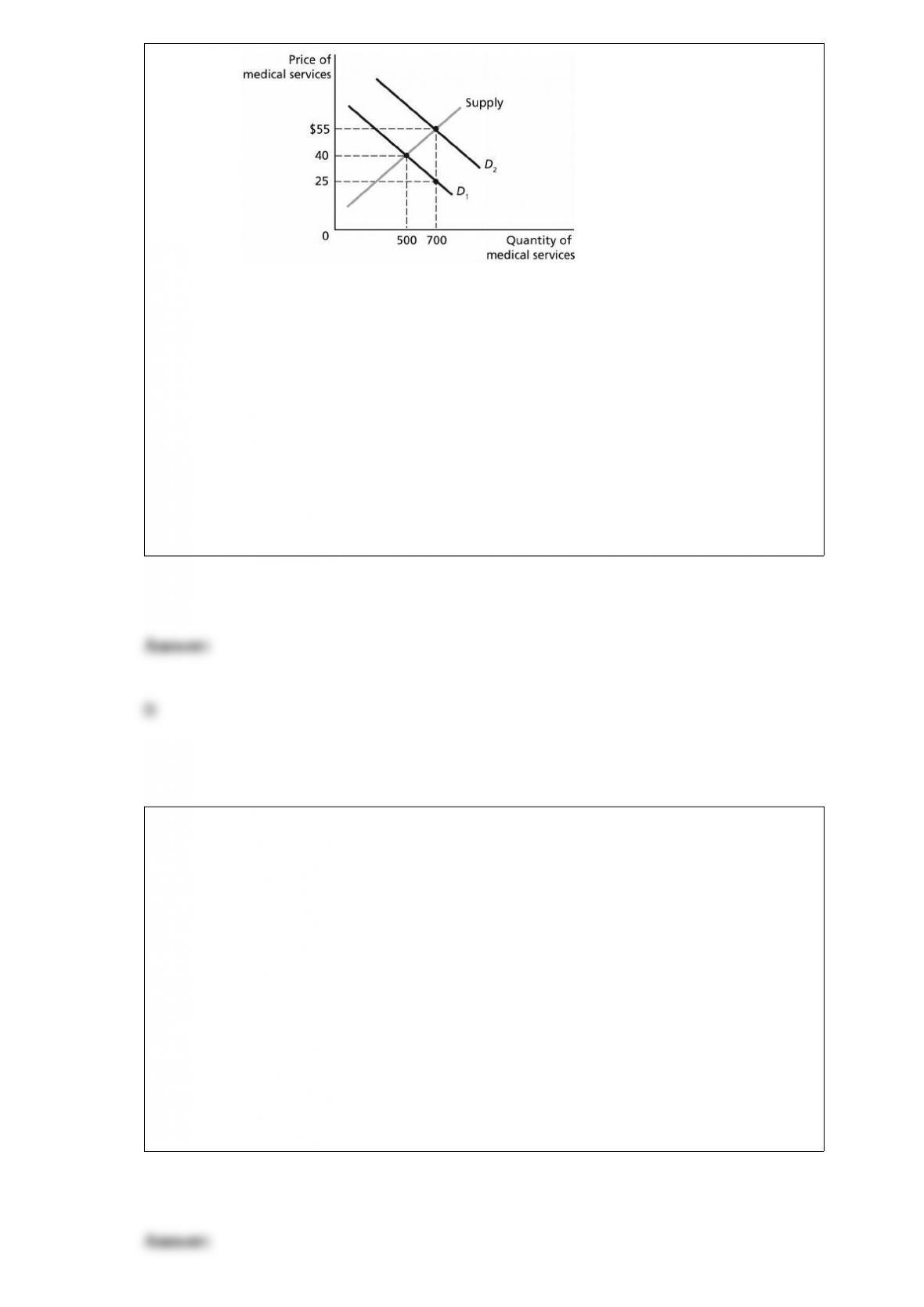
Figure 7-4 Figure 7-4 represents the
market for medical services with and without insurance, and the effect of a third-party
payer system on the demand for medical services.
The efficient price of medical services is
A) $25.
B) $40.
C) $55.
D) >$55.
Some economists believe that the economy benefits from firms having market power.
Which of the following is an argument that has been made to support this position?
A) Large firms are better able than small firms to spend funds on research and
development required to develop new products.
B) Competition is very rare in the U.S. economy and few new products are produced by
smaller, competitive firms.
C) Research has shown that the deadweight loss from monopolies is a small percentage
of the value of production in the United States.
D) Large firms can afford to lobby the U.S. government in order to impose restrictions
on imports and reduce the outsourcing of jobs to other countries.

If, due to a recession, foreign workers begin to leave the United States to search for
temporary work in their home countries until the recession has ended, this will
A) shift the short-run aggregate supply curve of the home country to the left.
B) shift the short-run aggregate supply curve of the home country to the right.
C) move the home country’s economy up along a stationary short-run aggregate supply
curve.
D) move the home country’s economy down along a stationary short-run aggregate
supply curve.
Which of the following is not a characteristic of monopolistic competition?
A) There are many buyers and sellers.
B) There are low barriers to entry.
C) Average revenue is equal to price.
D) The products sold by all firms are identical.
If a corporate bond with face value of $1,000 has an interest rate of eight percent paid

once a year for a term of 30 years, what is the size of the coupon payment?
A) $1,000
B) $300
C) $80
D) $8
Knowledge capital is ________ in production and ________. As a result, firms
________ free ride.
A) nonrival; nonexcludable; can
B) nonrival; excludable; can
C) rival; nonexcludable; cannot
D) nonrival; nonexcludable; cannot
Economies of scale exist as a firm increases its size in the long run because of all of the
following except
A) the firm can afford more sophisticated technology in production.
B) labor and management can specialize even further in their tasks.
C) as a larger input buyer, the firm can purchase inputs at a lower per unit cost.

D) as a firm expands its production, its profit margin per-unit of output increases.
A decrease in Social Security payments will
A) decrease consumption spending.
B) decrease investment spending.
C) decrease government spending.
D) decrease export spending.
Some economists argue that the apparent slowdown in economic growth in the United
States during the mid-1970s may not really have reduced the standard of living because
A) spending on new government regulations such as the Clean Air Act increased output
dramatically without increasing the standard of living of Americans.
B) significant improvements in the quality of services occurred, although the quantity
of these services did not increase much during this time.
C) changes in well-being are accurately reflected in statistics measuring economic
growth.
D) higher production costs from higher oil prices raised production and transportation
costs and reduced output.

Suppose $1 billion is available in the budget and Congress is considering allocating the
funds to one of the following three alternatives:
a. subsidies for education
b. research on Alzheimer’s
c. increased border security If voters prefer a to b and b to c, then if preferences are
transitive,
A) they should prefer a to c.
B) they should prefer c to a.
C) they should be indifferent between a and c.
D) it is not always possible to rank voters’ preferences between a and c.
The town of Harmonia gives away all 500 tickets to its annual Founder’s Day Free
Concert-in-the-Park to local residents. Each year, more than 500 people wish to attend
the concert, so some of the residents who receive the free tickets sell them for as much
as $75 each. Is a transaction where someone pays a resident $75 for a “free ticket”
economically efficient?
A) No, people should never be allowed to sell items they received for free.
B) Yes, it was a voluntary exchange that benefited both parties.
C) No, the buyer paid too much for the ticket.
D) Yes, it is efficient only from the perspective of the seller and not from the
perspective of the buyer.
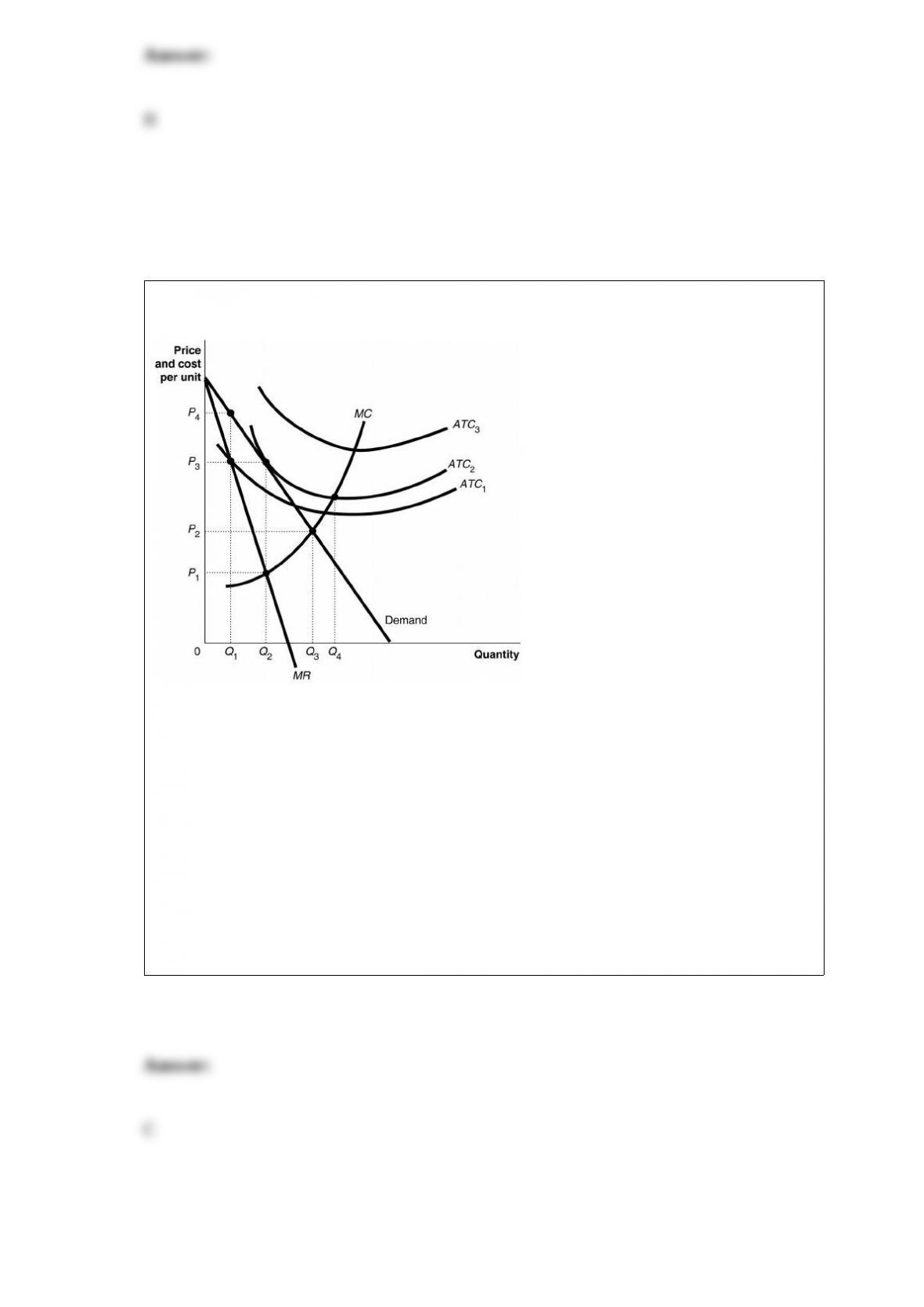
Figure 15-2
Figure 15-2 above shows the demand and cost curves facing a monopolist. The firm’s
profit-maximizing price is
A) P1.
B) P2.
C) P3.
D) P4.

Income inequality in the United States has increased somewhat over the past 25 years.
Two factors that appear to have contributed to this are
A) tax cuts on high income individuals and large increases in prices of stocks.
B) strong economic growth and low inflation.
C) rapid technological change and expanding international trade.
D) outsourcing of jobs by U.S. firms and cuts in taxes on capital gains.