
The higher the insurance coverage, the ________ the policyholder can gain from risky
activities that make an insurance payoff ________ likely.
A. more; less
B. more; more
C. less; less
D. less; more
Answer:
Which of the following is an entity of the Federal Reserve System?
A. the U.S. Treasury Secretary
B. the FOMC
C. the Comptroller of the Currency
D. the FDIC
Answer:
The number of futures contracts outstanding is called
A. turnover.

B. volume.
C. float.
D. open interest.
Answer:
Approaches to establishing central bank credibility include
A. inflation targeting.
B. exchange rate targeting.
C. central bank independence.
D. appointment of a more conservative central banker.
E. all of the above.
Answer:
In the Keynesian cross diagram, a decline in autonomous consumer expenditure causes
the aggregate demand function to shift down, the equilibrium level of aggregate output
to ________, and the IS curve to shift to the ________, everything else held constant.
A. rise; left

B. rise; right
C. fall; left
D. fall; right
Answer:
In the simple deposit expansion model, an expansion in checkable deposits of $1,000
when the required reserve ratio is equal to 20 percent implies that the Fed
A. sold $200 in government bonds.
B. sold $500 in government bonds.
C. purchased $200 in government bonds.
D. purchased $500 in government bonds.
Answer:
If wealth increases, the demand for stocks ________ and that of long-term bonds
________, everything else held constant.
A. increases; increases
B. increases; decreases

C. decreases; decreases
D. decreases; increases
Answer:
During World War II, whenever interest rates would ________ and the price of bonds
would begin to ________, the Fed would make open market purchases.
A. rise; rise
B. rise; fall
C. fall; rise
D. fall; fall
Answer:
Which of the following is an example of a bank realizing economies of scope?
A. The bank develops a standard mortgage loan application to make the process of
loaning out mortgages easier.
B. The bank reduces costs of credit checking for the loan process by outsourcing the
process to a specialist.

C. By using the information collected from a corporation, the bank can decide how easy
it would be to sell bonds issued by the corporation to the public.
D. A bank in a rural area specializes in providing agricultural loans.
Answer:
The amount paid for an option is the
A. strike price.
B. premium.
C. discount.
D. yield.
Answer:
Bank loans from the Federal Reserve are called ________ and represent a ________ of
funds.
A. discount loans; use
B. discount loans; source
C. fed funds; use

D. fed funds; source
Answer:
When the Fed ________ the money stock, the money supply curve shifts to the
________ and the interest rate ________, everything else held constant.
A. decreases; right; rises
B. increases; right; falls
C. decreases; left; falls
D. increases; left; rises
Answer:
Which of the following is NOT a requirement in selecting a policy instrument?
A. measurability
B. controllability
C. flexibility
D. predictability

Answer:
A Supreme Court ruling in March 1996 held that
A. state laws to prevent banks from selling insurance can be superseded by federal
rulings from banking regulators that allow banks to sell insurance.
B. state laws to prevent banks from selling insurance cannot be superseded by federal
rulings from banking regulators that allow banks to sell insurance.
C. state laws to prevent banks from selling insurance can be superseded only if
Congress enacts legislation that allow banks to sell insurance.
D. state laws to prevent banks from selling insurance cannot be superseded by federal
legislation.
Answer:
Another way to state the efficient markets hypothesis is: in an efficient market
A. unexploited profit opportunities will be quickly eliminated.
B. unexploited profit opportunities will never exist.
C. all prices can be accurately predicted.
D. every financial market participant must be well informed about securities.

Answer:
If a banker expects interest rates to fall in the future, her best strategy for the present is
A. to increase the duration of the bank’s liabilities.
B. to buy short-term bonds.
C. to sell long-term certificates of deposit.
D. to increase the duration of the bank’s assets.
Answer:
If the money supply is $600 and nominal income is $3,000, the velocity of money is
A. 1/50.
B. 1/5.
C. 5.
D. 50.
Answer:

If the required reserve ratio is 10 percent, currency in circulation is $1,200 billion,
checkable deposits are $1,600 billion, and excess reserves total $2,500 billion, then the
excess reserves-checkable deposit ratio is
a. 1.56.
b. 0.48.
c. 0.72.
d. 0.56.
Answer:
Conventional money demand functions tended to ________ money demand in the
middle and late 1970s, and ________ velocity beginning in
A. overpredict; overpredict
B. overpredict; underpredict
C. underpredict; overpredict
D. underpredict; underpredict
Answer:

Everything else held constant, when stock prices become ________ volatile, the
demand curve for bonds shifts to the ________ and the interest rate ________.
A. more; right; rises
B. more; right; falls
C. less; left; falls
D. less; left; does not change
Answer:
Uncertainty about interest-rate movements and returns is called
A. market potential.
B. interest-rate irregularities.
C. interest-rate risk.
D. financial creativity.
Answer:
The development of money market mutual funds contributed to the growth of ________
since the money market mutual funds need to hold liquid, high-quality, short-terms
assets.

A. the commercial paper market
B. the municipal bond market
C. the corporate bond market
D. the junk bond market
Answer:
Which of the following are transaction deposits?
A. savings accounts
B. small-denomination time deposits
C. checkable deposits
D. certificates of deposit
Answer:
If an individual uses money from a demand deposit account to purchase a U.S. savings
bond
A. M1 decreases and M2 stays the same.
B. M1 stays the same and M2 increases.
C. M1 stays the same and M2 stays the same.
D. M1 decreases and M2 decreases.
Answer:
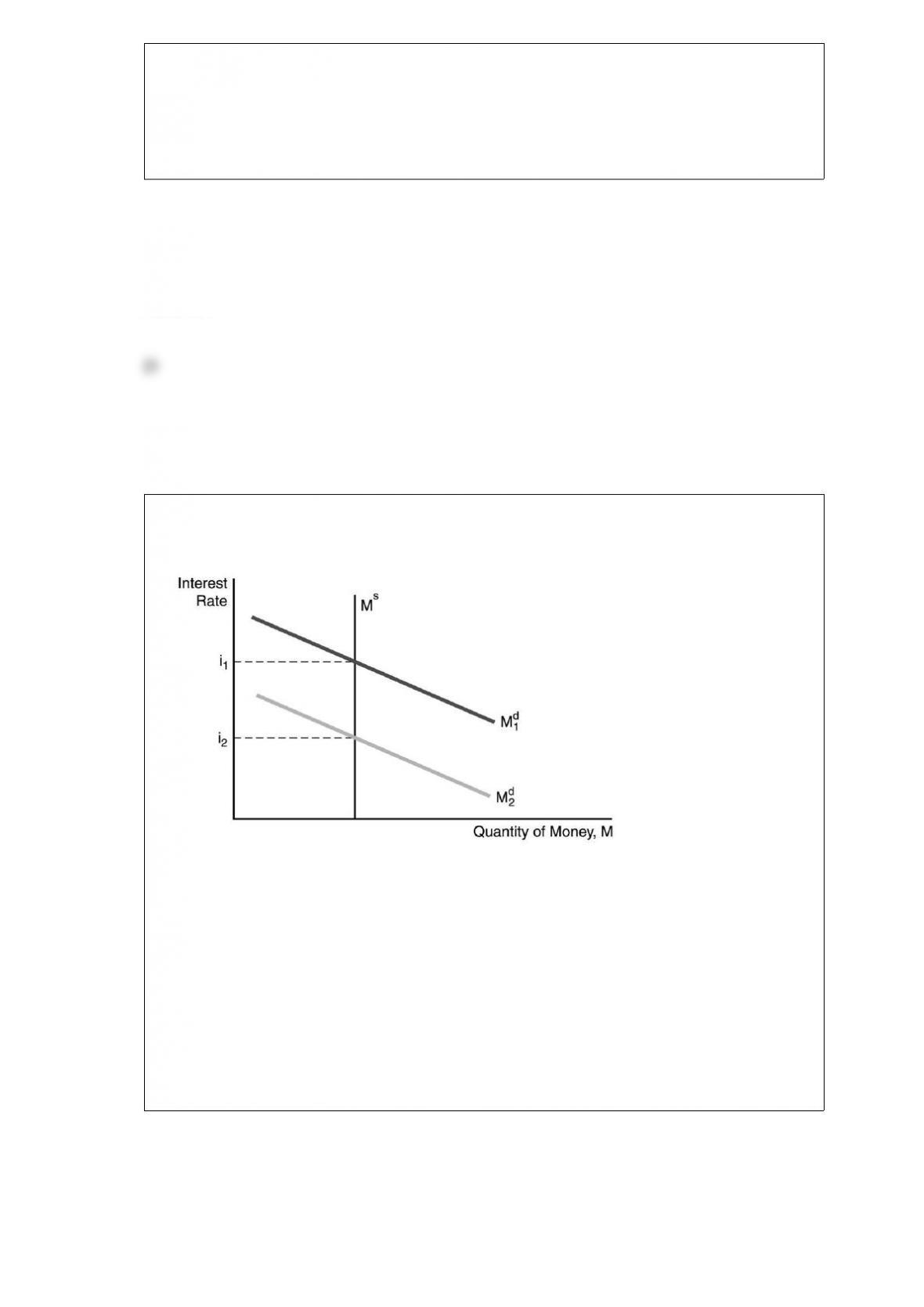
In the figure above, the decrease in the interest rate from i1 to i2 can be explained by
A. a decrease in money growth.
B. a decline in the expected price level.
C. an increase in income.
D. an increase in the expected price level.
Answer:

If a $5,000 face-value discount bond maturing in one year is selling for $5,000, then its
yield to maturity is
A. 0 percent.
B. 5 percent.
C. 10 percent.
D. 20 percent.
Answer:
Banks are required to file ________ usually quarterly that list information on the bank’s
assets and liabilities, income and dividends, and so forth.
A. call reports
B. balance reports
C. regulatory sheets
D. examiner updates
Answer:

If the required reserve ratio is 20 percent, the simple deposit multiplier is
A. 5.0.
B. 2.5.
C. 4.0.
D. 10.0.
Answer:
In rational expectations theory, the term “optimal forecast” is essentially synonymous
with
A. correct forecast.
B. the correct guess.
C. the actual outcome.
D. the best guess.
Answer:

A contract that requires the investor to sell securities on a future date is called a
A. short contract.
B. long contract.
C. hedge.
D. micro hedge.
Answer:
If the CPI is 120 in 1996 and 180 in 2002, then between 1996 and 2002, prices have
increased by
A. 180%.
B. 80%.
C. 60%.
D. 50%.
Answer:
Mean reversion refers to the fact that
A. small firms have higher than average returns.

B. stocks that have had low returns in the past are more likely to do well in the future.
C. stock returns are high during the month of January.
D. stock prices fluctuate more than is justified by fundamentals.
Answer:
If brokerage commissions on stocks fall, everything else held constant, the demand for
bonds ________, the price of bonds ________, and the interest rate ________.
A. decreases; decreases; increases
B. decreases; decreases; decreases
C. increases; decreases; increases
D. increases; increases; increases
Answer:
Comparing a discount bond and a coupon bond with the same maturity
A. the coupon bond has the greater effective maturity.
B. the discount bond has the greater effective maturity.

C. the effective maturity cannot be calculated for a coupon bond.
D. the effective maturity cannot be calculated for a discount bond.
Answer: