1) The more inelastic is demand and supply the:
A.larger is the efficiency loss of an excise tax.
B.smaller is the efficiency loss of an excise tax.
C.higher the proportion of an excise tax paid by consumers.
D.smaller the proportion of an excise tax paid by producers.
2) suppose that as the price of y falls from $2.00 to $1.90 the quantity of y demanded
increases from 110 to 118. then the price elasticity of demand is:
a.4.00
b.2.09
c.1.37
d.3.94
3) a product market is in equilibrium:
a.when there is no surplus of the product.
b.when there is no shortage of the product.
c.when consumers want to buy more of the product than producers offer for sale.
d.where the demand and supply curves intersect.
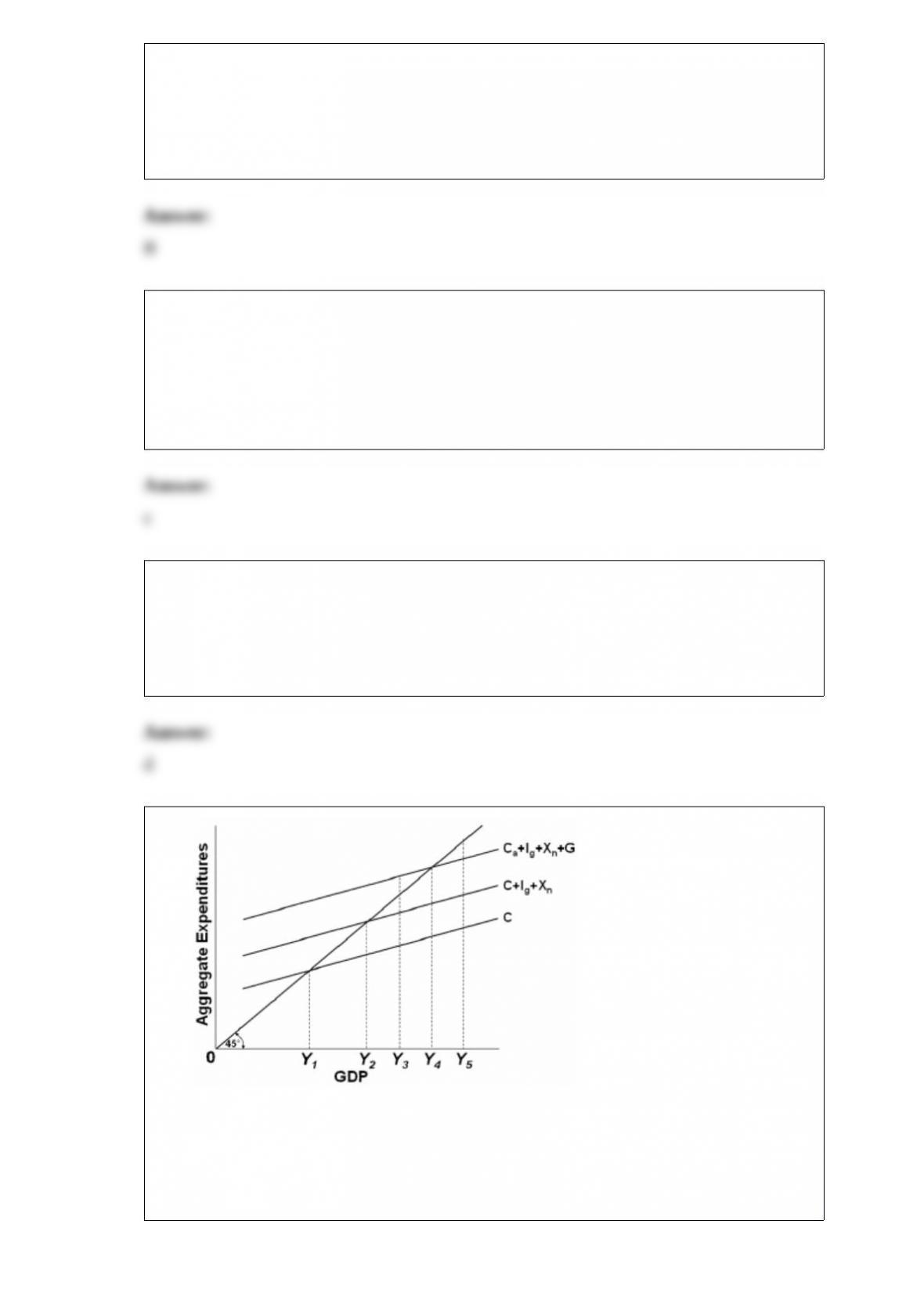
4)
Refer to the above diagram. If the full-employment GDP is Y3, government should:
A.incur neither a deficit nor a surplus.
B.increase taxes and government spending by equal amounts.
C.reduce taxes and increase government spending.
D.increase taxes and reduce government spending.
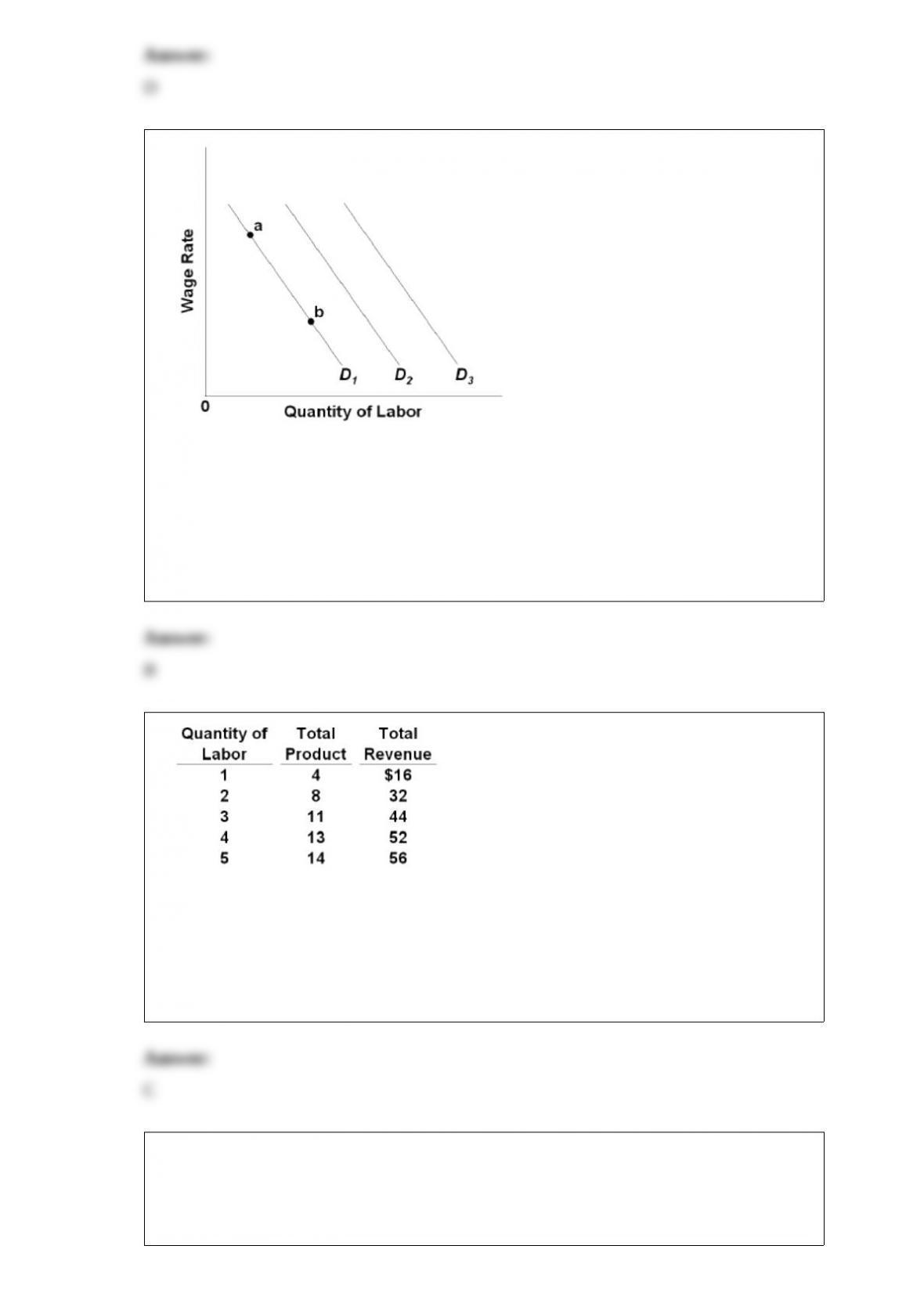
5)
Refer to the above graph. A move from b to a along labor demand curve D1 would
result from:
A.a decrease in the price of a substitute resource, assuming that the substitution effect
exceeds the output effect.
B.an increase in the wage rate.
C.a decrease in the wage rate.
D.an increase in the demand for the product that this labor is helping to produce.
6)
Refer to the above data. If the market wage rate is $8 and the firm hires its
profit-maximizing number of workers, the firm’s total wage bill (payment) will be:
A.$16.
B.$24.
C.$32.
D.$48.
7) the division of labor means that:
a.labor markets are geographically segmented.
b.unskilled workers outnumber skilled workers.
c.workers specialize in various production tasks.

d.each worker performs a large number of tasks.
8) Which of the following statements concerning the relative distribution of income is
correct?
A.The relative distribution of before-tax incomes has become decidedly more equal
since 1970.
B.Taxes increase, but transfer payments decrease, the degree of income inequality.
C.Taxes and transfer payments both decrease the degree of income inequality.
D.Taxes and transfer payments both increase the degree of income inequality.
9) If severe demand-pull inflation was occurring in the economy, proper government
policies would involve a government:
A.deficit and the purchase of securities in the open market, a higher discount rate, and
higher reserve requirements.
B.deficit and the sale of securities in the open market, a higher discount rate, and lower
reserve requirements.
C.surplus and the sale of securities in the open market, a higher discount rate, and
higher reserve requirements.
D.surplus and the purchase of securities in the open market, a lower discount rate, and
lower reserve requirements.
10) mrs. arnold is spending all her money income by buying bottles of soda and bags of
pretzels in such amounts that the marginal utility of the last bottle is 60 utils and the
marginal utility of the last bag is 30 utils. the prices of soda and pretzels are $.60 per
bottle and $.40 per bag respectively. it can be concluded that:
a.the two commodities are substitute goods.
b.mrs. arnold should spend more on pretzels and less on soda.
c.mrs. arnold should spend more on soda and less on pretzels.
d.mrs. arnold is buying soda and pretzels in the utility-maximizing amounts.
11) The highest quintile of households in the income distribution:
A.receives about 58 percent of the total income.
B.is comprised of 20 percent of all households.

C.is comprised of 5 percent of all households.
D.receives about 35 percent of the total income.
12) Market failure is said to occur whenever:
A.private markets do not allocate resources in the way that best satisfies society’s wants.
B.prices rise.
C.some consumers who want a good do not obtain it because the price is higher than
they are willing to pay.
D.government intervenes in the functioning of private markets.
13) unlike a private good, a public good:
a.produces no external benefits or external costs.
b.has no opportunity costs.
c.has benefits that are available to all, regardless of payment.
d.is characterized by rivalry and excludability.
14) Answer the next four questions based on the following data using year 1 as the base
year. All dollars are in billions.
(a)Find real income in year 2.
(b)What was the percentage rise in prices between years 2 and 3?
(c)What was the percentage rise in prices between years 3 and 4?
(d)What was the increase in real income from year 3 to year 4 in percentage?
15) which of the following would not be expected to occur in a purely competitive
market in long-run equilibrium?
a.consumer and producer surplus will be minimized.
b.p = mc = lowest atc.
c.the maximum willingness to pay equals the minimum acceptable price.
d.we would expect all of these to occur in the long run in a purely competitive market.
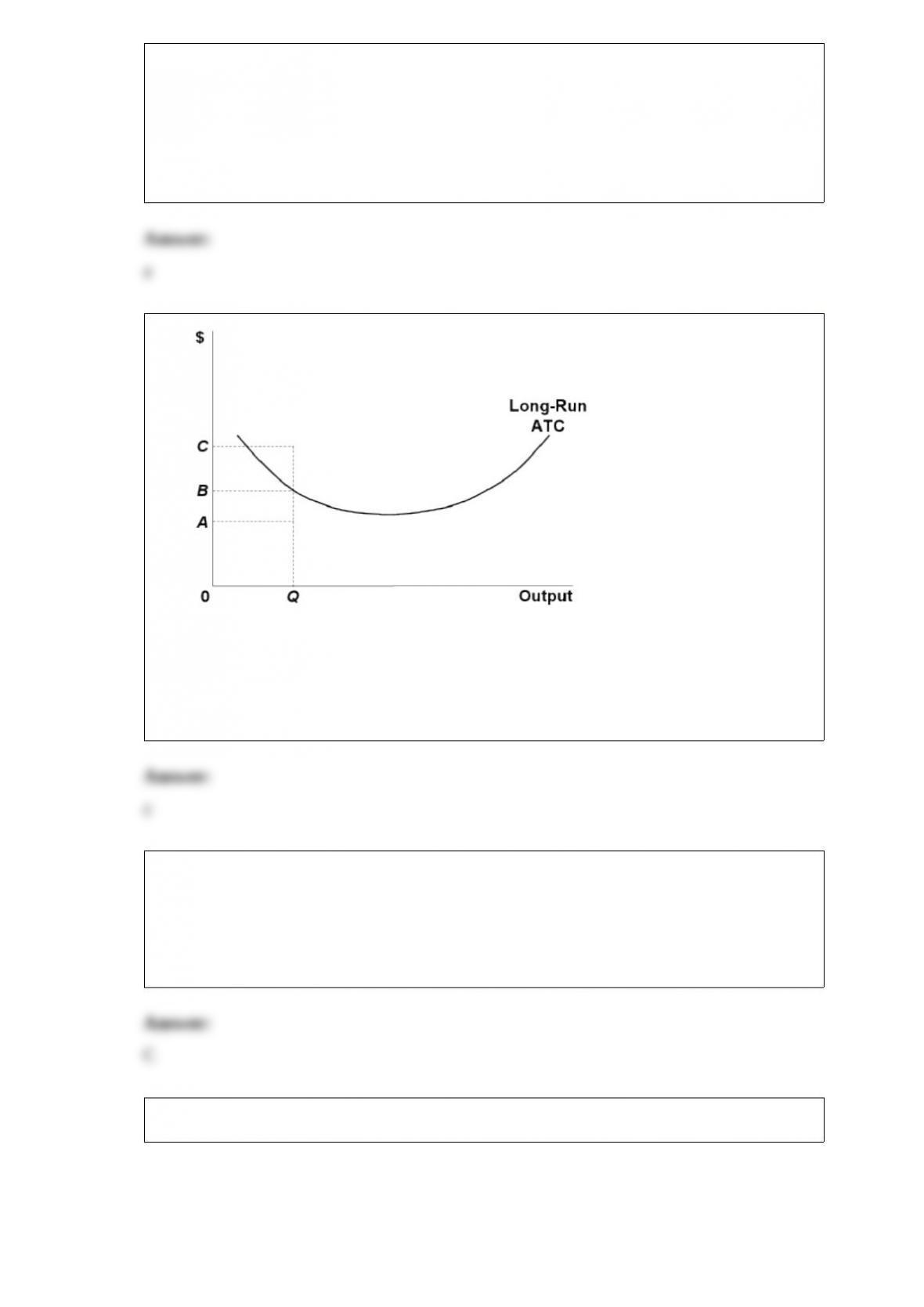
16)
refer to the above diagram. for output level q, per unit costs of c are:
a.unattainable and imply the inefficient use of resources.
b.unattainable, given resource prices and the current state of technology.
c.attainable, but imply the inefficient use of resources.
d.attainable and imply that resources are being combined efficiently.
17) In a purely competitive static economy:
A.the demand for loanable funds would disappear.
B.uncertainty would increase, causing profit to rise.
C.economic profit would be zero.
D.economic profit would be maximized.
18) the following data represent a personal income tax schedule.
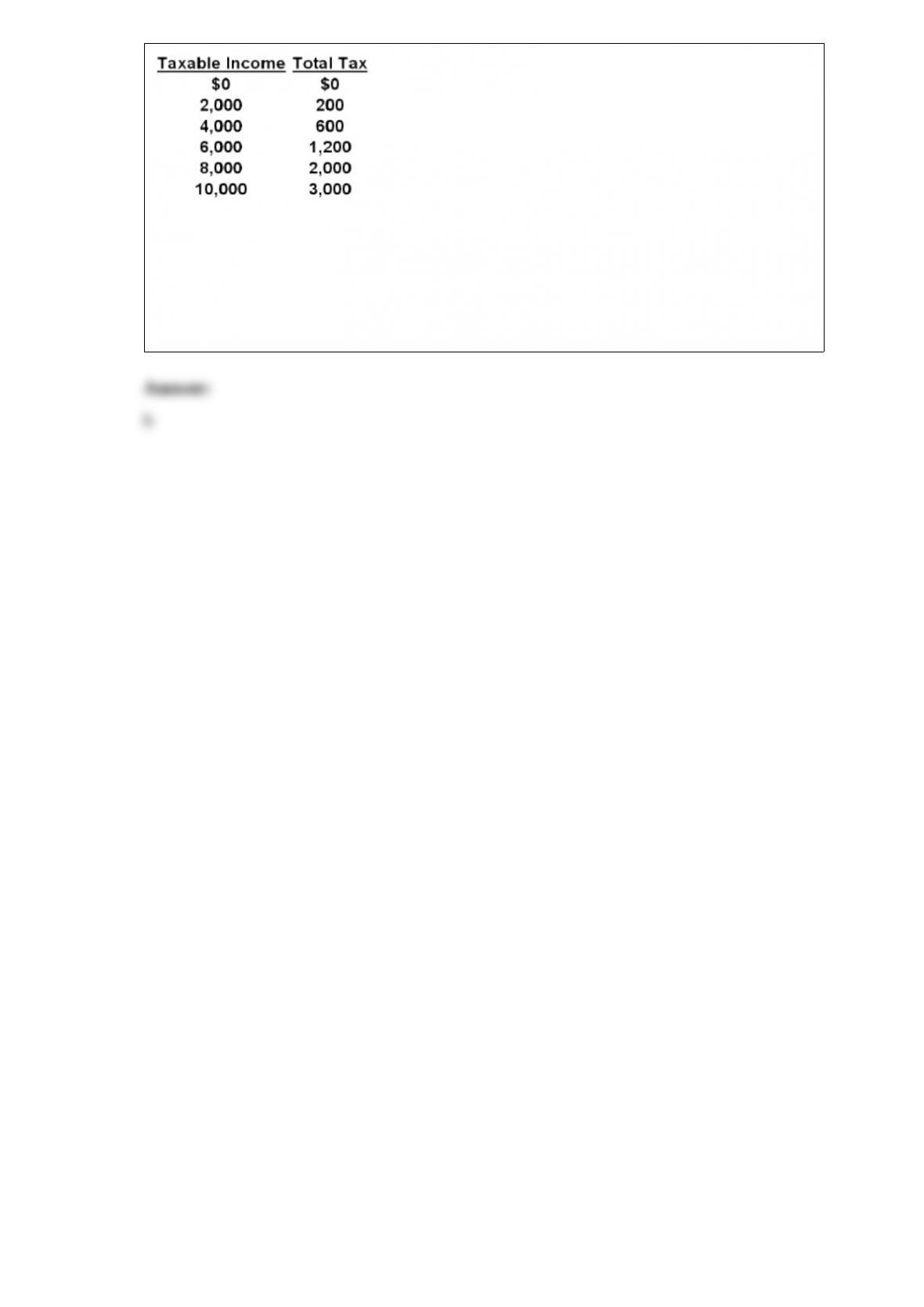
refer to the above table. if your taxable income is $8,000, your average tax rate is:
a.25 percent and the marginal rate on additional income is also 25 percent.
b.25 percent and the marginal rate on additional income is 40 percent.
c.25 percent and the marginal rate on additional income cannot be determined from the
information given.
d.20 percent and the marginal rate on additional income is 30 percent.