1) The United States produces more than twice as much output per million BTUs of
energy consumed than it did in 1950.
2) Anticompetitive mergers are illegal under provisions of the Clayton Act (as
amended).
3)
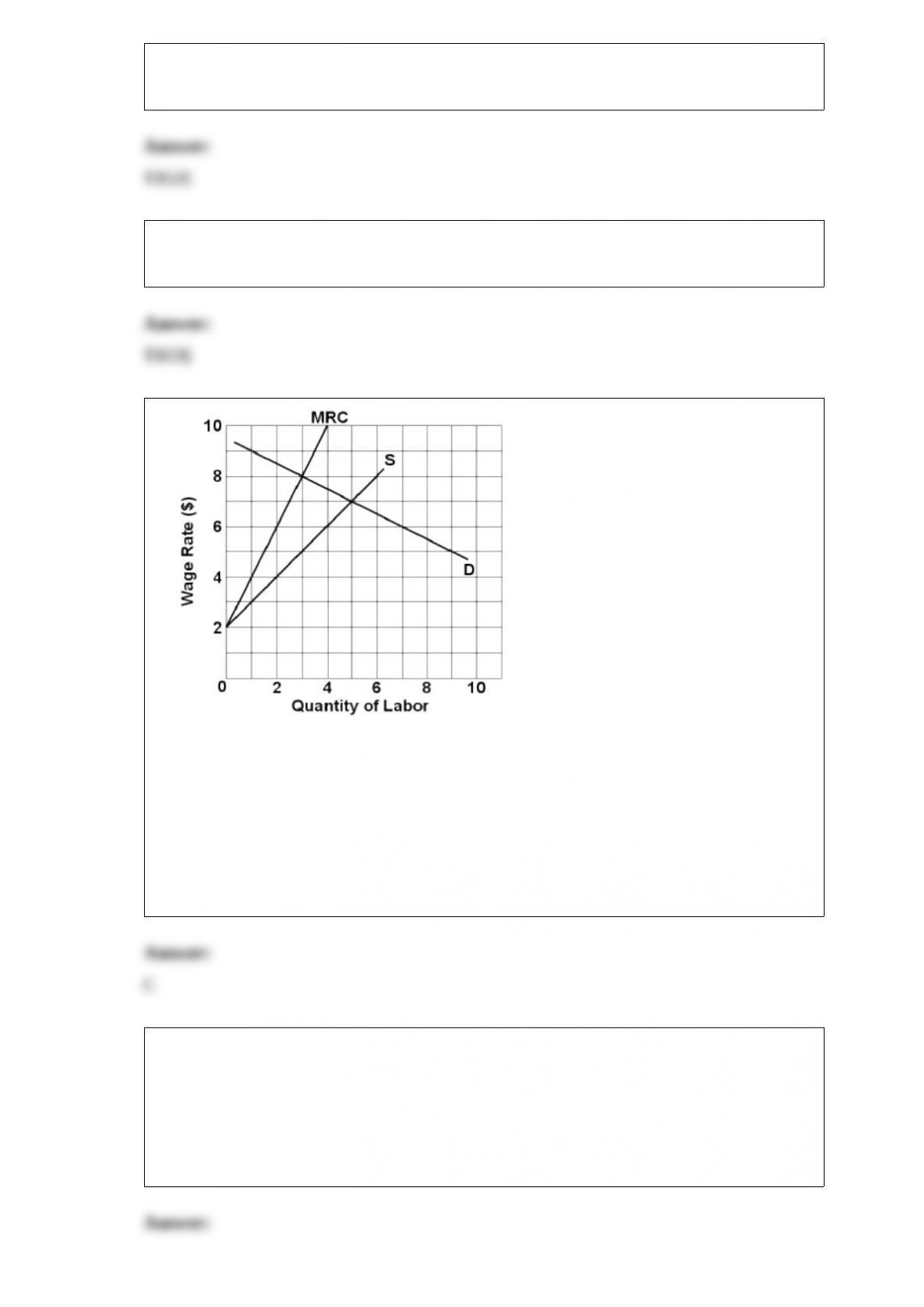
Refer to the above labor market diagram where D is the labor demand curve, S is the
labor supply curve, and MRC is the marginal resource (labor) cost curve. If this were a
purely competitive labor market, the equilibrium wage rate and level of employment
would be:
A.$5 and 3 respectively.
B.$6 and 4 respectively.
C.$7 and 5 respectively.
D.$8 and 3 respectively.
4) Whose An Essay on the Principle of Population argued that human living standards
could only temporarily rise above subsistence?
A.Adam Smith.
B.Thomas Malthus.
C.John Maynard Keynes.
D.Alfred Marshall.
5) assume the xyz corporation is producing 20 units of output. it is selling this output in
a purely competitive market at $10 per unit. its total fixed costs are $100 and its average
variable cost is $3 at 20 units of output. this corporation:
a.should close down in the short run.
b.is maximizing its profits.
c.is realizing a loss of $60.
d.is realizing an economic profit of $40.
6) the agency responsible for compiling the national income product accounts for the
u.s. economy is the:
a.council of economic advisers
b.bureau of economic analysis
c.national bureau of economic research
d.bureau of labor statistics
7) The Federal gasoline tax is assessed on a per-gallon basis and the proceeds are used
for highway maintenance and improvements. This tax is consistent with the:
A.ability-to-pay principal of taxation.
B.benefits-received principal of taxation.
C.single-tax theory of taxation.
D.pay-as-you go theory of taxation.
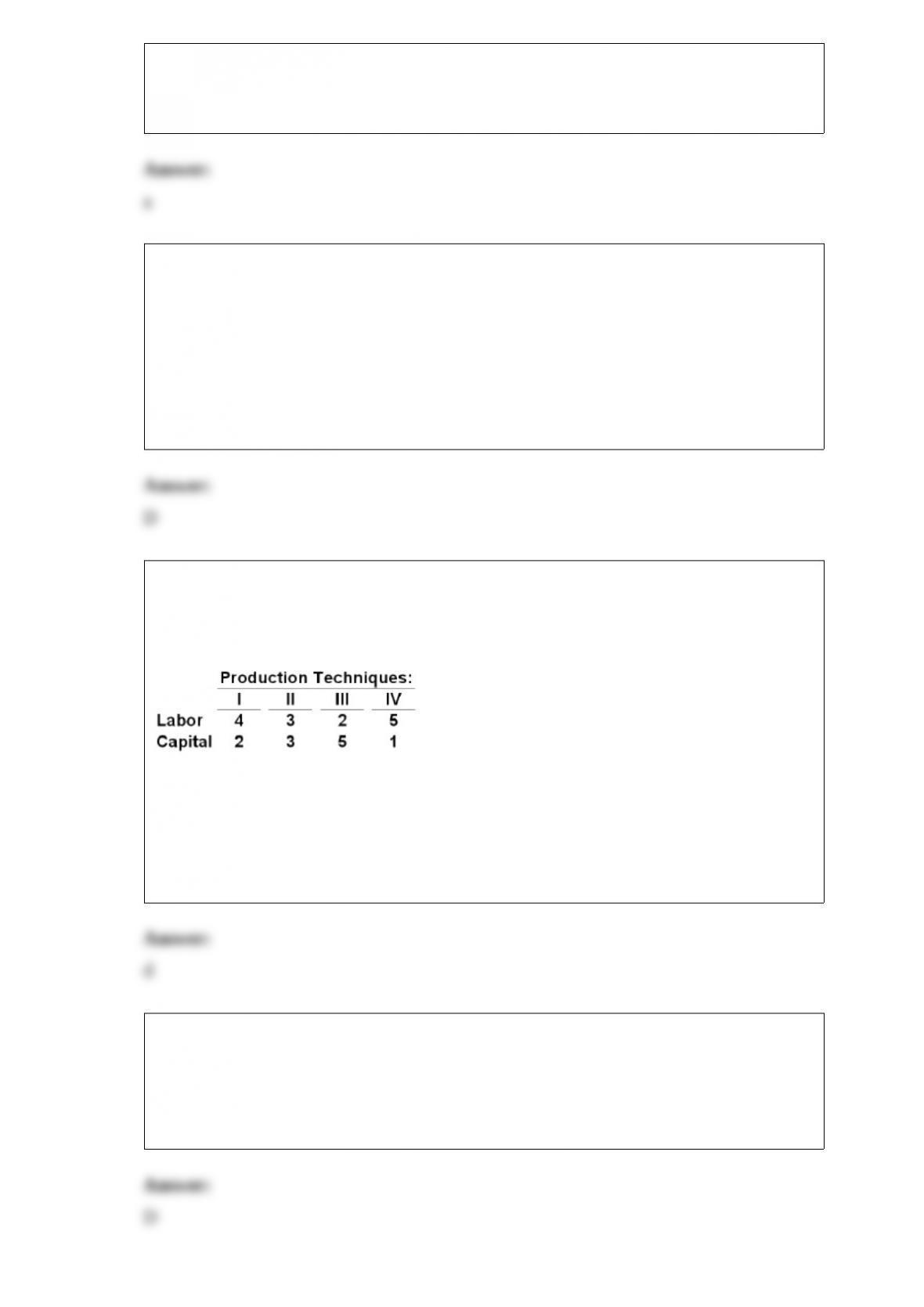
8) the following cost data for a purely competitive seller:
refer to the above data. the marginal cost of the fifth unit of output is:
a.$80.
b.$90.
c.$50.
d.$20.
9) Suppose Steve Stone takes a job with Zemo Manufacturing, whose labor contract
with its unions has an agency shop clause (30 days). Steve:
A.must join the union within 30 days.
B.can decide against joining the union and place the union dues in a retirement account.
C.can decide against joining the union but then will not receive any union-negotiated
wage increases.
D.can decide against joining the union but nevertheless will have to pay union dues or
donate an equivalent amount to an approved charity.
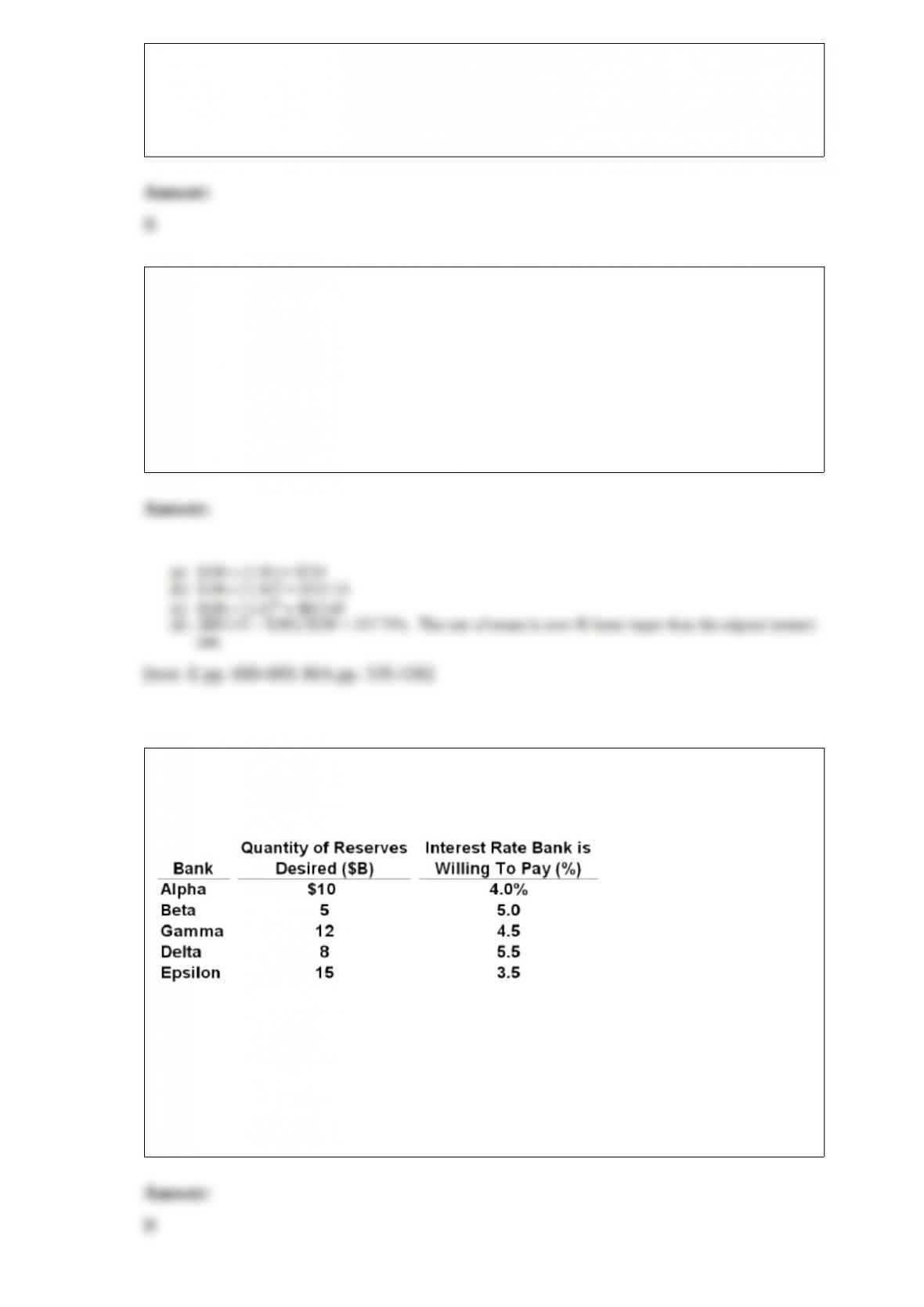
10) suppose 30 units of product a can be produced by employing just labor and capital
in the four ways shown below. assume the prices of labor and capital are $2 and $3
respectively.
refer to the above information. which technique is economically most efficient in
producing a?
a.i
b.ii
c.iii
d.iv
11) The idea of compensating differences is used:
A.by inclusive unions as an argument in bargaining for wage rate increases.
B.to justify the application of minimum wages to low-wage labor markets.
C.to explain the divergence between wage rates and marginal resource cost.
D.to explain wage rate differences based on differing nonmonetary aspects of jobs.

12) Other things equal, a tariff is:
A.superior to an import quota for Americans because a tariff increases the profits of
foreign producers.
B.inferior to an import quota for Americans because a tariff increases the profits of
domestic producers.
C.superior to an import quota for Americans because a tariff generates revenue for the
United States Treasury.
D.inferior to an import quota for Americans because a tariff generates revenue for the
United States Treasury.
13) In the U.S. Steel case, the court ruled that:
A.even though a firm’s behavior might be legal, the mere possession of monopoly
power was in violation of the Sherman Act.
B.only monopolies that unreasonably restrain trade are subject to antitrust action under
the Sherman Act.
C.when made by dominant firms, tying contracts are illegal, per se.
D.the company violated the Clayton Act and therefore should be dissolved into several
competing firms.
14) To increase the Federal funds rate, the Fed can:
A.buy government bonds from the public.
B.decrease the discount rate.
C.decrease the prime interest rate.
D.sell government bonds to commercial banks.
15) Overall, the U.S. tax system (combined Federal, state, and local) is:
A.highly progressive.
B.slightly progressive.
C.slightly regressive.
D.highly regressive.
16) Assume that in a private closed economy consumption is $240 billion and
investment is $50 billion, both at the $280 billion level of domestic output. Thus:
A.saving is $10 billion.
B.unplanned decreases in inventories of $10 billion will occur.
C.the MPC is .80.
D.unplanned increases in inventories of $10 billion will occur.
17) Suppose an asset originally costs $200 and earns an interest rate of 10%. Use this
information to answer the following questions.
(a)What value will the asset have after the first year?
(b)What value will the asset have after five years if the interest is compounded?
(c)Suppose the asset can be held for a maximum of 15 years. What is the final value of
this asset?
(d)If the asset is held the maximum length of time (15 years), what is its total rate of
return? How does it compare to its interest rate?
18) The following information: The Fed is going to auction $30 billion in reserves using
the term auction facility. It receives the following bids:
Refer to the above information. Which of the following banks will only be allowed to
borrow a fraction of the reserves it bid for at this auction?
A.Epsilon.
B.Alpha.
C.Gamma.
D.All of the banks will only be allowed to borrow a fraction, as reserves are allocated
proportionally to the amount of reserves desired.
19) national income accountants can avoid multiple counting by:
a.including transfers in their calculations.
b.only counting final goods.
c.counting both intermediate and final goods.
d.only counting intermediate goods.
20) (Consider This) Give two examples of legal actions against price fixing among
firms.
21) Which aspects, if any, of monetarist or rational expectations theory have been
integrated into mainstream macroeconomics?
22) Is innovation within existing firms important? Explain and give examples.
23) What are the likely economic effects of social regulation on prices, innovation, and
competition?
24) What factors determine the vertical shape of the aggregate supply curve in the
long-run? Explain.
25) Make the case that the United States is not running out of oil or energy.