
Assume that the demand curve for DVD players shifts to the left and the supply curve
for DVD players shifts to the right, but the supply curve shifts more than the demand
curve. As a result
A) both the equilibrium price and quantity of DVD players will decrease.
B) the equilibrium price of DVD players will decrease; the equilibrium quantity may
increase or decrease.
C) the equilibrium price of DVD players may increase or decrease; the equilibrium
quantity will increase.
D) the equilibrium price of DVD players will decrease; the equilibrium quantity will
increase.
You earned $30,000 in 2000, and your salary rose to $80,000 in 2013. If the CPI rose
from 82 to 202 between 2000 and 2013, which of the following is true?
A) There was deflation between 2000 and 2013.
B) The purchasing power of your salary fell between 2000 and 2013.
C) The purchasing power of your salary remained constant between 2000 and 2013.
D) The purchasing power of your salary increased between 2000 and 2013.
If the balance on the current account is $842 billion and the balance on the financial
account is -$603 billion, what is the balance on the capital account, assuming no
statistical discrepancy?
A) $1,445 billion
B) $239 billion
C) $0
D) -$239 billion
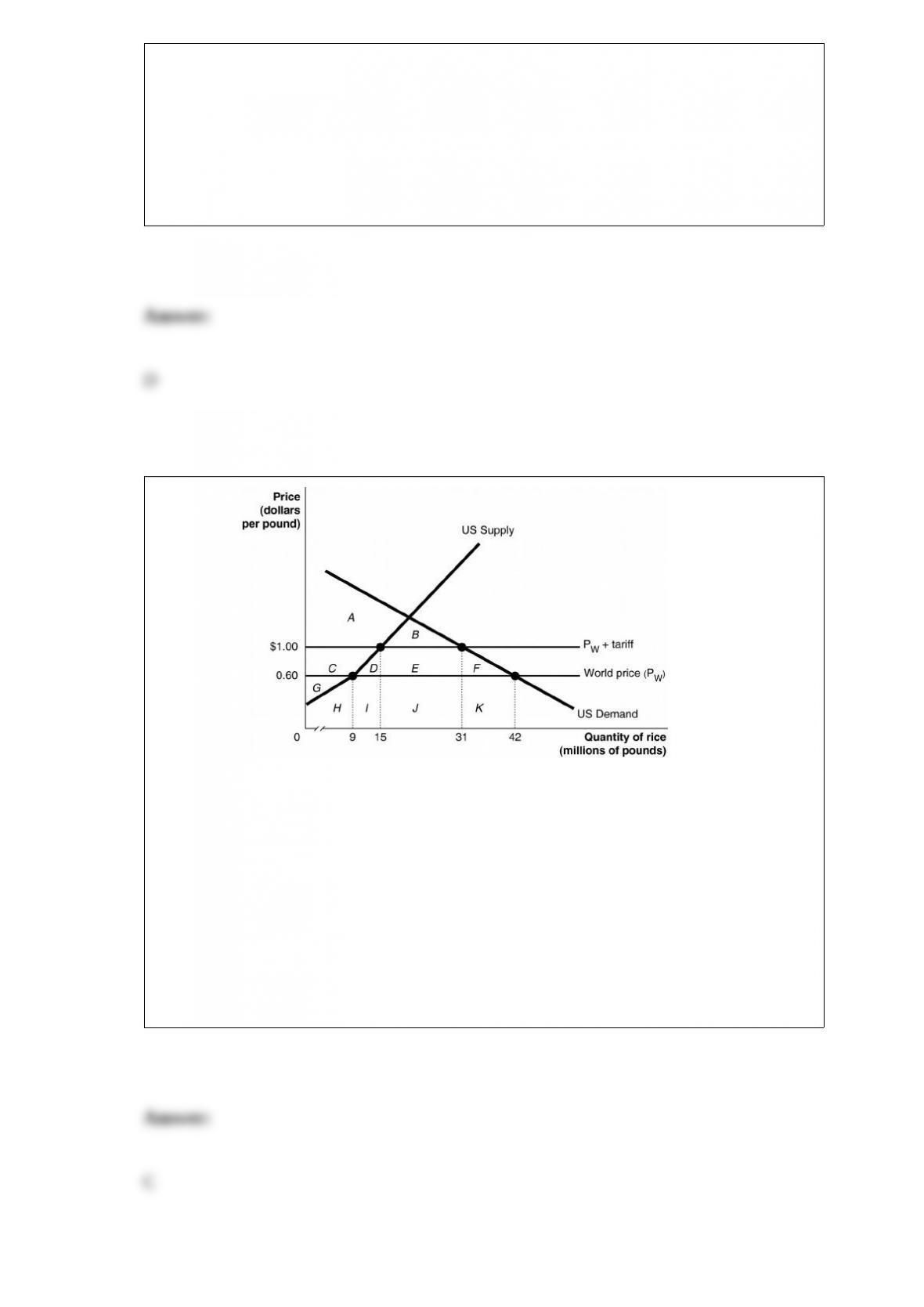
Figure 9-2 Suppose the U.S.
government imposes a $0.40 per pound tariff on rice imports. Figure 9-2 shows the
impact of this tariff. If the tariff was replaced by a quota which limited rice imports to
16 million pounds, the amount of revenue received by rice importers would equal
A) $6.4 million.
B) $9.6 million.
C) $16 million.
D) $19.8 million.

If the marginal propensity to save is 0.25, then a $10,000 decrease in disposable income
will
A) increase consumption by $7,500.
B) increase consumption by $2,500.
C) decrease consumption by $7,500.
D) decrease consumption by $2,500.
In an open economy, the government purchases multiplier will be smaller the
A) smaller the marginal propensity to import.
B) larger the tax rate.
C) larger the marginal propensity to consume.
D) All of the above are correct.
Suppose that when the price of oranges decreases, Sarita decreases her purchases of
peaches. To Sarita,
A) oranges and peaches are complements.
B) oranges and peaches are inferior goods.
C) oranges and peaches are normal goods.
D) oranges and peaches are substitutes.
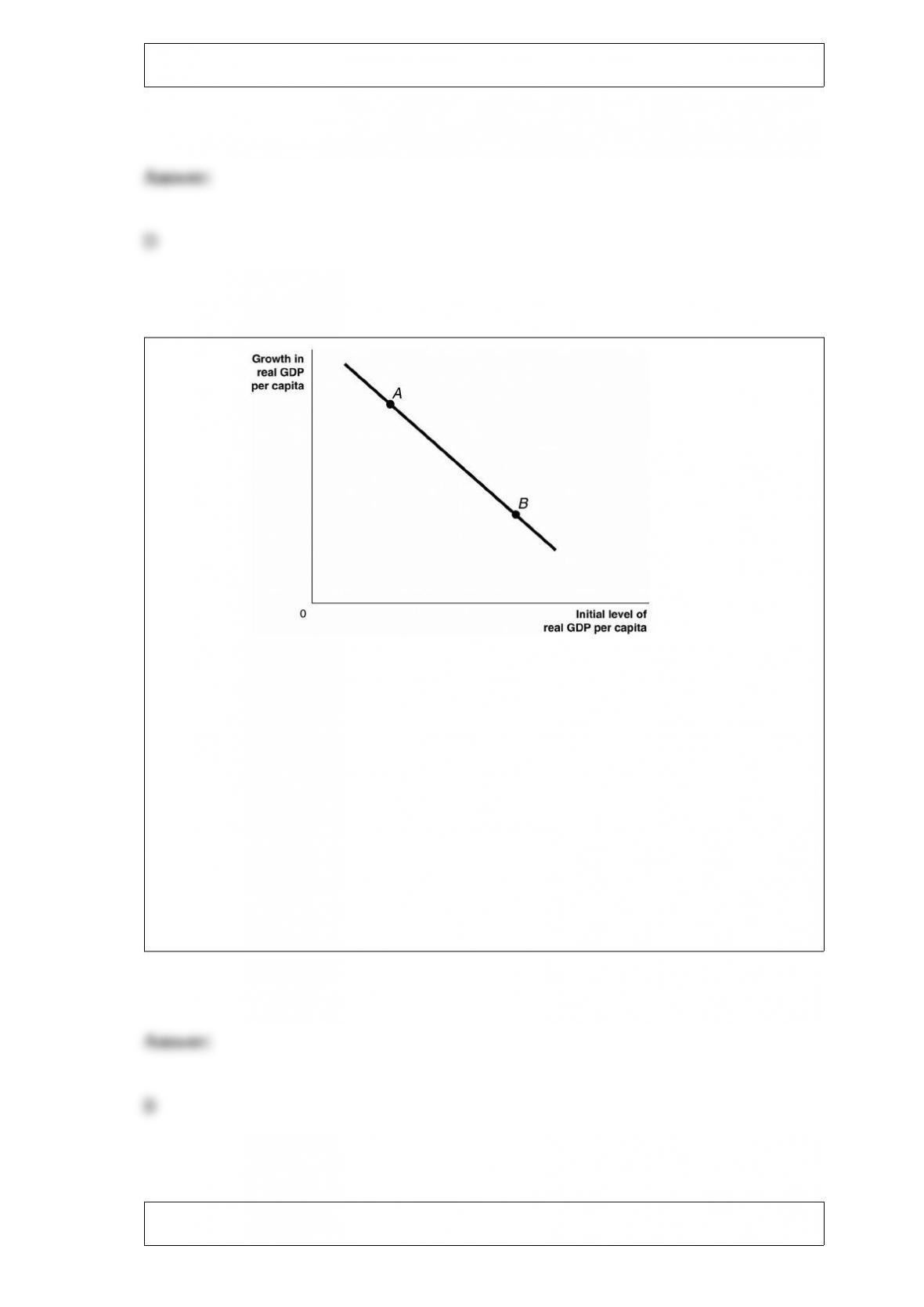
Figure 22-5
Based on the “catch-up line” drawn above, poorer countries are more likely to be at a
point like ________, where growth in GDP is relatively ________, while richer
countries are more likely to be at a point like ________, where growth in GDP is
relatively ________.
A) A; low; B; high
B) A; high; B; low
C) B; low; A; high
D) B; high; A; low
According to Joseph Schumpeter, economic growth is achieved through
A) focusing only on making old products better rather than inventing new ones.
B) centralizing economic production.
C) a process termed “creative destruction.”
D) removing the entrepreneur from the production function.
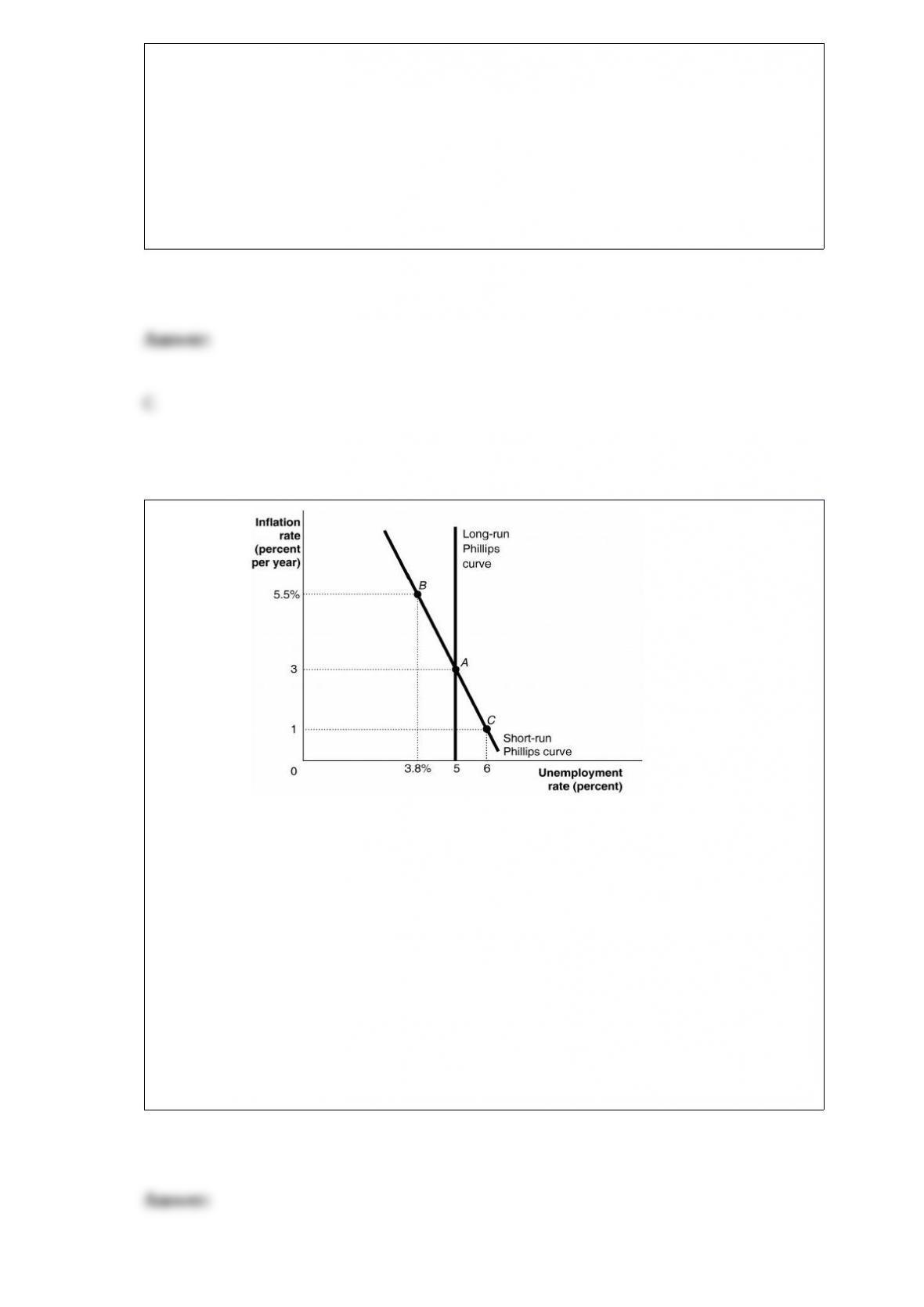
Figure 28-2
Suppose the economy is at point C in the figure above. If workers adjust their
expectations of inflation, which of the following will be true?
A) The short-run Phillips curve will shift to the right.
B) The short-run Phillips curve will shift to the left.
C) The economy will move from C to A.
D) Workers and firms expect inflation to be 1%.
E) The natural rate of unemployment is 6%.

A government tax rebate of $1,000 would ________ your disposable income by
________.
A) increase; less than $1,000
B) increase; $1,000
C) decrease; less than $1,000
D) decrease; $1,000
If in a perfectly competitive industry, the market price facing a firm is below its average
total cost but above average variable cost at the output where marginal cost equals
marginal revenue
A) the industry supply will not change.
B) new firms are attracted to the industry.
C) some existing firms will exit the industry.
D) firms are breaking even.

Figure 7-2 Suppose the U.S. government
imposes a $0.75 per pound tariff on coffee imports. Figure 7-2 shows the impact of this
tariff. As a result of the tariff, domestic producers increase their quantity supplied by
A) 6 million pounds of coffee.
B) 18 million pounds of coffee.
C) 26 million pounds or coffee.
D) 38 million pounds of coffee.
Which of the following correctly describes the result of a price increase for an inferior
good?
A) Both the substitution effect and the income effect cause the consumer to buy less of
the good.
B) The substitution effect causes the consumer to buy less of the good and the income
effect causes the consumer to buy more of the good.
C) The substitution effect causes the demand for the good to decrease; the income effect
causes the demand for the good to increase.
D) The substitution effect causes the demand for the good to increase; the income effect
causes the demand for the good to decrease.

A perfectly competitive firm’s supply curve is its
A) marginal cost curve.
B) marginal cost curve above its minimum average total cost.
C) marginal cost curve above its minimum average variable cost.
D) marginal cost curve above its minimum average fixed cost.