
College students often spend summers in internships that pay little or no income
because internships provide benefits in the form of higher future incomes.
a. True
b. False
In the collective bargaining process, once the United Auto Workers and General Motors
representatives agree on a contract, the union members
a. must accept the contract
b. may reject the contract and must then have their representatives continue negotiations
c. may reject the contract and must then go on strike
d. may reject the contract and must then vote on whether to strike or to continue
negotiations
e. may reject the contract and must then seek employment with a different firm
The ability of increasing quantity supplied in response to a higher price is identical
across industries.
a. True
b. False

Which of the following is most likely to be a partnership?
a. Uncle Mort’s Red Wrigglers
b. the accounting firm of Hope and Williams
c. General Motors
d. the Boston Symphony Orchestra
e. the U.S. Post Office
The bulk of exports from industrial countries are
a. manufactured goods
b. primary products
c. agricultural goods
d. raw materials
e. raw sugar products
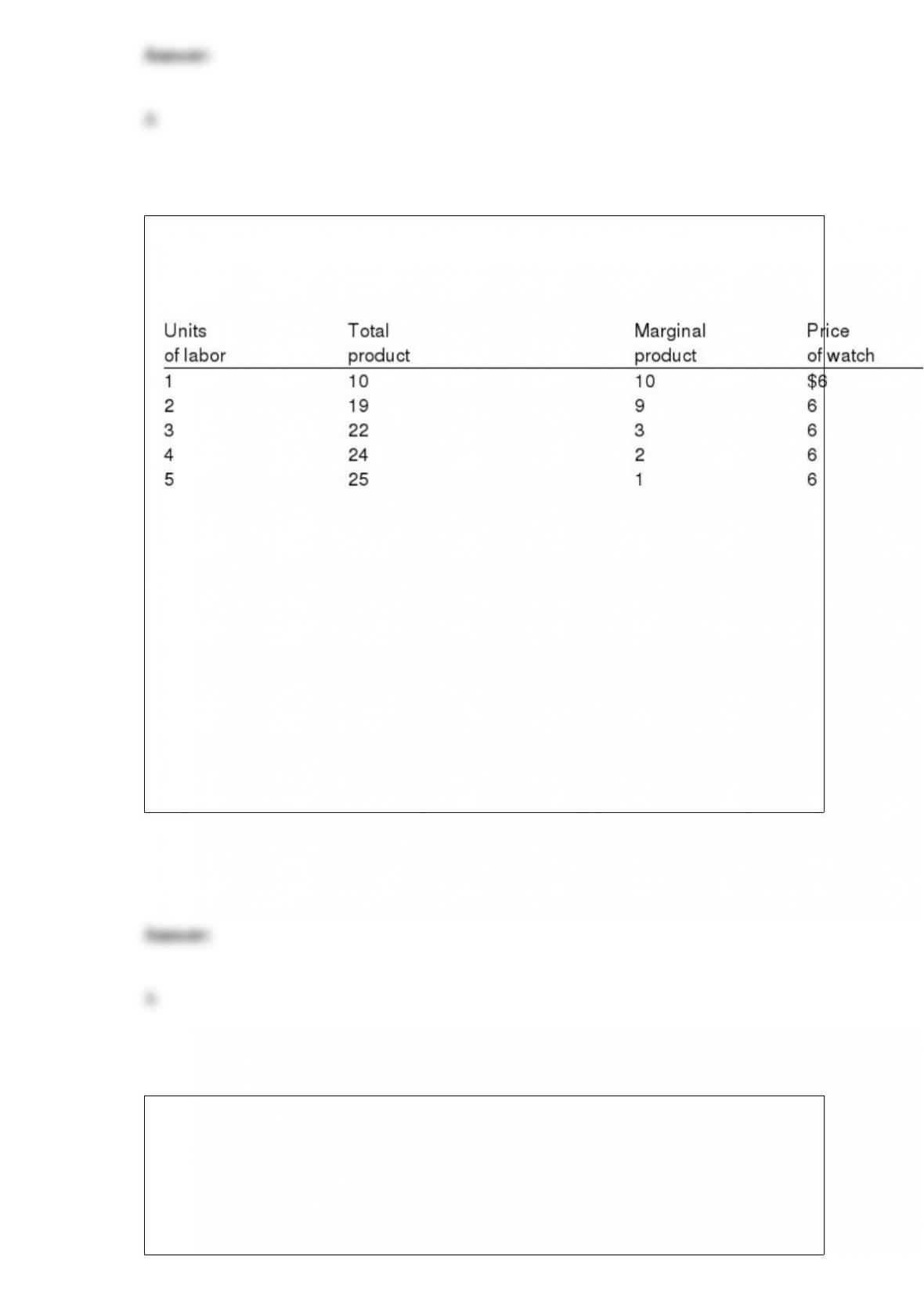
Exhibit 11-11
Exhibit 11-11 shows data on watch production. If the marginal resource cost is constant
at $70 per unit of labor, how many workers should the firm hire to maximize its profit?
a. zero
b. one
c. two
d. three
e. four
A natural monopoly exists when, throughout the range of market demand,
a. average cost is increasing
b. there are diseconomies of scale

c. there are economies of scale
d. average cost is constant
e. marginal cost exceeds average cost
Which of the following groups has the highest infant mortality rate?
a. middle-income economies
b. low-income economies
c. high-income economies
d. Western European economies
e. all the world’s economies
A farmer doubles her acreage of corn and as a result finds that her costs per bushel of
corn drop. She has experienced economies of scope.
a. True
b. False

Social capital is
a. the shared values and trust that promote cooperation in the economy
b. the buildings and equipment used to produce goods and services
c. a government regulation aimed at improving health and safety
d. the accumulated knowledge, skill, and experience of the labor force
e. the owner’s own or borrowed money invested in a business
In economics, the term “marginal” usually refers to
a. a small change in an economic variable
b. a low-quality product or resource
c. an unimportant and irrelevant economic variable
d. an all-or-nothing economic decision
e. a footnote or minor point

As resources move from low-valued uses in a resource market to highly-valued uses in
another resource market, the price paid to the resource in the highly-valued market will
a. not be affected, if the change is temporary
b. increase, if the change is temporary
c. remain the same
d. decrease
e. increase, if the change is permanent
Which of the following is not considered a resident when calculating the balance of
payments?
a. governments
b. capital equipment
c. organizations
d. firms
e. people
Unions are less likely to strike today than in the past because
a. real wages have increased over the last 20 years
b. employers are less willing to hire strike breakers
c. most workers in the U.S. are already union members
d. more workers, both union and nonunion, are willing to cross picket lines
e. many high-profile strikes (e.g., Caterpillar) have succeeded in winning job security
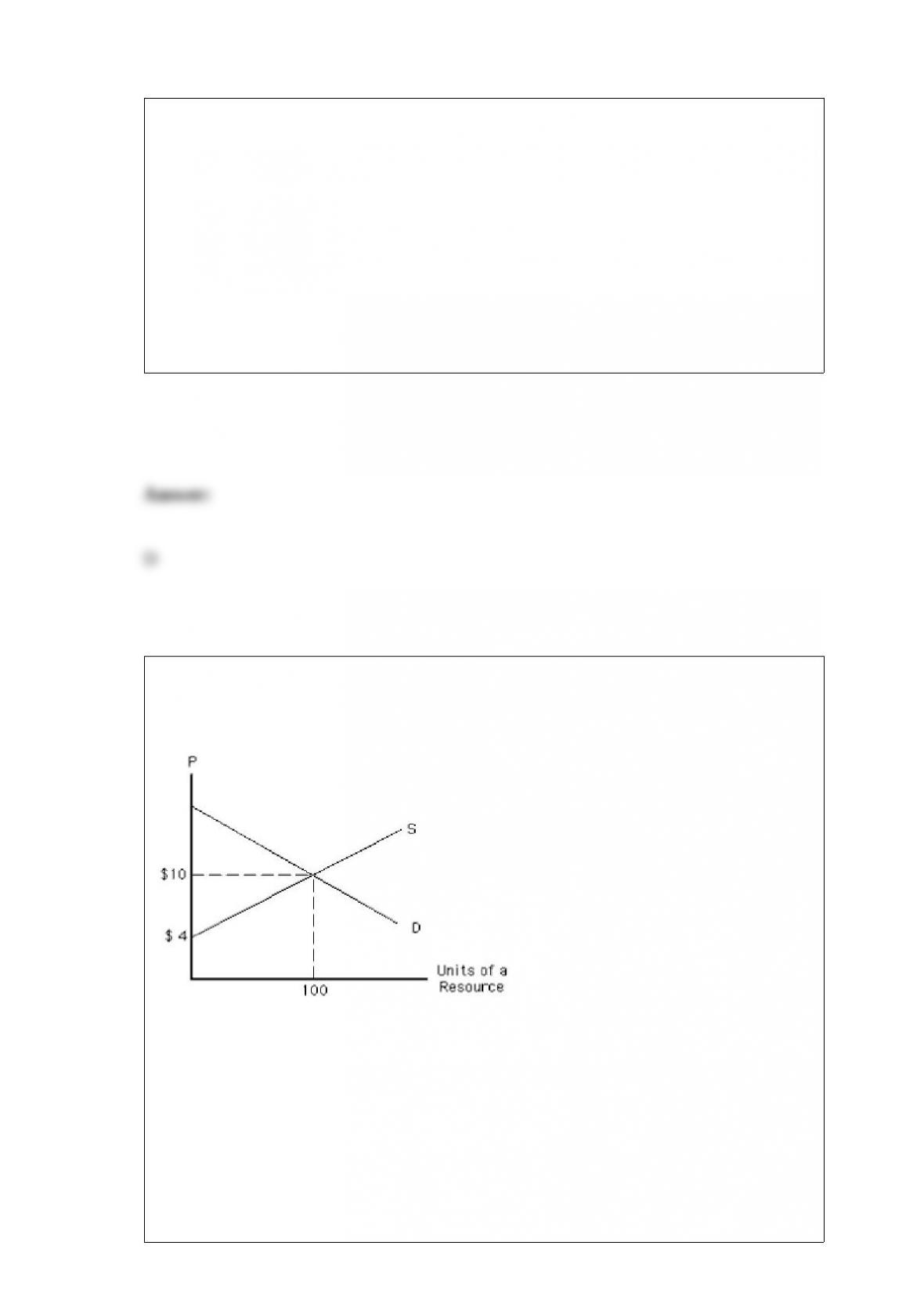
Exhibit 11-3
In Exhibit 11-3, opportunity cost in equilibrium equals
a. $40
b. $60
c. $100
d. $700

e. $300
The more broadly a good is defined
a. the more substitutes it has, so demand will be more price-elastic
b. the less substitutes it has, so demand will be more price-elastic
c. the more substitutes it has, so demand will be less price-elastic
d. the less substitutes it has, so demand will be less price-elastic
e. has no effect on the good’s price elasticity of demand
Natural monopolies form when
a. small firms merge to form larger firms
b. one firm has control over the entire supply of a basic input required to produce the
product
c. one firm’s monopoly position is created and enforced by the government
d. one firm receives patent protection for certain basic production processes
e. long-run average cost declines as a firm expands output
In the United States, the individual income tax is best described as a
a. regressive tax
b. proportional tax
c. flat tax
d. progressive tax
e. repressive tax
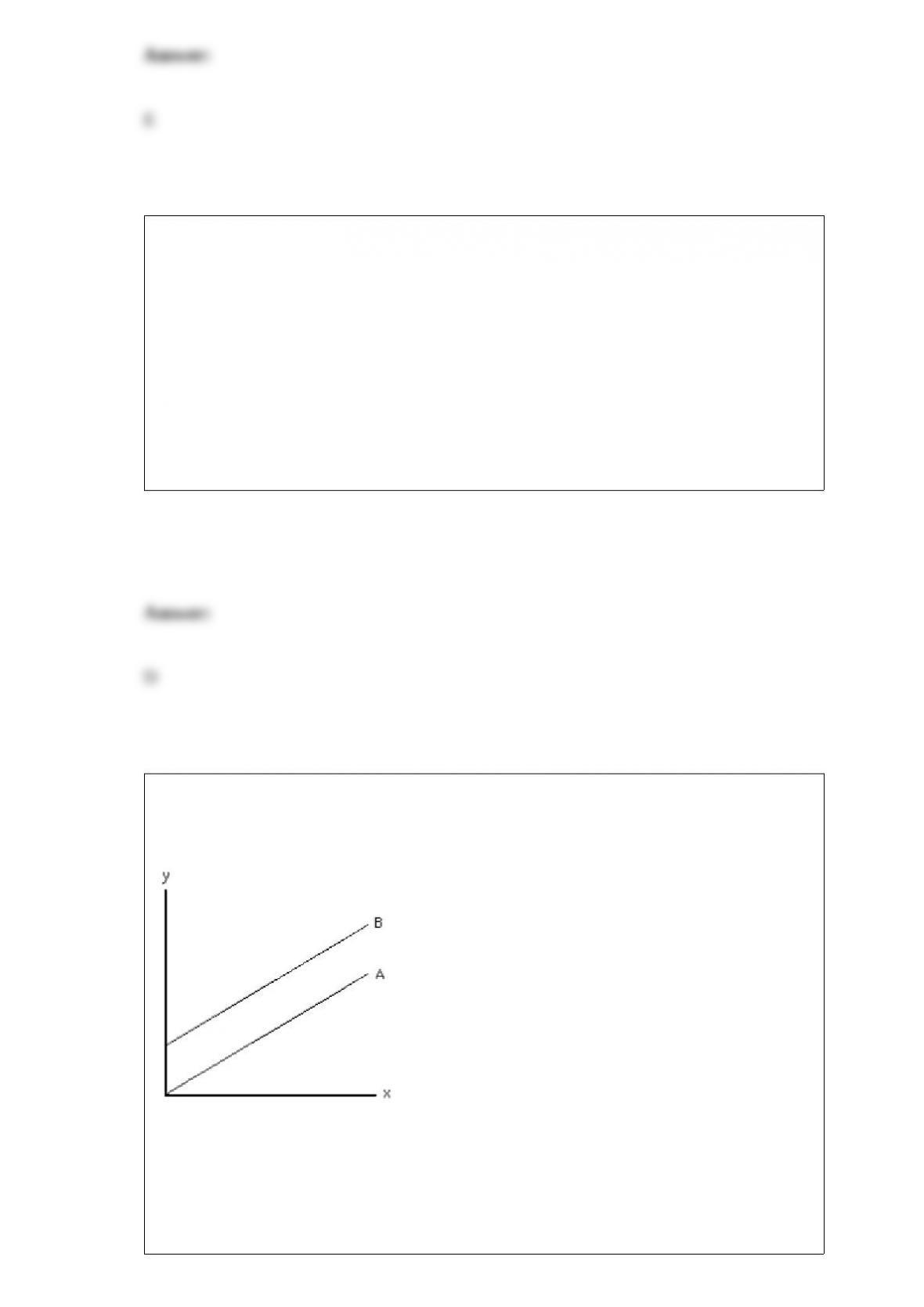
Exhibit 1-3
In Exhibit 1-3, for any value of y, the
a. value of x is larger on curve A than on curve B
b. value of x is smaller on curve A than on curve B

c. value of x is the same on curve A as on curve B
d. slope of line A is increasing
e. slope of line B is negative
People who use drive-through windows at restaurants and eat while on the road tend to
a. have a low opportunity cost of time
b. have a high opportunity cost of time
c. not maximize their utility
d. act irrationally
e. value their money more than their time
A change in the composition of the population will generally
a. change demand only if there is a change in the size of the population
b. change demand only if there is no change in the size of the population
c. change demand even if there is no change in the size of the population

d. have absolutely no effect on demand
e. result in a movement along the demand curve
Economies of scale throughout the range of market demand give natural monopolies
a. downward-sloping long-run average cost curves
b. upward-sloping long-run average total cost curves
c. upward-sloping long-run average cost curves
d. upward-sloping short-run average total cost curves
e. horizontal long-run average cost curves
Which component of U.S. household spending has grown the most over the past ten
years?
a. taxes
b. savings
c. spending on services
d. spending on nondurable goods

e. spending on durable goods
The typical concave (i.e., bowed-out) shape of the production possibilities frontier
reflects the law of increasing opportunity cost.
a. True
b. False
Market activity differs from government activity because
a. markets generally force prices to below-cost levels
b. governments never charge for the services they provide
c. markets do not use voluntary exchange mechanisms
d. markets provide a direct link between benefits and costs
e. governments have strong incentives to keep costs under strict control
The distribution of income in the United States is
a. more concentrated than the distribution of income in other developed countries
throughout the world
b. significantly more even than the distribution of income in other developed countries
throughout the world
c. quite similar to the distribution of income in other developed countries throughout
the world
d. significantly less even than the distribution of income in most developing countries
e. quite similar to the distribution of income in most developing countries
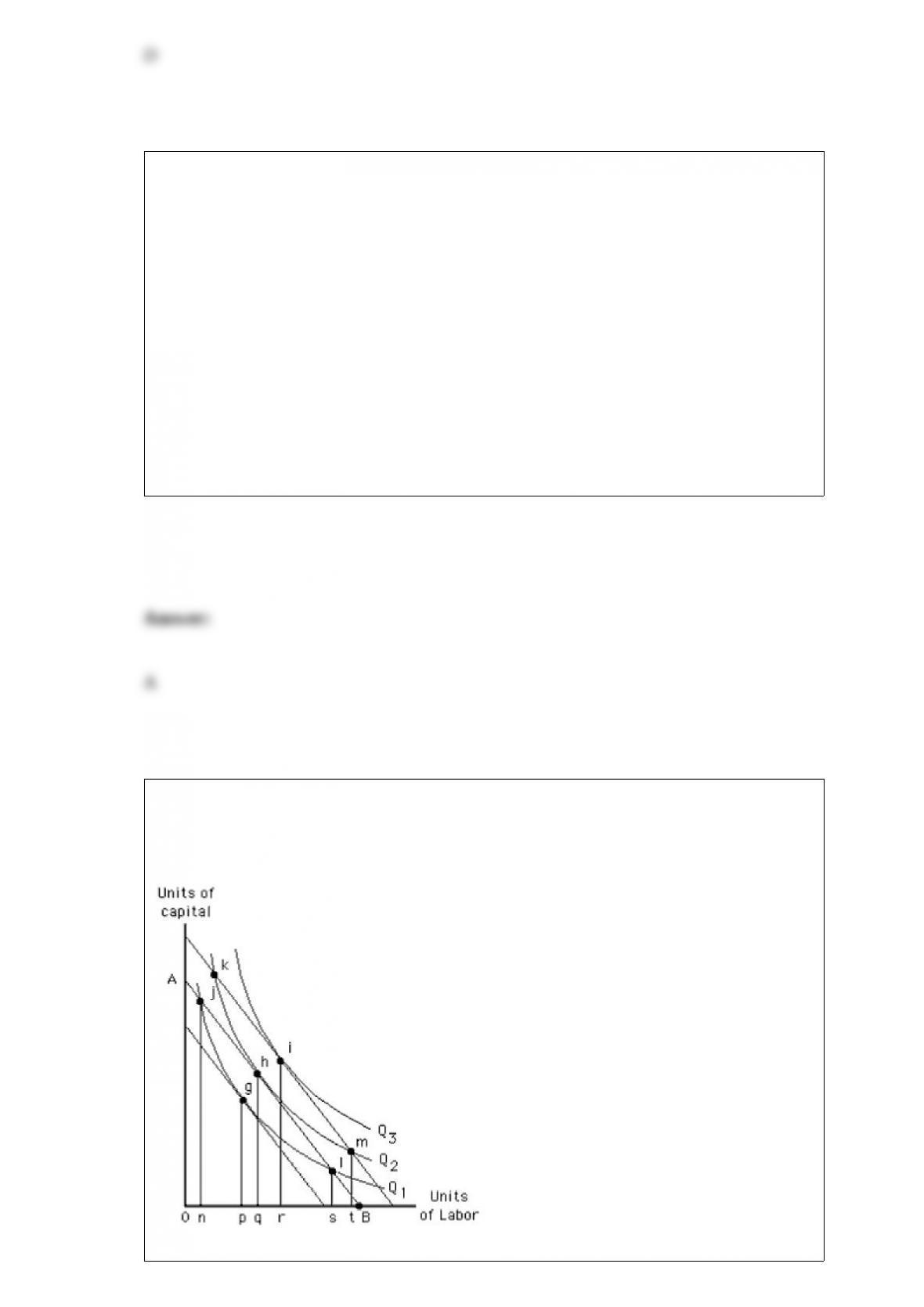
Exhibit 7-21

Connecting points g, h, and i in Exhibit 7-21 yields the firm’s
a. marginal rate of substitution
b. isocost line
c. marginal cost curve
d. expansion path
e. total revenue line
A firm could differentiate its product by all of the following means except one. Which is
the exception?
a. making the product available at a number of different locations
b. increasing the number of services that accompany the product
c. making the product physically different from other products
d. using packaging or advertising to create a special subjective image of the product in
the consumer’s mind
e. emphasizing that the product provides the same benefits to consumers as the others
on the market, even when it is really physically different

Allocative efficiency occurs in markets when
a. goods are produced using the least amount of society’s scarce resources
b. goods are produced at the lowest possible average total cost
c. goods are produced at the lowest possible marginal cost
d. the value to society of the last unit produced equals its marginal cost
e. the value to society of the last unit produced is greater than its marginal cost
Goods and activities typically are more highly valued the sooner they can be enjoyed,
other things constant,
a. only when interest rates are positive
b. because interest rates are positive
c. only when people save
d. because people save
e. because people have positive rates of time preference
If the marginal product of the second worker hired by a firm is 14 units and the price of
the tenth unit of output is $7, then the marginal revenue product
a. of the second worker is $98, regardless of the structure of the product market
b. of the second worker is $98 if the firm is a price searcher in the product market
c. of the second worker is $98 if the product market is perfectly competitive
d. of the tenth worker is $98 if the product market is perfectly competitive

e. of the tenth worker is $98 if the firm is a price searcher in the product market
If a firm can double inputs and, thereby, more than double output over the range of
output the market demands, it is said to be experiencing
a. decreasing minimum efficient scale
b. increasing returns to scale
c. constant returns to scale
d. decreasing returns to scale
e. increasing long run average cost
Consumer surplus can be used to compare the effects of any of the following except for
different
a. market structures
b. tax structures
c. production technologies, such as capital-intensive versus labor-intensive
d. public programs

e. levels of medical care benefits
A profit-maximizing monopolist never produces along the __________ portion of the
demand curve because marginal revenue is __________ there.
a. elastic; positive
b. elastic; negative
c. inelastic; negative
d. inelastic; positive
e. inelastic; zero