
Tanesha sells homemade candles over the Internet. Her annual revenue is $64,000 per
year, the explicit costs of her business are $17,000, and the opportunity costs of her
business are $22,000. What is her economic profit?
A) $17,000
B) $25,000
C) $42,000
D) $47,000
Article Summary
Cuba has announced its intentions to end its dual currency system which has been in
place since 1994. Presently, Cuba has two official currencies, the national peso (CUP)
and the convertible peso (CUC). The national peso is the currency used by most
businesses and citizens, and the convertible peso was designed to be used primarily in
the tourism industry and for foreign trade. The coveted convertible peso is pegged to
the U.S. dollar and is worth 25 times the national peso, despite the government treating
them as having equal value in official accounts, trading on a one-for-one basis for
official state entities. Few Cubans other than those with government ties have access to
convertible pesos, which allows them to enjoy a much improved lifestyle due to the
currency’s relative value. One exception is people working in the tourist-centered
hospitality industries, such as waiters and hotel staff, who receive convertible pesos as
tips, often earning them more than medical and legal professionals who are paid in
national pesos. The currency unification is expected to be a gradual process, taking up
to 18 months, and could involve both a devaluing of the convertible peso and a
revaluing of the national peso.
Source: Hannah Strange, “Cuba to end dual currency as part of Castro’s economic
reforms,” Telegraph, October 22, 2013.
Refer to the Article Summary. The convertible peso (CUC), which is pegged to the U.S.
dollar, is worth 25 times the national peso, yet Cuban officials treat the convertible peso
and the national peso as being of equal value. This indicates that the national peso is
________ compared to the convertible peso, and would need to be ________ to for the
two currencies have equal value in the marketplace.
A) undervalued; revalued
B) undervalued; devalued

C) overvalued; revalued
D) overvalued; devalued
The goals of monetary policy tend to be interrelated. For example, when the Fed
pursues the goal of ________, it also can achieve the goal of ________ simultaneously.
A) high employment; economic growth
B) high employment; lowering government spending
C) economic growth; a low current account deficit
D) stability of financial markets; a low current account deficit
Figure 13-2
Refer to Figure 13-2. Ceteris paribus, an increase in workers and firms adjusting to
having previously overestimated the price level would be represented by a movement
from

A) SRAS1 to SRAS2.
B) SRAS2 to SRAS1.
C) point A to point B.
D) point B to point A.
“Household production” refers to
A) the manufacturing of durable household products.
B) the home building sector of the economy.
C) home-based craft businesses.
D) goods and services people produce for themselves.
For each pound of salami that Hungary produces, it gives up the opportunity to make 10
bottles of beer. Slovakia can produce 1 pound of salami for every 8 bottles of beer it
produces. Which of the following is true about the comparative advantage between the
two countries?
A) Hungary has the comparative advantage in salami.
B) Hungary has the comparative advantage in beer.
C) Slovakia has the comparative advantage in salami and beer.

D) Slovakia has the comparative advantage in beer.
Health insurance plans which typically reimburse doctors mainly by paying ________
are known as health maintenance organizations.
A) a fee for each individual service provided
B) a fee for each individual office visit
C) an escalating fee based on the number of patients being treated
D) a flat fee per patient
What effect does a depreciation of the dollar have on real GDP in the United States in
the short run?
A) Real GDP will fall.
B) Real GDP will rise.
C) Real GDP will be unaffected by the depreciation of the dollar.
D) Real GDP will be unchanged, but nominal GDP will rise.
Americans, other than jewelers or rare coin collectors, were not allowed to own gold
from the early 1930s until the
A) 1950s.
B) 1960s.
C) 1970s.
D) 1980s.
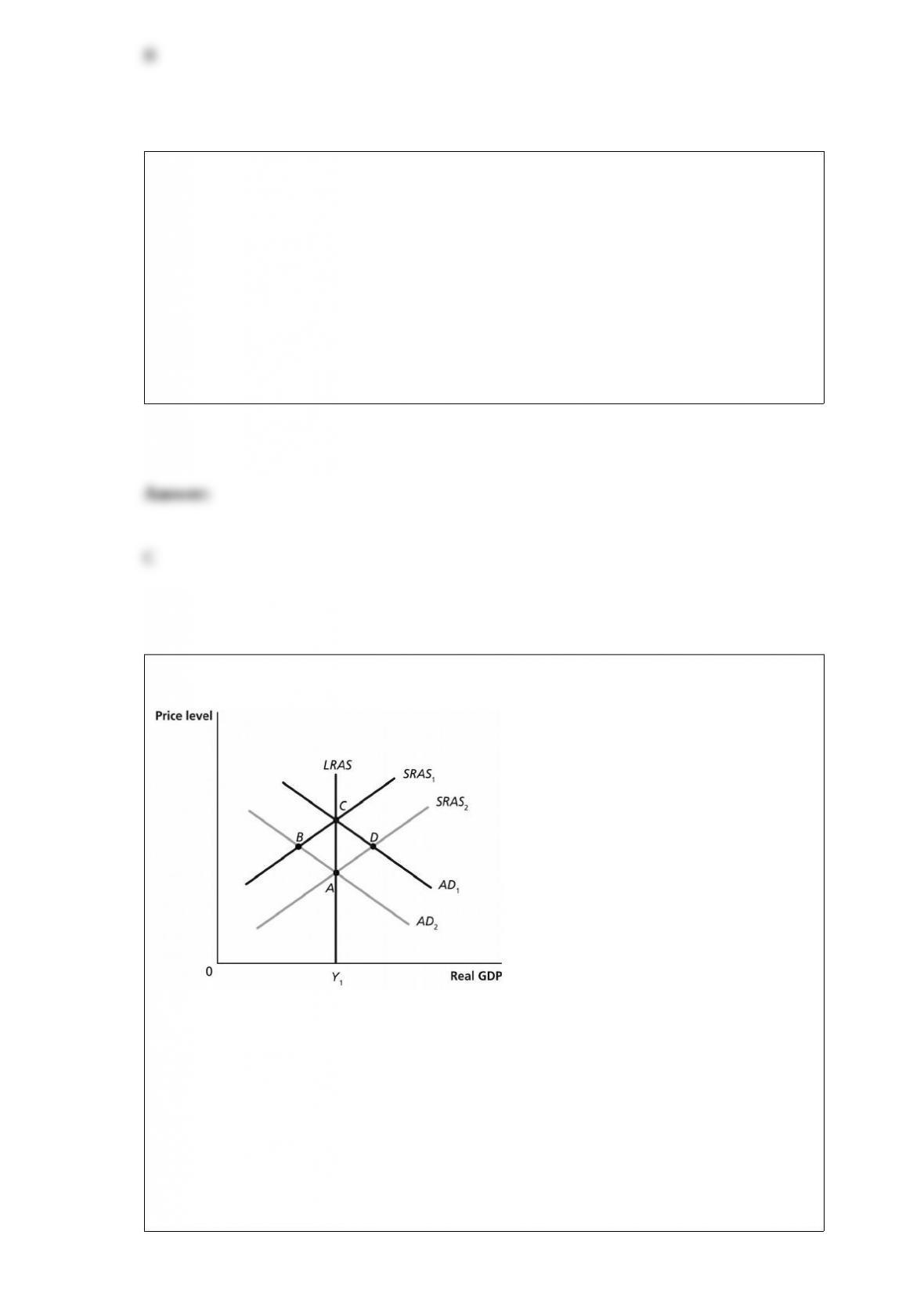
Figure 13-3
Refer to Figure 13-3. Which of the points in the above graph are possible short-run
equilibria?
A) A and B
B) A and C
C) A and D
D) A, B, C, and D

India’s rapid growth can be explained by
A) reduced regulations and market-based reforms.
B) investment in human capital from 1947 through 2013.
C) the movement of workers from the agricultural sector to the manufacturing sector.
D) an increase in labor force participation.