
If a firm is using a resource hired in a perfectly competitive market, and if the price of
the resource exceeds the marginal revenue product of the resource,
a. more of the resource should be used
b. less of the resource should be used
c. the firm should pay a lower price for the resource
d. the firm should pay a higher price for the resource
e. the firm is using the optimal amount of the resource
All of the following are evidence of specialization except
a. a solo carpenter who builds a whole bedroom set
b. restaurants that range from subs to sushi
c. the credits at the end of a movie
d. professional mourners in Taiwan
e. online sellers
Which of the following is a service?

a. a college education
b. an automobile
c. computer software
d. a compact disc
e. a textbook
It is possible for one person to have an absolute advantage in two tasks and a
comparative advantage in only one.
a. True
b. False
Exhibit 20-8
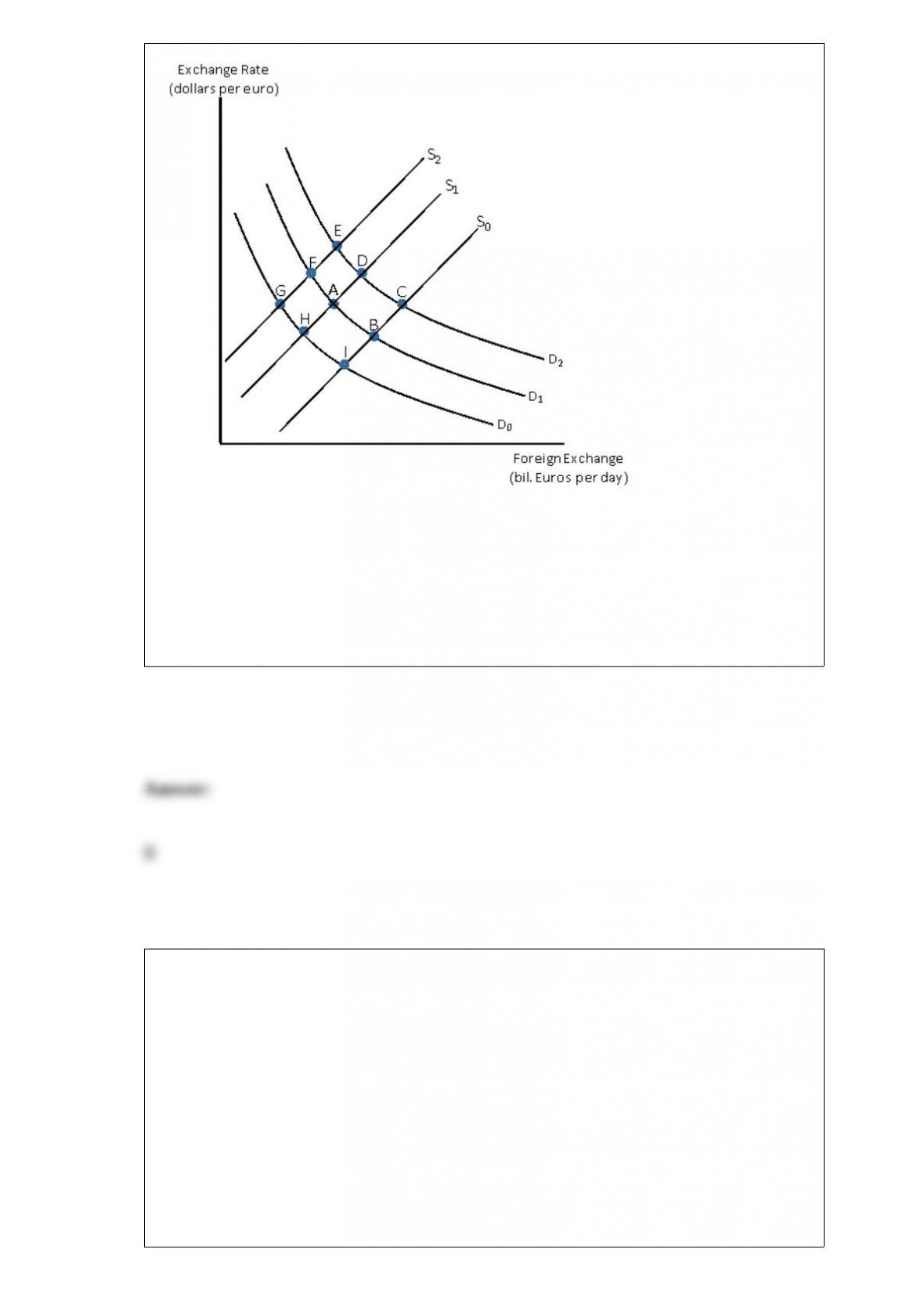
In Exhibit 20-8 a movement from point A to F represents a depreciation in the value of
the euro.
a. True
b. False
Which of the following would indicate that an income tax is progressive?
a. high-income people pay $3,000; low-income people pay $1,000
b. low-income people pay $3,000; high-income people pay $1,000
c. high-income and low-income people all pay $1000 each
d. high-income people pay 20 percent of their income in taxes; low-income people pay
10 percent
e. both high-income and low-income people pay 10 percent of their income in taxes
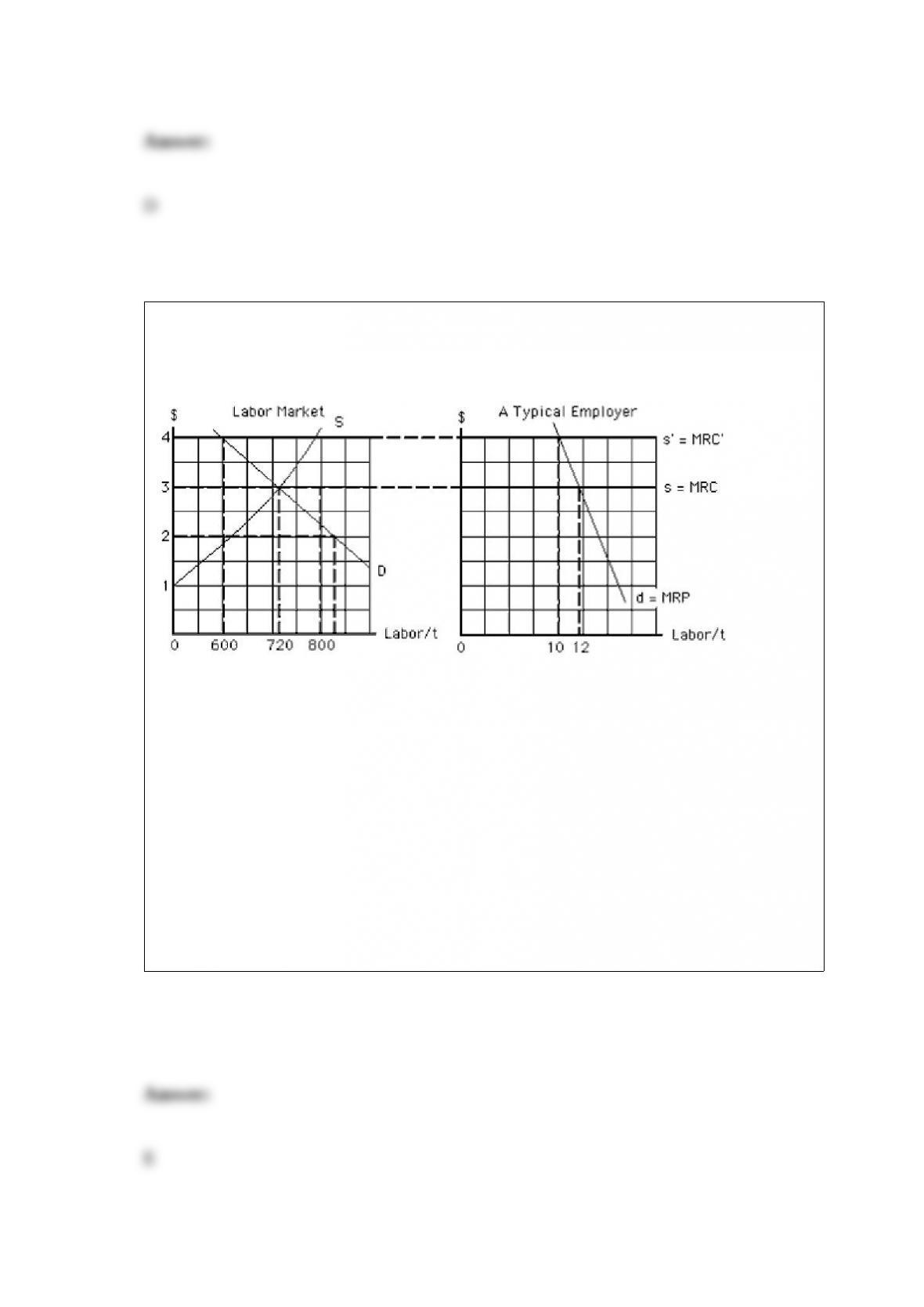
Exhibit 12-6
Assume an industrial union is formed and establishes the wage rate at $4 in Exhibit
12-6. The reason the wage rate will not fall to the competitive equilibrium level is that
a. all workers are wealthier in disequilibrium
b. nonunion workers are poorer than union workers
c. there is excess demand for labor at equilibrium
d. there is excess supply of labor at equilibrium
e. wages are determined by collective negotiation, not individual negotiation

The scientific method is useful
a. only in fields of science such as chemistry and physics
b. for testing the validity of theoretical predictions
c. for testing the validity of a model’s assumptions
d. when no economic variables can be assumed to be constant
e. only if a theory has been proven to be true
Suppose Norm really loves coffee and Diane really loves books. If we drew their
indifference curves on a graph with books on the horizontal axis and coffee on the
vertical axis, Diane’s indifference curves would be
a. the same as Norm’s
b. upward sloping, and Norm’s would be downward sloping
c. downward sloping, and Norm’s would be upward sloping
d. steeper than Norm’s
e. flatter than Norm’s
Which of the following is true of units of utility?

a. Each unit is worth $1.
b. They cannot be compared across consumers.
c. They apply to goods but not to services.
d. They do not exist for very wealthy individuals.
e. They are negative for inferior goods.
Which of the following is true?
a. In low-income countries, less than 5 percent of those 15 and older were illiterate in
2007
b. In middle-income countries, 17 percent of those 15 and older were illiterate in 2007
c. In high-income countries, 38 percent of those 15 and older were illiterate in 2007
d. Education bears little relationship to economic development in high income countries
e. Education is more important to the economic development of low income countries
than it is to high income countries
Consumer concern about “blood diamonds” or “conflict diamonds” may have caused a
drop in De Beers sales.
a. True
b. False
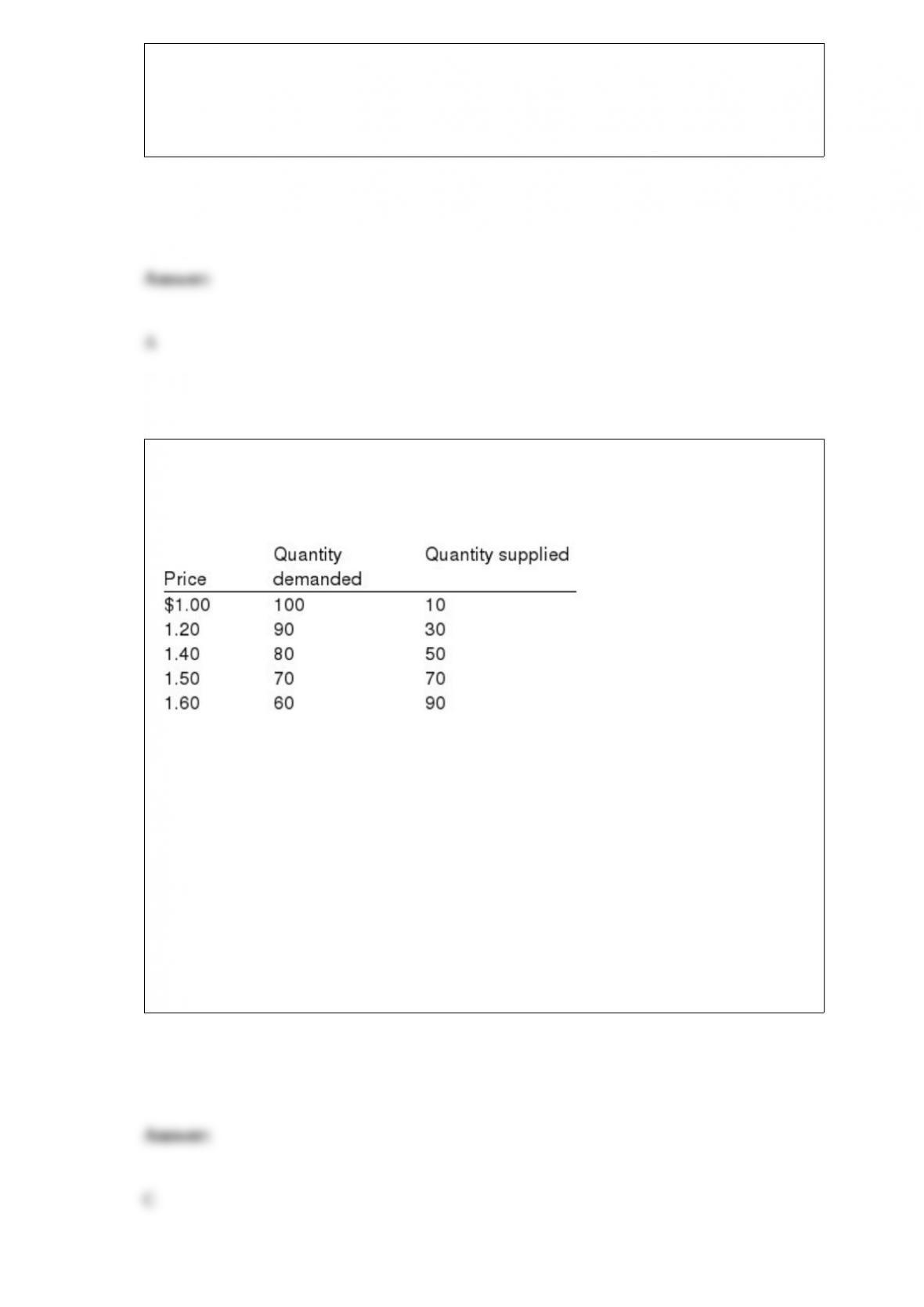
Exhibit 4-3
If the price of the good described in Exhibit 4-3 is $1.20, then there is a
a. shortage of 30 units
b. surplus of 30 units
c. shortage of 60 units
d. surplus of 60 units
e. surplus of 20 units

The statistical discrepancy
a. is always positive
b. is always negative
c. must be reduced to zero and eliminated from the balance of payments before the
records become official
d. is a residual factor that indicates the net error in the balance of payments data
e. is a record of all transactions between residents of two countries over a specified
period
As more pollution is abated, the marginal social benefit from further abatement
diminishes.
a. True
b. False
For a perfectly competitive firm,
a. P = AR at all levels of output
b. P = AR at the profit-maximizing quantity only

c. P > AR at all levels of output
d. P < AR at the profit-maximizing quantity only
e. P < AR at all levels of output
Which of the following is an example of an in-kind transfer?
a. welfare payments
b. most Social Security benefits
c. unemployment compensation payments
d. food stamps
e. charitable contributions
If Arnold thinks his last dollar spent golfing yields less satisfaction than the last dollar
spent on movies, and Arnold is a utility-maximizing consumer, he should
a. golf more so that the total satisfaction from this activity will increase
b. spend less on movies so that the marginal satisfaction from expenditures in this area
will increase
c. golf less and spend more on movies
d. eliminate golfing from his schedule

e. golf more since it costs less
Unlike firms in a perfectly competitive industry, monopolists have control over
a. the price they charge for the product
b. the quantity of output they produce
c. the prices they pay for resources
d. the quantities of various resources which are used
e. improvements in technology
A candy bar sells for 50 cents, video games are 25 cents each, the horizontal (candy)
intercept of Ann’s budget line is 12, and the vertical (video game) intercept of Ann’s
budget line is 24. Which of the following best describes what would happen to the
budget line if Ann’s income decreased?
a. It would shift rightward to a parallel position.
b. It would shift rightward to a nonparallel position.
c. It would shift leftward to a parallel position.
d. It would shift leftward to a nonparallel position.
e. Nothing.

Marginal utility can be objectively measured and compared from one individual to
another.
a. True
b. False
Open-access resources tend to be
a. conserved
b. taxed
c. overused
d. efficiently used
e. used in an environmentally sound manner

Different people may have different tastes, but their tastes do not change over time.
a. True
b. False
Which of the following is an example of a capital resource?
a. a bank loan
b. a corporate bond
c. a tractor used by a farmer
d. a lawn tractor used by a household
e. 100 acres of prime farmland
Unemployment is measured primarily in urban areas because in rural areas farm work is
usually an outlet for labor.
a. True
b. False

A meditation class meets on the second floor of a building; the first floor is a nightclub.
The loud music from the club disturbs the classes. The club could be soundproofed for a
cost of $5,000 or move at a cost of $8,000. The class can’t soundproof enough to
overcome the music, but could be moved for $4,000. According to Coase, a socially
optimal solution can be achieved if
a. the local government purchases the building
b. the building is torn down
c. property rights to be noisy are granted to the nightclub
d. property rights to a quiet environment are granted to the meditation class
e. both the nightclub and the meditation class relocate
The short-run supply curve of a perfectly competitive firm is the
a. upward-sloping portion of its average total cost curve
b. upward-sloping portion of its average variable cost curve
c. average fixed cost curve at all levels of output
d. marginal cost curve, which lies above the average variable cost curve
e. downward-sloping portion of its marginal cost curve
The shape of the long-run average cost curve reflects
a. market demand
b. economies and diseconomies of scale
c. increasing and diminishing marginal returns
d. productivity of fixed inputs
e. all of the above
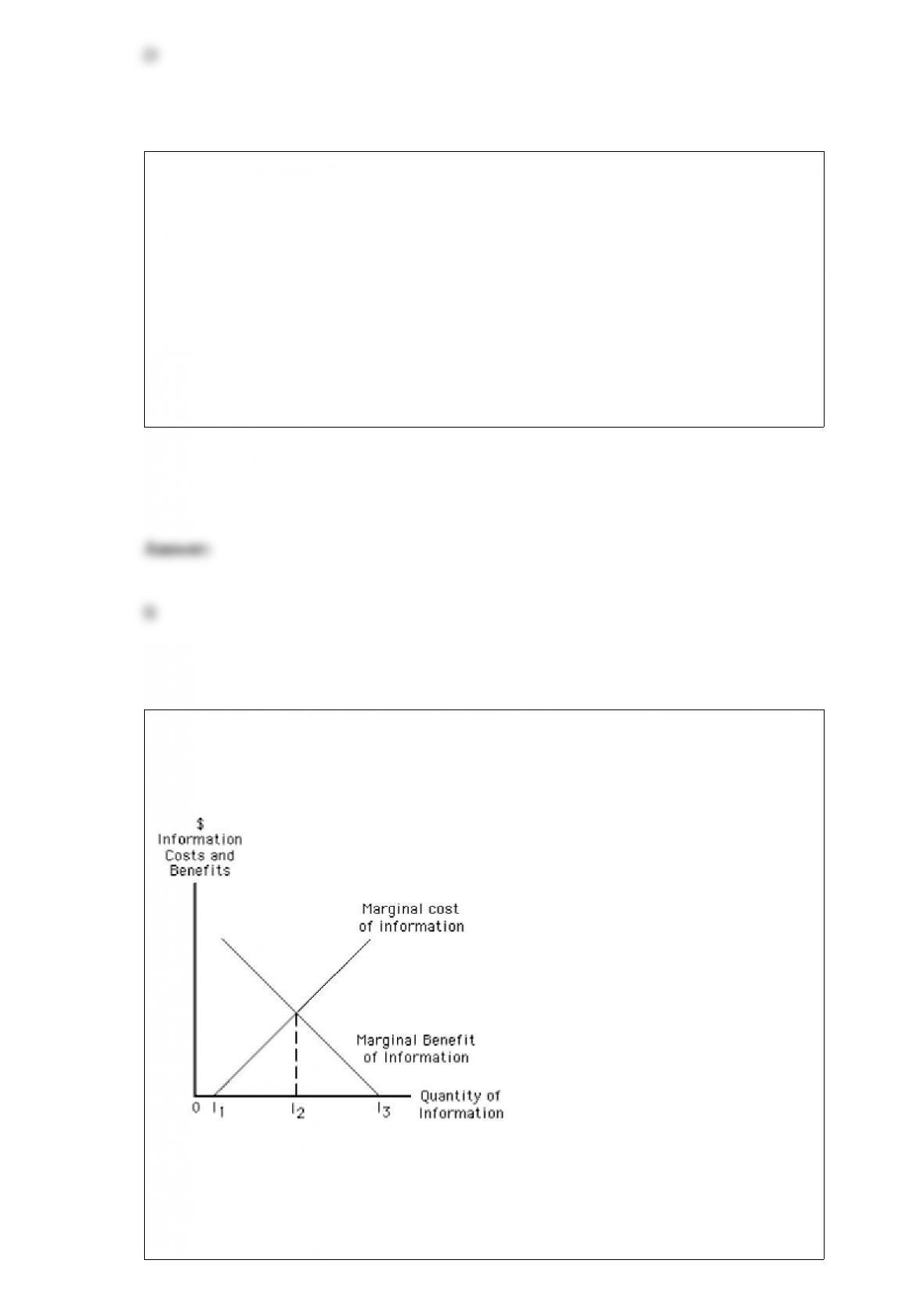
Exhibit 14-2
In Exhibit 14-2, if a consumer gathers an amount of information equal to I2,
a. he has made the optimal search

b. he has avoided the cost of acquiring information
c. he has searched too much
d. further information will be costless to him
e. he should increase his search
Unpriced by-products of production or consumption that provide benefits to other
consumers or other firms are known as
a. negative externalities
b. common pool benefits
c. positive externalities
d. private benefits
e. Coase by-products
The largest source of federal government revenue is
a. corporate income taxes
b. individual income taxes

c. payroll taxes
d. sales and excise taxes
e. tariffs on imported goods and other customs fees and duties
Suppose the equilibrium price in a perfectly competitive industry is $100 and a firm in
the industry charges $112. Which of the following will happen?
a. The firm will not sell any of its output.
b. The firm will sell more output than its competitors.
c. The firm’s profits will increase.
d. The firm’s revenue will increase.
e. The firm will gradually take over the entire industry.
The corporate form of business organization
a. is chosen by more firms than any other form of organization in the United States
b. gives firm owners limited liability
c. generates less than half of the output in the U.S. economy
d. combines the limited liability of the partnership with the personal control of the sole
proprietorship
e. is the least complex form of business organization

The Equal Employment Opportunity Commission
a. was established by the Equal Rights Act of 1984
b. examines cases in which a worker is not paid the same as other workers performing
the same work
c. guarantees a worker’s right to a job
d. established a minimum wage for minorities
e. has effectively eliminated racial discrimination in the workplace
Which of the following people would be least likely to search the newspaper ads for
bargains and clip store coupons?
a. a retired person
b. an unemployed person
c. a waitress earning $5 per hour
d. an attorney earning $100 per hour
e. a student on summer vacation