
Economists believe that people’s wants are
a. finite.
b. infinite.
c. irrational.
d. unimportant because needs are more important than wants.
Which of the following is an example of a positive economic statement?
a. The U.S. public should devote more resources to education.
b. The poor should pay lower taxes and the rich should pay higher taxes.
c. Soap operas should be taken off television.
d. If you drop a ball from the top of a building, it will fall to the ground.
When a store offers an incentive for buying more, such as charging $50 for one sweater
or $90 for two sweaters, it is an example of price discrimination.
a. True
b. False

Which of the following statements is true?
a. The administrative costs per dollar are greater for a large loan than a small loan.
b. The risk on a long-term loan is likely to be less than on a short-term loan, ceteris
paribus.
c. a and b
d. none of the above
If the percentage change in quantity demanded is less than the percentage change in
price for good Y, then the demand for good Y is
a. inelastic.
b. unit elastic.
c. elastic.
d. perfectly elastic.

The average-marginal rule states that if the marginal magnitude is
a. less than the average magnitude, the average magnitude falls.
b. greater than the average magnitude, the average magnitude falls.
c. rising, the average magnitude is necessarily above it.
d. falling, the average magnitude is necessarily below it.
e. c and d
A quota is
a. a tax imposed on imported goods.
b. a legal limit on the amount of a good that can be produced by foreign owners of a
firm located in a host country.
c. a legal limit on the amount of a good that can be imported.
d. an agreement between two countries in which the exporting country voluntarily
agrees to limit its exports to the importing country.
Suppose that if Madison Bumgarner, the major league baseball player, weren’t playing
baseball he would be coaching a college baseball team. It follows that
a. Bumgarner earns economic rent as long as his major league baseball salary is greater
than his salary as the coach of a college baseball team.

b. Bumgarner earns pure economic rent as a baseball player.
c. Bumgarner earns pure economic rent as a baseball player and simply economic rent
as a college coach.
d. if Bumgarner’s salary as a coach is much less than his salary as a baseball player,
then Bumgarner is overpaid as a baseball player.
e. none of the above
If all the individuals had the same innate and learned skills and abilities, applied the
same degree of effort on the job, and worked with the same amount and quality of other
factors of production,
a. all labor supply curves would be horizontal.
b. all labor demand curves would be horizontal.
c. wages in different markets would differ less than they currently do.
d. the quantity of labor supplied would decrease in all markets.
e. the demand curve for capital would be upward sloping.
Suppose the government decides that milk producers are not earning a high enough
price for their milk to maintain an adequate standard of living and that the solution to
the problem is to guarantee the milk producers a minimum price. We would expect that
a. consumers will have to pay a higher price per gallon of milk and will not be able to
consume as much as they did before.

b. the government will have to purchase the surplus milk on the market and then find a
means of storing this milk.
c. the dairy farmers will enjoy a higher standard of living at the expense of taxpayers
and consumers.
d. all of the above
Exhibit 22-13
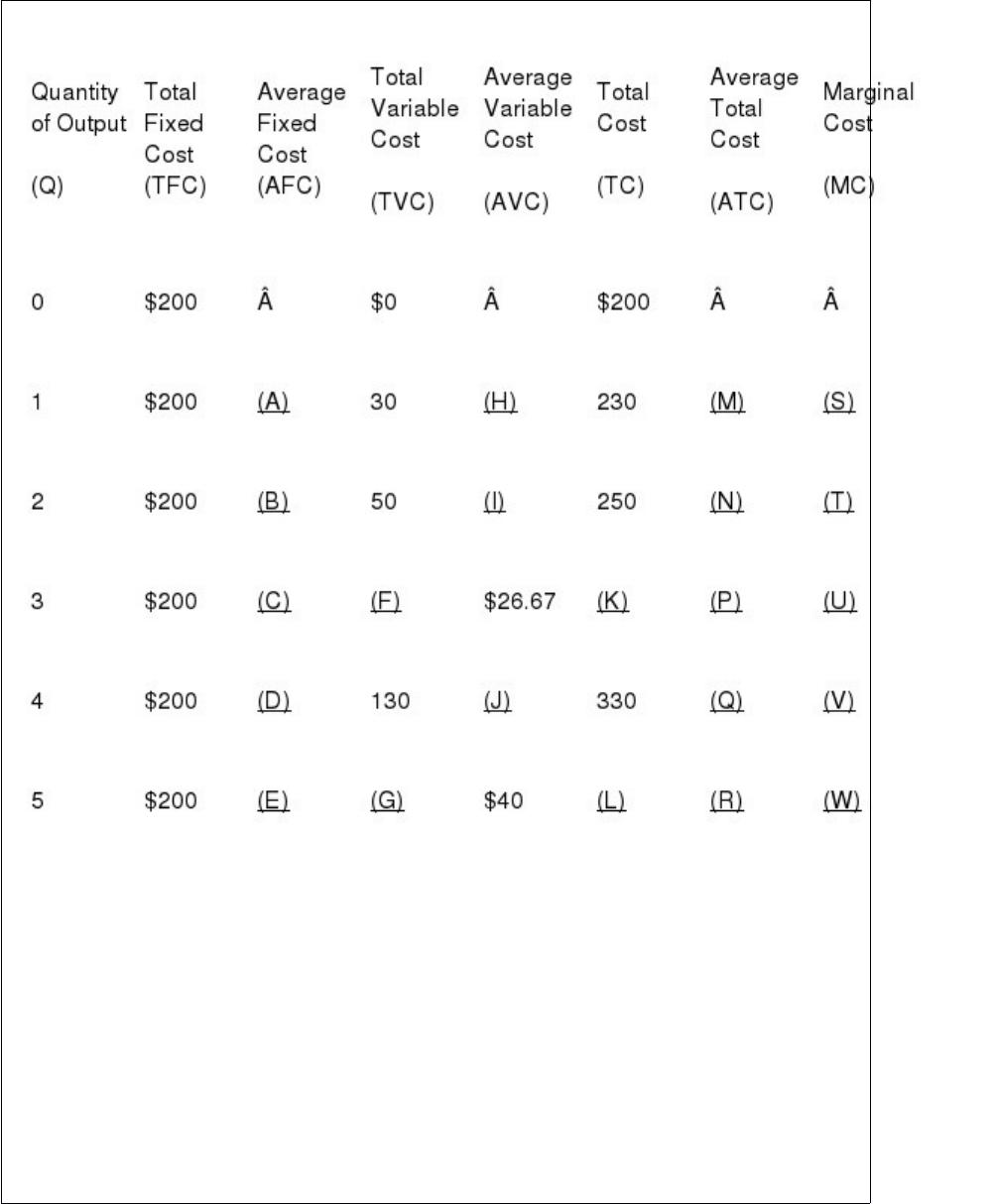
What dollar amounts go in blanks (P) and (Q), respectively?
a. $120; $125
b. $10; 95
c. $30; $80
d. $93.33; $82.50
e. There is not enough information to answer this question.

Consider the area between the line of perfect income equality and the Lorenz curve. In
country A this area is larger than in country B. It follows that
a. the bottom 20 percent income group receives a lower percentage of total income in
country A than in country B.
b. the bottom 20 percent income group receives a lower percentage of total income in
country B than in county A.
c. the top 20 percent income group receives a higher percentage of total income in
country B than in country A.
d. the top 20 percent income group receives a higher percentage of total income in
country A than in country B.
e. none of the above
In all cases, normative economics deals with
a. what is.
b. what should be.
c. relatively small units in the economy.
d. the entire economy.

If the demand for a good is inelastic and the price of the good decreases, then
a. total revenue increases.
b. total revenue decreases.
c. total revenue is not affected.
d. the direction of the change in total revenue cannot be determined from the
information given.
The difference between profit seeking under perfect competition and profit seeking
under monopoly is that
a. under the former output will increase and price will decrease, whereas under the
latter only output will increase.
b. under the former output will increase and price may increase, whereas under the
latter output will increase and price will decrease.
c. under the former new firms will enter the industry, whereas under the latter the firm
will simply raise its price and earn higher profits.
d. none of the above