
1) if the coefficient of income elasticity of demand is positive, the product is an inferior
good.
2) After the implementation of TANF, the U.S. welfare rolls fell by more than one-half
between 1996 and 2007.
3) The following information. Assume that by devoting all its resources to the
production of X, nation Alpha can produce 40 units of X. By devoting all its resources
to Y, Alpha can produce 60Y. Comparable figures for nation Beta are 60X and 40Y.
Refer to the above information. Beta would prefer terms of trade at, or close to, 1X =
11/2Y.
4) the basic source of state government’s revenue is the property tax.
5) in maximizing profit a firm will always produce that output where total revenues are
at a maximum.
6) the simplest way to calculate gdp is to sum the total sales of all business firms.
7) The following 2006 balance of payments data (+ and -) for the hypothetical nation of
Zabella. All figures are in billions of dollars.
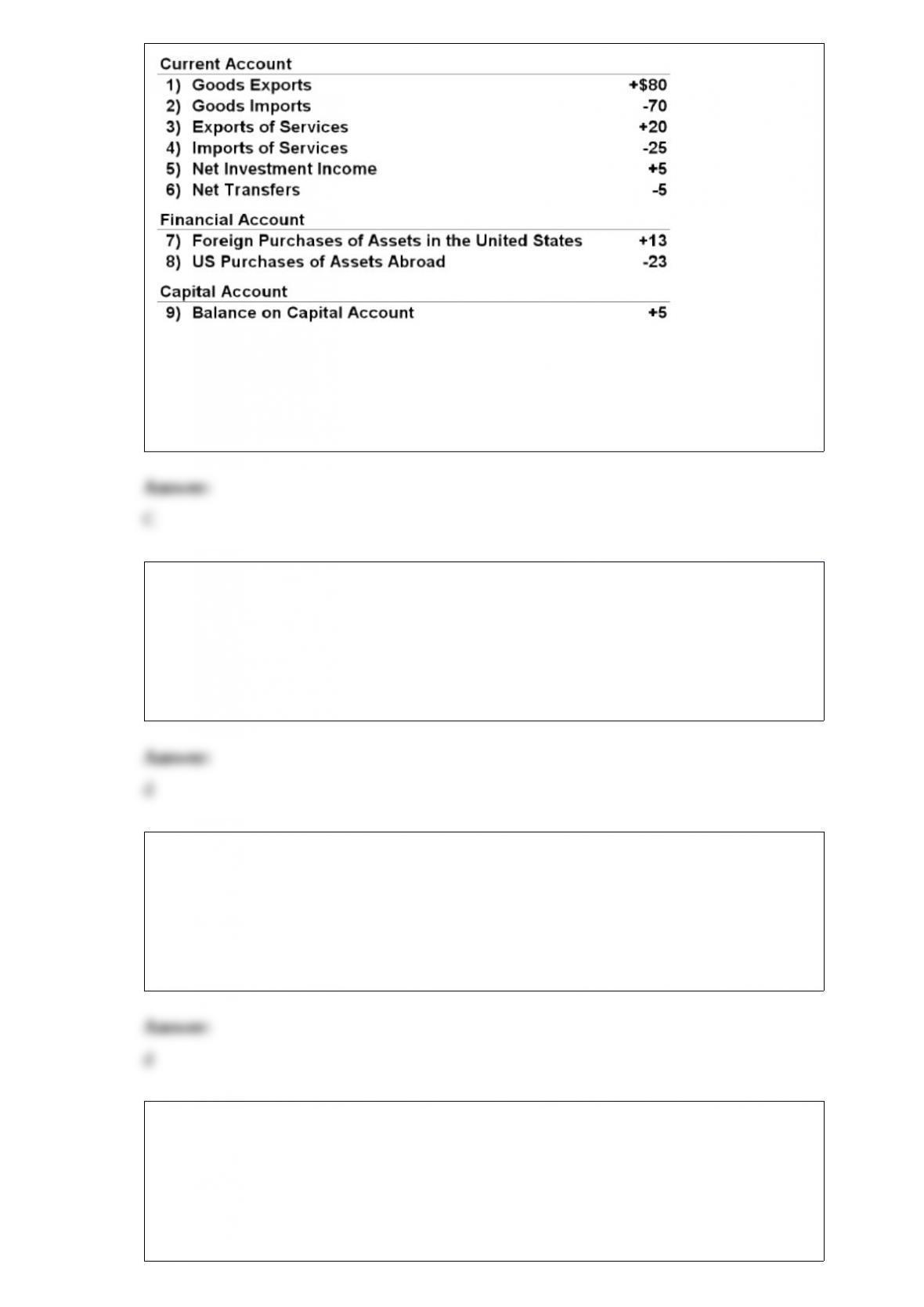
Refer to the above data. Zabella has a balance of trade (goods):
A.deficit of $10 billion.
B.surplus of $5 billion.
C.surplus of $10 billion.
D.deficit of $5 billion.
8) the industries or sectors of the economy in which business cycle fluctuations tend to
affect output the most are:
a.military goods and capital goods.
b.services and nondurable consumer goods.
c.clothing and education.
d.capital goods and durable consumer goods.
9) suppose that dave normally orders two tacos, but on seeing they are on sale, decides
to buy three. dave’s decision is best explained by the:
a.law of increasing opportunity costs.
b.law of supply.
c.principle of comparative advantage.
d.the principle of utility maximization.
10) suppose that coffee growers sell 200 million pounds of coffee beans at $2 per pound
in 2007, and sell 240 million pounds for $3 per pound in 2008. based on this
information we can conclude that the:
a.law of supply has been violated.
b.law of demand has been violated.
c.demand for coffee beans has increased.
d.supply of coffee beans has increased.
11) The current chairperson of the Board of Governors of the Federal Reserve System
is:
A.Lawrence Summers.
B.John B. Taylor.
C.Alan Greenspan.
D.Ben Bernanke.
12) In countries like Botswana and Zimbabwe, local villages have been given property
rights over local elephants with the result that elephant populations:
A.have been decimated as villagers try to maximize short-run profit.
B.have grown as villagers have protected the elephants to support their tourist industry.
C.have grown exponentially, with adverse environmental impacts.
D.are in serious decline as ivory prices have risen.
13)
Refer to the above diagrams. Curve A:
A.is an investment schedule and curve B is a consumption of fixed capital schedule.
B.is an investment demand curve and curve B is an investment schedule.
C.and B are totally unrelated.
D. shifts to the left when curve B shifts upward.
14)
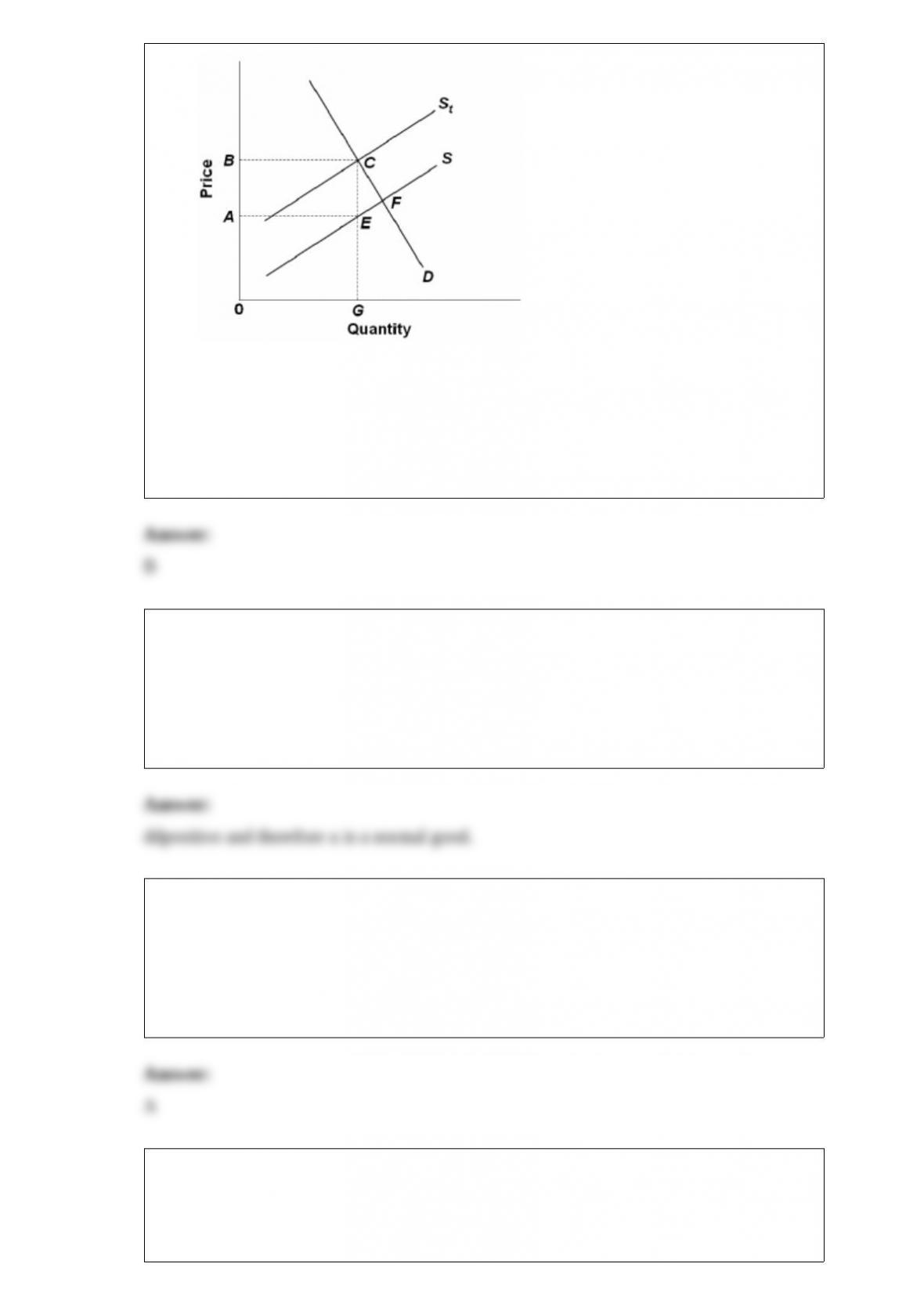
Refer to the above figure in which S is the before-tax supply curve and St is the supply
curve after an excise tax is imposed. The burden of this tax is borne:
A.equally by consumers and producers.
B.most heavily by consumers.
C.most heavily by producers.
D.only by consumers.
15) assume that a 4 percent increase in income in the economy produces an 8 percent
increase in the quantity demanded of good x. the coefficient of income elasticity of
demand is:
a.negative and therefore x is an inferior good.
b.negative and therefore x is a normal good.
c.positive and therefore x is an inferior good.
16) The purely competitive employer of resource A will maximize the profits from A by
equating the:
A.price of A with the MRP of A.
B.marginal productivity of A with the MRC of A.
C.marginal productivity of A with the price of A.
D.price of A with the MRC of A.
17) (Last Word) The U.S. sugar program has:
A.improved the world allocation of agricultural resources.
B.caused the world price of sugar to rise above its domestic price.
C.increased domestic sugar production.
D.lowered the incomes of U.S. sugar growers.
18) Answer the next question based on the following consolidated balance sheet for the
commercial banking system. Assume the required reserve ratio is 25%. All figures are
in billions of dollars.
(a)What is the amount of excess reserves in this commercial banking system?
(b)What is the maximum amount that the money supply can be expanded?
(c)If the reserve ratio fell to 25%, what is now the maximum amount that the money
supply can be expanded?
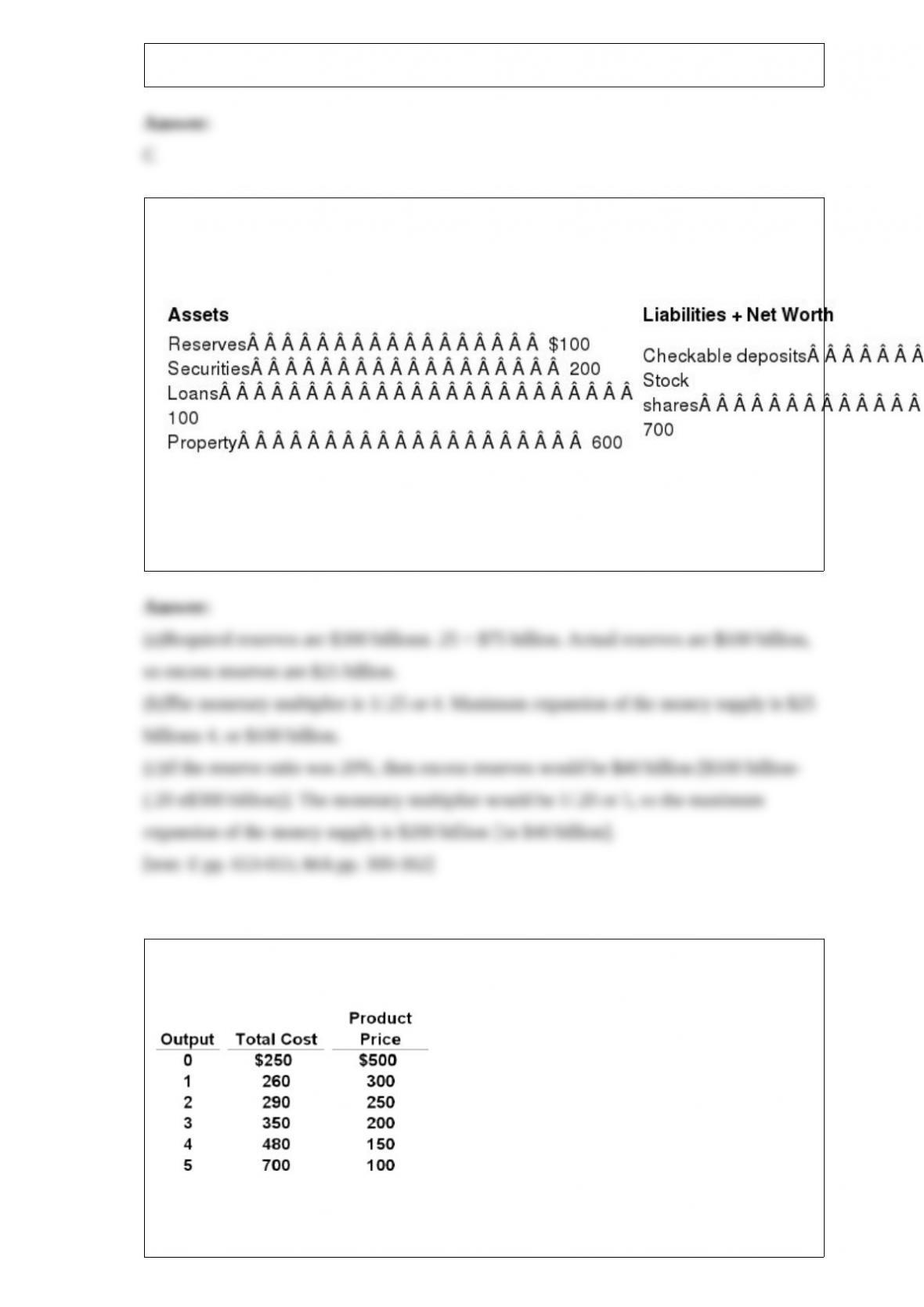
19) the following information for a pure monopolist:
if the above profit-maximizing monopolist is able to price discriminate, charging each
customer the price associated with each given level of output, how much profit will the
firm earn?
a.$120
b.$250
c.$300
d.$420
20) assuming the total population is 100 million, the civilian labor force is 50 million,
and 47 million workers are employed, the unemployment rate is:
a.3 percent.
b.6 percent.
c.7 percent.
d.53 percent.
21) Suppose three roommates cannot agree on the size of a pizza to order. Domino
argues for a medium pizza, Godfather contends a large pizza will be needed, and Little
Caesar wants a super-large pizza. Assuming no paradox of voting, majority voting will
result in a decision to order:
A.a medium pizza.
B.a large pizza.
C.a super-large pizza.
D.two medium pizzas.
22) The poverty rate in the United States was:
A.5 percent in 2006.
B.higher in 2006 than in 1960.
C.lower in 2006 than in 1993.
D.15 percent in 2006.
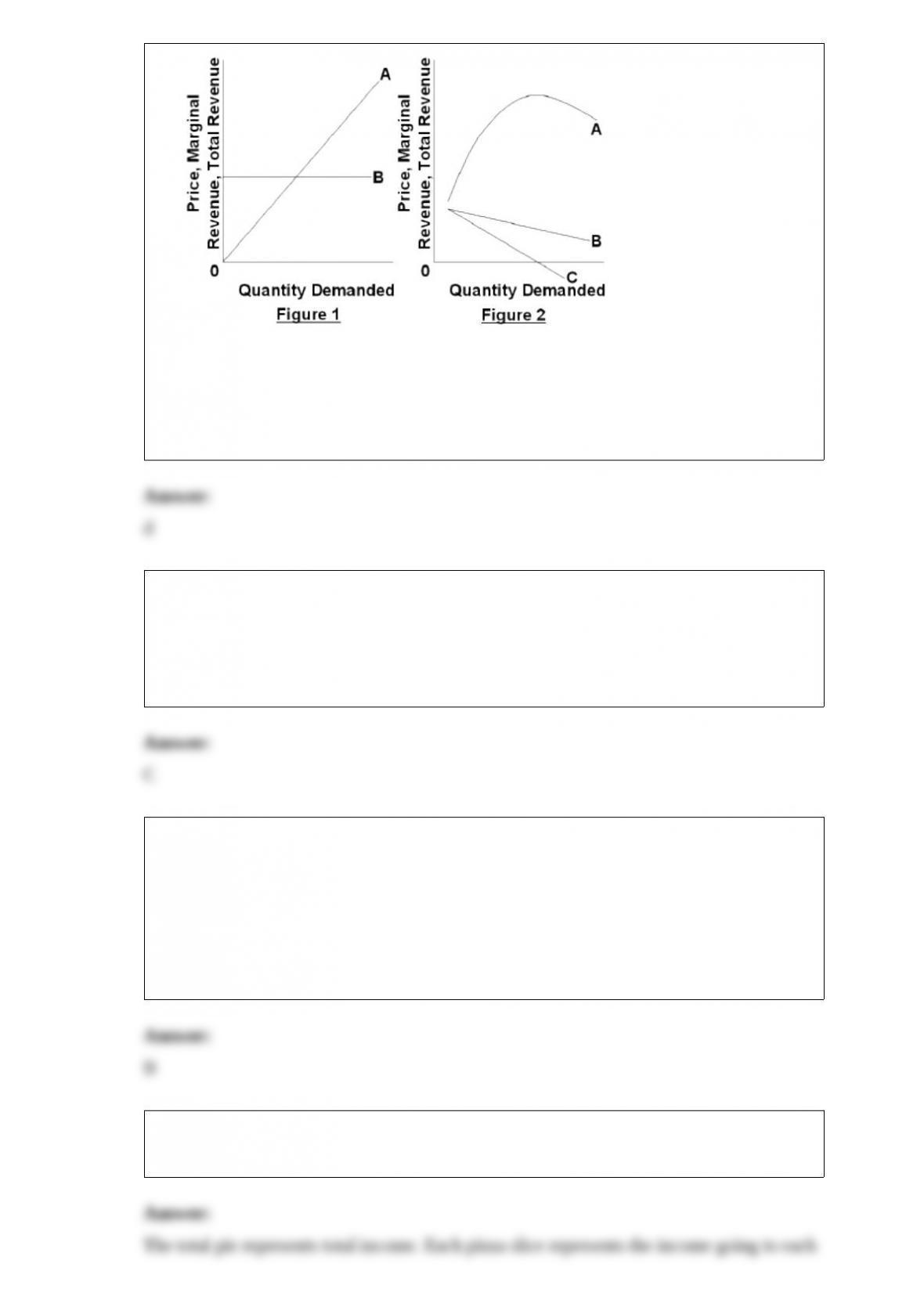
23)
refer to the above two diagrams for individual firms. figure 2 pertains to:
a.a market characterized by government regulation of price and output.
b.either an imperfectly competitive or a purely competitive seller.
c.a purely competitive seller.
d.an imperfectly competitive seller.
24) The growing importance of export demand for American agriculture has:
A.reduced the international value of the dollar.
B.had no significant effect on the stability of the demand for farm products.
C.destabilized the total demand for farm products.
D.stabilized the total demand for farm products.
25) Suppose that a mixed open economy is producing at its equilibrium income and that
net exports are zero. If at the equilibrium income the public sector’s budget shows a
surplus:
A.Ca + Ig + Xn + G must exceed GDP.
B.planned investment must exceed saving.
C.a recessionary expenditure gap must exist.
D.saving must exceed planned investment.
26) (Consider This) Use a pizza pie analogy to discuss the tradeoff between income
equality and economic efficiency.
27) What obstacles might a group of oligopolists encounter in forming a cartel or an
informal understanding?
28) Offer a skeptical perspective on the long-term economics of the recent productivity
acceleration.
29) The welfare state is not a mechanism which provides something for nothing; every
piece of social insurance must be paid for. Evaluate and explain. Can you think of any
circumstances in which unemployment compensation might provide something for
nothing?
30) Describe the three major disadvantages of flexible exchange rates.
31) Explain why the demand for food is inelastic in terms of the substitution effect and
diminishing returns.
32) The main purpose of required reserves is to promote bank liquidity and protect
depositors. Evaluate this statement.
33) List the various causes of income inequality in the United States.