1) fiscal policy:
a.is enacted by the nation’s central bank (the federal reserve in the u.s.).
b.refers to government spending and taxation policies aimed at promoting price stability
and full employment.
c.directly raises or lowers the level of interest rates to promote levels of spending
consistent with full employment and price stability.
d.is only used to reduce unemployment rates that are too high.
2) a supply curve that is a vertical straight line indicates that:
a.production costs for this product cannot be calculated.
b.the relationship between price and quantity supplied is inverse.
c.a change in price will have no effect on the quantity supplied.
d.an unlimited amount of the product will be supplied at a constant price.
3) if the supply of product x is perfectly elastic, an increase in the demand for it will
increase:
a.equilibrium quantity but reduce equilibrium price.
b.equilibrium quantity but equilibrium price will be unchanged.
c.equilibrium price but reduce equilibrium quantity.
d.equilibrium price but equilibrium quantity will be unchanged.
4) If the price index rises from 100 to 120, the purchasing power value of the dollar:
A.may either rise or fall.
B.will rise by one-sixth.
C.will fall by one-sixth.
D.will rise by 20 percent.
5) if an economy is operating on its production possibilities curve for consumer goods
and capital goods, this means that:
a.it is impossible to produce more consumer goods.
b.resources cannot be reallocated between the two goods.
c.it is impossible to produce more capital goods.
d.more consumer goods can only be produced at the cost of fewer capital goods.
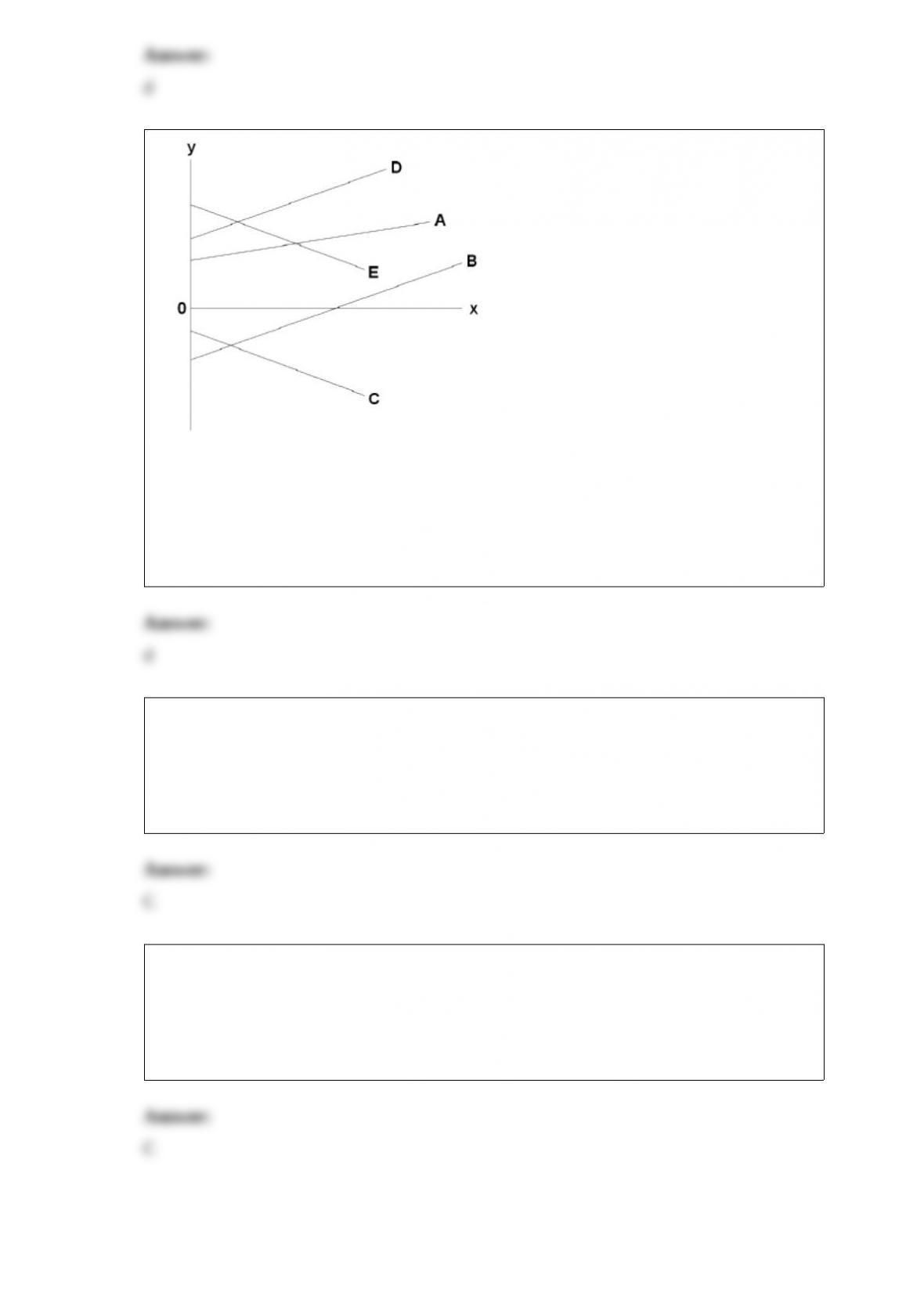
6)
refer to the above diagram. which line(s) show(s) a negative relationship between x and
y?
a.a only.
b.both a and d
c.a, b, and d
d.both c and e
7) Higher interest rates will, all else equal:
A.increase the extraction cost of a resource.
B.increase the user cost of extracting a resource.
C.reduce the user cost of extracting a resource.
D.have no impact on either the user cost or extraction cost of a resource.
8) Which of the following policies has succeeded in reducing fishery catch sizes?
A.Limiting the length of the catch season.
B.Limiting the number of boats allowed in a given area.
C.Limiting catch size (TAC).
D.All of these.
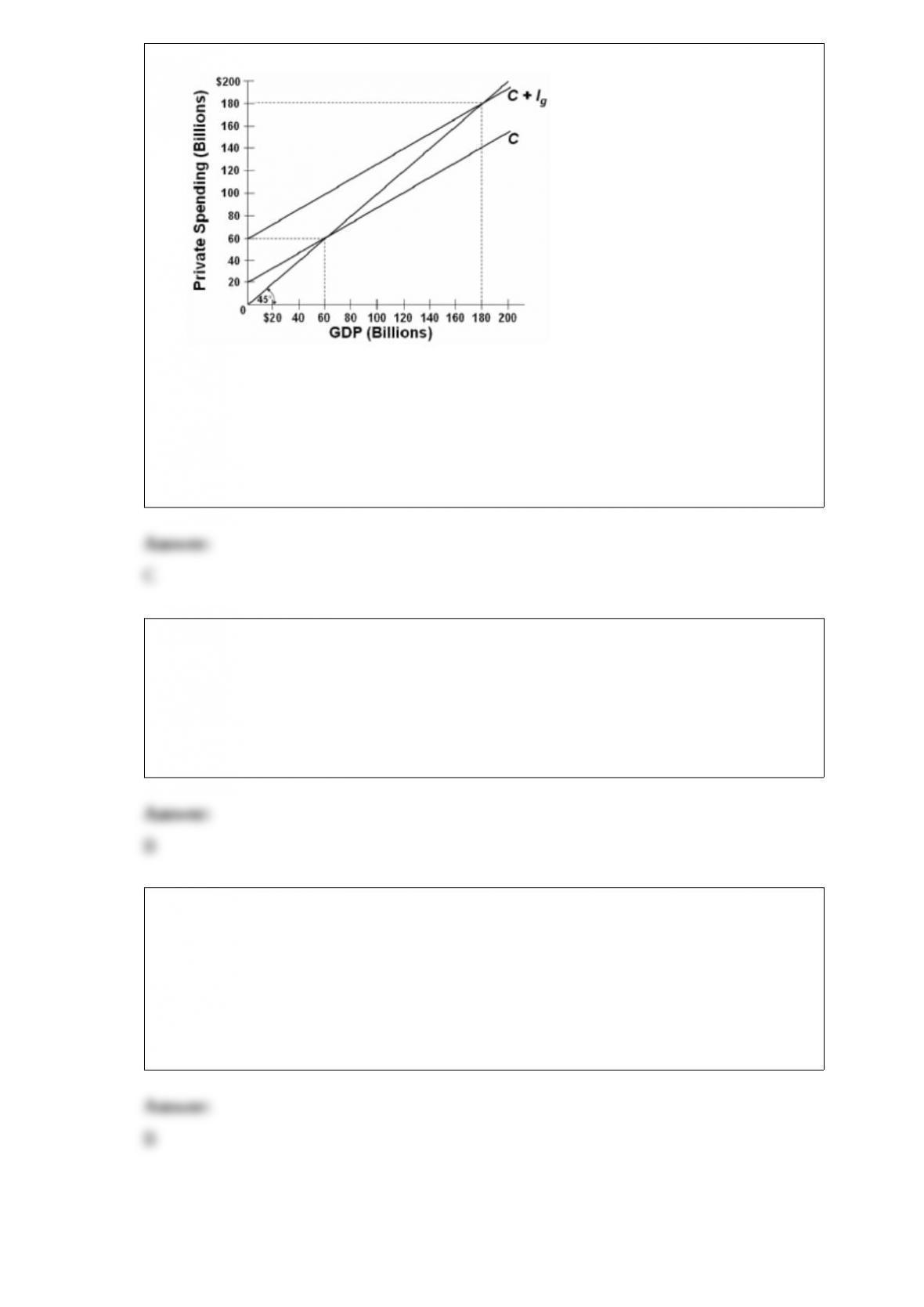
9)
Refer to the above diagram for a private closed economy. Aggregate saving in this
economy will be zero when:
A.C + Ig cuts the 45-degree line.
B.GDP is $180 billion.
C.GDP is $60 billion.
D.GDP is also zero.
10) (Last Word) In 2001, a U.S. court of appeals tossed out an earlier U.S. district court
order that Microsoft:
A.license Windows for sale by competitors.
B.be split into two competing firms.
C.divest itself of its Word and PowerPoint software programs.
D.end its proposed acquisition of Sun Microsystems.
11) Suppose all workers are identical, but working for Ajax is more pleasant than
working for Acme. In all other nonwage aspects the two firms offer the same job
characteristics. We would expect:
A.wage rates at Ajax to be higher than at Acme.
B.wage rates at Ajax to be lower than at Acme.
C.wage rates at Ajax and Acme to be the same.
D.workers at Ajax would have to be monitored more closely than at Acme.
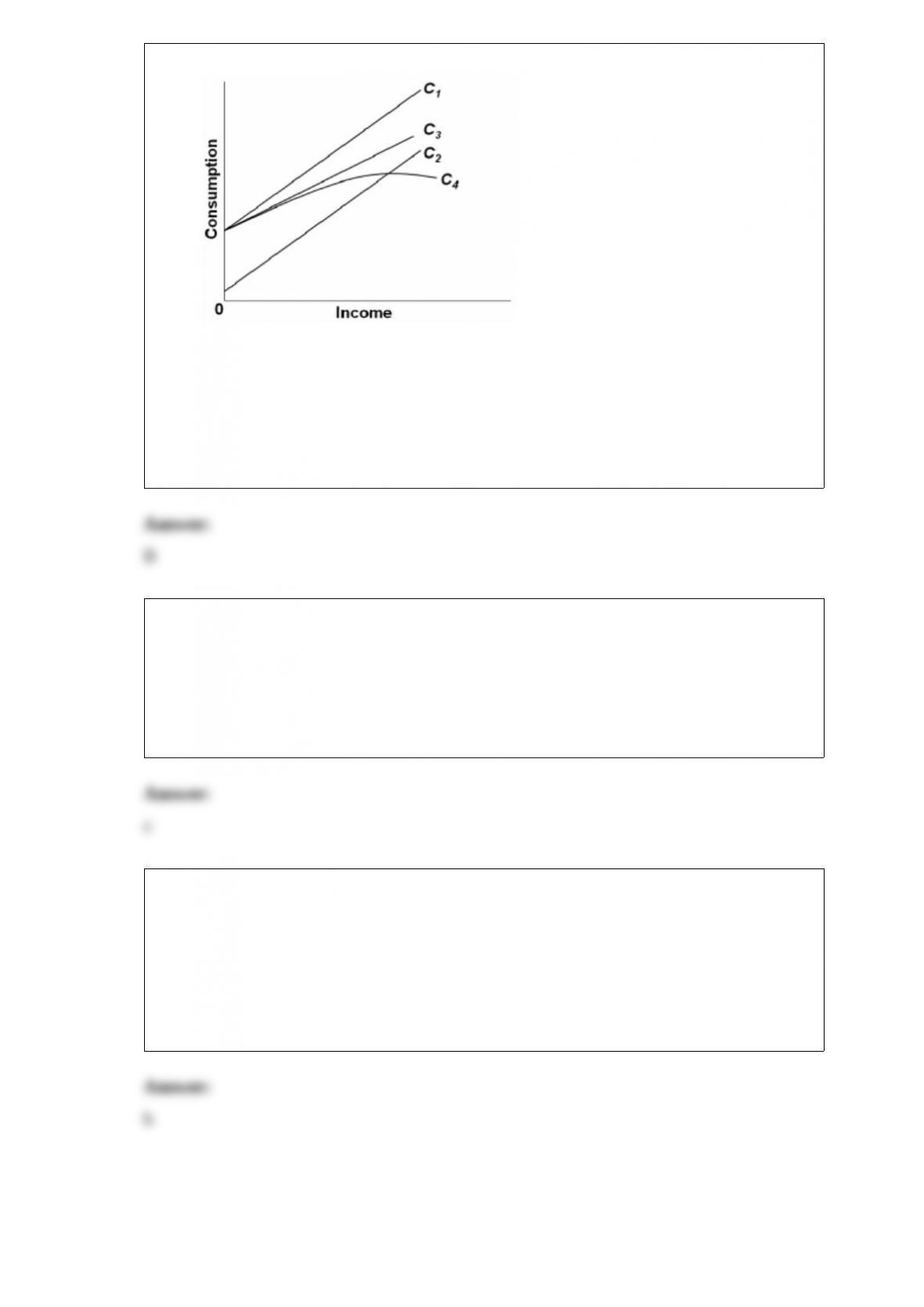
12)
(Advanced analysis) Refer to the above diagram, in which C3 is the before-tax
consumption schedule. The after-tax consumption schedule represented by C2 reflects:
A.a lower MPC than is embodied in C3.
B.a regressive tax system.
C.a proportional tax system.
D.a progressive tax system.
13) macroeconomic stability is said to exist in an economy whenever:
a.there is no inflation.
b.total spending exceeds production capacity.
c.output matches production capacity, labor is fully employed, and inflation is low and
stable.
d.the rates of output growth, unemployment, and inflation are all zero.
14) defensive medicine refers to the idea that:
a.it is more cost-efficient to prevent illnesses than to cure them.
b.physicians may require unnecessary testing as a means of protecting themselves
against malpractice suits.
c.doctors know much more about diagnosing and treating illnesses than do health care
consumers.
d.physicians do not advertise their services or fees.
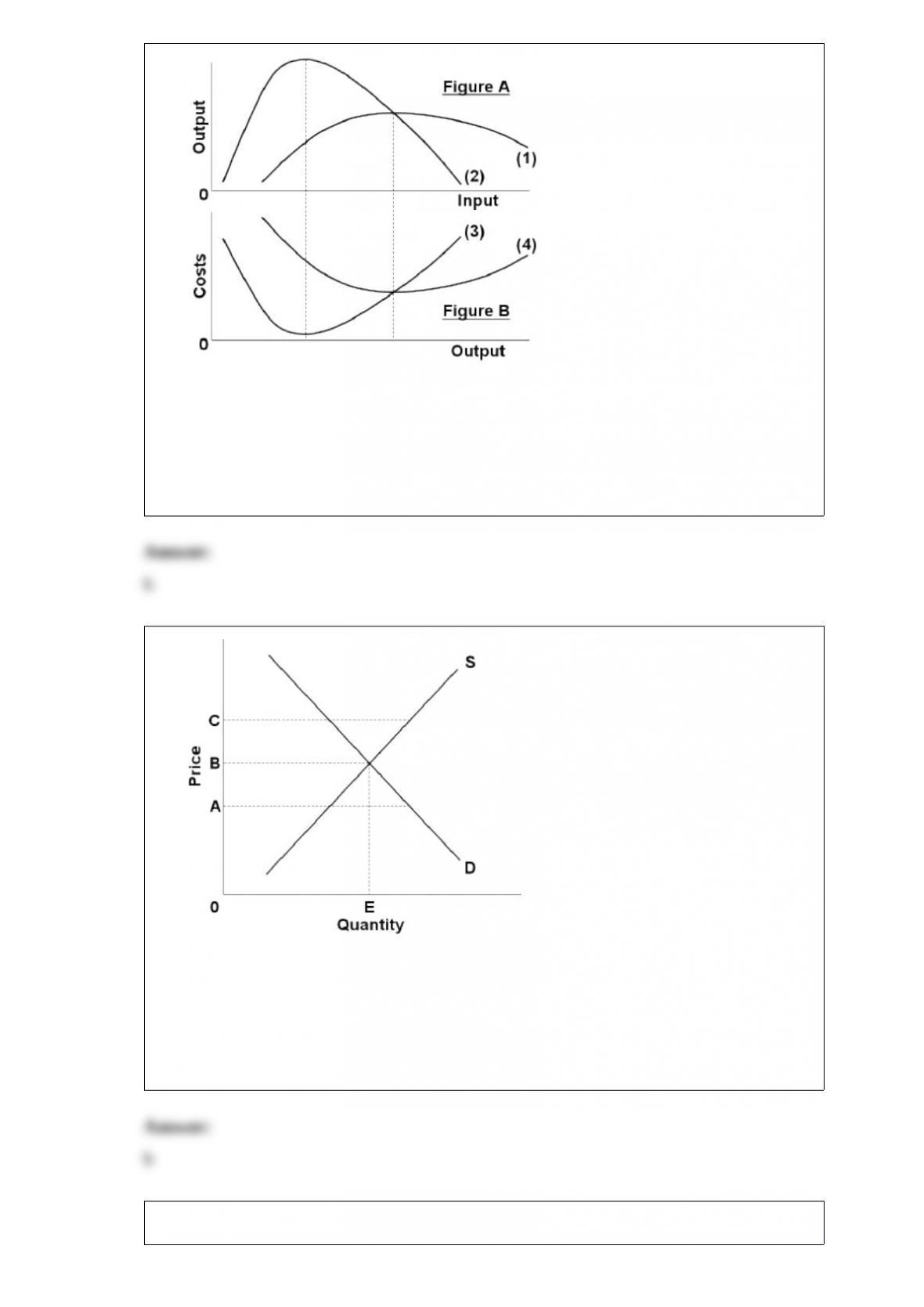
15)
refer to the above short-run production and cost data. the curves of figures a and b
suggest that:
a.marginal product and marginal cost reach their maximum points at the same output.
b.marginal cost reaches a minimum where marginal product is at its maximum.
c.marginal cost and marginal product reach their minimum points at the same output.
d.avc cuts mc at the latter’s minimum point.
16)
refer to the above diagram. a government price support program to aid farmers is best
illustrated by:
a.quantity e.
b.price c.
c.price a.
d.price b.
17) an unprofitable motel will stay open in the short-run if:

a.price (average nightly room rate) exceeds average variable cost.
b.marginal revenue exceeds marginal cost.
c.price (average nightly room rate) exceeds average fixed cost.
d.marginal revenue exceeds price.
18) (Consider This) In the market for used cars:
A.”lemon laws” reduce the demand for, and the price of, used cars.
B.owners of defective cars have less incentive than owners of high-quality used-cars to
sell their cars because buyers refuse to pay high prices for “lemons.”
C.late-model used-cars look like they are brand new and therefore buyers tend to ignore
the possibility that a particular car has defects.
D.new cars lose much of their value immediately when buyers drive them off the
dealers’ lots because potential used-car buyers cannot easily distinguish the defective
“lemons” from the high-quality cars.
19) Which is correct?
A.Wealth is less equally distributed than income and therefore increases income
inequality.
B.Wealth is more equally distributed than income and therefore increases income
inequality.
C.Wealth is less equally distributed than income and therefore decreases income
inequality.
D.Wealth is more equally distributed than income and therefore decreases income
inequality.