
When the oil-exporting countries of the Middle East raised the price of crude oil very
sharply, tens of billions of dollars were transferred from the oil-consuming to the
oil-exporting nations. From this one can conclude that
a. there is no substitute for Middle East oil.
b. the demand for crude oil is highly price elastic.
c. the demand for crude oil is highly price inelastic.
d. the demand curve for crude oil is horizontal.
e. the demand for crude oil is unit-price elastic.
The direct exchange of goods produced for goods consumed is called
a. managed float.
b. appreciation.
c. fractional reserve banking.
d. fiduciary displacement.
e. bartering.
In a market economy, firms decide what and how much to produce on the basis of their

a. income, tastes, and market supplies.
b. marginal and average utilities.
c. humanitarian ideals.
d. costs and what they can charge for their products.
e. orders from a central government planning bureau.
Under which of the following is trade between countries brought into balance through
shifts in currency supply and demand curves?
a. the gold standard
b. the multinational exchange standard
c. fixed exchange rates
d. flexible exchange rates
e. equation of exchange rates
The best economic models
a. are complex.

b. are chosen by secret ballot.
c. make a profit.
d. cannot be quantified.
e. forecast accurately.
A production technique is essentially a
a. level of output.
b. given combination of inputs.
c. type of market structure.
d. form of public regulation.
e. length of time.
In the long run, a monopolist incurring short-run losses is likely to
a. charge the highest price possible.
b. increase the demand.

c. do nothing unless demand conditions change.
d. change the scale of operations.
e. do nothing unless cost conditions change.
Productive activities typically excluded from GDP include
a. government and private transfer payments.
b. sales of secondhand goods.
c. services performed by government.
d. nonmarket transactions.
e. sales and purchases of securities.
The nation’s farm problem follows from
a. a price inelastic demand curve for farm goods coupled with changes in the supply
curve, leading to great variations in price.
b. market demand curves derived by summing across individual demand curves.
c. the lack of good substitutes creating price elastic demand curves.

d. shifts in the demand curve that are greater than shifts in the supply curve over time.
e. too few farmers to permit the efficient operation of free markets.
In the U.S. economy, each percentage point change in the unemployment rate is
equivalent to ________ million people.
a. 8
b. 5.1
c. 3.2
d. 1.5
e. 0.5
Surpluses generally result from
a. price floors.
b. equilibrium prices.
c. price ceilings.
d. fair prices.
e. scientific prices.

Proponents of real business cycle models argue that the correlation between changes in
the money supply and changes in real GDP may reflect the fact that
a. the velocity of money is unpredictable.
b. the quantity of money demanded is relatively insensitive to changes in the interest
rate.
c. as real output increases, the demand for money increases, leading to an increase in
the money supply.
d. the free enterprise economy has strong self-regulating mechanisms promoting full
employment.
e. the equation of exchange varies considerably over the course of the business cycle.
If the supply of an input is fixed, its supply curve is a(n)
a. upward-sloping line.
b. vertical line.
c. downward-sloping line.
d. horizontal line.
e. single point.

Deviations in national output around potential output are called a
a. business cycle.
b. price index.
c. Keynesian equilibrium.
d. market phase.
e. theory.
About what percentage of national output does the United States’ current national debt
represent?
a. between 10 and 25 percent
b. between 25 and 40 percent
c. between 40 and 55 percent
d. between 55 and 70 percent
e. over 70 percent

The Banking Act of 1935 has been called the ‘single most important piece of banking
legislation since the original Federal Reserve Act” because the act
a. guaranteed the solvency of member banks.
b. gave the Fed authority to take a leadership role in setting monetary policy.
c. made the Fed subservient to the Treasury, thus ensuring control of its power.
d. made the Fed a “reactive” agency, thus encouraging more sensitivity to political
pressures of the times.
e. committed the U.S. government to continue backing its currency with gold.
The Fed’s ability to simultaneously control the rate of growth of the money supply and
the level of interest rates is impeded by changes in the
a. supply of money.
b. interest rates.
c. demand curve for money.
d. required reserve ratio.
e. number of banks in the Federal Reserve System.
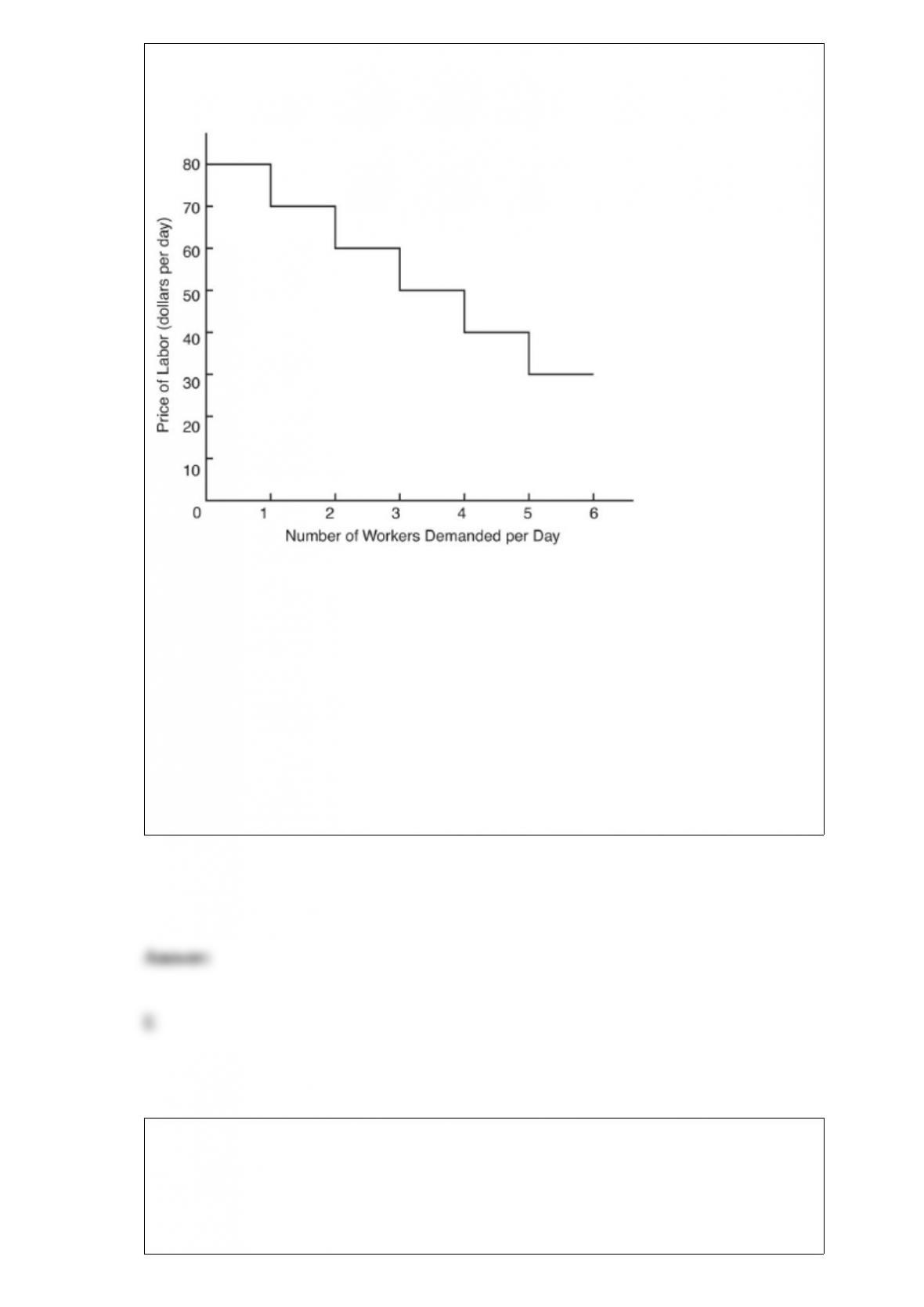
The following questions are based on the following perfectly competitive firm’s demand
curve for labor:
This firm would hire no labor if the price per day rose above
a. $6.
b. $30.
c. $40.
d. $60.
e. $80.
The 1997 Kyoto environmental summit embraced which of the following policies to
reduce worldwide pollution?
a. carbon taxes
b. zero economic growth
c. worldwide effluent fees collected by the United Nations
d. tradable emissions permits
e. internationally uniform targets for greenhouse gas emissions
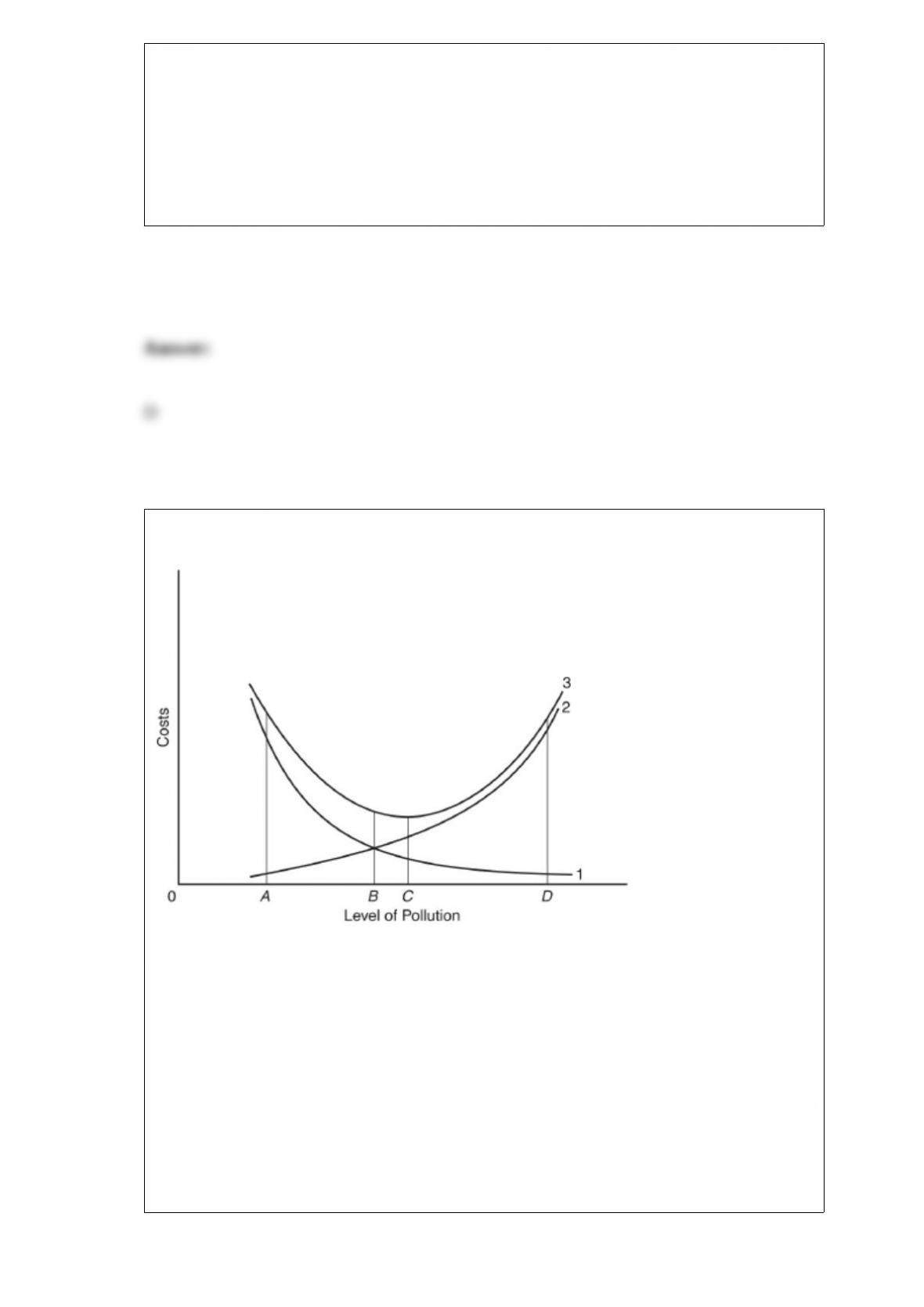
The following questions are based on the following diagram:
Curve 1 represents the
a. cost of pollution to society.
b. cost of pollution control to society.
c. difference between the cost of pollution and the cost of pollution control.
d. sum of the costs of pollution and of pollution control.
e. cost of pollution divided by the cost of pollution control.

The data on the circulation velocity of money since 1920 indicate that the velocity
a. has steadily decreased over time.
b. is quite stable in the short run.
c. tends to increase during depressions and decrease during booms.
d. has been fairly stable over the long run but not over the business cycle.
e. has been directly proportional to GDP.
The goals of those who offer infant industry and national defense as arguments for
tariffs and quota protection might be more efficiently achieved through the use of
a. direct subsidies.
b. moral suasion.
c. wage and price controls.
d. a gold standard.
e. excess profits taxes on importers.

The total of the value added by all U.S. industries equals the
a. net exports.
b. gross business profits.
c. total business sales.
d. gross private domestic investment.
e. gross domestic product.
The crowding-out effect
a. is a basic tenet of Keynesian analysis.
b. occurs when people expect prices to rise as a result of stabilization policy and take
measures to raise their wages.
c. asserts that expansionary fiscal policy will bid up interest rates and reduce private
spending.
d. asserts that an increase in aggregate supply will force down price levels and reduce
competition for output by households and businesses.
e. states that increasing the money supply will lower interest rates, making it impossible
for some borrowers to obtain adequate funds.

Technological change
a. inevitably creates persistent technological unemployment.
b. is reflected in improvements in labor output per hour.
c. increases the intended spending function faster than the growth in output.
d. has no impact on long-run aggregate supply without specific government
intervention to increase it.
e. causes the profitability of existing investment to fall, reducing the intended spending
function.
When the economy is at equilibrium in the horizontal range of the short-run aggregate
supply curve
a. there is little upward pressure on prices because of widespread unemployment.
b. the aggregate demand curve must be horizontal as well.
c. economic conditions similar to those experienced during World War II prevail.
d. real output is equal to potential output.
e. a change in aggregate demand causes price levels to fall.

A bill incorporating a major tax change
a. is first considered by the House Ways and Means Committee.
b. is considered by the House after it is approved by the Senate.
c. may be vetoed by the central bank.
d. is sent to a conference committee when differences exist between Congress and the
president.
e. need be passed only by the House if the two legislative branches cannot agree.
When Adam Smith described the invisible hand, he was talking about
a. the price system.
b. central planning.
c. opportunity cost.
d. the division of labor.
e. disguised unemployment.
The following questions are based on the following diagrams, showing the demand and
supply of U.S. dollars in terms of Danish krone. For all cases D0 and S0 are initial
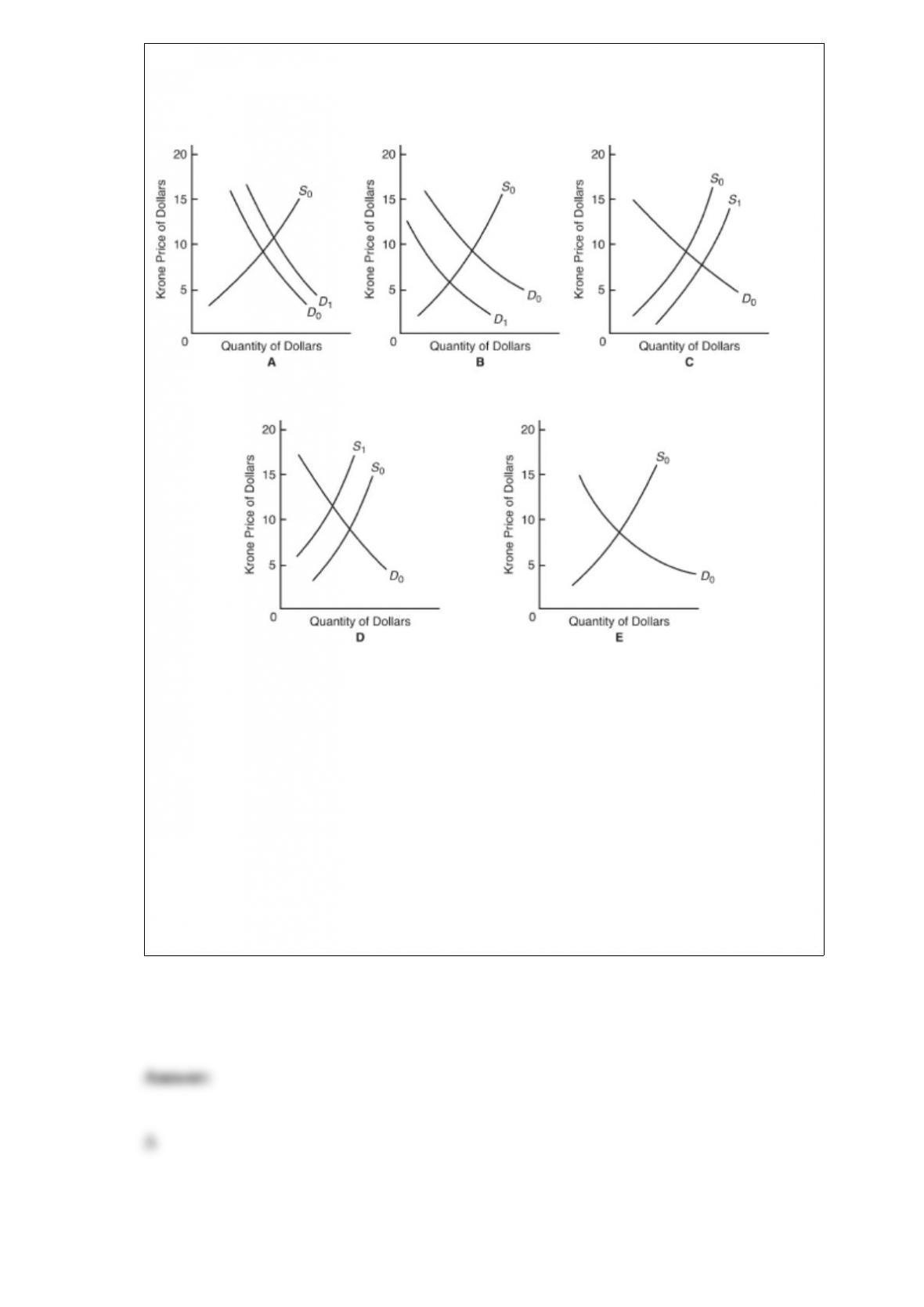
demand and supply and D1 and S1 are new demand and supply. Assume an initial
exchange rate of 9 krone to $1.
Which diagram best illustrates the effect of an increase in the Danish demand for U.S.
computers?
a. A
b. B
c. C
d. D
e. E

An expenditure by the government for which no products or services are received in
exchange is called a
a. tax.
b. public good.
c. transfer payment.
d. multiplier.
e. stabilizer.
The most widely quoted measure of inflation in the United States is the
a. Phillips curve.
b. price output ratio.
c. consumer price index.
d. cost of living adjustment.
e. Dow Jones Industrial Average.
If country A can produce either 10 automobiles or 200 computers with 1 unit of
resources while country B can produce either 8 automobiles or 125 computers with 1

unit of resources, then with respect to the production of computers, country A is
________ country B.
a. relatively less efficient than
b. 28 percent more efficient than
c. 37.5 percent more efficient than
d. 60 percent more efficient than
e. 4.75 times as efficient as
Proponents of a budget that promotes an optimal combination of unemployment and
inflation generally hold that the problems of an increased national debt that may result
are
a. nonexistent.
b. completely avoidable by the use of monetary policy.
c. severe but worth the cost in the long run.
d. completely unpredictable in scope and direction.
e. small in comparison to social problems caused by unemployment and inflation.

In order of their frequency, what are the three basic forms of business organization?
a. proprietorships, corporations, partnerships
b. corporations, proprietorships, partnerships
c. partnerships, proprietorships, corporations
d. proprietorships, partnerships, corporations
e. corporations, partnerships, proprietorships
Currency withdrawals from the banking system
a. expand the money supply.
b. increase bank reserves by an equal amount.
c. reduce the legally required ratio of reserves to deposits.
d. reduce the amount of demand deposits the banking system can create.
e. leave the amount of legally required reserves held with the Fed unchanged.