
Excluded from the list of those having primary responsibility for making fiscal policy is
the
a. president of the United States.
b. Council of Economic Advisers.
c. Federal Reserve System.
d. Congressional Budget Office.
e. Joint Economic Committee of Congress.
In general, appropriate fiscal policy would involve a budget
a. deficit during a recession and a surplus during periods of inflationary full
employment.
b. balanced annually regardless of the economic climate.
c. surplus at all times.
d. that completely eliminates the national debt in a single year.
e. that makes the actual budget deficit equal to the full-employment budget surplus.
The important determinants of the price elasticity of demand are the

a. number and closeness of available substitutes, importance in consumers’ budgets, and
length of the time period.
b. number of markets, size of buyers’ incomes, and empirical validity.
c. number of firms, number of variables that must be held constant, and degree to which
markets are separable.
d. scope and method of measurement and calculation and transitivity of preferences.
e. state of technology, size of the firm’s plants, and size of the absolute change in input
prices and quantity.
A natural monopoly is a likely result whenever
a. the market demand curve is downward sloping to the right.
b. the market demand curve is horizontal.
c. a firm is granted a patent on a new product or process.
d. long-run marginal costs increase as output rises.
e. there are significant economies of scale.
During periods of high inflation, investors tend to buy real estate, art, and commodities

like gold because
a. during inflation these are the only items that are not in short supply.
b. such items tend to grow in value at a rate higher than the inflation rate.
c. real estate and commodities are very cheap during periods of inflation.
d. banks and other lenders are very eager to support such investments.
e. the purchasing power of money rises during inflationary periods.
The cumulative expansion process in the commercial banking system will come to an
end when a bank’s
a. excess reserves equal required reserves.
b. legal reserves equal required reserves.
c. total reserves equal demand deposits.
d. required reserves plus excess reserves equal legal reserves.
e. demand deposits are some fraction of legal reserves.
Difficulties in coordinating and transmitting information in a large firm can lead to

a. increasing returns to scale.
b. falling long-run marginal cost curves.
c. L-shaped long-run average total cost curves.
d. decreasing returns to scale.
e. linear total cost functions.
The political dilemma facing the Eastern European countries as they attempted to
reform their economies in the 1990s was
a. that they had to give up their domestic currency’s convertibility for fixed exchange
rates.
b. the falling price of bread, which was creating unrest among the masses.
c. reduced domestic consumption because their exports were greater than their imports.
d. the need to absorb the current pain associated with reforms whose benefits would be
realized only much later.
e. that in many cases the state-owned enterprises were run much more efficiently than
was possible under private ownership.
If people believe that in the future the government will have to resort to creating money

to pay the interest on debt currently financed by the sale of bonds, they may
a. try to hold less money now, pushing up the current demand for goods and services as
well as the current price level.
b. increase the demand for current government bonds, raising bond prices and reducing
interest rates.
c. reduce current consumption because they expect price levels to fall in the future as
the government is forced to lower taxes.
d. increase their current holdings of government bonds because they expect interest
rates on government bonds to rise.
e. do any of the above since government deficits have an unpredictable impact on the
economy.
In the 1990s, thousands of new companies were formed to take advantage of the
a. pure rate of interest.
b. single-tax movement.
c. Internet.
d. investment tax credit program.
e. anti-usury laws.

The more sophisticated version of the quantity theory of money concludes
a. nominal GDP is proportional to the money supply.
b. real GDP is proportional to the money supply.
c. the money supply should be kept constant to ensure steady growth in GDP with
declining prices.
d. investment expenditures are quantitatively more important than consumption
expenditures.
e. the circulation velocity of money is extremely volatile.
Under the gold standard, a country with a rising price level
a. must decrease the price of gold.
b. sees its currency appreciate.
c. imports more than it exports.
d. eventually runs out of gold.
e. has an inflow of gold.
The following questions are based on the following diagram:
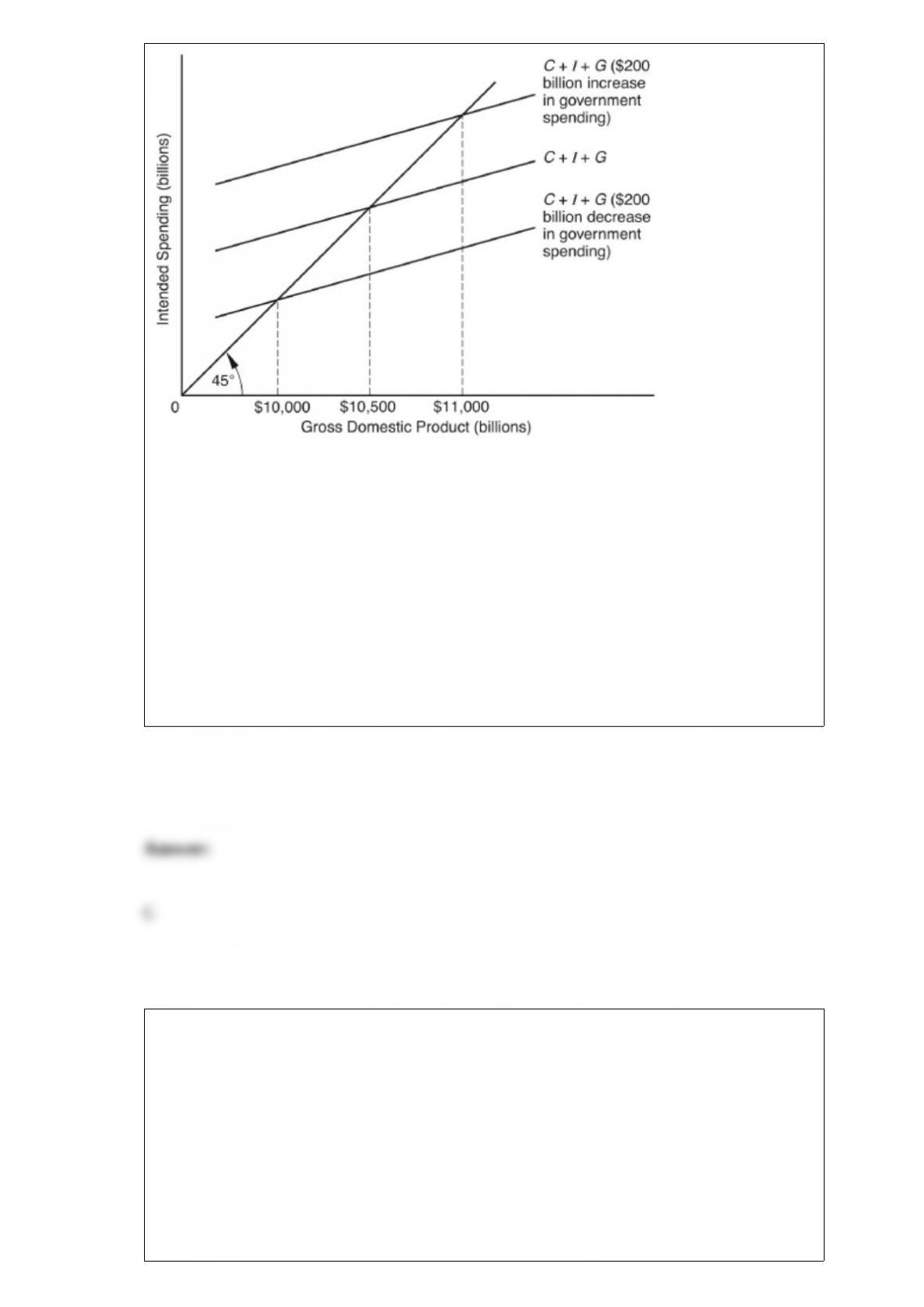
From the diagram, one can infer that the
a. C + I + G line cannot change.
b. marginal propensity to save is 1.
c. multiplier is 2.5.
d. 45-degree line is unstable.
e. total intended spending always equals GDP.
In 1997, weekly payrolls in manufacturing were $553, while the consumer price index
was 161 (1982″84 = 100). In terms of base-period dollars, real weekly earnings for the
quarter were
a. identical to real weekly earnings in 1982″84.
b. greater than $553.
c. equal to $553.

d. less than $553.
e. impossible to determine from the information given.
A possible reason for the existence of increasing returns to scale is
a. the inability of a firm to increase all inputs proportionately.
b. the problems of coordination and control.
c. higher input prices.
d. larger fixed costs with a larger plant size.
e. greater specialization.
When firms compete aggressively through advertising and product development, it is
called ________ competition.
a. perfect
b. nonprice
c. natural
d. foreign
e. attributive
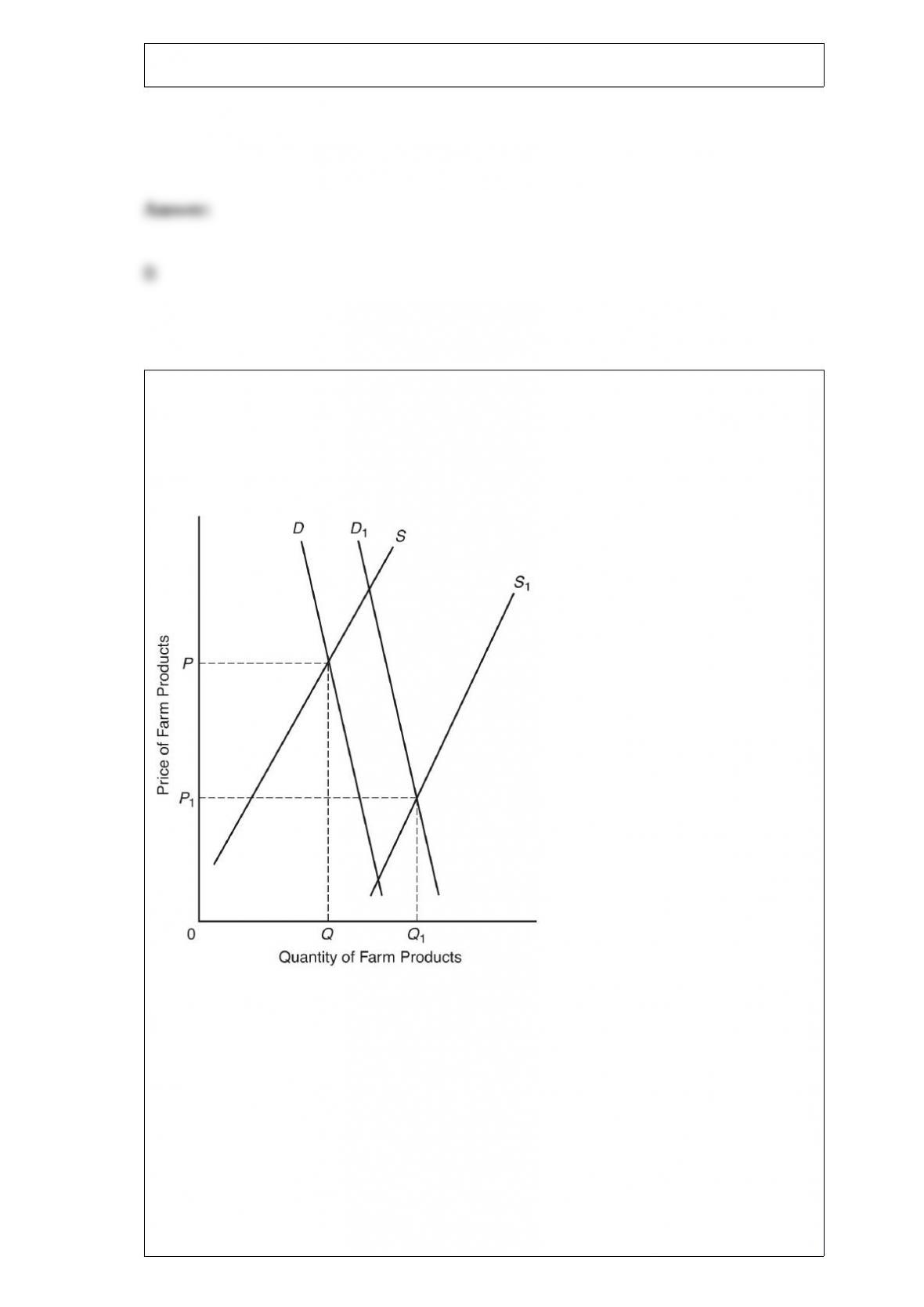
The following questions are based on the following graph. The curves D and S
represent the market demand and supply curves for farm products in 1960. The curves
D1 and S1 represent the market demand and supply curves for farm products in It is
supposed that there were no support programs in either year.
From the event depicted in the graph, one can conclude that, over the period in
question, farm
a. prices and output fell.
b. prices and output rose.
c. prices and income rose.
d. output and income fell.

e. prices fell and output rose.
Costs incurred by a firm when it changes its prices are called ________ costs.
a. opportunity
b. fixed
c. menu
d. variable
e. advertising
The system of checks and balances that guides the decisions of corporate managers is
known as
a. implicit contracts.
b. corporate governance.
c. the production function.
d. profit maximization.
e. collective bargaining.

If the U.S. government were to impose a quota on shoes imported from Italy, the
a. price of shoes in the United States would remain the same but the quantity bought
would rise.
b. United States would reduce its export of shoes.
c. price of shoes in Italy would rise.
d. total quantity of shoes purchased (both domestically produced and imported) would
decline in the United States.
e. revenue raised would exceed that from a tariff (which would have had the same effect
on the shoe market).
In the diagram, movement toward equilibrium would cause the
a. supply curve to shift to the right and the demand curve to shift to the left.
b. actual price to fall below $10 and the quantity supplied and demanded to fall.
c. actual price to remain the same but the supply to drift to the left as producers cut
down on production.
d. actual price to rise above $10 and the quantity demanded to fall.
e. actual price to fall below $10, the quantity supplied to fall, and the quantity
demanded to rise.

If a $100,000 household consumes 50 percent of its income whereas a $10,000
household consumes 90 percent of its income, then a 5 percent sales tax
a. affects both households equally.
b. effectively taxes the income of the low-income household at the rate of 4.5 percent
and the income of the high-income household at 2.5 percent.
c. taxes the incomes of both households at the rate of 5 percent.
d. costs the low-income household $500 per year and the high-income household
$5,000 per year; therefore, a greater burden is placed on the high-income household.
e. effectively duplicates the impact of a rising marginal tax rate.
Holding money to fund current purchases is called the ________ demand for money.
a. precautionary
b. speculative
c. transactions
d. aggregate
e. penultimate

If full employment is defined by an unemployment rate of 5 percent, potential GDP can
be estimated by multiplying
a. last year’s GDP times 1.05.
b. the average output of the workforce times 95 percent.
c. the normal hours of work times last year’s GDP times 100.
d. 95 percent of the labor force times the normal hours of work per year times the
average output per hour of work.
e. the normal hours of work per year times the average output of the white-collar
worker at the relevant time times 95.
One popular measure of the rate of technological change is the rate
a. of profit from research and development.
b. of increase in the capital-output ratio.
c. of investment in human capital.
d. at which the gap between actual and potential output is narrowed.
e. of growth in output per worker.

A favorable supply shock
a. shifts aggregate demand to the right.
b. shifts aggregate supply to the right.
c. shifts aggregate demand to the left.
d. shifts aggregate supply to the left.
e. has no effect on either the aggregate supply or aggregate demand, only on the
quantities supplied and demanded.
When money serves as a common denominator for measuring the exchange rates
among goods and services, it performs as a
a. medium of exchange.
b. store of value.
c. standard of value.
d. measure of fiat.
e. standard of intrinsic worth.

The basic assertion of those who argue that the long-run Phillips curve is vertical is that
a. both unemployment and price stability can be achieved through proper discretionary
monetary and fiscal policies.
b. over the long run, the Phillips curve is useful for making economic policy tradeoffs
between inflation and unemployment.
c. inflation is caused by cost-push forces and can be reduced only by wage and price
controls.
d. expansionary monetary and fiscal policies improve the rate of unemployment only
temporarily because they also change inflationary expectations.
e. the natural rate of unemployment will fall to zero over time.
Government aid to agriculture in the United States
a. has not been effective in increasing the net worth of farm households.
b. has eliminated acreage allotment programs.
c. has restricted most agricultural exports to less developed countries.
d. has been costly and inefficient.
e. made the farmers responsible for storing the surpluses.

The ________ administration is associated with a 10 percent surcharge on income taxes
to reduce inflationary pressure.
a. Kennedy
b. Johnson
c. Ford
d. Carter
e. Reagan