
All goods that generate external benefits are public goods.
A private good with external benefits is a public good.
A monopolistically competitive firm influences market price by virtue of its size.
People will buy more of a normal good when their income decreases.

If the price elasticity of demand for tablets is 3, then a 10% increase in the price will
result in an increase in total revenue.
An increase in demand shifts the demand curve to the right, increasing the equilibrium
price.
Studies have shown that the tit-for-tat strategy is ineffective at maintaining a price
fixing agreement.
A small, one-unit change in value is called a marginal change.

Suppose that the price elasticity of demand for milk is 0.9 and the price elasticity of
supply for milk is 1.1, then a 6% increase in the demand for the product can be
expected to increase the price by 2.5%.
Using the midpoint formula, the percent change of the number of TVs from 1 to 2
should be the same if you instead go from 2 to 1.
If demand for a good is elastic and price rises, total revenue will fall.

If you buy a 1 gallon paint and the manufacturer gives you $5 dollars off mail in rebate
and you mail the receipt to claim the rebate. You are not willing to pay as much as the
typical consumer.
In oligopoly the actions of one firm has a perceptible affect on the other firms.
Some firms in monopolistically competitive markets differentiate their products by their
physical characteristics.
A tax on the likelihood of being in a collision will help internalize the external costs of

collisions.
If the price of organic milk increases by 10% and quantity demanded falls by 20%, then
the price elasticity of demand for organic milk is 2.
Entry into a market can be deterred by practicing limit pricing.
The Clayton Act outlawed specific practices that discourage competition.

From the perspective of consumers, a quota is preferred to a tariff.
The prisoners’ dilemma is one reason why police must guard against false confessions.
Opportunity cost is the difference between the benefit and cost of some action.
If the price elasticity of demand is 2 then a 4% increase in the price of the product can
be expected to reduce quantity demanded by 8%.

Entry of new firms in an increasing-cost industry leads to an downward shift of the
LRAC curve.
When a firm’s economic profit is equal to one, the firm is at the break-even point.
If the cost of producing a good goes down, this will cause the equilibrium price of the
good to go down and the equilibrium quantity of the good to go up.

The reason why economists do not need details regarding the topography of a region
when determining driving directions is because the topography is irrelevant to complete
your objective of getting to a certain place.
Economists will always reach the same conclusion in their positive analyses.
A contestable market has low entry and high exist costs.
Among the rationales for protection is that it helps the domestic economy grow.

Marketable pollution permits increase the amount of pollution generated because firms
that don’t want to reduce pollution can buy the right to pollute.
There are winners and losers from licensing programs such as a taxi medallion policy.
The losers are producers, who receive lower prices for taxi rides.
A consumer’s budget line is very similar with a demand curve in that both curves show
the possible combination of two goods.
UG Tech Inc. is a perfectly competitive firm producing wireless mouses where marginal
revenue is equal to marginal cost. The current market price of wireless mouse is $30.00.
UG Tech Inc. sells 500 wireless mouses. Its short run average variable cost is $10.00
and its average fixed cost is $5.00. What should UG Tech Inc. do?
A) Continue to produce because price exceeds short run average variable cost.
B) Shut down and produce zero sandwiches because price is less than short run average
variable cost.
C) Decrease production so that short run average variable cost will decrease.
D) Increase production so that average fixed cost will decrease.
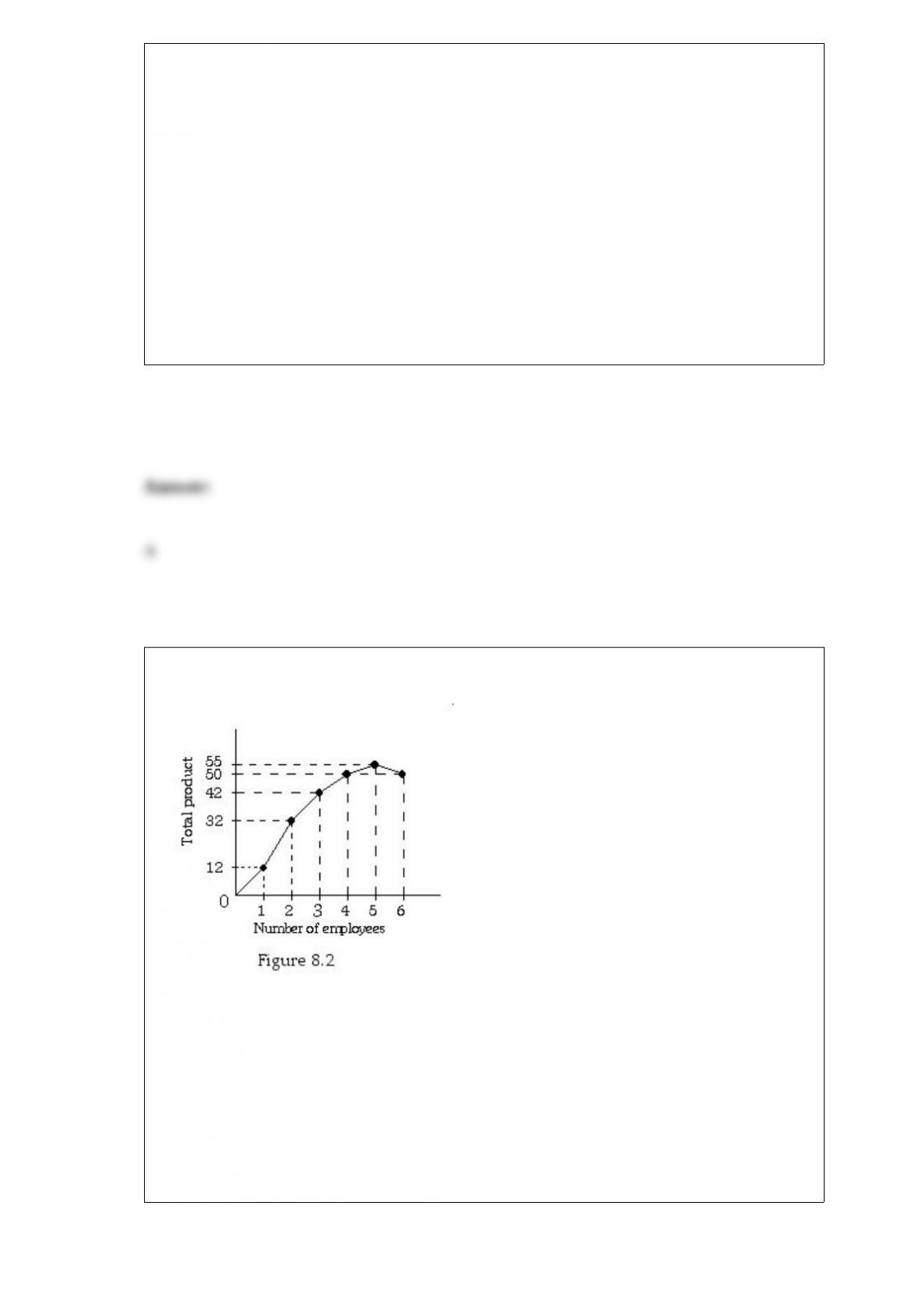
Refer to Figure 8.2. The marginal product of the sixth worker is ________.
A) 0
B) 5
C) -5
D) 50

Suppose the market price for bagels is $1.50 each. If Fresh Bagels Bakery’s marginal
cost of producing that bagel is $0.75, its producer surplus from that bagel is:
A) $0.
B) $0.25.
C) $0.75.
D) $1.25.
Which of the following is likely to have an elastic demand?
A) salt
B) textbooks
C) coffee
D) movies
Suppose that Carol is the owner of a candle factory. Carol wants to know what will
happen if the price of the candles being sold drops below the shut-down price.
A) Carol’s total revenue will be equal to total fixed costs.
B) Carol’s total revenue will exceed total variable costs.
C) Carol’s total revenue will be less than total variable costs.
D) Carol’s total revenue will be maximized.
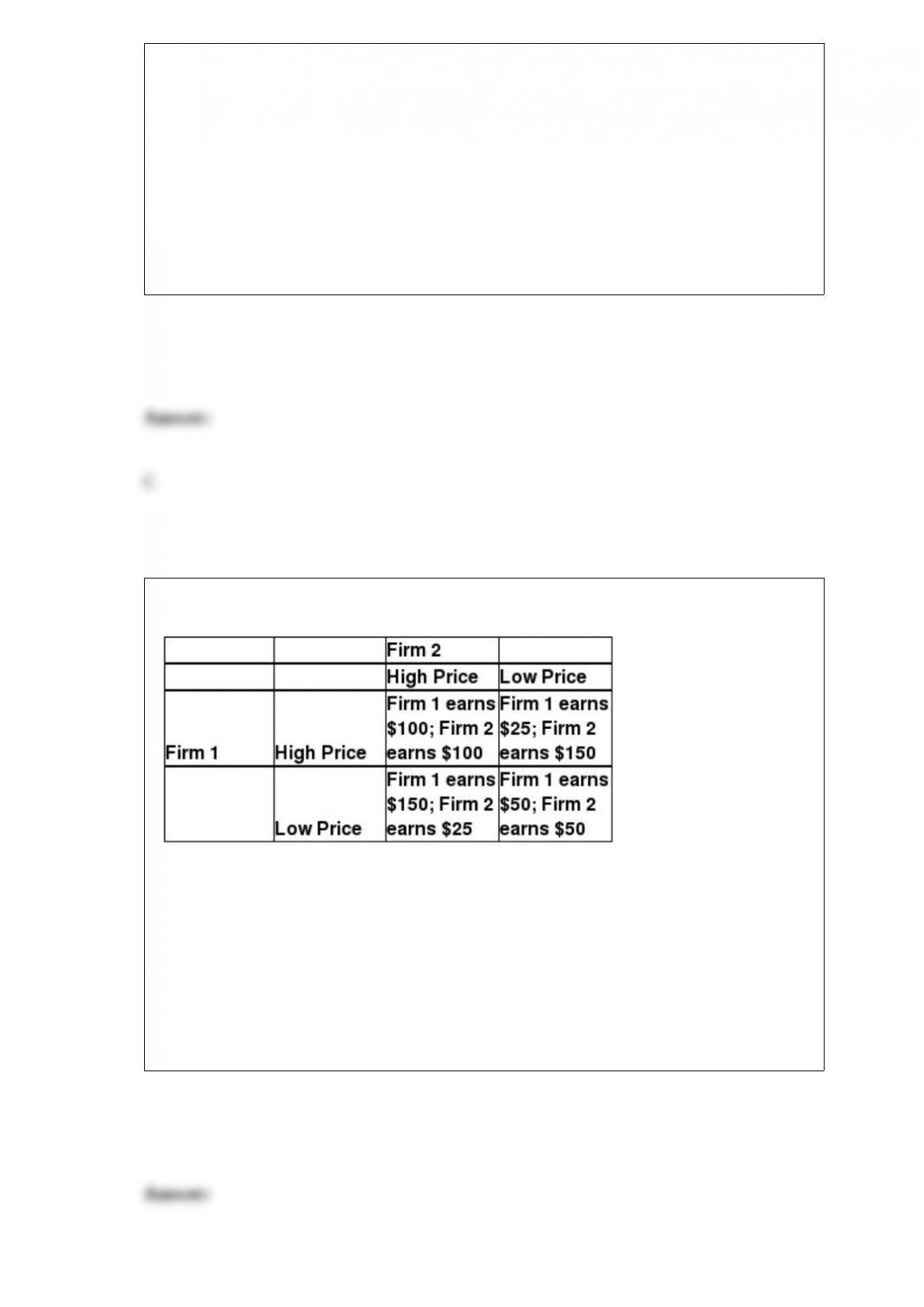
In the game shown in Table 12.2, the firms:
Table 12.2
A) both have a dominant strategy of choosing a low price.
B) both have a dominant strategy of choosing a high price.
C) do not have a dominant strategy.
D) will alternate between high price and low price strategies.

Which of the following factors would indicate an inelastic demand?
A) The good is a necessity, rather than a luxury.
B) The good represents a small fraction of the budget.
C) Demand is measured over a shorter period of time.
D) all of the above
Suppose that the percentage change in supply is 20%, the price elasticity of demand is
3, and the percentage change in the equilibrium price is 4%. What is the price elasticity
of supply?
A) 0
B) 2
C) 4
D) 5

If the number of people with the skills necessary to perform a job increases, labor
________ shifts ________.
A) demand; left
B) demand; right
C) supply; left
D) supply; right
There exists asymmetric information in a market:
A) if both sides of the market have the same information about the good.
B) only if buyers have better information about the good than sellers.
C) only if sellers have better information about the good than buyers.
D) if either buyers or sellers have better information than the other group.
The study of the choices made by individual households, firms, and government is
called:
A) macroeconomics.
B) microeconomics.

C) managerial economics.
D) market economics.
If in the short run the firm incurs zero marginal cost, then the firm will:
A) never shut down.
B) shut down if the price is greater than the average variable cost.
C) shut down if the price is less than the average total cost.
D) shut down if the marginal cost equals the marginal revenue.
When a monopolist charges a low price to drive out competition, then charges a high
price, the monopolist is engaging in:
A) a trust agreement.
B) a merger.
C) duopoly pricing.
D) predatory pricing.
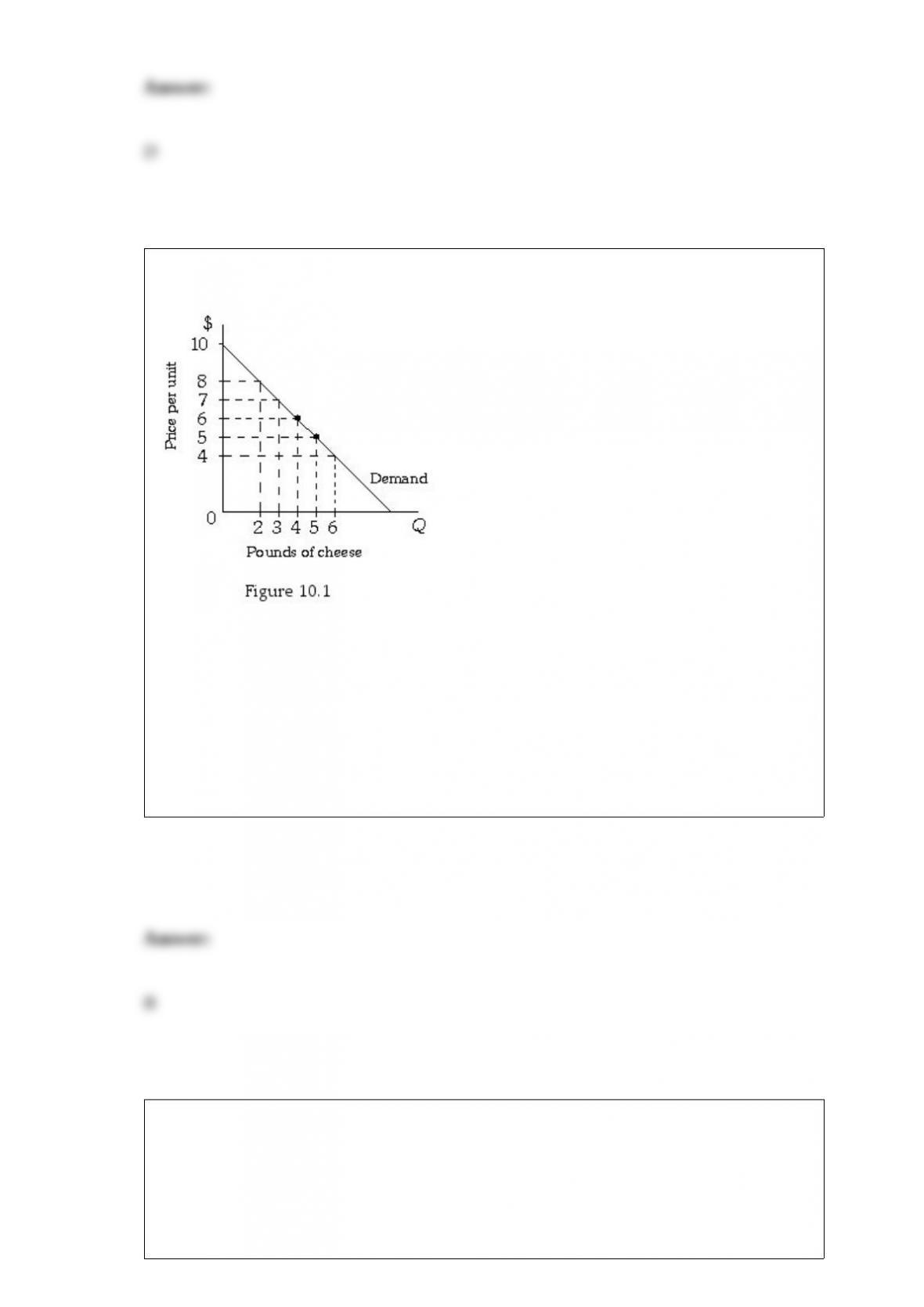
Refer to Figure 10.1. The marginal revenue of the sixth pound of cheese is:
A) -$4.
B) -$1.
C) $1.
D) $4.
Price discrimination is related to elasticity because:
A) the firm can increase revenues by charging customers with elastic demands higher
prices and charging customers with inelastic demands lower prices.
B) the firm can increase revenues by charging customers with elastic demands lower

prices and charging customers with inelastic demands higher prices.
C) the firm can increase revenues by charging all customers higher prices.
D) None of the above; elasticity and price discrimination are unrelated.
The midpoint formula for elasticity of demand solves the problem of:
A) whether elasticity of demand is really positive or negative.
B) whether to use quantity or price in the numerator.
C) which price or quantity to use as the initial value of the variable.
D) whether to use quantity demanded or supplied.
The change in total variable cost resulting from a one-unit increase in the change in
quantity is:
A) average variable cost.
B) marginal cost.
C) average total cost.
D) opportunity cost.
Economists call the phenomenon that leads individual consumers and producers to the
market equilibrium:
A) the invisible foot.
B) the invisible head.
C) the invisible arm.
D) the invisible hand.
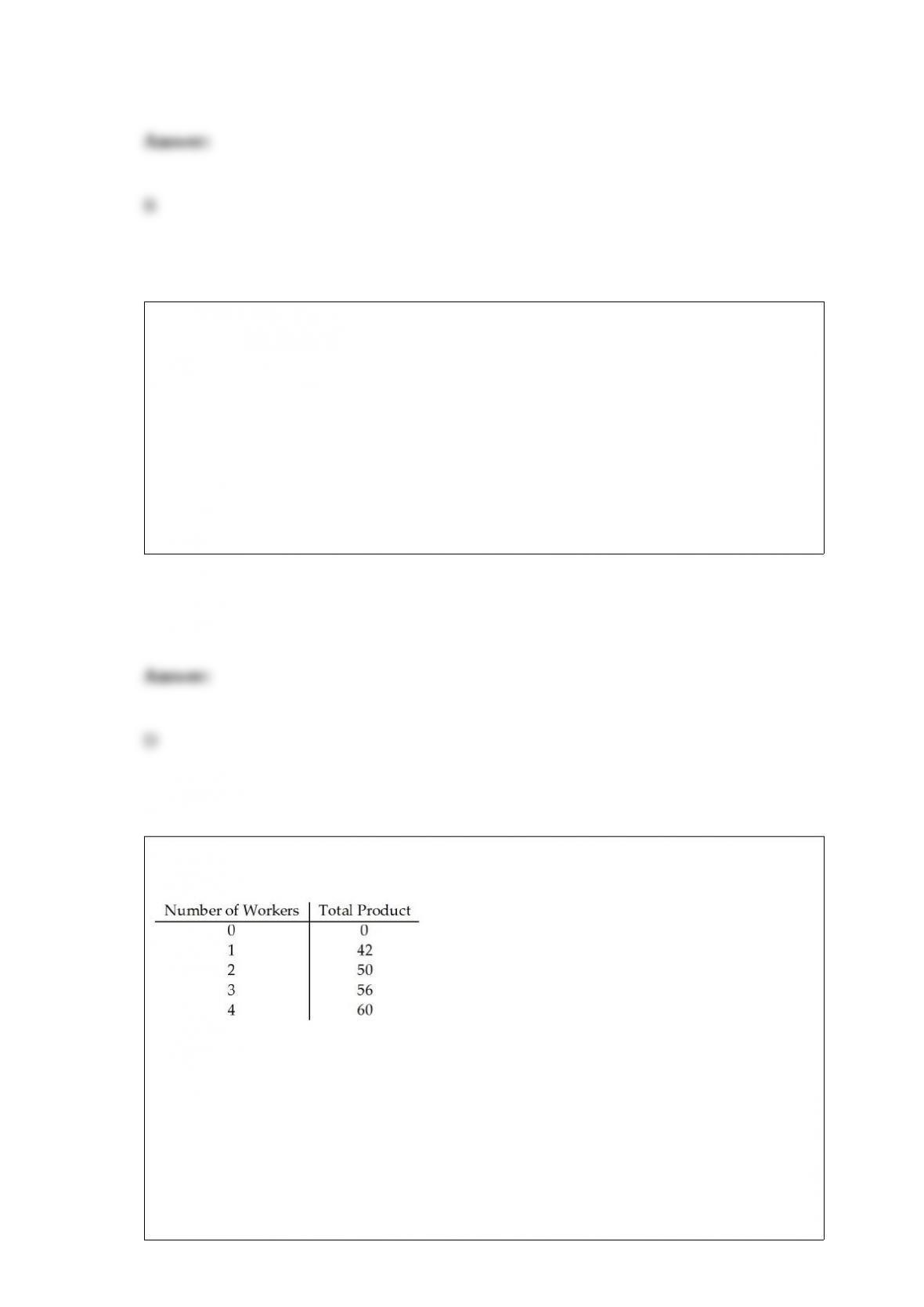
Refer to Table 17.4. If the wage rate is $12 and the output sells for $3 per unit, how
many workers will the firm hire?
Table 17.4
A) 1
B) 2
C) 3

D) 4
Recall the Application. The developer who was interested in building a casino in
Creswell, Oregon was willing to offering the citizens of Creswell a yearly cash payment
if they voted to approve his casino because in Creswell, the casino market would most
likely be:
A) perfectly competitive.
B) monopolistically competitive.
C) an oligopoly.
D) a monopoly.
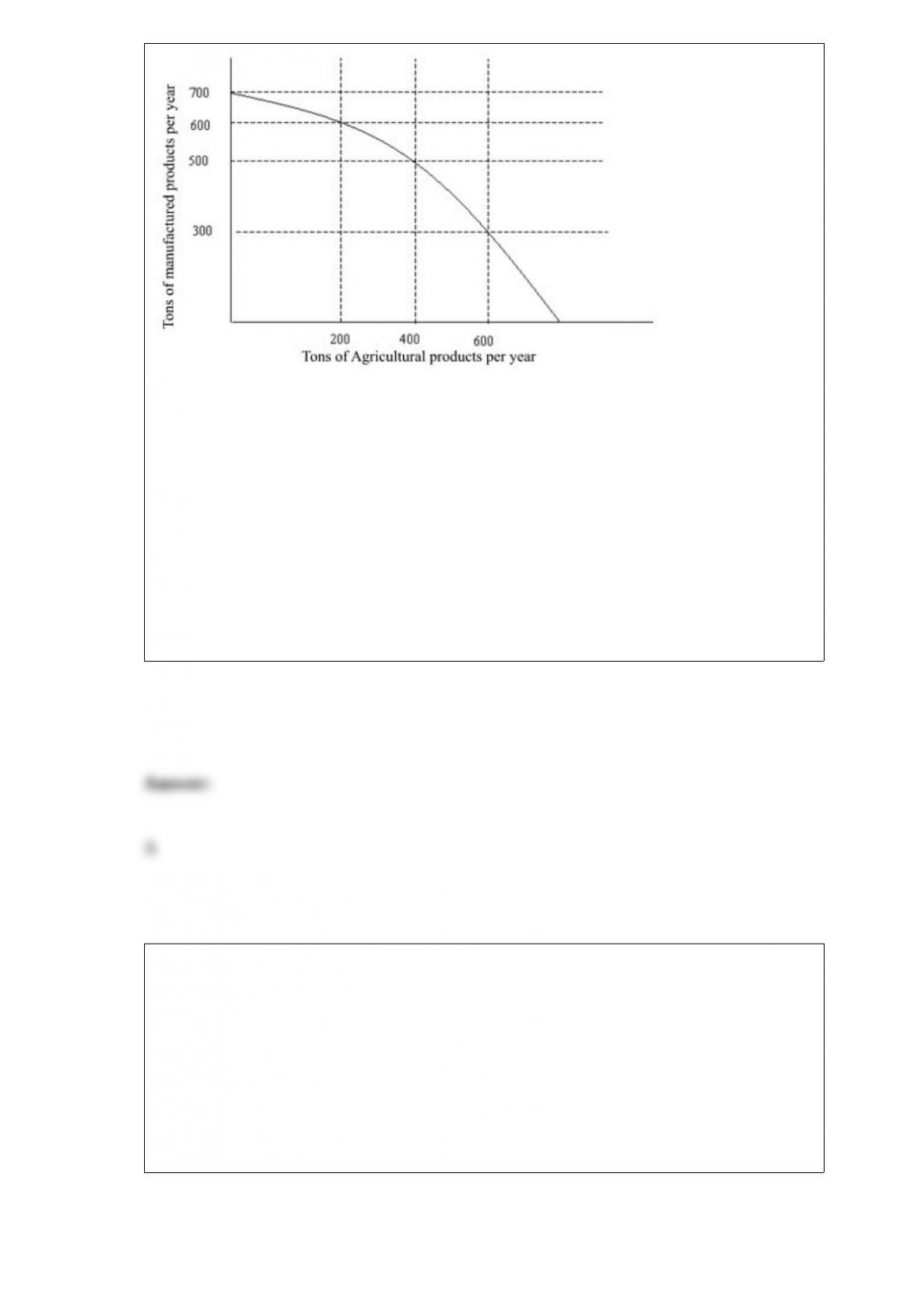
Figure 2.1
If you are producing 600 tons of agricultural products per year, what is the maximum
amount of manufactured products you can produce per year?
A) 300 tons
B) 500 tons
C) 600 tons
D) 700 tons
If we observe that the price is rising in the sugar market, it could be due to:
A) an excess supply of sugar.
B) an excess demand for sugar.
C) an increase in the supply of sugar.
D) a decrease in the demand for sugar.

Positive economics:
A) is the focus of most modern economic reasoning.
B) concerns the forces that affect economic activity.
C) predicts the consequences of alternative actions.
D) All of the above are correct.
Tom would be willing to pay a maximum of $2,500 to attend the Super Bowl this year,
and he can buy a ticket for $2,050. His consumer surplus is:
A) $25.
B) $50.
C) $275.
D) $450.

A group of people has formed a house cleaning and yard maintenance business. The
number of houses or yards that they can clean or maintain in any given day is depicted
in Table 2.1. The opportunity cost of cleaning the second house in a day is:
Table 2.1
A) 1 yard maintained.
B) 2 yards maintained.
C) 3 yards maintained.
D) 18 yards maintained.
The more substitutes there are for a product:
A) the less price elastic the demand for the product is.
B) the more price elastic the demand for the product is.
C) the greater the income elasticity for the product.
D) the smaller the income elasticity for the product.
When the government eliminates artificial barriers to entry:
A) more firms will enter the market.
B) prices to consumers will likely increase.
C) competition in the market will decrease.
D) All of the above will occur.
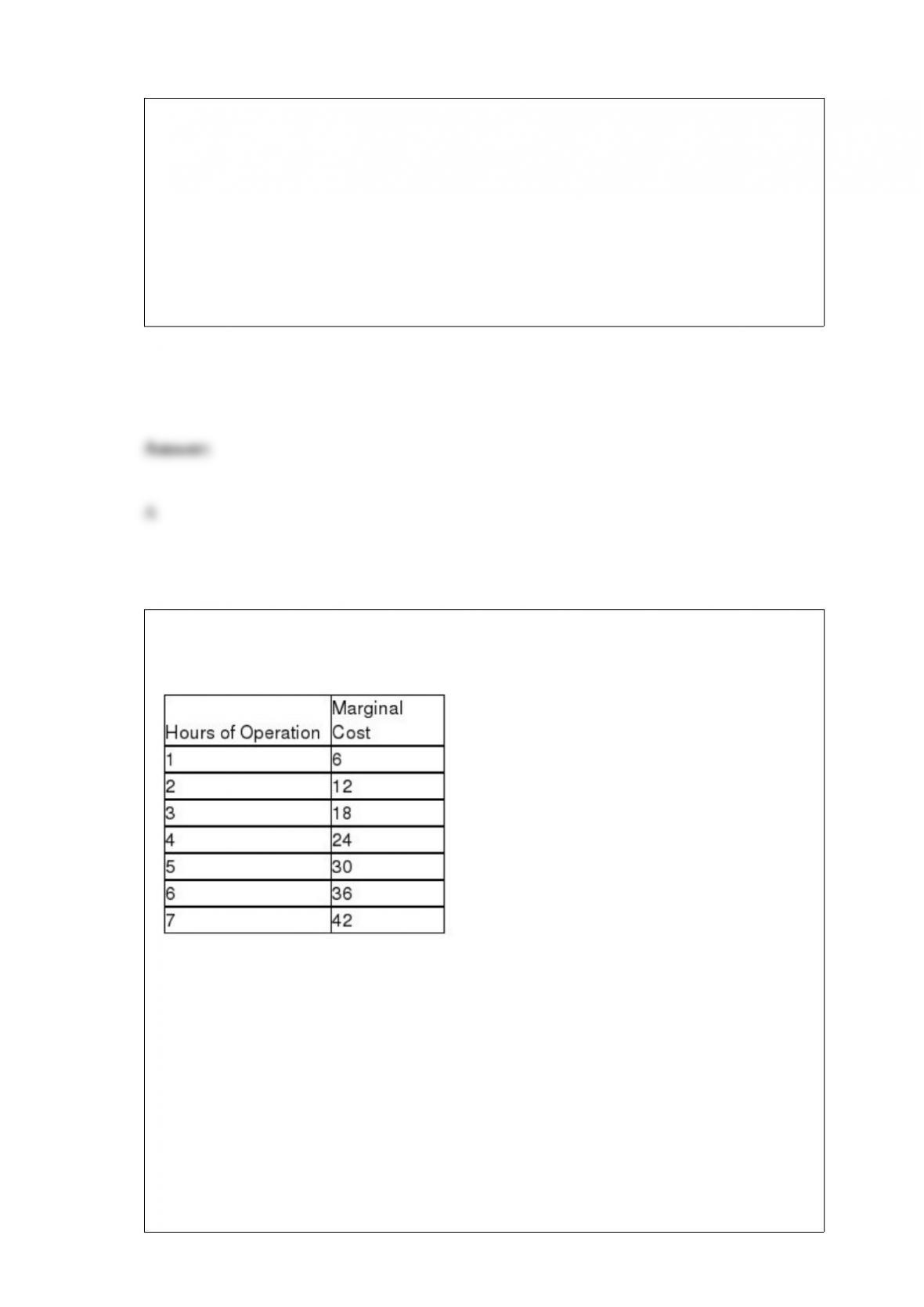
Krystal runs a nail salon and needs to decide how many hours to stay open. Table 2.2
illustrates her marginal costs of staying open for each additional hour.
Table 2.2
Suppose that we observe Krystal staying open 5 hours and her marginal benefit of
staying open per hour is $18. If she is following the marginal principle, Krystal should:
A) stay open 2 more hours.
B) stay open 3 more hours.
C) stay open 2 fewer hours.
D) stay open 3 fewer hours.
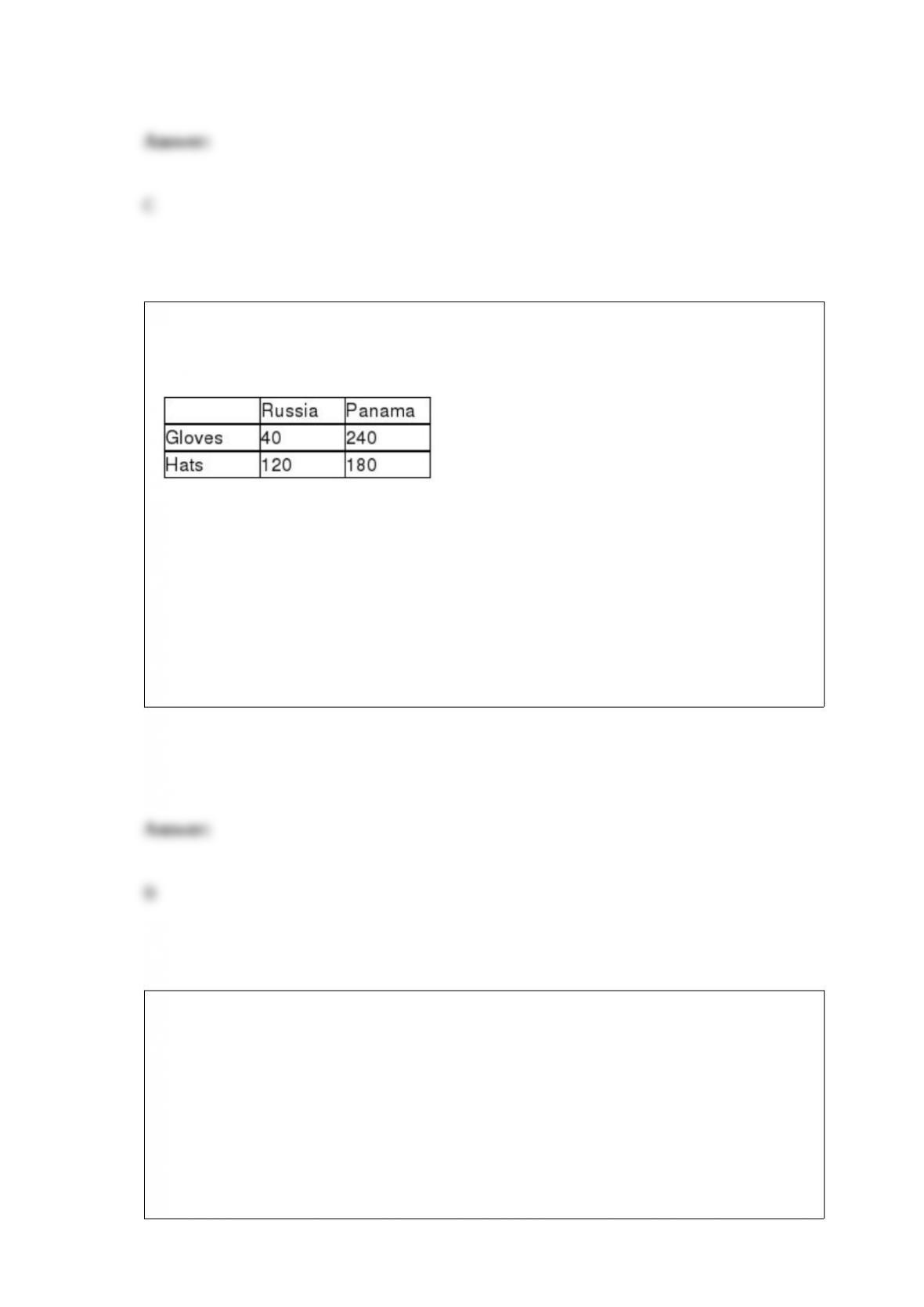
Refer to Table 18.1. The opportunity cost of a glove in Panama is:
Daily Output of Russia and Panama
Table 18.1
A) 1/8 of a hat.
B) 3/4 of a hat.
C) 4/3 hats.
D) 8 hats.
The slope of the production possibilities curve is:
A) positive.
B) positive and increasing.
C) positive and decreasing.
D) the opportunity cost of one good in terms of the other.
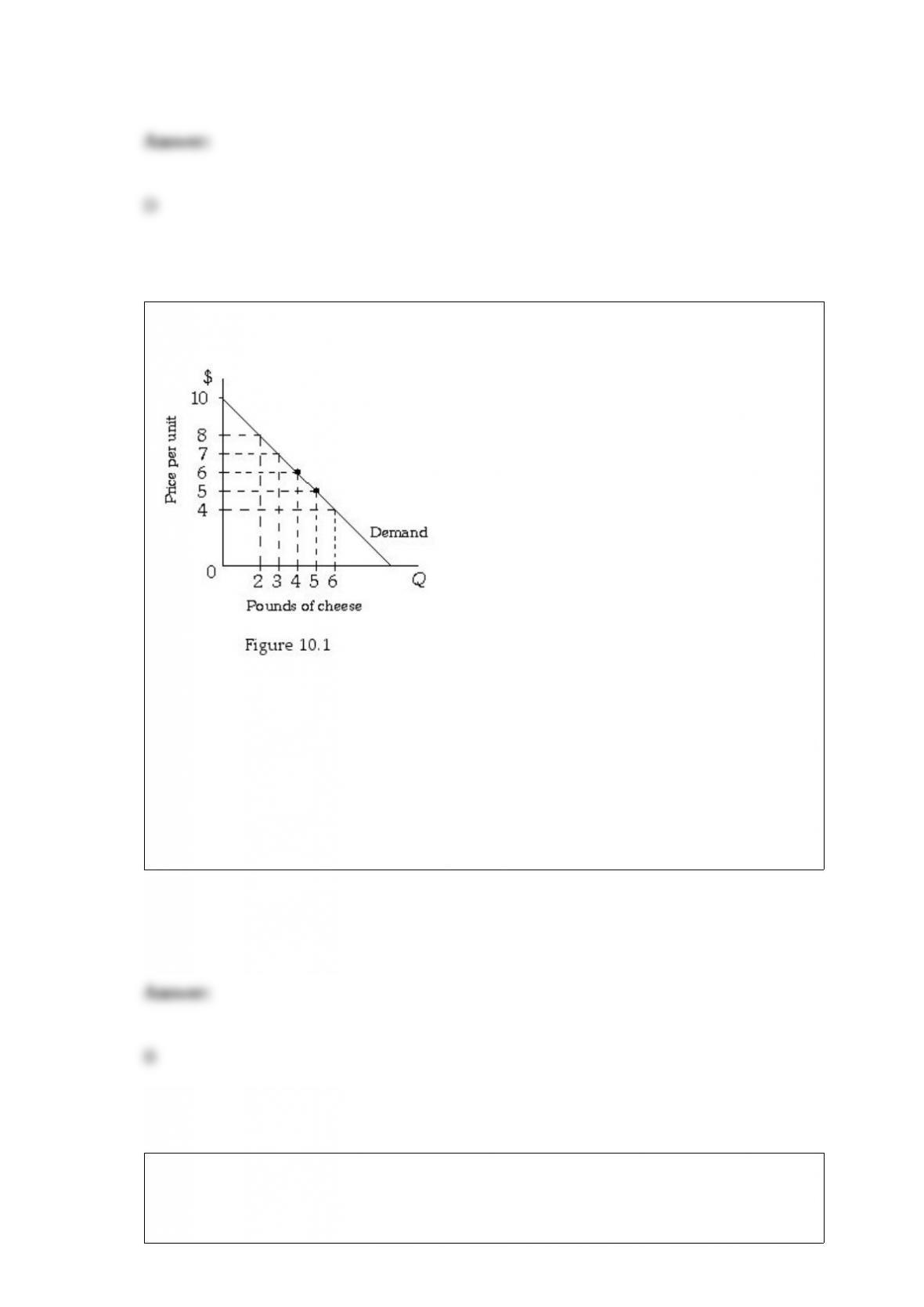
Refer to Figure 10.1. The marginal revenue of the fifth pound of cheese is:
A) $2.
B) $1.
C) $5.
D) $25.
If a profit-maximizing firm in a perfectly competitive market is currently producing the
output where (price – average variable cost) > average fixed cost, the firm is:

A) making a positive economic profit.
B) making a zero economic profit.
C) suffering an economic loss.
D) none of the above
Which of the following is NOT a factor of production?
A) money
B) human capital
C) physical capital
D) labor
The market income includes earnings from the following:
A) wages and salaries.
B) bonds and stocks.
C) real estate.
D) all of the above.

an appliances manufacturer adopts a new technology that, ceteris paribus, increases the
productivity of capital. At the same time, its employees unionize and demand higher
wages. Assume that for this manufacturer capital and labor are substitutable. Which of
the following is most likely to occur?
A) Capital will be substituted for labor.
B) Labor will be substituted for capital.
C) Output increases as do the prices of capital and labor.
D) Output decreases as does the price of cars.
When the price of toothpaste increases by 15 percent, the quantity of toothpaste
demanded falls by 30 percent. Calculate the price elasticity of demand. Is the demand
for toothpaste elastic, inelastic, or unit elastic?
Explain the difference between the short run and the long run.
Explain what would happen to the equilibrium price and quantity of iPhones if the
supply of iPhones increased while the demand for iPhones also increased.
________ occurs in a market when consumers are willing to buy more than producers
are willing to sell, or can supply
Explain how a competitive industry’s long-run supply curve can be positively sloped.
Why are fast growing economies predicted to grow even faster in the future?
Your friend Harry has quit his $20,000-a-year job to start a business that rents fishing
boats. He asks you to lend him $50,000 and agrees to pay you a 10% return on your
$50,000 if he earns a profit. During the first year Harry’s total revenue is $120,000 and
his total cost for equipment and supplies are $100,000. Harry tells you that he cannot
pay you any interest this year because he did not earn a profit. Is your friend Harry
trying to cheat you?

The price elasticity of supply for hotdogs is 1.2 and the price elasticity of demand of
hotdogs is 2.0. If the demand for hotdogs rises by 20%, what will happen to the price of
hotdogs?
Provide an intuitive explanation of the free-rider problem.
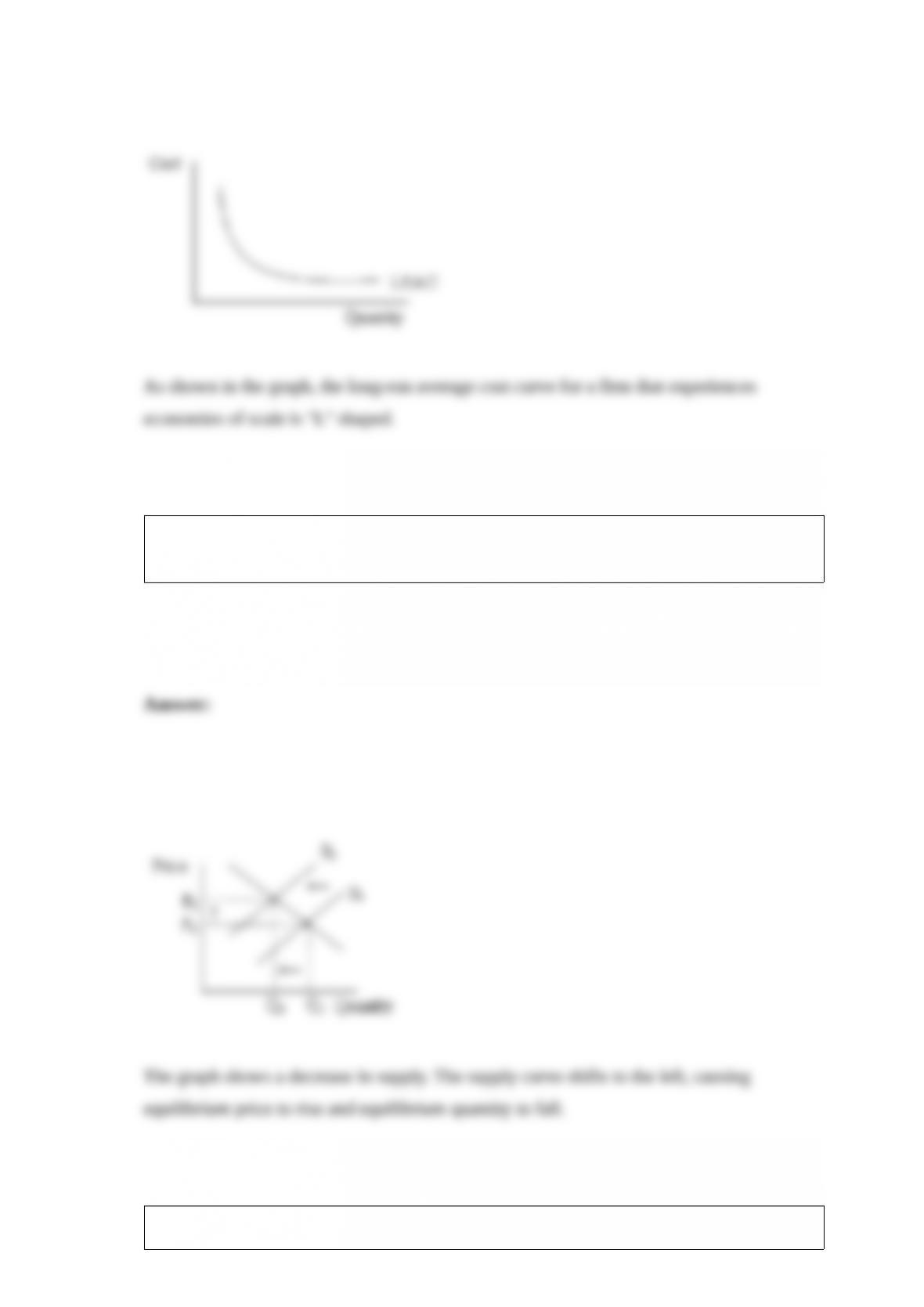
Draw a graph showing the long-run average cost curve for a firm that experiences
economies of scale.
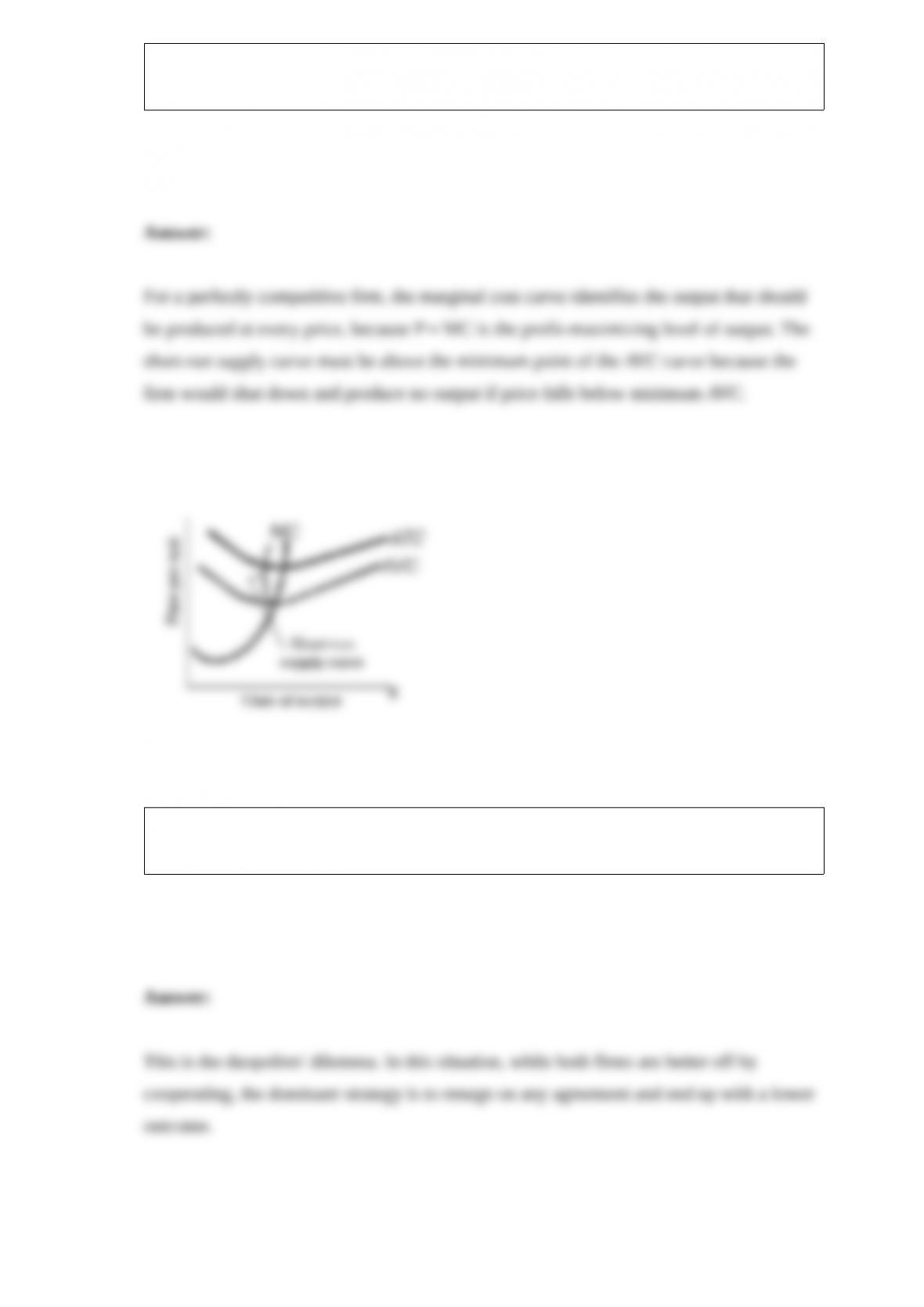
Using a graph, illustrate the effect that an increase in production costs will have on the
equilibrium price and quantity of a good.
Draw a graph of a firm’s short-run marginal cost, average variable cost, and average
total cost curves. On this graph, identify the firm’s short-run supply curve. Explain why
this is the firm’s short-run supply curve.
Briefly explain why often two firms could both be made better off by cooperating, but
they fail to cooperate.
Explain why perfectly competitive firms make zero economic profit in the long run.
You own a local sub shop in a college town. You primarily serve two groups of people:
local residents (both students and other local residents) and visitors to your town.
Devise a price discrimination strategy that will increase your revenues compared to a
single-pricing strategy.

Comment on the following statement: “Taxes on pollution are typically used to
eliminate the pollution generated.”