
1) Other things equal, an increase in the price level will:
A.shift the aggregate supply curve to the right.
B.shift the aggregate demand curve to the right.
C.cause a movement up along a short-run aggregate supply curve.
D.cause a movement down an aggregate demand curve.
2) Suppose a technological improvement increases the productivity of a firm’s capital
and, simultaneously, its workers’ union negotiates a wage increase. We can predict that:
A.the firm will use relatively more capital and relatively less labor.
B.the firm will use relatively more labor and relatively less capital.
C.inputs of capital and labor will be unchanged.
D.the firm’s equilibrium output will necessarily increase.
3) Under the Food, Conservation, and Energy Act of 2008, subsidies to farmers based
on gaps between actual prices of crops and targeted prices are called:
A.direct payments.
B.price supports.
C.countercyclical payments.
D.price gap set-asides.
4) exchange rates are particularly important because:
a.they present a challenge to financial speculators.
b.they link the price levels of various nations to one another.
c.they represent exceptions to the laws of demand and supply.
d.equilibrium is never achieved in such markets.
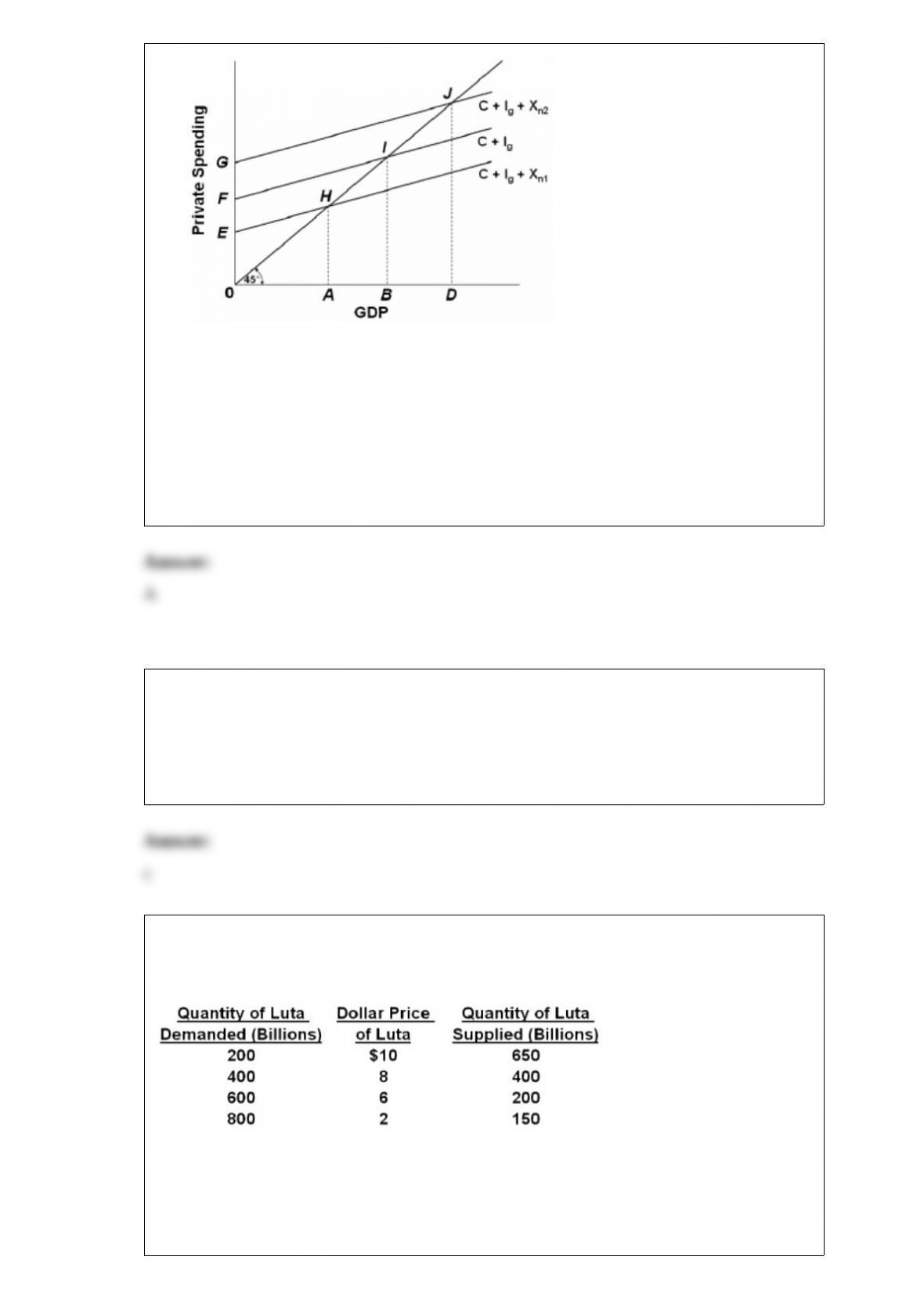
5)
Refer to the above diagram. The change in aggregate expenditures as shown from (C +
Ig + Xn2) to (C + Ig + Xn1) might be caused by:
A.an appreciation of this nation’s currency relative to the currencies of its trading
partners.
B.a depreciation of this nation’s currency relative to the currencies of its trading
partners.
C.a decrease in this nation’s price level relative to price levels abroad.
D. a rightward shift in this nation’s 45-degree line.
6) the total output of a firm will be at a maximum where:
a.mp is at a maximum.
b.ap is at a minimum.
c.mp is zero.
d.ap is at a maximum.
7) the following table which indicates the dollar price of luta, the currency used in the
hypothetical economy of luteland:
refer to the above table. suppose that the united states imports more products from
luteland than before. all else equal, the dollar price of luta will:
a.rise and the dollar will depreciate.
b.fall and the dollar will depreciate.
c.rise and the dollar will appreciate.

d.fall and the dollar will appreciate.
8) Suppose aggregate demand in the economy sharply declines. Mainstream economists
say that the price level (at least for a time) will _______ and real output will
_________.
A.decrease; remain constant
B.increase; remain constant
C.remain constant; decrease
D.remain constant; increase
9) which of the following statements is true?
a.microeconomics focuses on specific decision-making units of the economy;
macroeconomics examines the economy as a whole.
b.macroeconomics focuses on specific decision-making units of the economy;
microeconomics examines the economy as a whole.
c.every topic in economics is either a microeconomic or a macroeconomic issue; a topic
cannot be both.
d.topics in microeconomics have public policy implications; topics in macroeconomics
do not.
10) health maintenance organizations (hmos):
a.are based on the traditional fee-for-service system of paying physicians.
b.charge a fixed amount per member, hire many of their own physicians, and provide
health services only to members.
c.are also known as preferred provider organizations.
d.are illegal in several states.
11) A nation’s official reserves:
A.compensates for differences in the current and capital and financial accounts.
B.consist of all domestic and foreign currency held by a nation’s central bank.
C.is always zero.
D.is always negative.

12) We would expect a decline in personal and corporate income taxes to:
A.shift the aggregate demand curve rightward.
B.decrease consumption and investment spending.
C.decrease real output.
D.shift the aggregate supply curve leftward.
13) enterprise managers and workers in the soviet union often resisted innovations in
production methods because:
a.production targets were often increased when innovation occurred.
b.there was a chronic shortage of computers.
c.workers could not be reallocated geographically.
d.innovations ordinarily increased dependence on world markets.