
1) Scenario 15-5
An airline knows that there are two types of travelers: business travelers and
vacationers. For a particular flight, there are 100 business travelers who will pay $600
for a ticket while there are 50 vacationers who will pay $300 for a ticket. There are 150
seats available on the plane. Suppose the cost to the airline of providing the flight is
$20,000, which includes the cost of the pilots, flight attendants, fuel, etc.
How much profit will the airline earn if it sets the price of each ticket at $600?
a. -$5,000
b. $15,000
c. $40,000
d. $60,000
2) A firm cannot price discriminate if it
a.has perfect information about consumer demand.
b.operates in a competitive market.
c.faces a downward-sloping demand curve.
d.is regulated by the government.
3) The study by economists Cox and Alm found
a.the gap between rich and poor shrinks greatly if using after-tax income compared with
pre-tax income.
b.the gap between rich and poor shrinks slightly if using after-tax income compared
with pre-tax income.
c.the gap between rich and poor widens slightly if using after-tax income compared
with pre-tax income.
d.the gap between rich and poor widens greatly if using after-tax income compared with
pre-tax income.
4) Becky is a single mother of two young children who spend their days at a daycare
center while Becky goes to work. The daycare center closes at 5:30. If parents do not
pick up their children at or before 5:30, the daycare center charges a late fee of $5 per
child for every 10 minutes the parent is late.
Suppose Becky lives in a city with an optional toll lane that assures a drive at the posted
speed limit. She leaves her office at 5:00 for her usual 30 minute commute but hears on
the radio that if she drives in the non-toll lanes, her commute will take 1 hour due to an
accident. Becky should
a.call the daycare and tell them to expect her at 6:00.
b.choose to drive in the free-flowing toll lane as long as the toll is less than $10.
c.choose to drive in the free-flowing toll lane as long as the toll is less than $30.
d.choose to drive an alternate route to try to avoid some of the traffic.
5) When the price of chai tea latt©s is $5, Maxine buys 20 per month. When the price is
$4, she buys 30 per month.
Maxine’s demand for chai tea latt©s is
a.elastic, and her demand curve would be relatively flat.
b.elastic, and her demand curve would be relatively steep.
c.inelastic, and her demand curve would be relatively flat.
d.inelastic, and her demand curve would be relatively steep.
6) Which of the following statements is an example of a positive, as opposed to
normative, statement?
a.Americans deserve a cleaner environment.
b.Reducing emissions reduces days missed from school due to asthma.
c.All Americans are entitled to quality health care.
d.Economic policies should focus on improving equality.
7) If a monopolistically competitive firm can increase its level of production and lower
its average total cost of production at the same time then
a.the firm has a product-variety opportunity.
b.the firm has excess capacity.
c.the firm has a business-stealing opportunity.
d.the firm is producing a quantity of output higher than its efficient scale of production.
8) Because the benefits of basic research are obvious and easy to measure, it is likely
that the public sector pays for the right amount and the right kinds of basic research.
a.True
b.False
9) Which voter is the voter whose views on a policy issue are in the middle of the
spectrum, with half of the voters on one side of this voter’s view and half on the other
side.
a.Average voter
b.Mean voter
c.Modal voter
d.Median voter
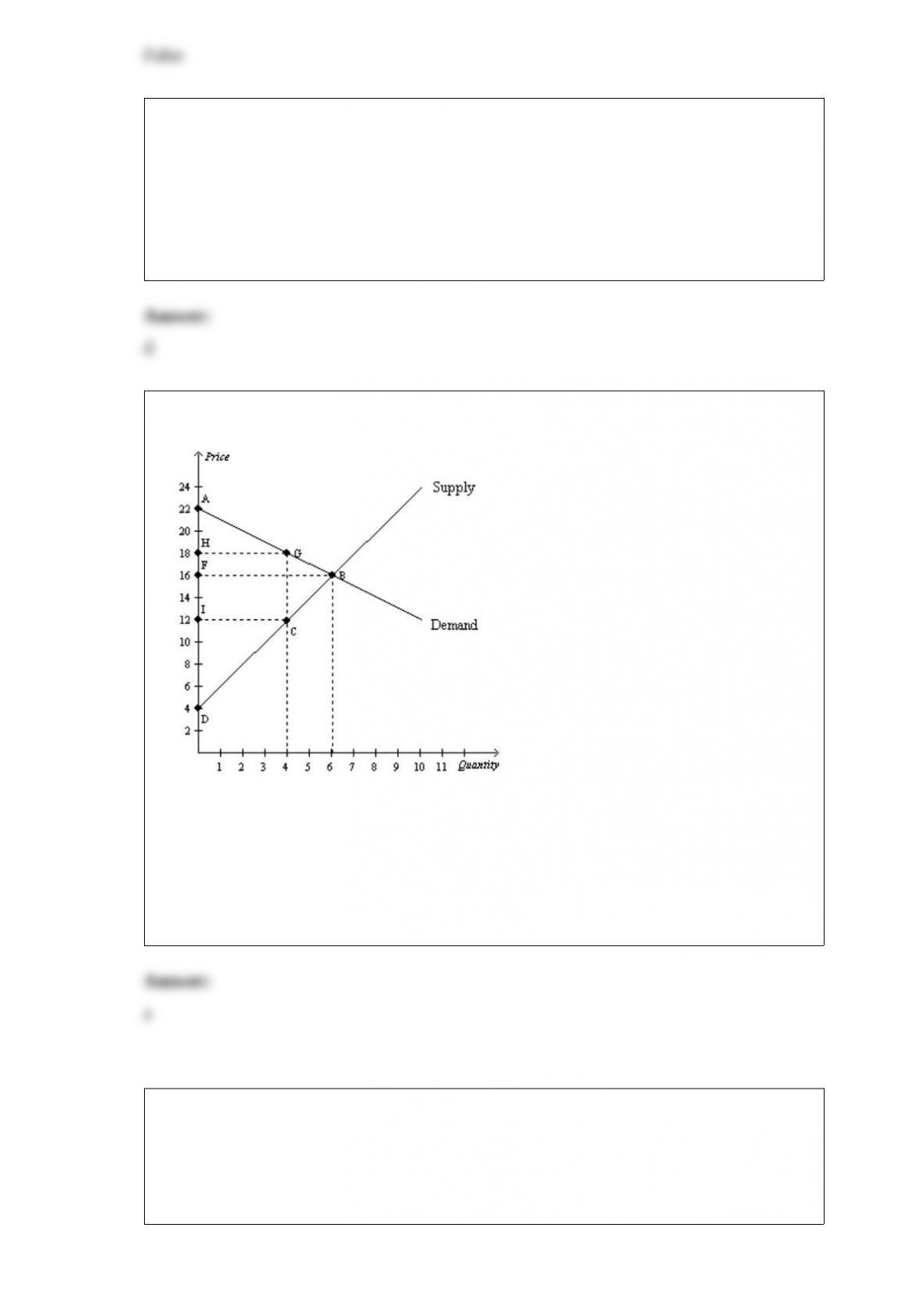
10) Figure 7-24
Refer to Figure 7-24. If the government imposes a price ceiling at $12, then producer
surplus is
a.CDI.
b.BDF.
c.BCIF.
d.HGCD.
11) Adverse selection
a.occurs when the overall quality of choices facing a consumer is very low.
b.is a greater problem for employees than employers.
c.occurs more frequently in the market for new cars than used cars.
d.is not easily remedied by free markets.

12) For economists, substitutes for laboratory experiments often come in the form of
a.natural experiments offered by history.
b.untested theories.
c.rules of thumb and other such conveniences.
d.reliance upon the wisdom of elders in the economics profession.
13) It is possible for this economy to produce 45
doghouses and 30 dishwashers.
a.True
b.False
14) Suppose the demand function for good X is given by: where
is the quantity demanded of good X, is the price of good X, and is the price of
good Y, which is related to good X.
Using the midpoint method, if the price of good X is constant at $10 and the price of
good Y decreases from $10 to $8, the cross is about
a.0.57, and X and Y are substitutes.
b.-0.22, and X and Y are complements.
c.-0.80, and X and Y are complements.
d.-2.57, and X and Y are complements.
15) Prices usually reflect
a.only the value of a good to society.
b.only the cost to society of making a good.
c.both the value of a good to society and the cost to society of making the good.
d.neither the value of a good to society nor the cost to society of making the good.
16) An example of the “Tragedy of the Commons” is litter in the picnic area of a local
park.
a.True
b.False
17) What do we mean when we say that a good is rival in consumption?
18) Time spent filling out tax forms, time spent keeping tax records, and government
resources spent to enforce tax laws are examples of theof the U.S. income tax system.
19) Figure 7-31
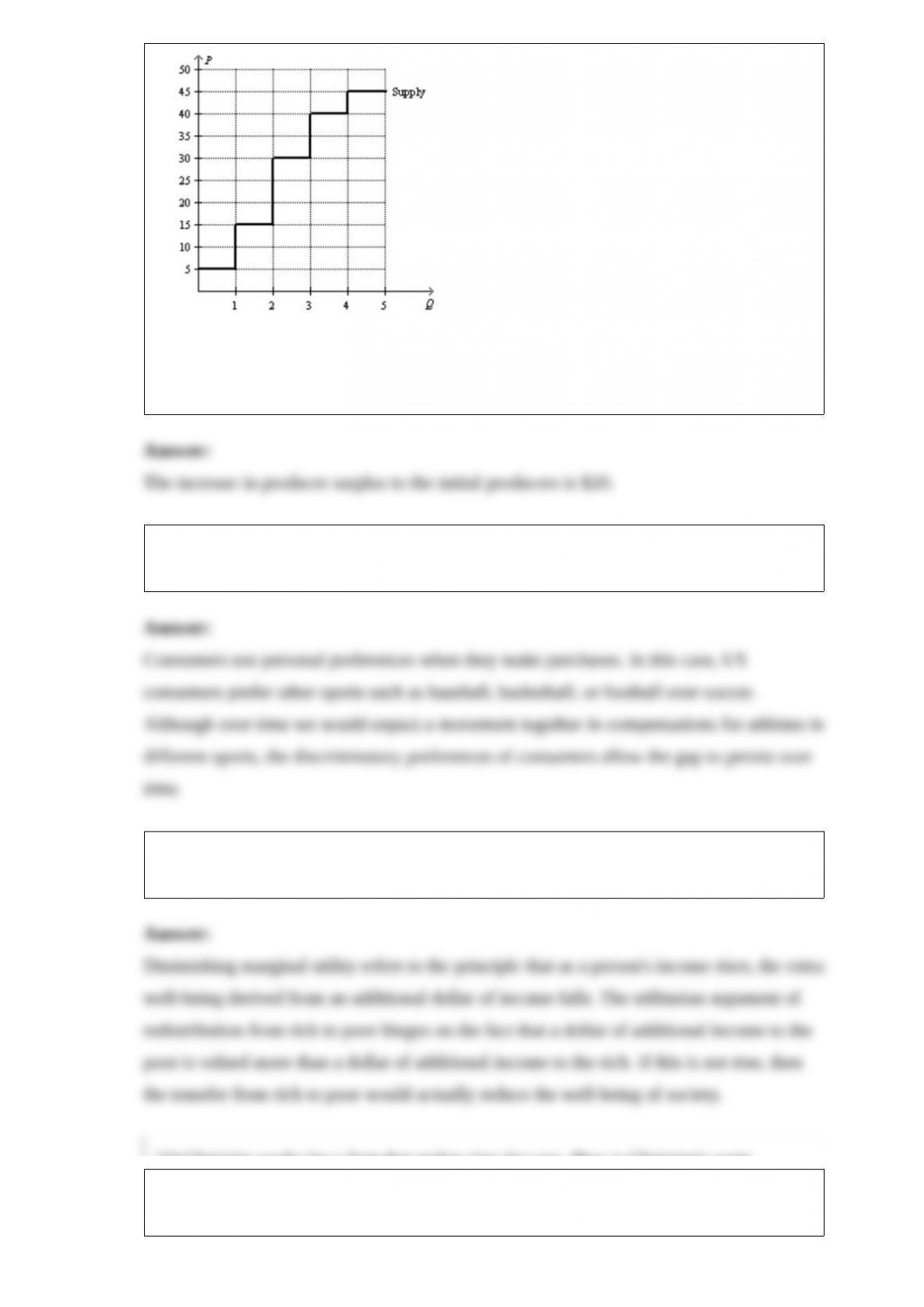
Refer to Figure 7-31. If the market equilibrium price rises from $25 to $35, how much
is the increase in producer surplus to the producers supplying units at the initial $25
price?
20) Explain why the following situation is likely to persist: soccer players in Europe are
the highest paid athletes and in the US they are among the lowest paid athletes.
21) Explain the concept of diminishing marginal utility, and describe the role that it
plays in the utilitarian argument for the redistribution of income.
22) Christine works for a firm that makes tires for cars. How is Christine’s wage
affected if the price of tires decreases?
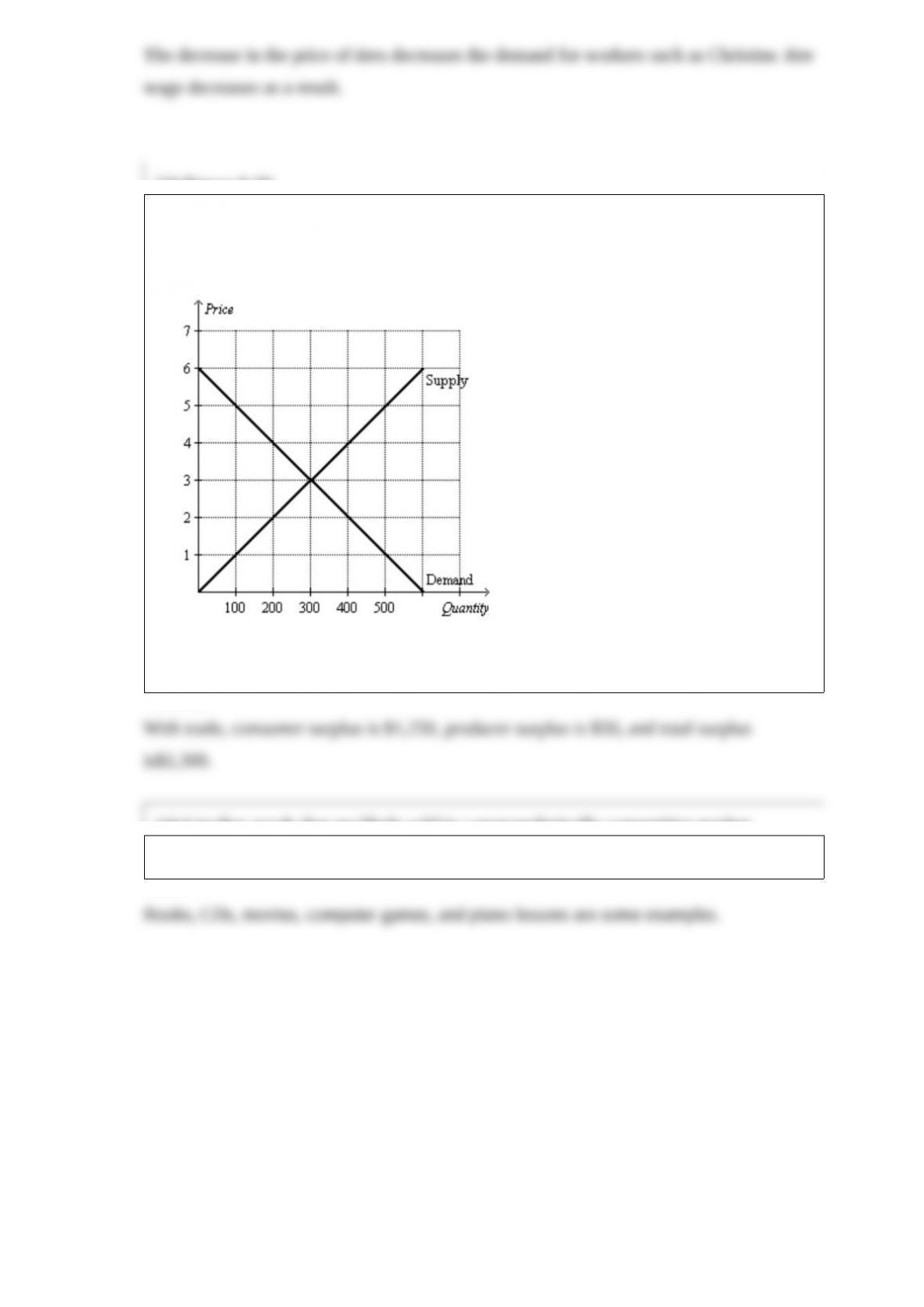
23) Figure 9-29
The following diagram shows the domestic demand and domestic supply curves in a
market. Assume that the world price in this market is $1 per unit.
If the country allows free trade, how much are consumer surplus, producer surplus, and
total surplus with trade?
24) List five goods that are likely sold in a monopolistically competitive market.