
1) Which of the following groups of economists is most likely to favor annually
balanced Federal budgets?
A.Mainstream economists
B.Supply-side economists
C.Rational expectations economists
D.Functional finance economists
2) In the last half of the 1990s, the usual short-run tradeoff between inflation and
unemployment did not arise because:
A.the Fed held interest rates constant.
B.the Federal government balanced its budget.
C.the U.S. personal savings rate rose.
D.productivity (and thus aggregate supply) grew faster than previously.
3) An economy’s infrastructure refers to its:
A.public capital goods, such as roads, schools, and power facilities.
B.financial and banking institutions.
C.land and natural resources.
D.surplus supplies of unskilled labor.
4) which of the following explanations is given for why labor supply (on a per capita
basis) is greater in the united states than in france and other rich leader countries?
a.france and other rich leader countries have more generous unemployment and welfare
programs than the united states.
b.the united states has lower tax rates than france and other rich leader countries.
c.the united states has a longer legal work-week than france and other rich leader
countries.
d.all of these.

5)
Refer to the above data. If a lump-sum tax (the same tax amount at each level of GDP)
of $40 is imposed in this economy, the marginal propensity to consume is:
A..8 before taxes and .6 after taxes.
B..8 both before and after taxes.
C..6 before taxes and .8 after taxes.
D..8 before taxes and .4 after taxes.
6) when the u.s. economy has achieved full employment, the unemployment rate is
between:
a.5 and 6 percent.
b.4 and 5 percent.
c.3 and 4 percent.
d.2 and 3 percent.
7) Which of the following has contributed to large U.S. trade deficits in recent years?
A.China fixing its exchange rate.
B.Rapid increases in the price of oil.
C.A declining U.S. saving rate.
D.All of these have contributed.
8) In a monopsonistic labor market the employer will maximize profits by employing
workers up to that point at which:
A.the difference between the wage rate and marginal resource (labor) cost is at a
maximum.
B.marginal revenue product equals marginal resource (labor) cost.
C.the wage rate equals marginal revenue product.
D.the wage rate equals marginal resource (labor) cost.

9) The labor demand curve of a purely competitive seller:
A.slopes downward because the firm must lower price to sell more output.
B.slopes downward because labor productivity increases as successive workers are
hired.
C.is perfectly elastic because the firm is hiring an insignificant portion of the total labor
supply.
D.slopes downward because the marginal product of successive workers declines.
10) In the aggregate expenditures model, a reduction in taxes may:
A.increase saving.
B.decrease real GDP.
C.increase unemployment.
D.reduce consumption.
11) Which of the following occupations is projected to be the fastest growing in the
U.S. in terms of percentage increases?
A.medical assistants
B.network systems and data communication analysts
C.home health aides
D.software engineers
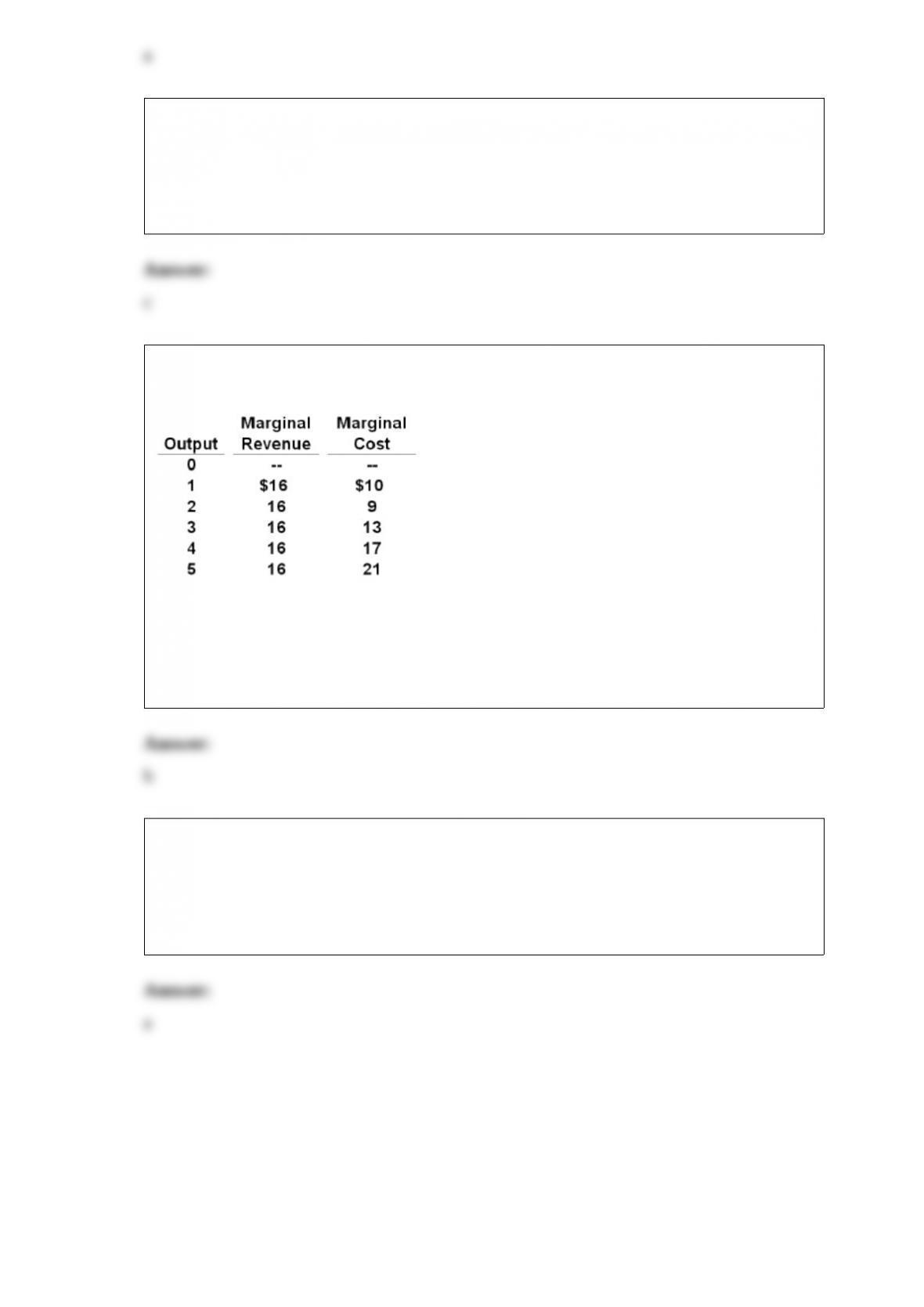
12) the following data confronting a firm:
refer to the above data. at the profit-maximizing output the firm’s total revenue is:
a.$48.
b.$32.
c.$80.
d.$64.
13) other things equal, if the prices of a firm’s variable inputs were to fall:
a.one could not predict how unit costs of production would be affected.
b.marginal cost, average variable cost, and average fixed cost would all fall.
c.marginal cost, average variable cost, and average total cost would all fall.
d.average variable cost would fall, but marginal cost would be unchanged.
14) the following data confronting a firm:
refer to the above data. the firm’s:
a.economic profit is $12.
b.economic profit is $16.
c.loss is $14.
d.economic profit is $3.
15) the price elasticity of demand coefficient measures:
a.buyer responsiveness to price changes.
b.the extent to which a demand curve shifts as incomes change.
c.the slope of the demand curve.
d.how far business executives can stretch their fixed costs.