
If the nominal exchange rate between the American dollar and the Canadian dollar is
0.89 Canadian dollars per American dollar, how many American dollars are required to
buy a product that costs 2.5 Canadian dollars?
A) $1.32
B) $2.23
C) $2.75
D) $2.81
In the United States, many beekeepers travel from state to state, renting out their bee
colonies to farmers for pollination services. This is an example of
A) a Coasian solution to a positive externality problem.
B) a Pigovian solution to a positive externality problem.
C) a tradable exchange contract.
D) command and control policy.
A negative supply shock in the short run causes
A) the aggregate supply curve to shift to the left.
B) the price level to fall.
C) unemployment to fall.

D) equilibrium real GDP to rise.
If net foreign investment is positive, which of the following must be true? (Assume that
the capital account is zero and net transfers are zero.)
A) Capital outflows are less than capital inflows.
B) Domestic investment must be less than national saving.
C) Net exports are negative.
D) None of the above are true when net foreign investment is positive.
Which of the following statements is false?
A) Corporations can issue stocks and bonds, while proprietorships cannot.
B) Corporations have one owner, while proprietorships have many owners.
C) Corporations face more taxes than do proprietorships.
D) Proprietorships have unlimited liability, while corporations have limited liability.

A decrease in the price level in the United States will have what effect on the aggregate
expenditure line?
A) Aggregate expenditure will shift downward.
B) Aggregate expenditure will become steeper.
C) Aggregate expenditure will shift upward.
D) Aggregate expenditure will not be affected by an increase in the price level in the
United States.
Which of the following will not cause the labor demand curve to shift to the right?
A) an increase in the price of the firm’s product
B) a technological improvement that increases labor productivity
C) an increase in human capital in the labor force
D) an increase in the market wage rate
Figure 13-8
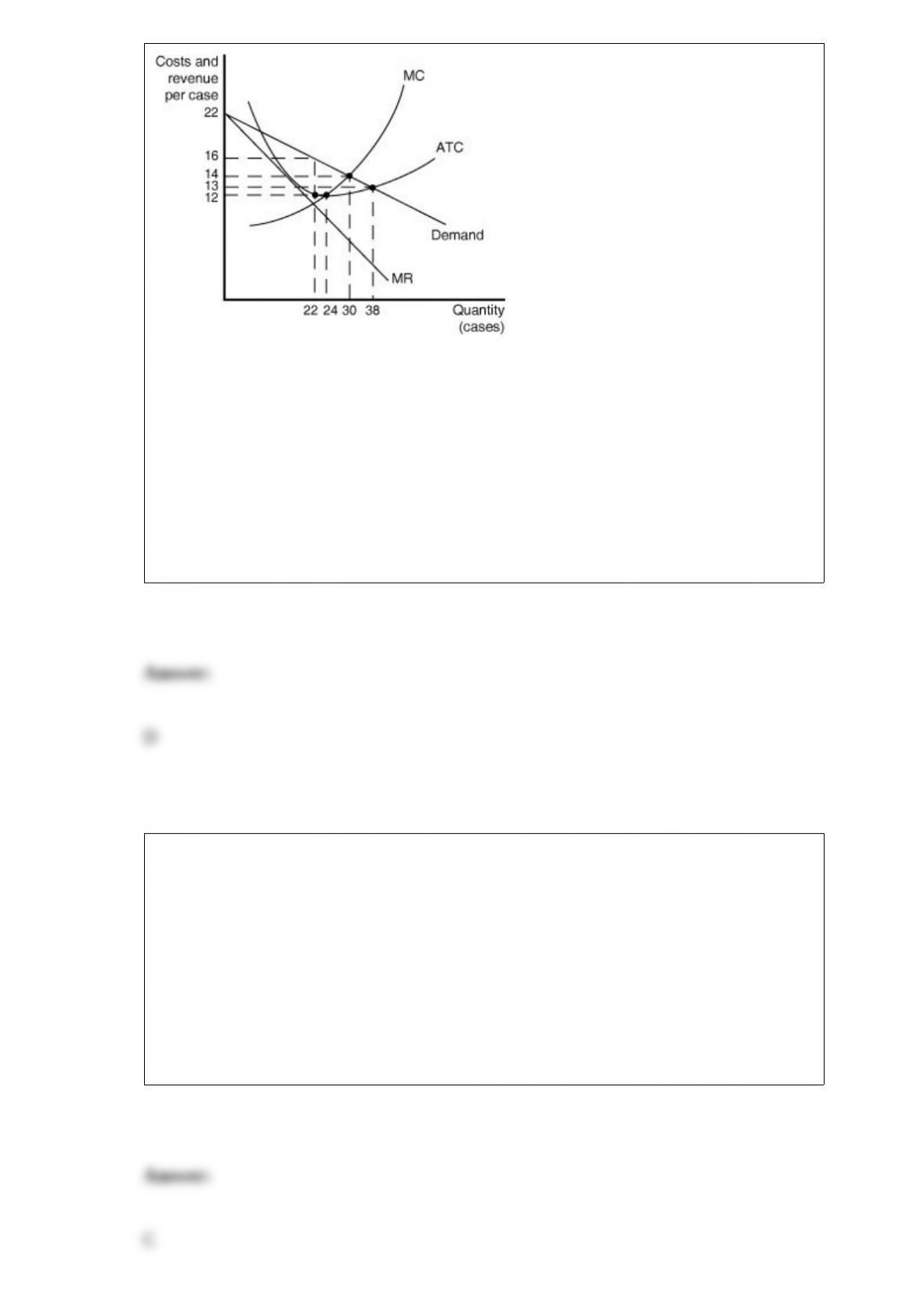
Figure 13-8 shows cost and demand
curves for a monopolistically competitive producer of iced tea. What is the firm’s
profit-maximizing price?
A) $12
B) $13
C) $14
D) $16
If the price of gasoline was $3.25 a gallon and it is now $3.75 a gallon, what is the
percentage change in price?
A) 7.1 percent
B) 13.3 percent
C) 15.4 percent
D) 33.3 percent

How does the long-run equilibrium of a monopolistically competitive industry differ
from that of a perfectly competitive industry?
A) A firm in monopolistic competition will earn economic profits, but a firm in perfect
competition earns zero profit.
B) A firm in monopolistic competition will charge a price higher than the average cost
of production, but a firm in perfect competition charges a price equal to the average cost
of production.
C) A firm in monopolistic competition does not take full advantage of its economies of
scale, but a firm in perfect competition produces at the lowest average cost possible.
D) A firm in monopolistic competition produces an allocatively efficient output level,
while a firm in perfect competition produces a productively efficient output level.
Currency traders expect the dollar to depreciate. What impact will this have on
equilibrium in the foreign exchange market?
A) The dollar will appreciate, and the equilibrium quantity of dollars will decrease.
B) The dollar will depreciate, and the equilibrium quantity of dollars exchanged will
decrease.
C) The dollar will appreciate, and the equilibrium quantity of dollars will increase.
D) The dollar will depreciate, and the change in the equilibrium quantity of dollars
exchanged cannot be determined.

Article Summary. Based on resale prices for tickets for the 2013 Super Bowl in New
Orleans, face-value prices for the most expensive tickets to the 2014 game are
expected to more than double, with significant price increases for lesser-valued
tickets as well. Evidence indicates that sports teams are more interested in
maximizing attendance instead of ticket revenue, since greater attendance means
more spending on items such as parking and concessions. Higher ticket prices in
secondary markets seem to verify that teams are charging less than they could be
if their goal was to maximize ticket revenue.
Source: Patrick Rishe, “Super Bowl XLVIII Pricing: A Lesson In Demand
Elasticity,” Forbes, September 19, 2013.
How would sports teams know if they were operating on the elastic portion of the
demand curve for tickets?
A) If they increased ticket prices and the total revenue from ticket sales increased.
B) If they increased ticket prices and the total revenue from ticket sales did not change.
C) If they increased ticket prices and the total revenue from ticket sales decreased.
D) If they decreased ticket prices and the total revenue from ticket sales did not change.
Which one of the following is not considered a financial intermediary?
A) a bank
B) a pension fund
C) an insurance company
D) a credit counselor
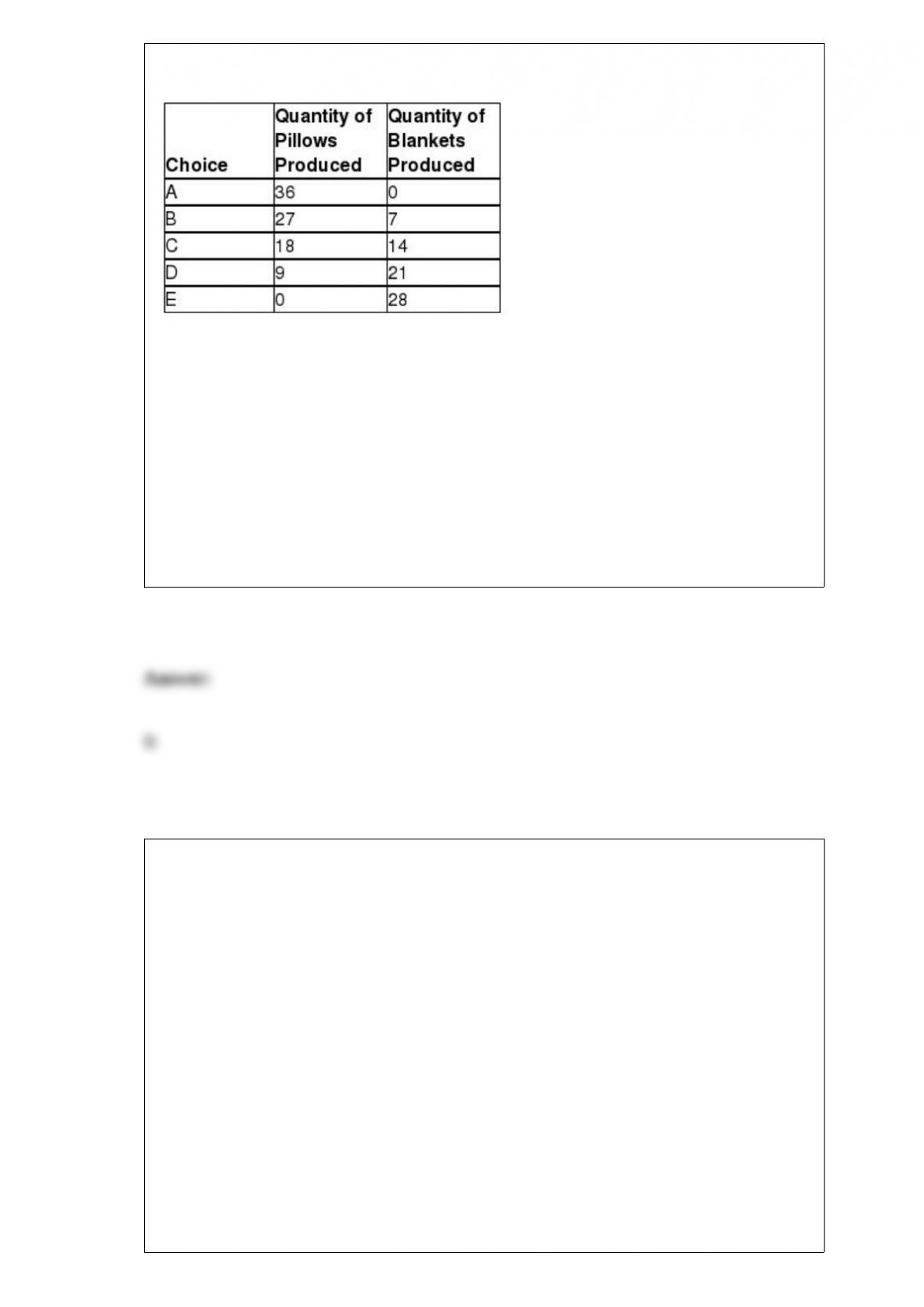
Table 2-2 Production choices for Billie’s Bedroom Shop
Assume Billie’s Bedroom Shop only produces pillows and blankets. Billie faces
________ opportunity costs in the production of pillows and blankets.
A) increasing
B) constant
C) decreasing
D) negative
Article Summary. Starting as a Chicago antique store that sold sandwiches on the
side, Potbelly has grown from this 1977 beginning into a company which today
operates approximately 300 sandwich shops in the United States. In October 2013,
Potbelly sold stock for the first time through an initial public offering (IPO), with
shares jumping in price from the initial offering price of $14 to more than $32 on
the same day. Since 2011, Potbelly has seen an increase in in both sales and
revenue, and earned a profit of $2.8 million in the first half of 2013. Source: Matt
Krantz, “Potbelly IPO shares more than double on open,” USA Today, October 4,
2013. When Potbelly sold stock to the public in its IPO, it did so through the NASDAQ
market. This was an example of Potbelly raising funds through
A) reinvesting retained earnings.
B) a financial intermediary.
C) dividend reinvestment.

D) a financial market.
If the absolute value of the price elasticity of demand for aspirin equals 0.8, then
A) aspirin is a normal good.
B) the demand for aspirin is inelastic.
C) aspirin has few substitutes.
D) the demand for aspirin is elastic.
Hyperinflation is caused by
A) a constant increase in the money supply.
B) a high rate of growth in the money supply.
C) Real GDP growing more rapidly than the money supply.
D) the money supply growing more slowly than GDP.