In the United States from 1960 to 2010, the largest positive contribution to national
saving was from:
A. the public sector.
B. the government budget deficit.
C. business saving.
D. household saving.
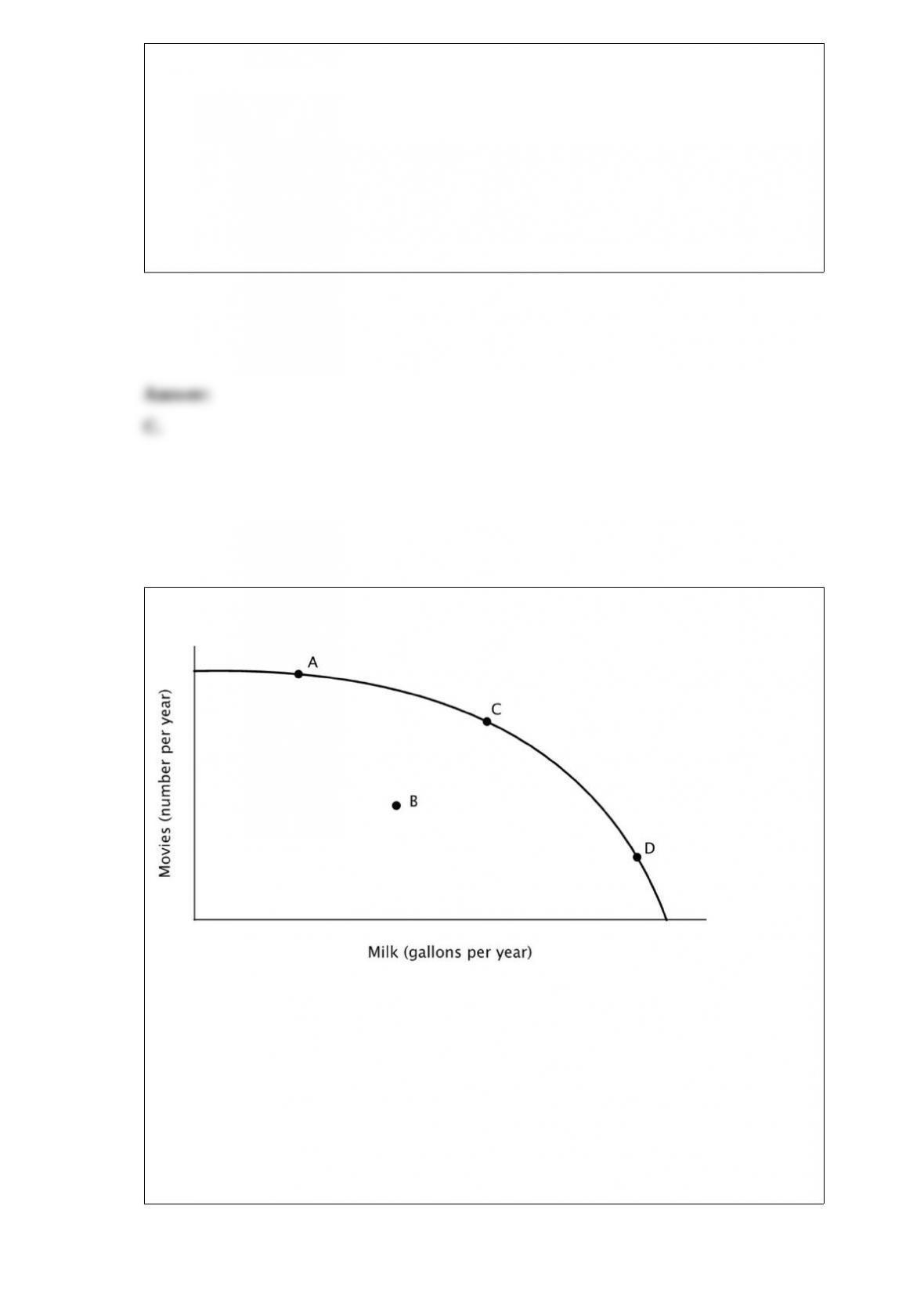
Refer to the figure below. This economy would be operating at point B if:
A. it was operating efficiently.
B. the opportunity cost of making milk were higher than the opportunity cost of making
movies.
C. the opportunity cost of making movies were higher than the opportunity cost of
making milk.
D. resources that are better-suited to making movies were being used to make milk,
while resources that are better-suited to making milk were being used to make movies.

In an open economy with a given level of real interest rates and risk, an increase in real
interest rates abroad will ______ capital inflows and ______ the equilibrium domestic
real interest rate.
A. increase; increase
B. increase; decrease
C. decrease; decrease
D. decrease; increase
In the Keynesian model, a $5 billion decrease in autonomous planned investment leads
to ______ in short-run equilibrium output.
A. a $5 billion increase
B. a greater than $5 billion decrease
C. no change.
D. a $5 billion decrease
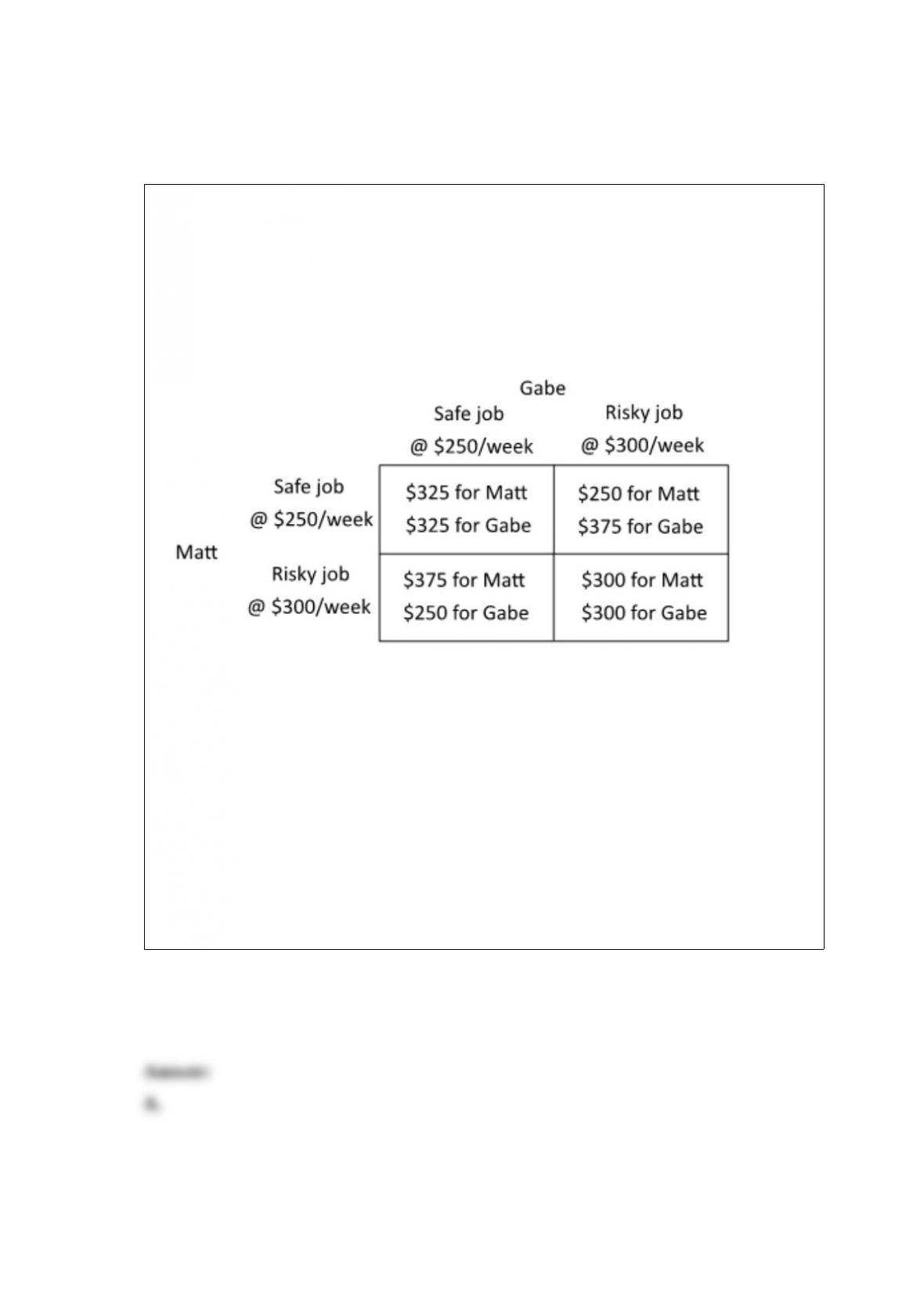
Suppose Matt and Gabe must both choose between two jobs, a safe job that pays $250
per week and a risky job that pays $300 per week. The value of safety to each is $75 per
week. Having more income than the other is worth $75 per week to each, and having
less income than the other means a $75-per-week reduction in satisfaction. Having the
same income as the other means no change in satisfaction. The payoff matrix below
summarizes this situation.
When Matt chooses the safe job, Gabe will get more satisfaction by choosing the
______ job, and when Matt chooses the risky job, Gabe will get more satisfaction by
choosing the ______ job.
A. risky; risky
B. risky; safe
C. safe; risky
D. safe; safe

Suppose a firm uses workers and office space to produce output. The firm is locked into
a year-long lease on its office space, but it can easily vary the number of
employee-hours it uses each day. The table below describes the relationship between
the number of employee-hours the firm uses each day and the firm’s daily output. Each
unit of output sells for $2, the hourly wage rate is $14, and the rent on the office space
is $50 per day.
When the firm uses 9 employee-hours, its total revenue each day is:
A. $240.
B. $160.
C. $120.
D. $18.
Real GDP per person can increase:
A. only if the share of the population employed increases.
B. only if the share of the population employed decreases.
C. only if average labor productivity increases.
D. if the share of population employed and/or average labor productivity increases.

Which of the following is likely to have the highest price elasticity of demand?
A. shoes
B. running shoes
C. Nike running shoes
D. The price elasticity of demand will be the same for all of the answers listed.
The typical family on the Planet Econ consumes 10 pizzas, 7 pairs of jeans, and 20
gallons of milk. In 2008, pizzas cost $10 each, jeans cost $40 per pair, and milk cost $3
per gallon. In 2009, the price of pizzas increased to $14 each, while the price of jeans
and milk remained the same. Between 2008 and 2009, a typical family’s cost of living:
A. increased by 9 percent.
B. decreased by 9 percent.
C. remained the same.
D. increased by 40 percent.
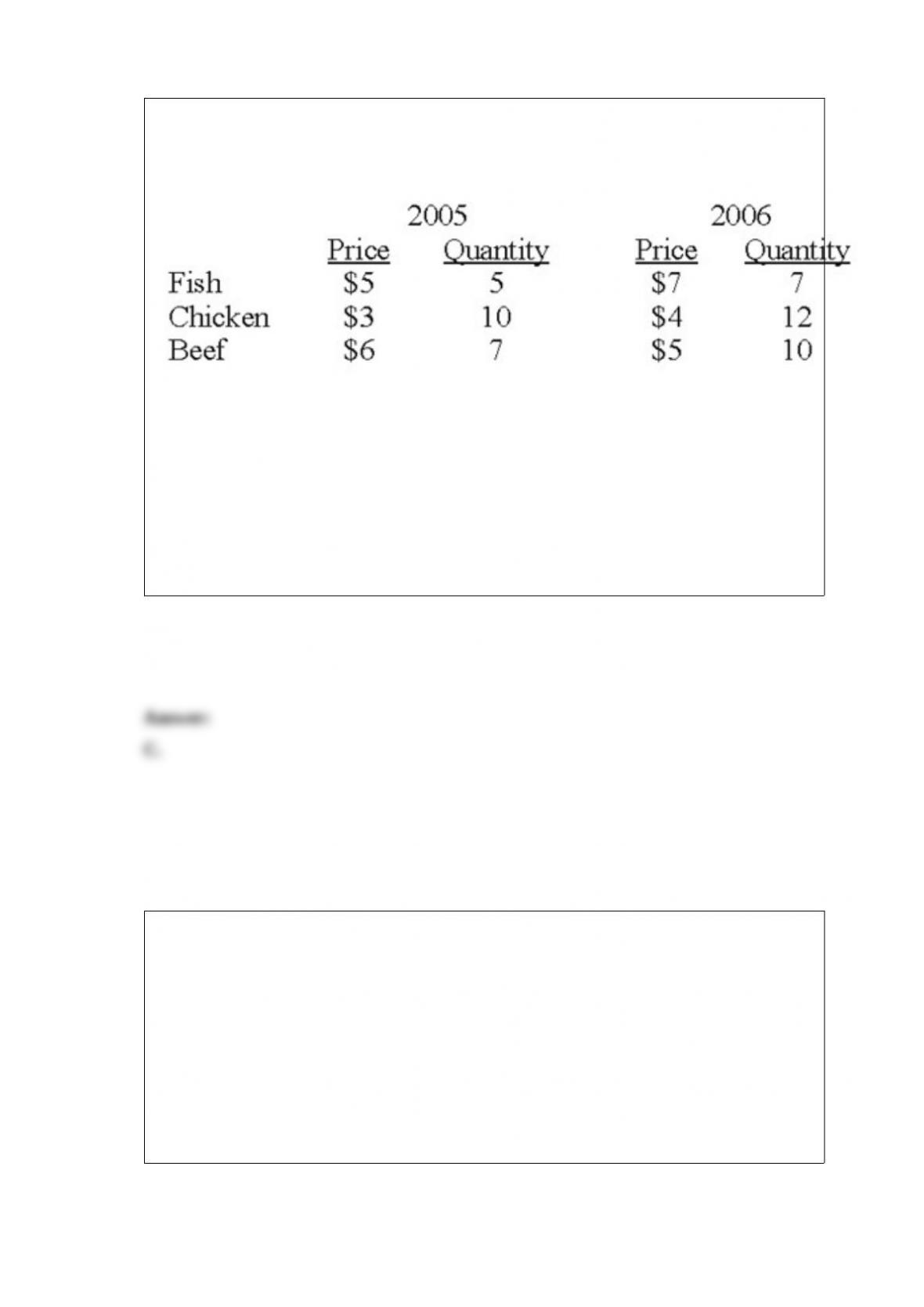
A consumer expenditure survey reports the following information on consumer protein
spending:
Using 2005 as the base year, by how much does a “cost of protein” index increase
between 2005 and 2006?
A. 5.2 percent
B. 8.6 percent
C. 13.4 percent
D. 14.3 percent
If the nominal interest rate is above the equilibrium value, then the quantity demanded
of money is ______ than the quantity supplied of money, bond prices will ____, and the
nominal interest rate will ____.
A. greater; fall; increase
B. less; rise; decrease
C. greater; rise; increase
D. less; fall; increase
If a linear, two-good production possibilities curve has a slope of 2, then:
A. having an additional unit of the good measured on the vertical axis means giving up
2 units of the good measured on the horizontal axis.
B. having an additional unit of the good measured on the vertical axis means giving up
½ of an unit of the good measured on the horizontal axis.
C. you have an absolute advantage in the good measured on the vertical axis.
D. you have a comparative advantage in the good measured on the vertical axis.
According to the textbook, government price controls fail because:
A. they are not enforced.
B. legislation cannot repeal basic economic motives.
C. bureaucrats lack accurate market data.
D. firms ignore the restrictions.
Which of the following is NOT an example of a good with network economies?
A. A cell phone
B. Internet service
C. A computer printer
D. Facebook
Which of the following best explains why you are more likely to see a poor person than
a wealthy person picking up aluminum cans to sell?
A. Wealthy people do not care about the environment.
B. The opportunity cost of picking up cans is higher for wealthy people than for poor
people.
C. Wealthy people are more concerned about their public image than are poor people.

D. Wealthy people are more aware of diseases transmitted through litter than are poor
people.
A market comprised of a downward-sloping demand curve that intersects an
upward-sloping supply curve is said to be stable because:
A. price will never change.
B. quantity will never change.
C. demand will never change.
D. at any price other than equilibrium, forces in the market move price towards the
equilibrium.
The Federal Reserve can:
A. simultaneously set independent money supply and nominal interest rate targets.

B. only target the nominal interest rate, not the money supply.
C. only set a money supply target that is consistent with a nominal interest rate target,
and vice versa.
D. only target the money supply, not the nominal interest rate.
Consider the labor markets shown below.
If the government imposes a minimum wage above $6 per hour, then total earnings will
______.
A. rise
B. fall
C. stay the same
D. initially rise and then fall
As the price of computers falls, the quantity of computers demanded increases. This is
an application of:
A. the law of supply
B. the production possibilities curve
C. the law of demand
D. needs versus wants
Refer to the figure below. The current level of GDP in this economy is ______; the
potential level of GDP is ______.
A. Y1; Y1
B. Y2; Y2
C. Y1; Y2
D. Y2; Y1
Economies of scale exist when:
A. firms become larger.

B. input prices are falling.
C. the average cost of production falls as output rises.
D. doubling all the inputs leads to less than double the output.
Which of the following would increase the consumption component of U.S. GDP?
A. You purchase a vacation at Disney World in Florida.
B. A business purchases Disney World vacations as rewards for the firm’s best
salespeople.
C. Disney World purchases tires for the monorail from a firm in Ohio.
D. A French man purchases a vacation at a Disney theme park in France.
If the United States has a $300 billion net capital inflow, then there must be a:
A. trade surplus of $300 billion.
B. trade deficit of $300 billion.

C. trade surplus of $600 billion.
D. net capital outflow of $300 billion.
Refer to the table below. The average benefit of 4 units of activity is:
A. $4
B. $5
C. $9
D. $10
If the professional opinions of economists regarding the natural rate of unemployment
vary between 4.5 and 6 percent, then when the actual rate of unemployment equals 5
percent:
A. the natural rate of unemployment equals 5 percent.
B. there is a recessionary gap.
C. there is an expansionary gap.
D. there could be either an expansionary or recessionary gap, or the economy could be
at potential output depending on the accuracy of measurement.

To derive the labor demand curve for a particular market, one should ______ for all the
firms in the market:
A. vertically sum the value of the marginal product of labor curves
B. vertically sum the marginal product of labor curves
C. horizontally sum the value of the marginal product of labor curves
D. horizontally sum the marginal product of labor curves
If consumers cannot readily switch to a close substitute when the price of a good
increases, the demand for that good is likely to be:
A. elastic.
B. inelastic.
C. unit elastic.
D. perfectly elastic.

Refer to the figure above. Now suppose that the government imposes a price ceiling of
$40. What is the most likely result?
A. Many sellers would go out of business because $40 is above the equilibrium.
B. There would be no change in the price.
C. The market would reach a new equilibrium at a price of $40.
D. An underground, or black, market would emerge where this product would be sold at
a price above $40.
In the short-run Keynesian model where the marginal propensity to consume is 0.75, to
offset an expansionary gap resulting from a $1 billion increase in autonomous
consumption, transfers must be:
A. increased by $1 billion.
B. decreased by $1 billion.
C. increased by $1.33 billion.
D. decreased by $1.33 billion.

If real GDP per person were equal to $2,000 in 1900 and grew at a one percent annual
rate, what would be the value of real GDP per person 100 years later?
A. $2,210
B. $4,000
C. $5,410
D. $20,000
Suppose Island Bikes, a profit-maximizing firm, is the only bike rental company in a
small resort town. The marginal cost to Island Bikes of renting out a bike is $3, and
Island Bikes has no fixed costs. Each day Island Bikes has six potential customers,
whose reservations prices are listed below.
What is the socially optimal number of bikes for Island Bikes to rent out each day?
A. 6
B. 5
C. 4
D. 3

The three broad reasons for saving, as identified by economists, relate to:
A. consumption, investment, and exports.
B. national, public, and private production.
C. the life-cycle, precaution, and bequests.
D. capital gains, capital losses, and deficits.
Statistical discrimination in the automobile insurance industry means that young male
drivers who drive ______ will pay ______ rates relative to the claims they generate.
A. carefully; lower
B. recklessly; higher
C. carefully; higher
D. slowly; lower