
Net foreign investment is a measure of net capital outflows, equal to capital outflows
minus capital inflows in a given period of accounting.
If you purchase a share of stock from your friend who initially purchased the stock
three years ago, your purchase of the stock represents a transaction in the secondary
financial market.
New classical macroeconomic theory emphasizes the role of ‘sticky” prices in the
economy.
A public franchise gives the exclusive right to produce a product for 20 years from the
date the product is invented.

The U.S. economy has been more stable since 1950.
The level of crowding out associated with a tax cut will be smaller if the tax change has
a supply-side effect than it will be if it only has a demand-side effect.
If a country is producing efficiently and is on the production possibilities frontier,
producing more of one good would result in a movement along the frontier.
A perfectly competitive firm breaks even at a price equal to its minimum average total
cost.

The fact that the prices for McDonald’s Big Mac sandwich are not the same around the
world illustrates one reason why purchasing power does not hold: Many goods are not
traded internationally.
Saving exceeds domestic investment in Japan, which generates a financial account
deficit in Japan’s balance of payments.
The relationship between GDP and the money supply has gotten stronger since the
1980s.
An expansionary monetary policy in the United States should
A) decrease the foreign currency price of U.S. exports.
B) cause the dollar to appreciate.
C) decrease the dollar price of imports.
D) decrease net exports.
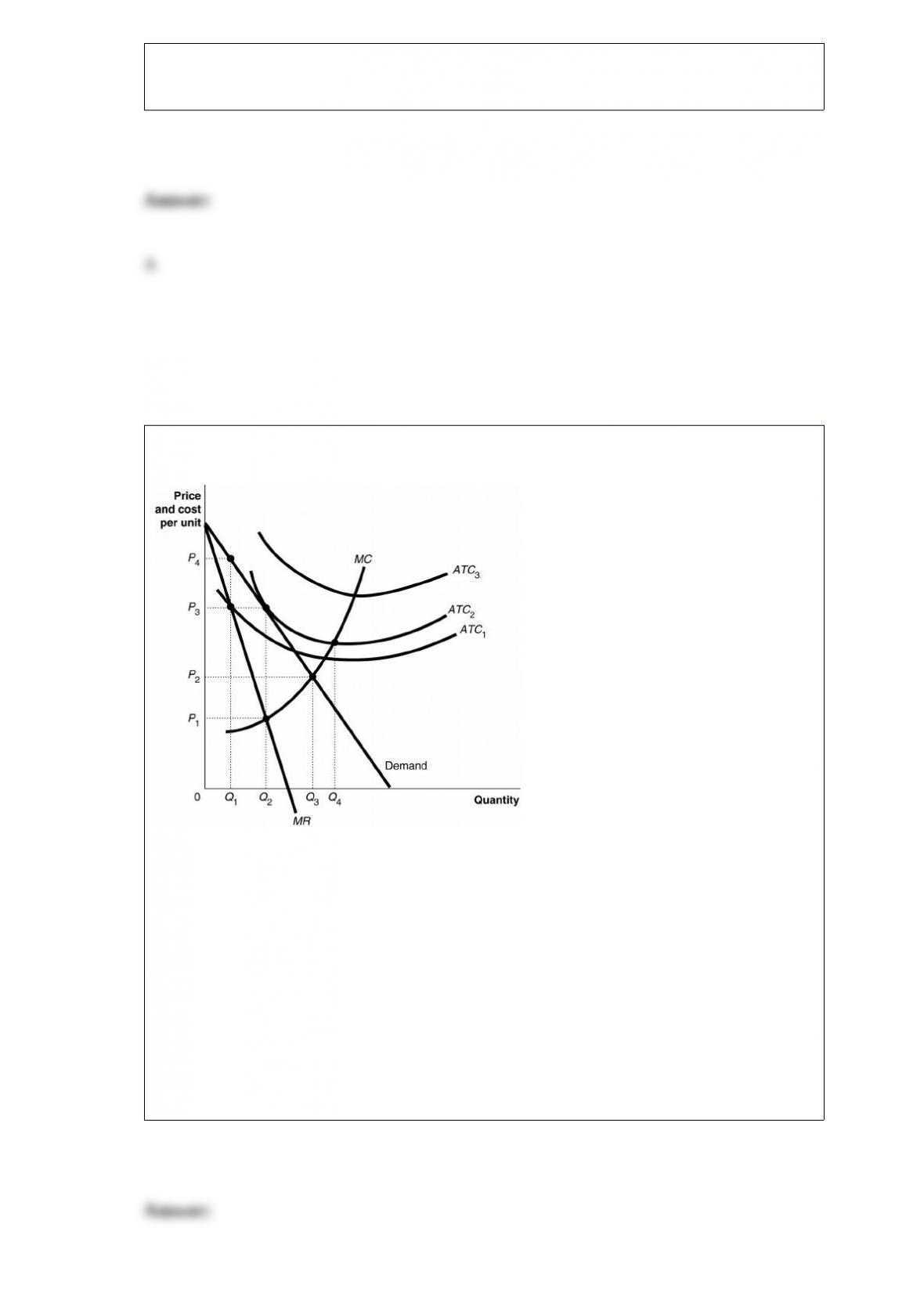
Figure 15-2
Figure 15-2 above shows the demand and cost curves facing a monopolist. To maximize
profit, the firm will produce
A) Q1.
B) Q2.
C) Q3.
D) Q4.

When the government wants to give an exclusive right to one firm to produce a product,
it
A) imposes a tariff on imports of the product.
B) imposes a quota on imports of the product.
C) grants a patent or copyright to an individual or firm.
D) uses antitrust laws to keep other firms from entering the market.
Public saving in the economy can be increased by
A) lowering taxes.
B) raising government spending.
C) raising taxes.
D) raising transfer payments.
Which of the following is not a reason why low-income countries might experience low
economic growth?
A) The country has endured extended periods of war.

B) The country fails to enforce a rule of law.
C) The country has a good education system.
D) The country has a low rate of saving and investment.
Goods with upward sloping demand curves are referred to as
A) Marshall goods.
B) Giffen goods.
C) substitute goods.
D) luxury goods.
The demand curve of a monopolistically competitive firm
A) is horizontal because the firm must cut its price to sell more.
B) is perfectly elastic.
C) is downward-sloping because it sells an identical product.
D) is downward-sloping because it must cut its price to sell more.

Which industry has the highest four-firm concentration ratio?
A) discount department stores
B) college bookstores
C) retail gasoline stations
D) cigarettes
Article Summary. Since 2008, the United States has been involved in trade
negotiations over the Trans-Pacific Partnership (TPP), a free trade agreement with
11 other countries on both sides of the Pacific Ocean. One area of the negotiations
involves patents and intellectual property rights in the pharmaceutical industry. A
number of developing countries have ignored international agreements concerning
patents and intellectual property rights as a way to benefit their domestic
pharmaceutical industries, to the detriment of those companies which have spent
considerable time and money developing new medicines. For every 5,000 to 10,000
experimental drugs contemplated, only one will typically gain FDA approval, and
this occurs only after up to 15 years of research at an average cost of more than $1
billion. Also, 30 percent of the U.S. workforce is either directly or indirectly
employed in the pharmaceutical industry, so protection of these intellectual
property rights is very important for the U.S. economy.
Source: Doug Schoen, “Intellectual Property Rights Matter,” Forbes, September
24, 2013.
If more developing countries began abiding by international agreements which protect
intellectual property rights, all of the following would most likely occur except
A) pharmaceutical companies would increase investment in the development of more
experimental drugs.
B) pharmaceutical companies would consider expanding operations to these developing
countries.
C) more patents would be issued to pharmaceutical companies.
D) fewer dollars would be spent on the development of new medicines.
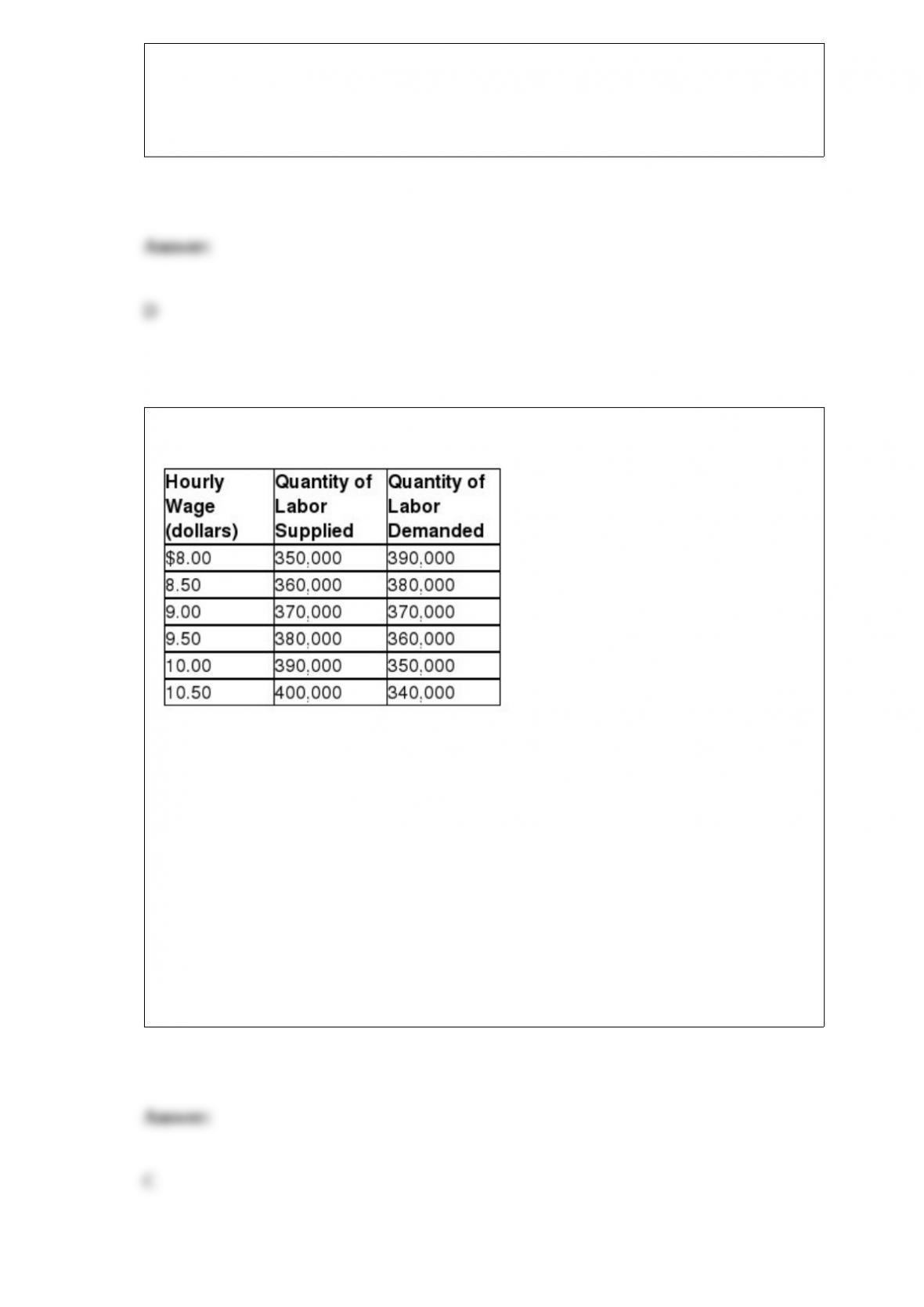
Table 4-8
Table 4-8 shows the demand and supply schedules for the low-skilled labor market in
the city of Westover.
If a minimum wage of $10.50 an hour is mandated, what is the quantity of labor
demanded?
A) 400,000
B) 370,000
C) 340,000
D) 60,000
You borrow $10,000 from a bank for one year at a nominal interest rate of 5%. The CPI
over that year rises from 180 to 200. What is the real interest rate you are paying?
A) 15%
B) 5%
C) -1.1%
D) -6.1%
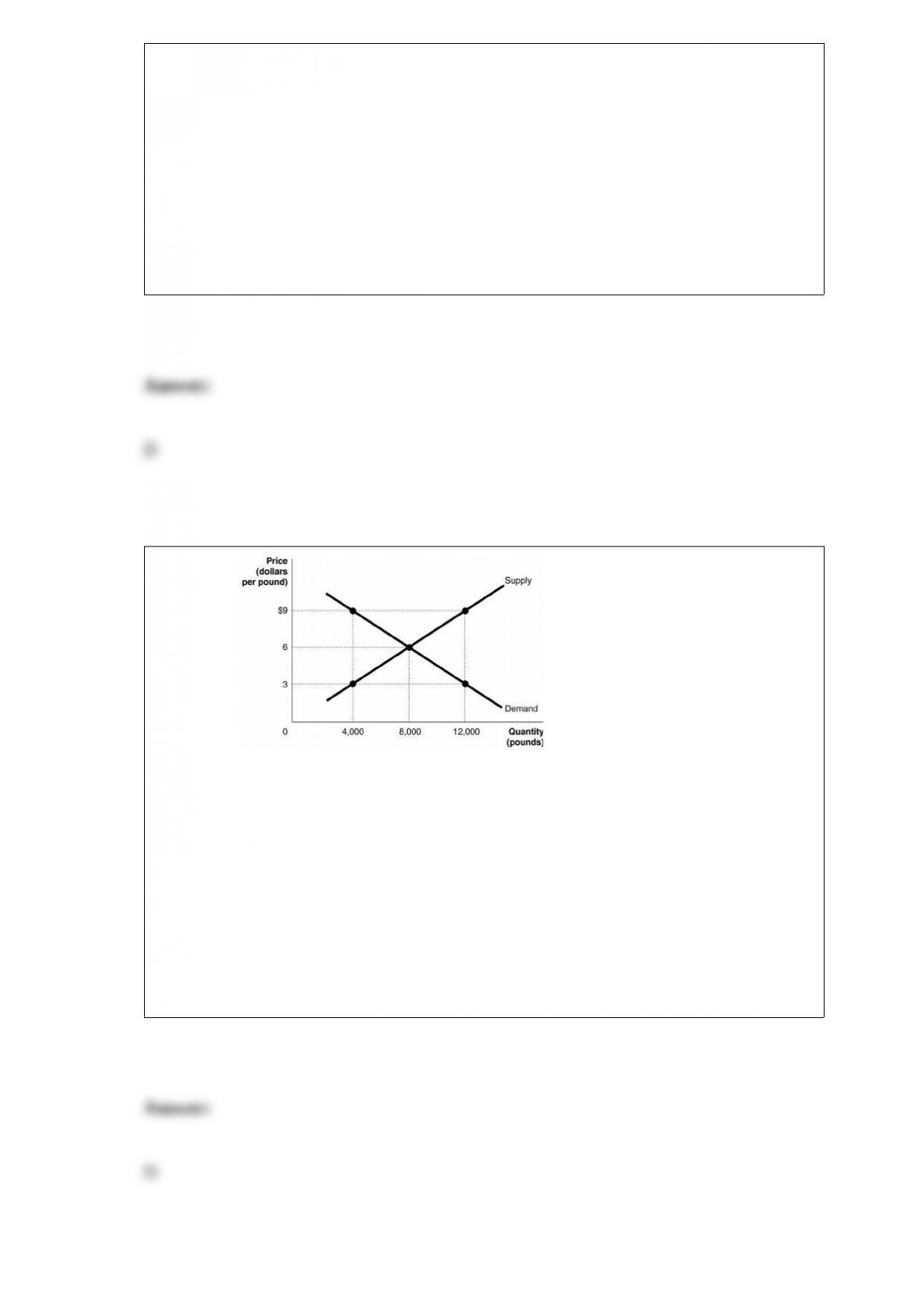
Figure 4-5
The figure above represents the market for pecans. Assume that this is a competitive
market. If 8,000 pounds of pecans are sold,
A) the deadweight loss is equal to economic surplus.
B) producer surplus equals consumer surplus.
C) the marginal benefit of each of the 8,000 pounds of pecans equals $9.
D) marginal benefit is equal to marginal cost.

When firms analyze the relationship between their level of production and their costs
they separate the time period involved into
A) morning and evening.
B) 6 months or less; 6 months to 1 year; more than 1 year.
C) a fixed period and a variable period.
D) the short run and the long run.
The main result of the monetarist model is that
A) workers and firms have rational expectations.
B) the quantity of money should be increased at a constant rate.
C) productivity shocks explain fluctuations in real GDP.
D) the economy is slow to adjust to sticky wages and prices.
What is the voting paradox?
A) the observation that less than 60 percent of those eligible to vote actually vote
B) the observation that majority voting may not always result in consistent choices
C) the idea that wealthy corporations are able to sway politicians to act in ways contrary
to the desires of the majority

D) People are aware that their votes will not change the political outcome since these
outcomes are predetermined by a group of influential politicians.
How will the exchange rate (foreign currency per dollar) respond to an increase in the
relative rate of productivity growth in the United States in the long run?
A) Exchange rates will rise.
B) Exchange rates will fall.
C) Exchange rates will be unaffected by changes in the relative rate of productivity
growth in the United States, both in the short run and in the long run.
D) The exchange rate will be affected in the short run, but not in the long run.
Assume that the demand curve for DVD players shifts to the left and the supply curve
for DVD players shifts to the right, but the supply curve shifts less than the demand
curve. As a result
A) both the equilibrium price and quantity of DVD players will decrease.
B) the equilibrium price of DVD players will decrease; the equilibrium quantity may
increase or decrease.
C) the equilibrium price of DVD players may increase or decrease; the equilibrium
quantity will increase.
D) the equilibrium price of DVD players will decrease; the equilibrium quantity will
increase.

An increase in the price level in the United States will have what effect on the aggregate
expenditure line?
A) Aggregate expenditure will shift downward.
B) Aggregate expenditure will become steeper.
C) Aggregate expenditure will shift upward.
D) Aggregate expenditure will not be affected by an increase in the price level in the
United States.
In most business situations where firms compete, often they can escape the prisoner’s
dilemma and reach the most profitable outcome. Which of the following is a reason for
this?
A) Firms engage in aggressive advertising to overcome the barriers to loyalty.
B) Most games are one-shot games so firms learn from their mistakes.
C) Most games are repeated games and firms can employ retaliation strategies against
those who do not cooperate.
D) Firms are constantly improving their products and anticipating changing consumer
tastes.

The federal budget was in deficit from 1931 to 1939, except in the year 1937. Given
this fact, how do you explain E. Cary Brown’s statement, “Fiscal policy, then, seems to
have been an unsuccessful recovery device in the ‘thirties-not because it did not work,
but because it was not tried.”
Cigars are becoming increasingly popular in the United States, and a growing number
of cigar manufacturers in the Caribbean and Central America have begun producing and
exporting cigars to the U.S. market. How has this affected the equilibrium price and
quantity of cigars?
Suppose you hit a progressive jackpot on a slot machine in a casino in Atlantic City and
are given the choice of the following prizes: Prize 1: $150,000 to be received right
away, with three additional payments of $150,000 to be received each year for the next

three years. Prize 2: $500,000 to be received right away. If the interest rate is 5 percent,
what is the present value of each prize?
Why does the substitution bias cause the consumer price index to overstate inflation and
the cost of living? Why does the increase in quality bias cause the consumer price index
to overstate inflation and the cost of living?
In September of 2007, the Federal Reserve Board Open Market Committee voted to
lower interest rates for the first time that year. Explain how lower interest rates affect
the aggregate demand curve.