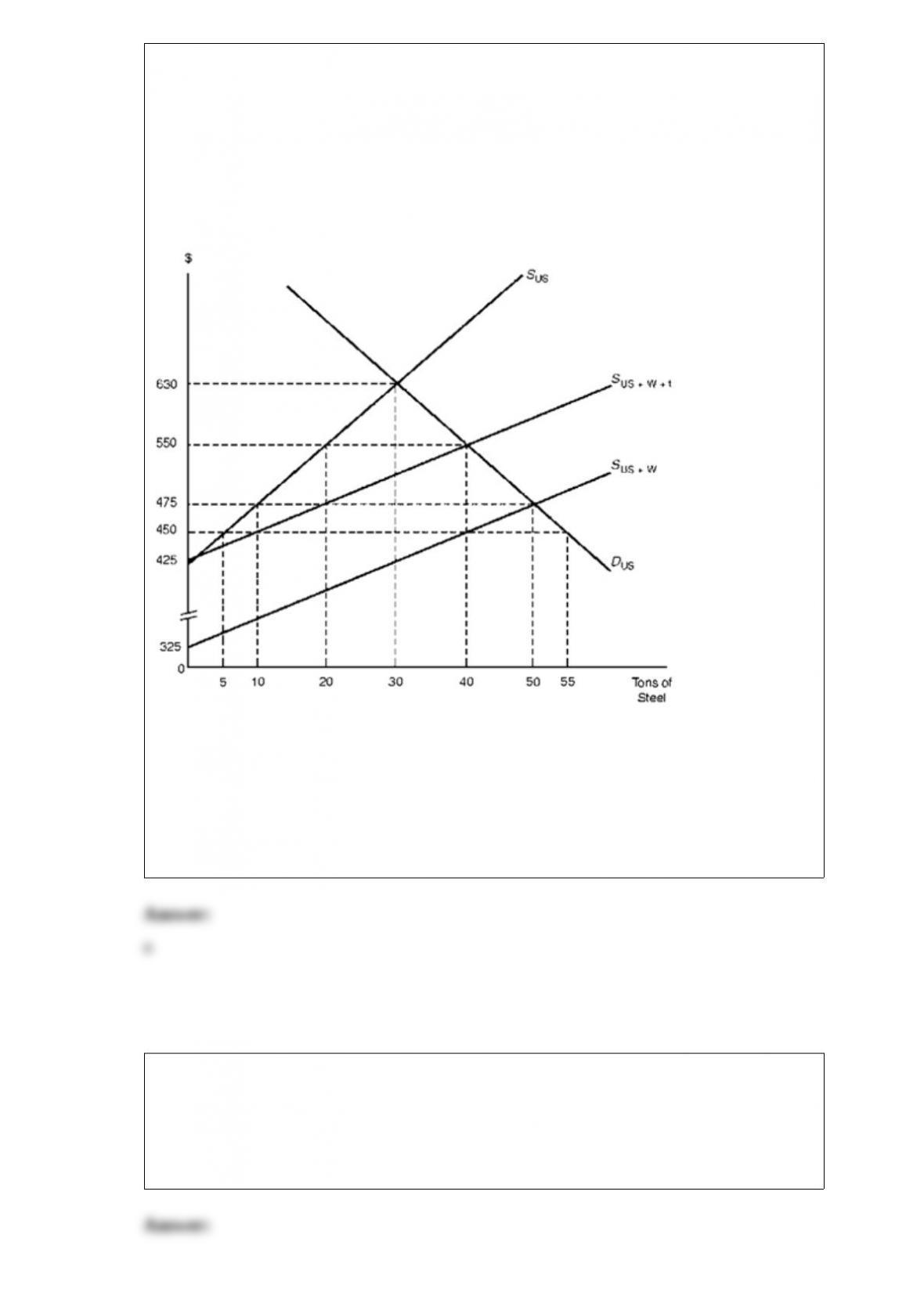
1) assume the united states is a large consumer of steel that is able to influence the
world price. its demand and supply schedules are respectively denoted by du.s. and su.s.
in figure 4.2. the overall (united states plus world) supply schedule of steel is denoted
by su.s.+w.
figure 4.2. import tariff levied by a “large” country
consider figure 4.2. suppose the united states imposes a tariff of $100 on each ton of
steel imported. with the tariff, the price of steel rises to $____ and imports fall to ____
tons.
a.$550, 20 tons
b.$550, 30 tons
c.$575, 20 tons
d.$575, 30 tons
2) during periods of falling demand for coffee, an international commodity agreement
could offset downward pressure on price by implementing policies to increase the
supply of coffee.
a.true
b.false
3) a nation benefits from international trade if it can achieve a higher indifference curve
than it can in autarky.
a.true
b.false
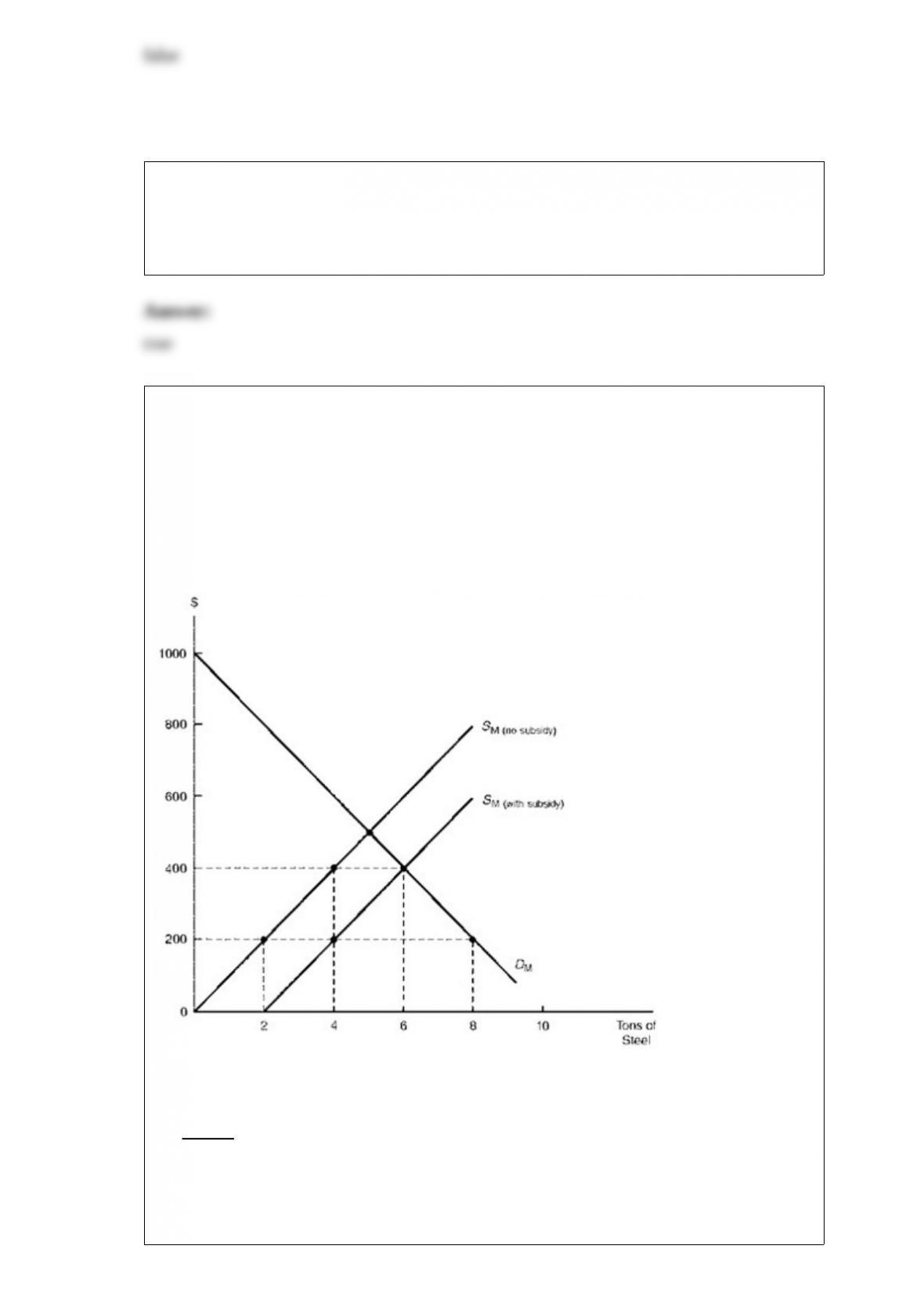
4) figure 5.1 illustrates the steel market for mexico, assumed to be a ‘small” country that
is unable to affect the world price. suppose the world price of steel is given and constant
at $200 per ton. now suppose the mexican steel industry is able to obtain trade
protection.
figure 5.1. alternative nontariff trade barriers levied by a ‘small” country
consider figure 5.1. suppose the mexican government provides a subsidy of $200 per
ton to its steel producers, as indicated by the supply schedule sm (with subsidy).
the overall deadweight welfare loss to mexico equals:
a.$200
b.$400
c.$600
d.$800
5) according to the strategic-trade-policy hypothesis, government can alter the terms of
competition to favor domestic companies, thus increasing their profits at the expense of
their rivals.
a.true
b.false
6) multinational corporations sometimes locate manufacturing subsidiaries abroad to
avoid tariff barriers which would place their products at a competitive disadvantage in a
foreign country.
a.true
b.false
7) according to the marshall-lerner approach, a currency depreciation will best lead to
an improvement on the home country’s trade balance when the:
a.home demand for imports is inelastic–foreign export demand is inelastic
b.home demand for imports is inelastic–foreign export demand is elastic
c.home demand for imports is elastic–foreign export demand is inelastic
d.home demand for imports is elastic–foreign export demand is elastic
8) exchange rate controls
a.achieved prominence during the economic crises of the late 1930’s
b.were popular immediately after world war ii
c.are widely used by the developing nations
d.all of the above
9) if the international terms of trade lies beneath (inside) the mexican cost ratio, mexico
is worse off with trade than without trade.
a.true
b.false
10) established in 1995, the world trade organization took charge of administering the
new global trade rules agreed in the uruguay round of multilateral trade negotiations.
a.true
b.false
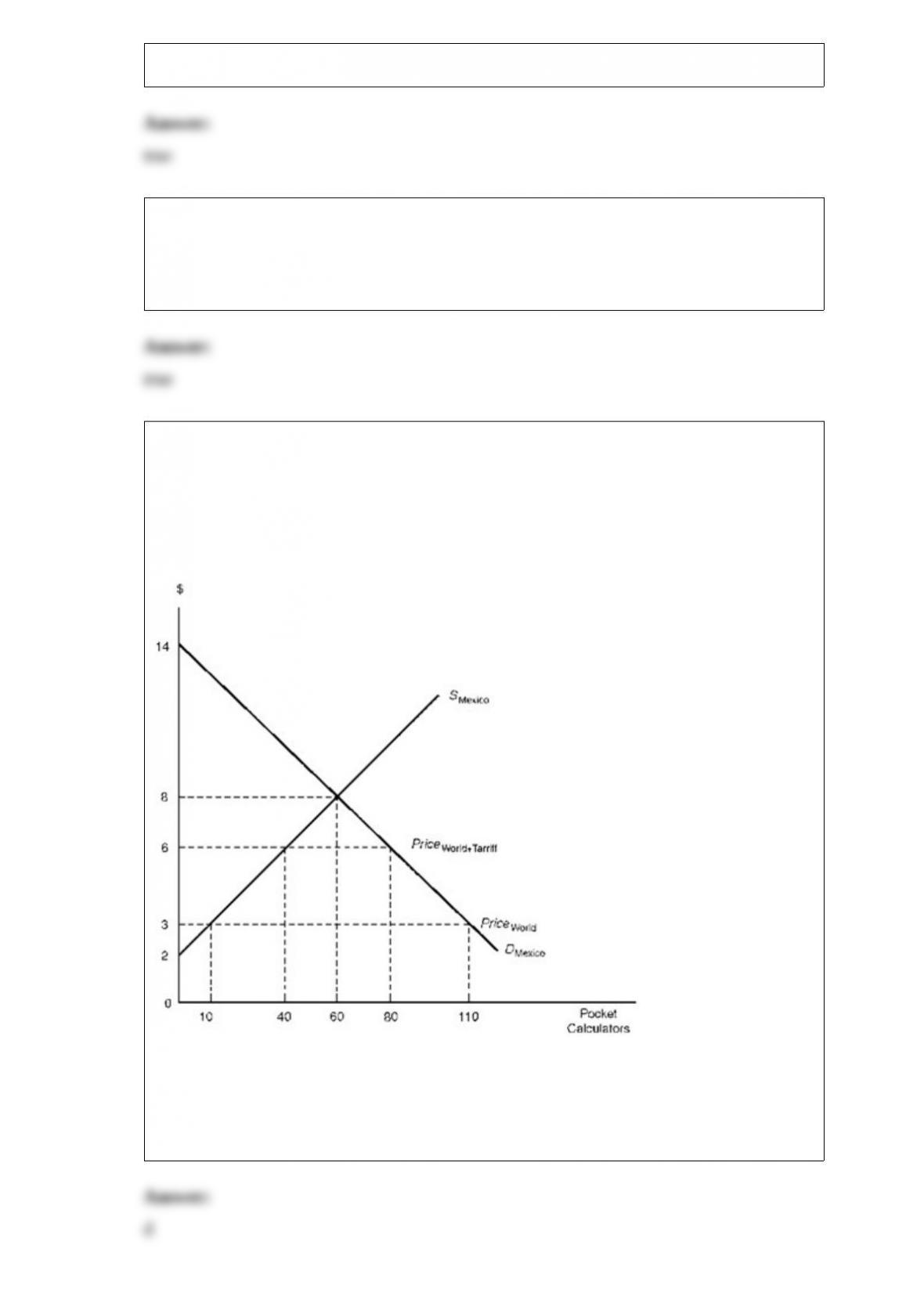
11) figure 4.1 illustrates the demand and supply schedules for pocket calculators in
mexico, a ‘small” nation that is unable to affect the world price.
figure 4.1. import tariff levied by a ‘small” country
according to figure 4.1, the deadweight cost of the tariff totals:
a.$60
b.$70
c.$80
d.$90
12) during a business recession, when cheaper products are purchased, a specific tariff
provides domestic producers a greater amount of protection against import-competing
goods.
a.true
b.false
13) the basis for trade is explained by the principle of absolute advantage according to
david ricardo and the principle of comparative advantage according to adam smith.
a.true
b.false
14) with globalization and import competition, u.s. prices have generally:
a.increased
b.decreased
c.remained stable
d.all of these at various times
15) the writings of g. macdougall emphasized which of the following as an explanation
of a country’s competitive position?
a.national income levels
b.relative endowments of natural resources
c.domestic tastes and preferences
d.labor compensation and productivity levels
16) assume that the united states imports televisions from taiwan at a price of $300 per
unit and that these televisions are subject to an import tariff of 25 percent. also assume
that u.s. components are used in the televisions assembled by taiwan and that these
components have a value of $100. under the offshore assembly provision of u.s. tariff
policy, the price of an imported television to the u.s. consumer after the tariff has been
levied is $375
a.true
b.false
17) the greater a nation’s propensity to apply tariffs and quotas to key sectors, the
greater will be the need for international reserves.
a.true
b.false
18) if the size of the canadian market is large enough to permit efficient production in
canada, a u.s. firm would profit by establishing a canadian manufacturing subsidiary or
licensing rights to a canadian firm to manufacture and sell its product in canada.
a.true
b.false
19) the united states exports a larger percentage of its gross domestic product than
japan, germany, and canada.
a.true
b.false