1) Melanie and Oli are competing Pacific Halibut fishers. Both have been allocated
ITQs that limit their catch to 1,000 tons of Pacific Halibut each. Melanie’s cost per ton
is $20; Oli’s cost per ton is $28.
Refer to the information above. If the market price of Pacific Halibut is $40 per ton,
what is the minimum amount Melanie would have to offer Oli to convince him to sell
Melanie his ITQs?
A.$8.
B.$10.
C.$20.
D.$12.
2) The basic problem portrayed by the traditional Phillips Curve is:
A.that a level of aggregate demand sufficiently high to result in full employment may
also cause inflation.
B.that changes in the composition of total labor demand tend to be deflationary.
C.that unemployment rises at the same time the general price level is rising.
D.the possibility that automation will increase the level of noncyclical unemployment.
3) transfer payments are about ____ percent of u.s. domestic output.
a.40 percent
b.8 percent
c.13 percent
d.22 percent
4)
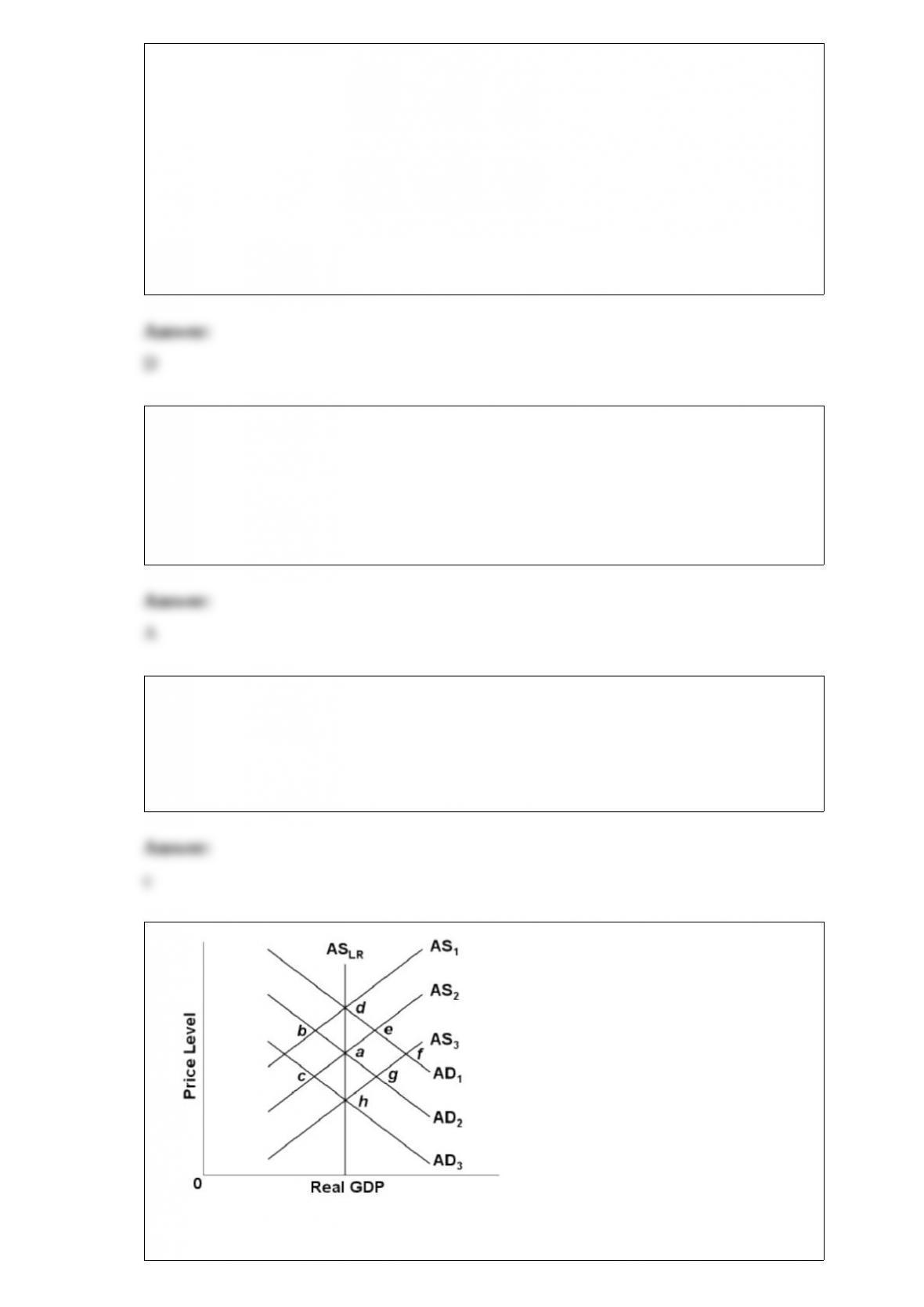
Refer to the above figure and assume the economy initially is in equilibrium at point a.
In the new classical theory, a fully anticipated decrease in aggregate demand from AD2
to AD3 would move the economy:
A.directly from a to h
B.from a to g to h
C.directly from a to d
D.from a to c to h
5) (Last Word) The composite index of leading indicators is useful for:
A.predicting potential GDP.
B.determining the natural rate of unemployment.
C.developing discretionary fiscal policy.
D.forecasting aggregate supply shocks.
6) If all workers are homogeneous, all jobs are equally attractive to workers, and labor
markets are perfectly competitive:
A.compensating differences would cause wage differentials.
B.noncompeting groups of workers would result in wage differentials.
C.all workers would receive the same wage rate.
D.worker mobility would occur such that wage differentials would widen.
7)
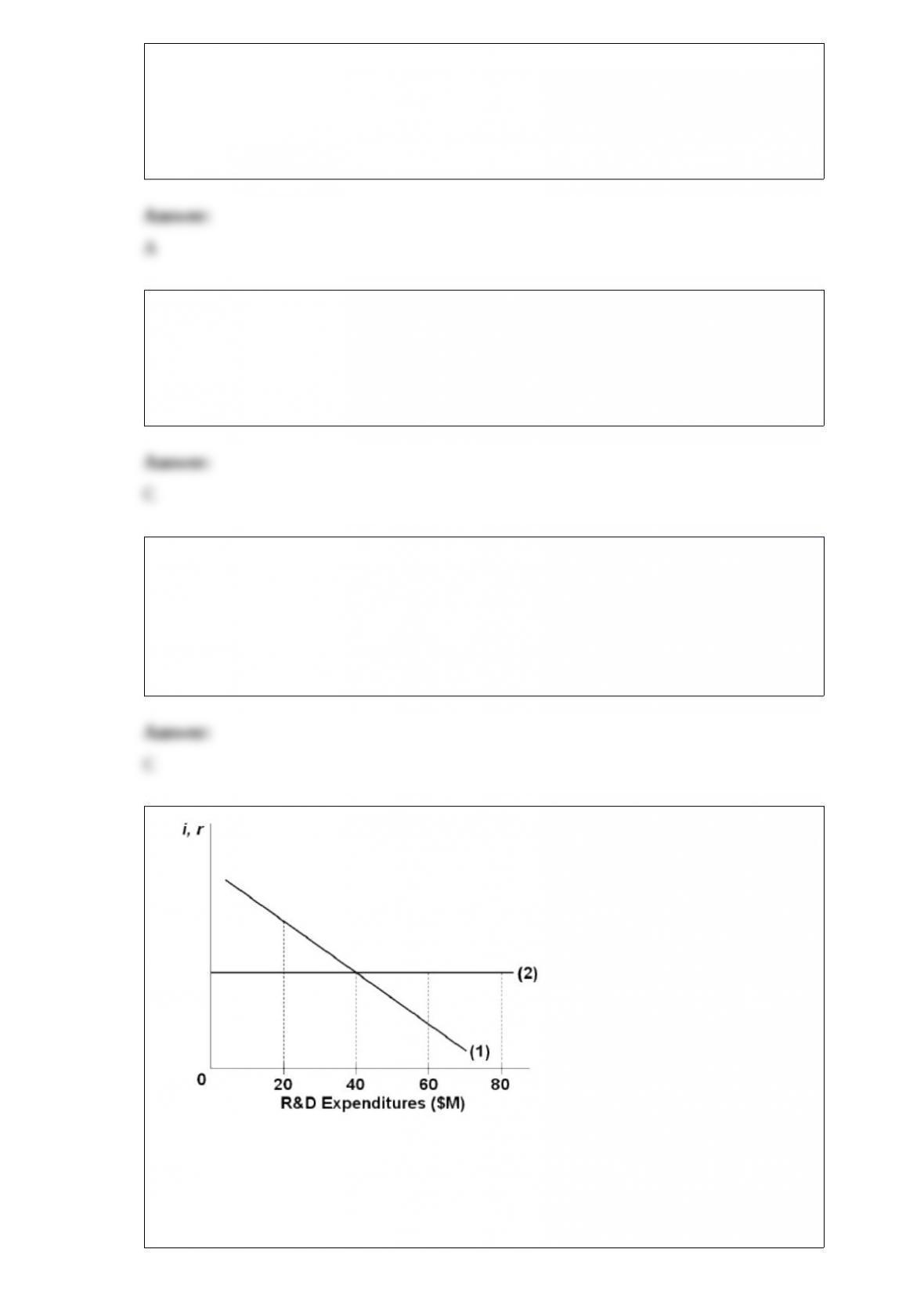
Assume that a firm’s interest-rate-cost of funds curve for R&D is perfectly elastic.
Which of the following would decrease a firm’s optimal R&D expenditures and, in
equilibrium, leave the expected rate of return on the last dollar of R&D unchanged?
A.a rightward shift of the expected-rate-of-return curve
B.an upward shift of the interest-rate-cost of funds curve

C.a leftward shift of the expected-rate-of-return curve
D.a downward shift of the interest-rate-cost of funds curve
8) The function of investigating instances of fraudulent advertising has been assigned to
the:
A.Joint Economic Committee of Congress.
B.Federal Trade Commission.
C.Bureau of Standards.
D.Department of Justice.
9) compared to other industrial nations, inflation rates in the united states are:
a.significantly higher.
b.significantly lower.
c.significantly higher than those in europe, and significantly lower than those in japan.
d.neither significantly higher nor significantly lower.
10) In the aggregate expenditures model, the level of GDP moves toward an
equilibrium because:
A.the investment schedule is steeper than the saving schedule.
B.the 45-degree line is steeper than the aggregate expenditures schedule.
C.the saving schedule is steeper than the consumption schedule.
D.wages and prices are flexible downward.
11)
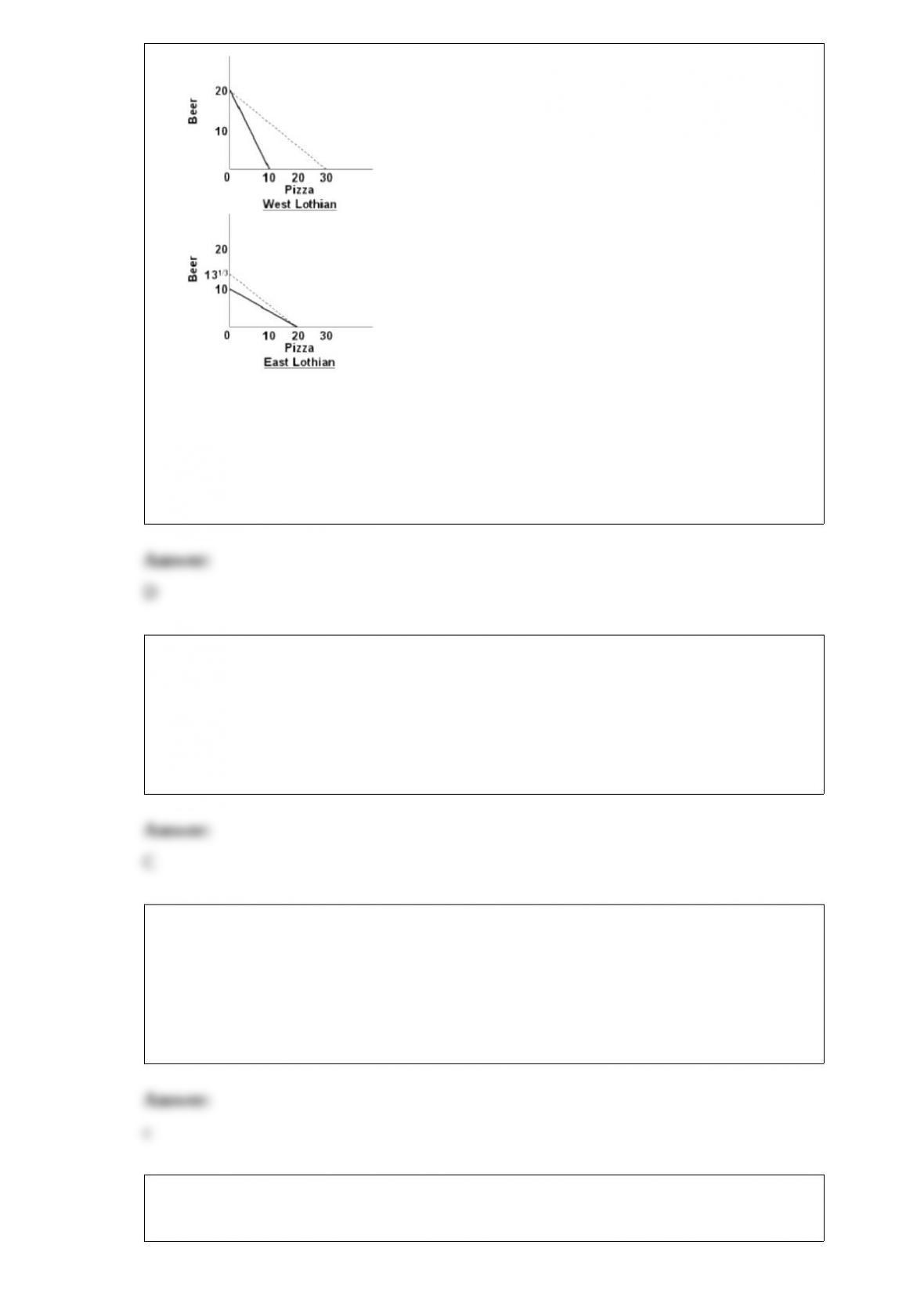
Refer to the above diagrams. The solid lines are production possibilities curves; the
dashed lines are trading possibilities curves. The opportunity cost of producing a:
A.pizza is 2 beers in both countries.
B.beer is 1/2 a pizza in both countries.
C.pizza in East Lothian is 1 beer.
D.beer in West Lothian is 1/2 a pizza.
12) The World Trade Organization:
A.is also known as the International Monetary Fund (IMF).
B.is also known as NAFTA.
C.was established to resolve disputes arising under world trade rules.
D.enhances world trade by providing interest rate subsidies to foreign borrowers who
buy exports on credit.
13) if the university chamber music society decides to raise ticket prices to provide
more funds to finance concerts, the society is assuming that the demand for tickets is:
a.parallel to the horizontal axis.
b.shifting to the left.
c.inelastic.
d.elastic.
14) the typical production possibilities curve is:
a.an upsloping line that is concave to the origin.
b.a downsloping line that is convex to the origin.
c.a downsloping line that is concave to the origin.
d.a straight upsloping line.
15)
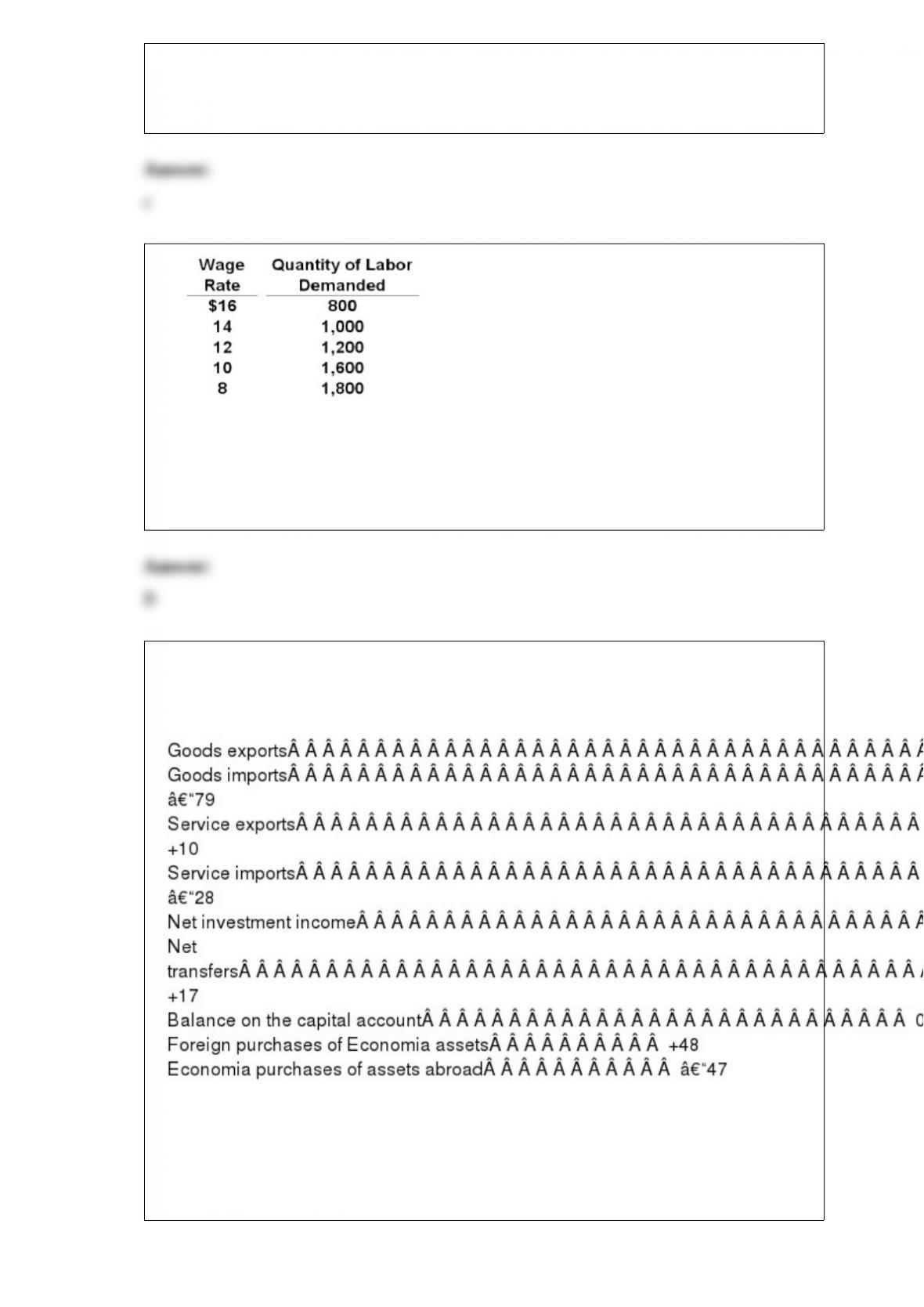
Refer to the above data. For the $16 to $14 range of wage rates, labor demand is:
A.perfectly elastic.
B.elastic.
C.perfectly inelastic.
D.inelastic.
16) Answer the next five questions on the basis of the following hypothetical data for a
hypothetical nation Economia. All numbers are in billions of dollars.
(a)What is the balance of trade?
(b)What is the balance on goods and services?
(c)What is the balance on the current account?
(d)What is the balance on the financial account?
(e)What official reserves will be needed to settle the balance-of-payment accounts?