1) Refer to Scenario 9-2. Suppose the world price of cardboard is $45 and international
trade is allowed. Then
Boxland’s consumers demand
a.110 tons of cardboard and Boxland’s producers supply 75 tons of cardboard.
b.110 tons of cardboard and Boxland’s producers supply 96 tons of cardboard.
c.96 tons of cardboard and Boxland’s producers supply 75 tons of cardboard.
d.96 tons of cardboard and Boxland’s producers supply 96 tons of cardboard.
2) The administrative burden of regulating price in a monopolistically competitive
market is
a.small due to economies of scale.
b.large because price is usually below marginal cost.
c.large because of the large number of firms that produce differentiated products.
d.small because firms produce with excess capacity.
3) The production possibilities frontier shows the opportunity cost of one good as
measured in terms of the other good.
a.True
b.False
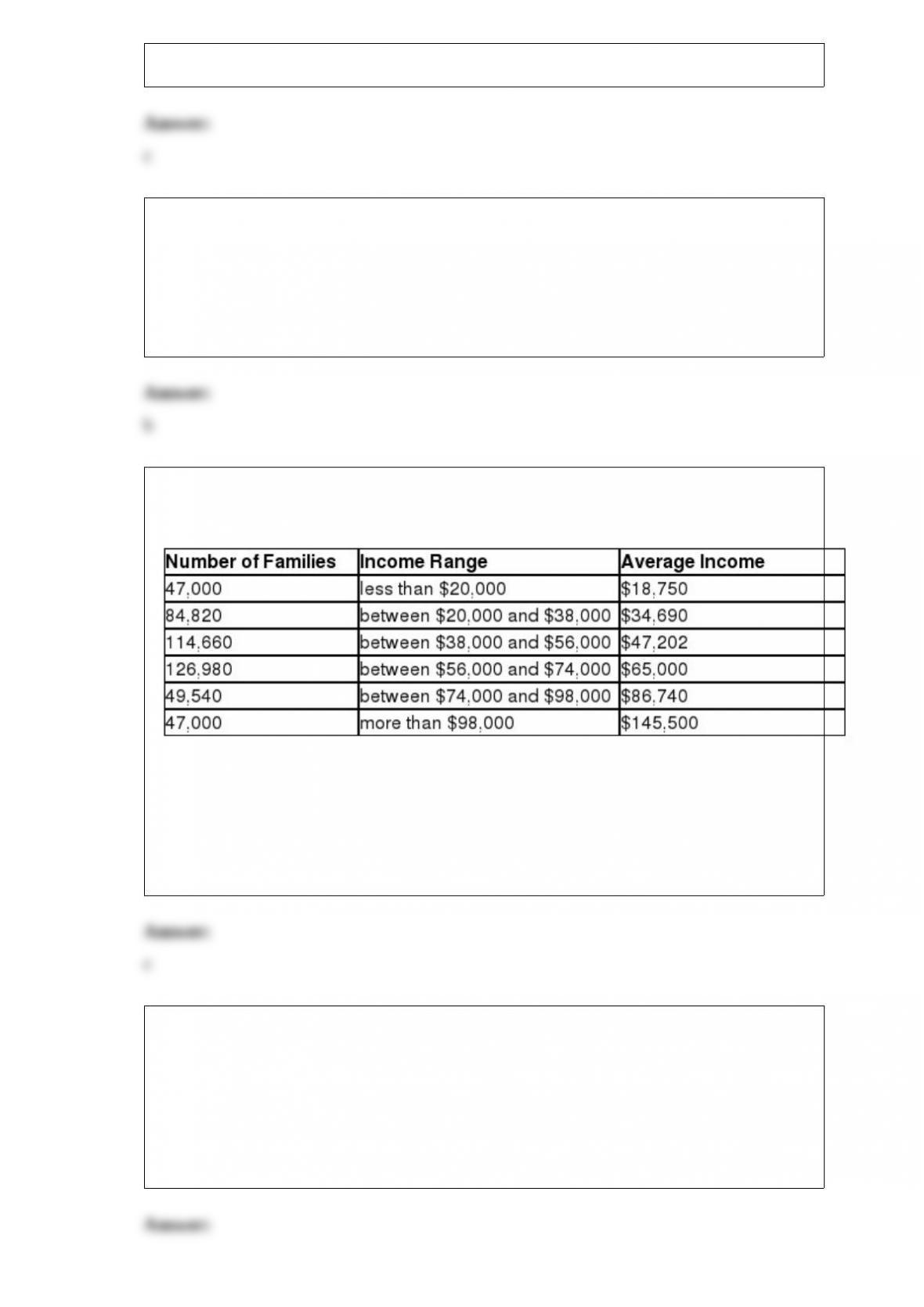
4) Consider the town of Springfield with only three residents, Sophia, Amber, and
Cedric. The three residents are trying to determine how large, in acres, they should
build the public park. The table below shows each resident’s willingness to pay for each
acre of the park.
Suppose the cost to build the park is $24 per acre and that the residents have agreed to
split the cost of building the park equally. If the residents decide to build a park with
size equal to the number of acres that maximizes total surplus from the park, how much
total surplus will Amber receive?
a.$0 b. $26 c. $32 d. $56
5) Suppose that a new invention increases the marginal productivity of labor, shifting
labor demand to the right. Such an invention would be an example of
a.labor-saving technology.
b.labor-augmenting technology.
c.revenue technology.
d.supply-shifting technology.
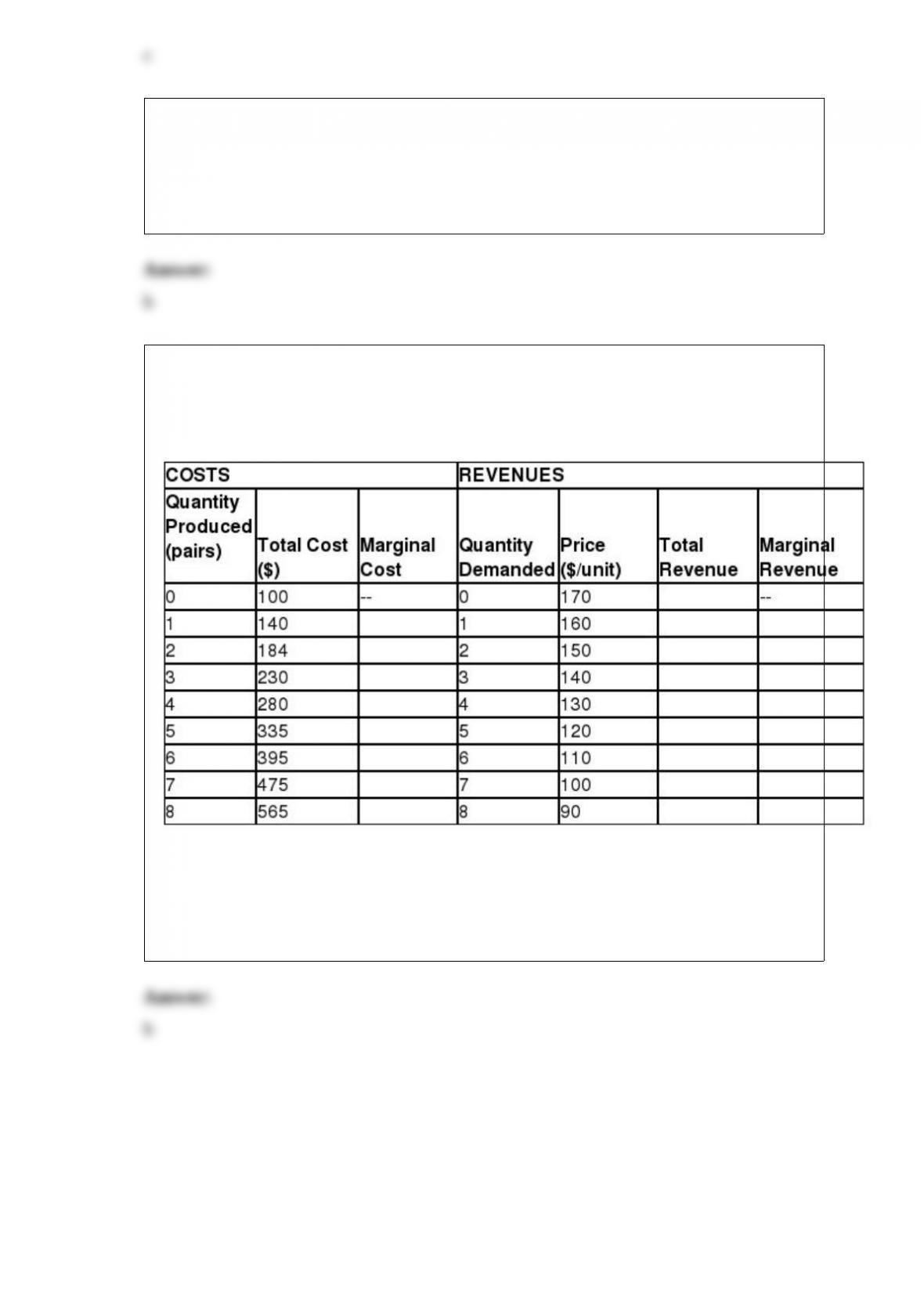
6) Table 20-5
Distribution of Income in Umakastan
Refer to Table 20-5. Where would the government of Umakastan have to set the
poverty line to have a poverty rate of about 28%?
a.$20,000
b.$34,690
c.$38,000
d.$56,000
7) When adding another unit of labor leads to an increase in output that is smaller than
the increases in output that resulted from adding previous units of labor, the firm is
experiencing
a.diminishing labor.
b.diminishing output.
c.diminishing marginal product.
d.negative marginal product.
8) The primary determinant of a country’s standard of living is
a.the country’s ability to prevail over foreign competition.
b.the country’s ability to produce goods and services.
c.the total supply of money in the economy.
d.the average age of the country’s labor force.
9) Table 15-7
Sally owns the only shoe store in town. She has the following cost and revenue
information.
What is the total variable cost of production when Sally produces six pairs of shoes?
a. $100
b. $295
c. $600
d. $620
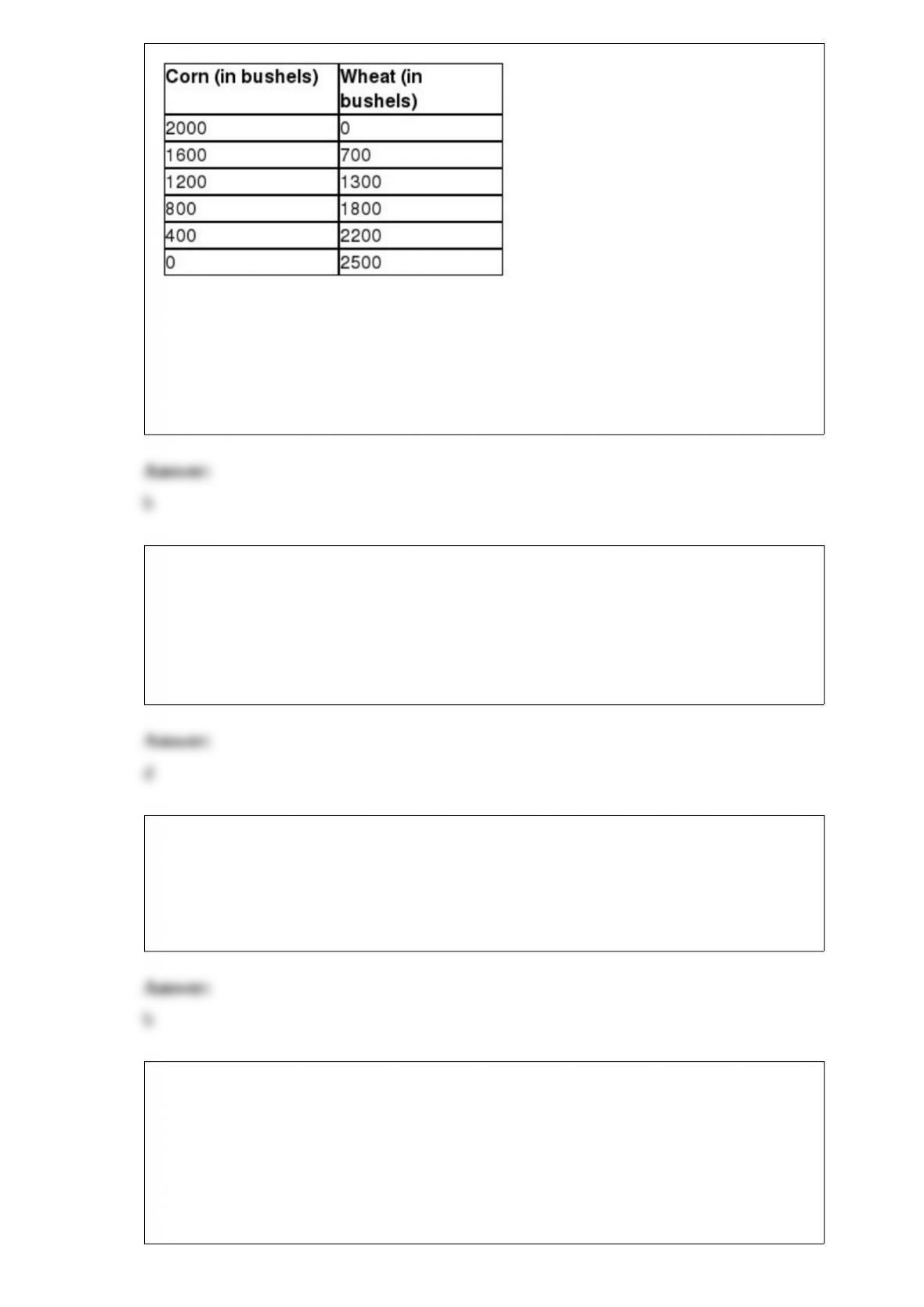
10) Table 2-5 shows one set of production possibilities. What is the opportunity cost of
increasing the production of corn from 400 bushels to 800 bushels?
a.200 bushels of wheat
b.400 bushels of wheat
c.600 bushels of wheat
d.800 bushels of wheat
11) If an electric power plant does not bear the entire cost of the pollution it emits, it
will
a.not emit any pollution so as to avoid the entire cost of the pollution.
b.emit lower levels of pollution.
c.emit an acceptable level of pollution.
d.emit too much pollution.
12) A monopolistically competitive market could be considered inefficient because
a.marginal revenue exceeds average revenue.
b.price exceeds marginal cost.
c.the efficient scale of production is only achieved in the long run, not in the short run.
d.markup pricing does not occur in any other market structure.
13) Suppose a consumer consumes two goods, X and Y. The slope of the budget
constraint equals the
a.marginal rate of substitution.
b.rate at which the consumer will give up X to gain Y while maintaining the same level
of utility.
c.relative price of the two goods.
d.All of the above are correct.
14) That some schools direct females away from science and math courses is evidence
of
a.labor-market discrimination
b.discrimination that occurs prior to people entering the labor market
c.discrimination by customers
d.discrimination by employers
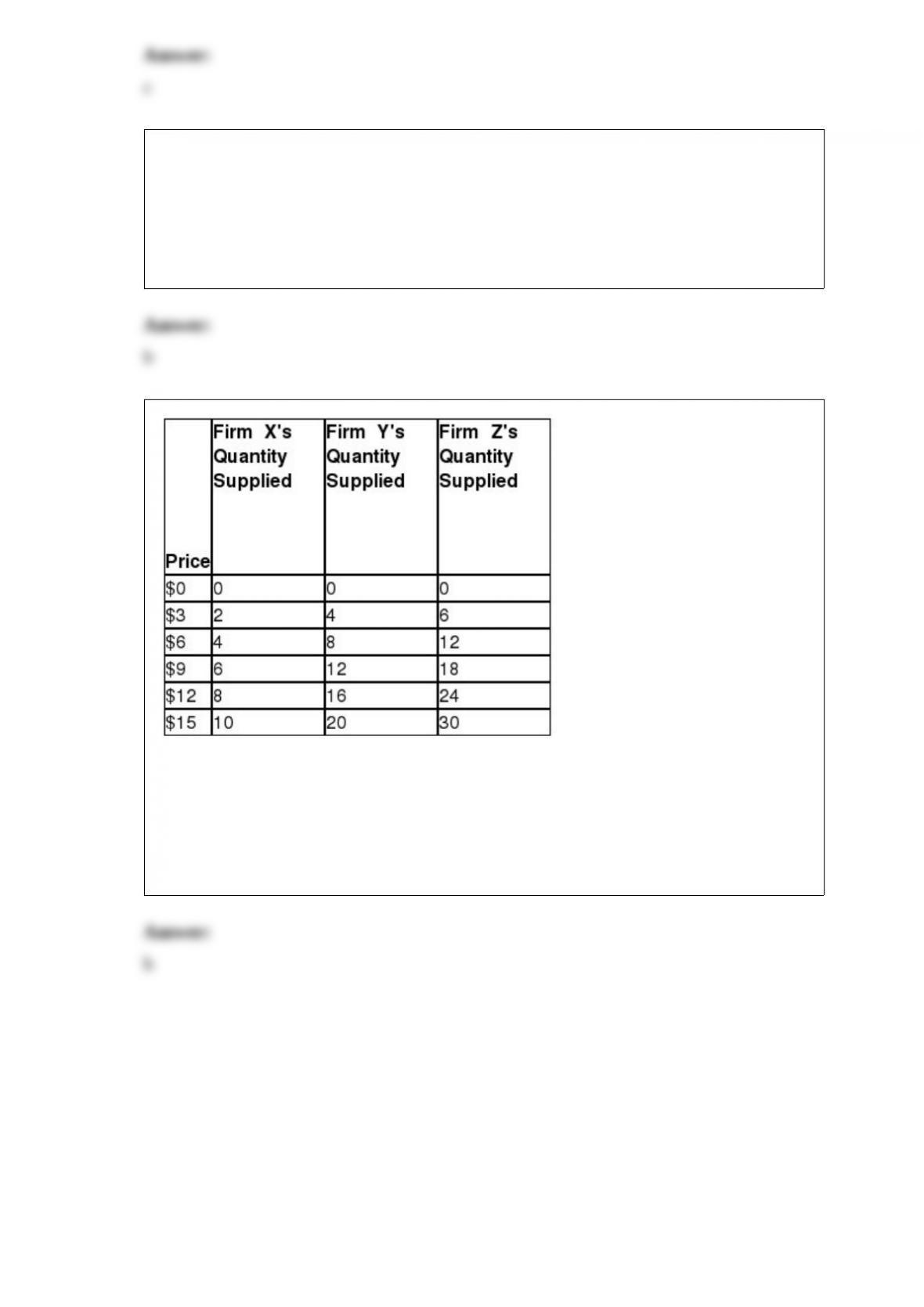
15) If these are the only three sellers in the market, then an increase in the market price
from $6 to $12 will increase quantity supplied by
a.12 units.
b.24 units.
c.36 units.
d.48 units.