1) that u.s. importers purchase bananas from brazil constitutes a debit transaction on the
u.s. balance of payments.
a.true
b.false
2) countervailing duties may be imposed:
a.in response to a foreign export subsidy
b.in response to a foreign antidumping tariff
c.to promote exports of domestic companies
d.to promote imports of domestic consumers
3) tariffs are not defended on the ground that they:
a.improve the terms of trade of foreign nations
b.protect jobs and reduce unemployment
c.promote growth and development of young industries
d.prevent overdependence of a country on only a few industries
4) the benefits of international trade accrue in the forms of lower domestic prices,
development of more efficient methods and new products, and a greater range of
consumption choices.
a.true
b.false
5) if the japanese yen appreciates against other currencies in the exchange markets, this
will:
a.have no effect on the japanese balance of trade
b.tend to improve the japanese balance of trade
c.tend to worsen the japanese balance of trade
d.none of the above
6) the most recent round of multilateral trade negotiations is the:
a.kennedy round
b.tokyo round
c.doha round
d.geneva round
7) which of the following suggests that a nation will export the commodity in the
production of which a great deal of its relatively abundant and cheap factor is used?
a.the linder theory
b.the product life cycle theory
c.the macdougall theory
d.the heckscher-ohlin theory
8) an appreciation in the value of the u.s. dollar against the british pound would tend to:
a.discourage the british from buying american goods
b.discourage americans from buying british goods
c.increase the number of dollars that could be bought with a pound
d.discourage u.s. tourists from traveling to britain
9) figure 5.1 illustrates the steel market for mexico, assumed to be a ‘small” country that
is unable to affect the world price. suppose the world price of steel is given and constant
at $200 per ton. now suppose the mexican steel industry is able to obtain trade
protection.
figure 5.1. alternative nontariff trade barriers levied by a ‘small” country
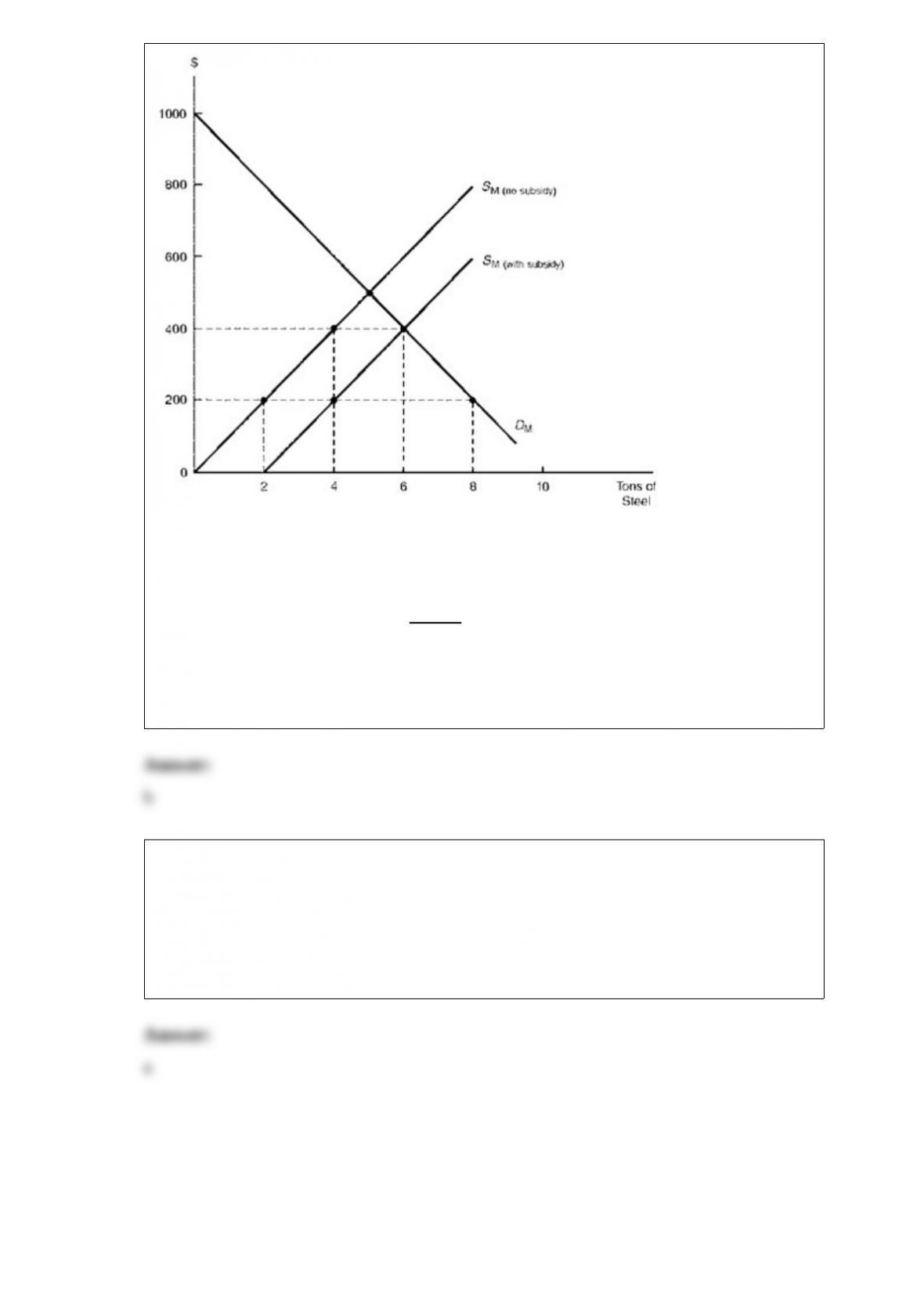
consider figure 5.1. suppose the rest of the world voluntarily agrees to reduce steel
shipments to mexico vis-a-vis an export quota equal to 2 tons.
assuming mexican importers behave as monopoly buyers while foreign exporters
behave as competitive sellers, the overall welfare loss of the quota to mexico is:
a.$200
b.$400
c.$600
d.$800
10) the strongest political pressure for a trade policy that results in higher protectionism
comes from:
a.domestic workers lobbying for import restrictions
b.domestic workers lobbying for export restrictions
c.domestic consumers lobbying for export restrictions
d.domestic consumers lobbying for import restrictions