Monopolistically competitive firms use product differentiation to
A) ensure long-run profits.
B) achieve market power.
C) block other firms from entering the industry.
D) limit the number of firms in the industry.
You take a class that improves your critical thinking skills. This represents an
investment in your
A) human capital.
B) social capital.
C) tangible capital.
D) financial capital.
Related to the Economics in Practice on page 722: By 2001, the majority of the fishing
fleet in the Indian state of Kerala had mobile phones. As a result of the introduction of
mobile phone service, ________ in this fishing industry was virtually eliminated.
A) human capital

B) profit
C) competition
D) waste
A firm will reduce its quantity of labor as long as the MRP of labor ________ the
market wage rate.
A) is greater than or equal to
B) is less than
C) is equal to
D) determines
A ________ line is a perfectly price elastic demand curve.
A) horizontal
B) vertical
C) positively sloped
D) negatively sloped
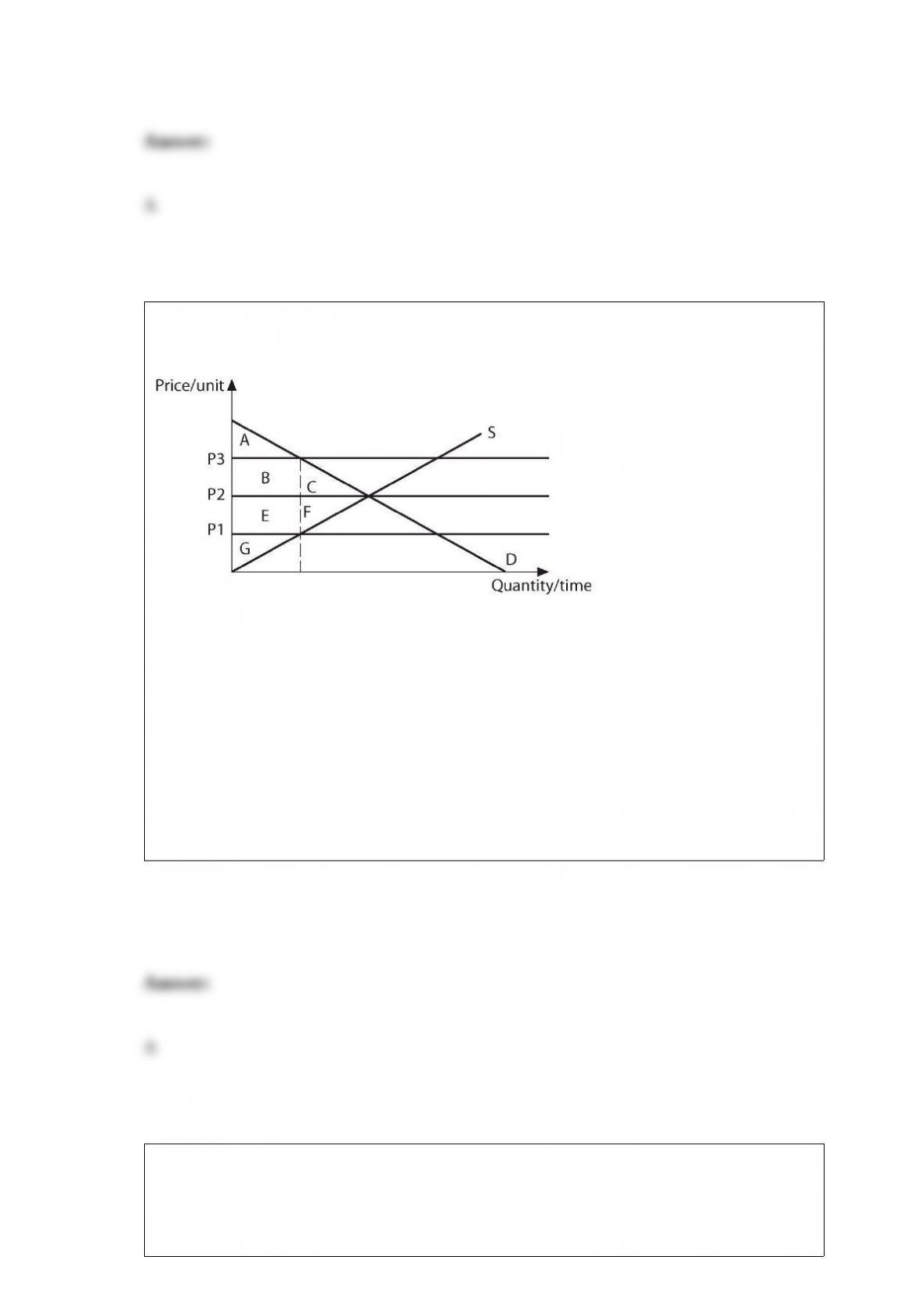
Equilibrium in this market occurs at the intersection of curves S and D.
Figure 4.6
In figure 4.6 if price goes from equilibrium to P1, consumer surplus changes by the area
A) E-C.
B) C+E.
C) E+F.
D) B-F.
If a nation has ________ status conferred on it, then exports from that country are taxed
at the lowest negotiated tariff rates.
A) international-ally

B) no-child-labor
C) total-trade-guaranteed
D) most-favored-nation
An increase in demand caused no change in the equilibrium price. Thus, supply must be
A) perfectly inelastic.
B) inelastic.
C) elastic.
D) perfectly elastic.
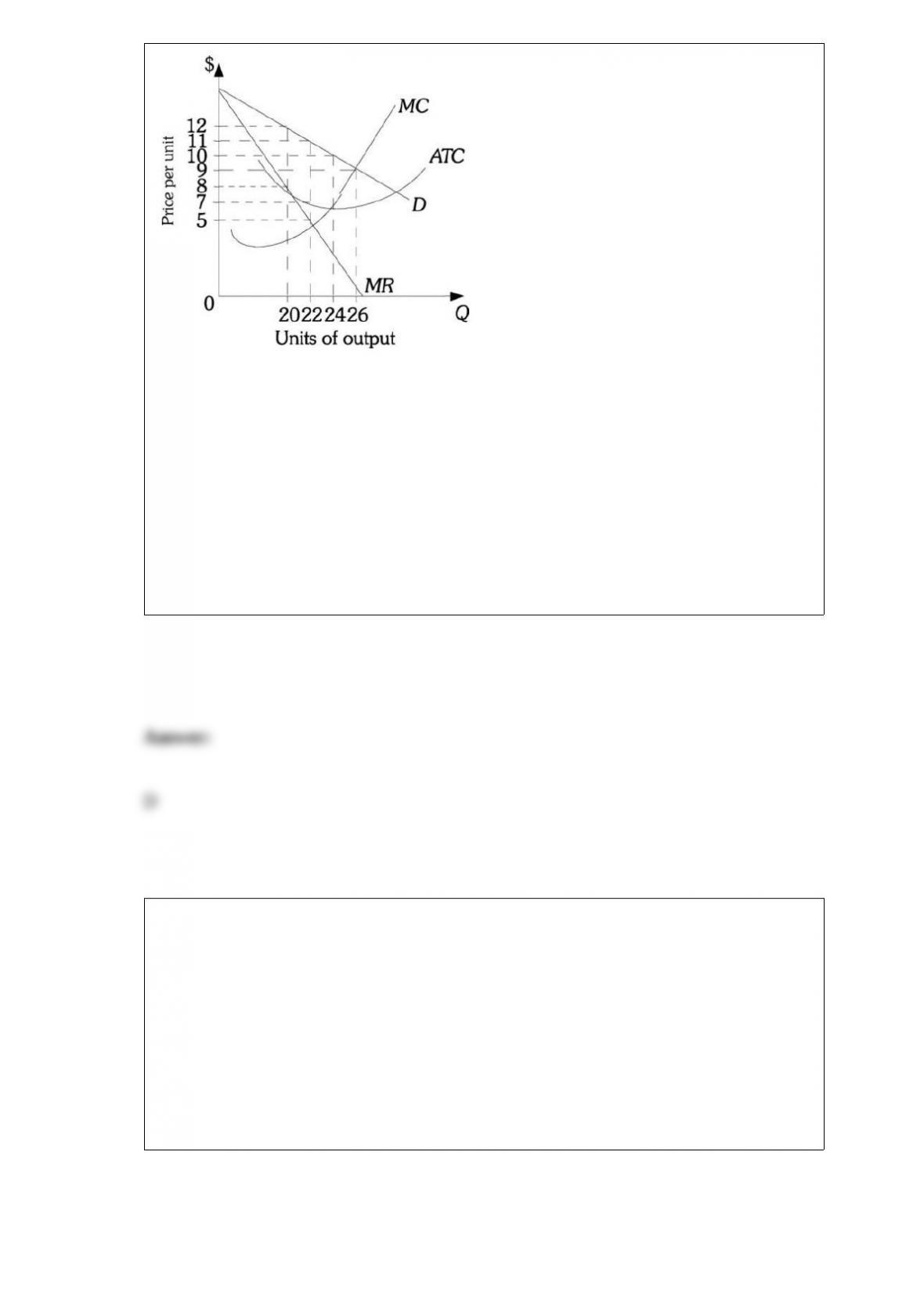
Figure 13.5
Refer to Figure 13.5. At its production point, the ________ for this firm is $11.
A) average total cost
B) marginal revenue
C) marginal cost
D) profit-maximizing price
The demand curve facing a dominant firm in the price leadership model is derived by
subtracting the
A) amount supplied by the smaller firms from market demand.
B) amount supplied by the smaller firms from market supply.
C) amount demanded by customers from the smaller firms from market supply.
D) dominant firm’s marginal cost curve from the industry’s supply curve.
A credit union faces a(n) ________ problem when it lends funds to a customer to
remodel her home and the customer then opportunistically uses the funds for a
gambling trip to Las Vegas.
A) adverse selection
B) moral hazard
C) external cost
D) free-rider
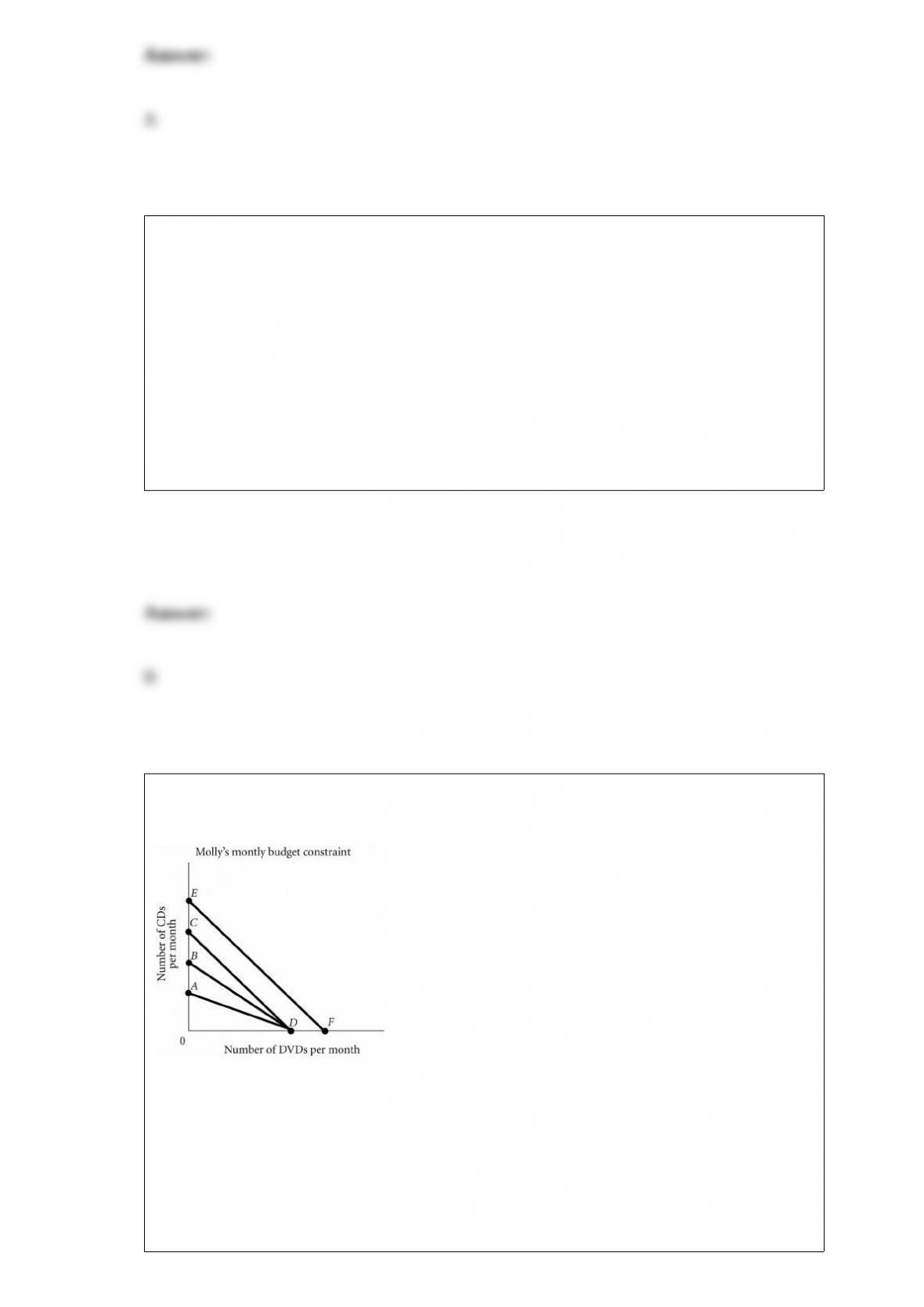
Figure 6.5
Refer to Figure 6.5. Molly’s budget constraint is BD. If the price of CDs decreases, her
new budget constraint becomes
A) AD.
B) AO.

C) CD.
D) EF.
For Adrian, the marginal utility of the 5th energy drink in a day is positive and the
marginal utility of the 6th energy drink in a day is zero. This
A) implies that Adrian’s demand curve for energy drinks per day will become upward
sloping at 6 energy drinks per day.
B) is impossible because each additional unit of consumption of any good must provide
positive marginal utility.
C) implies that at a zero price Adrian’s demand curve will intersect the quantity axis at
6.
D) implies that Adrian maximizes utility by consuming 5 energy drinks per day.
A technological change in smartphone production will
A) affect only the markets for inputs used to produce smartphones.
B) affect only the way smartphones are produced.
C) have no effect on consumers.
D) affect input and output markets in the smartphone industry and other related
industries.
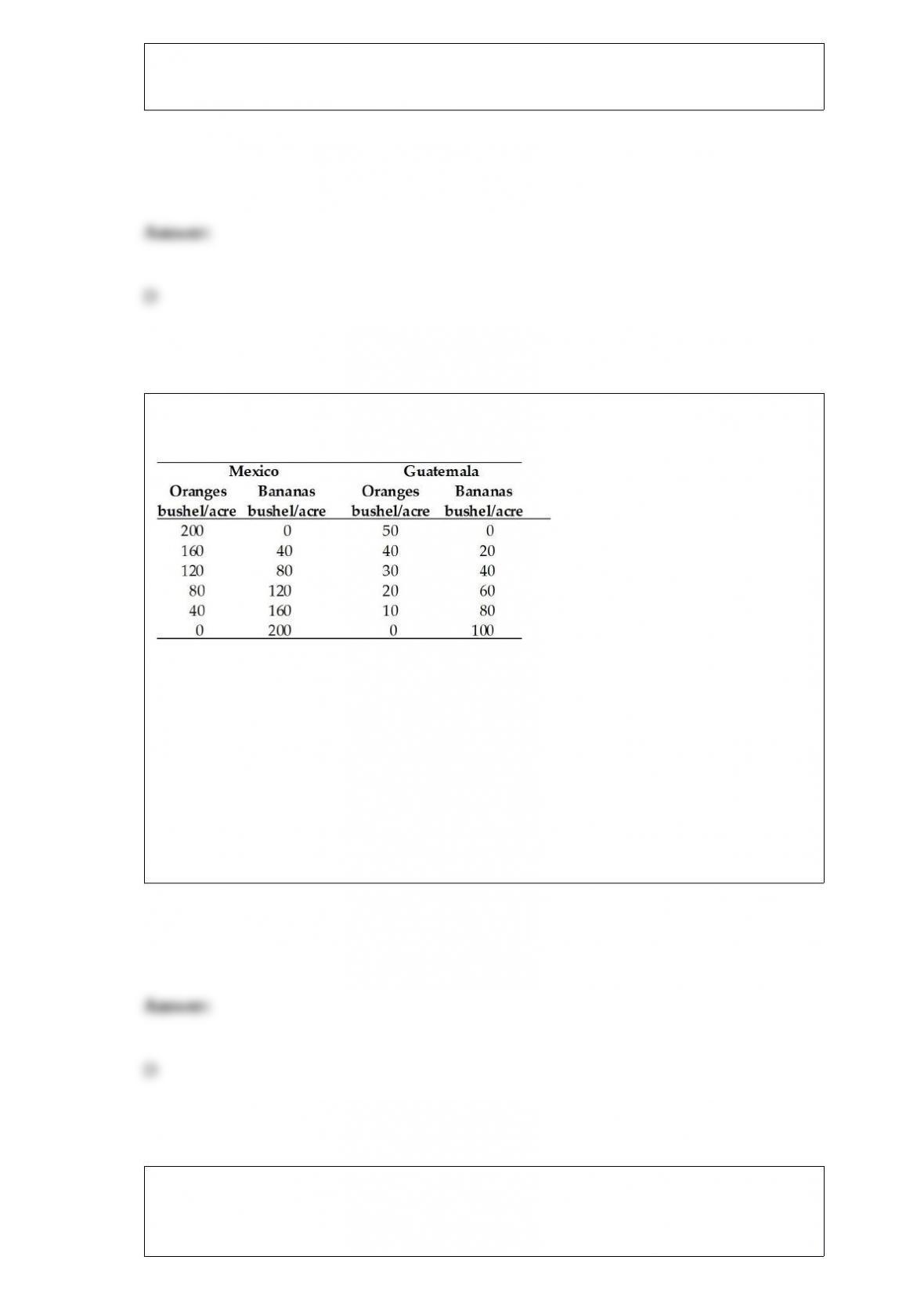
Table 20.1
Refer to Table 20.1. Guatemala has
A) a comparative advantage in orange production.
B) an absolute advantage in orange production.
C) an absolute advantage in banana production.
D) a comparative advantage in banana production.
The ratio of the marginal utility of tea to the marginal utility of scones is six for an
individual maximizing utility. This implies that

A) a scone is six times more valuable than a cup of tea.
B) the tea to scones price ratio is one to six.
C) the tea to scones price ratio is six to one.
D) this person always eats scones with tea.
The study of economics
A) is a very narrow endeavor.
B) is a way of analyzing decision-making processes caused by scarcity.
C) is concerned with proving that capitalism is better than socialism.
D) focuses on how a business should function.
Someone has a comparative advantage in producing a good if they can produce that
good
A) in greater quantities.
B) at a lower opportunity cost.
C) using more capital and less labor.
D) using more labor and less capital.
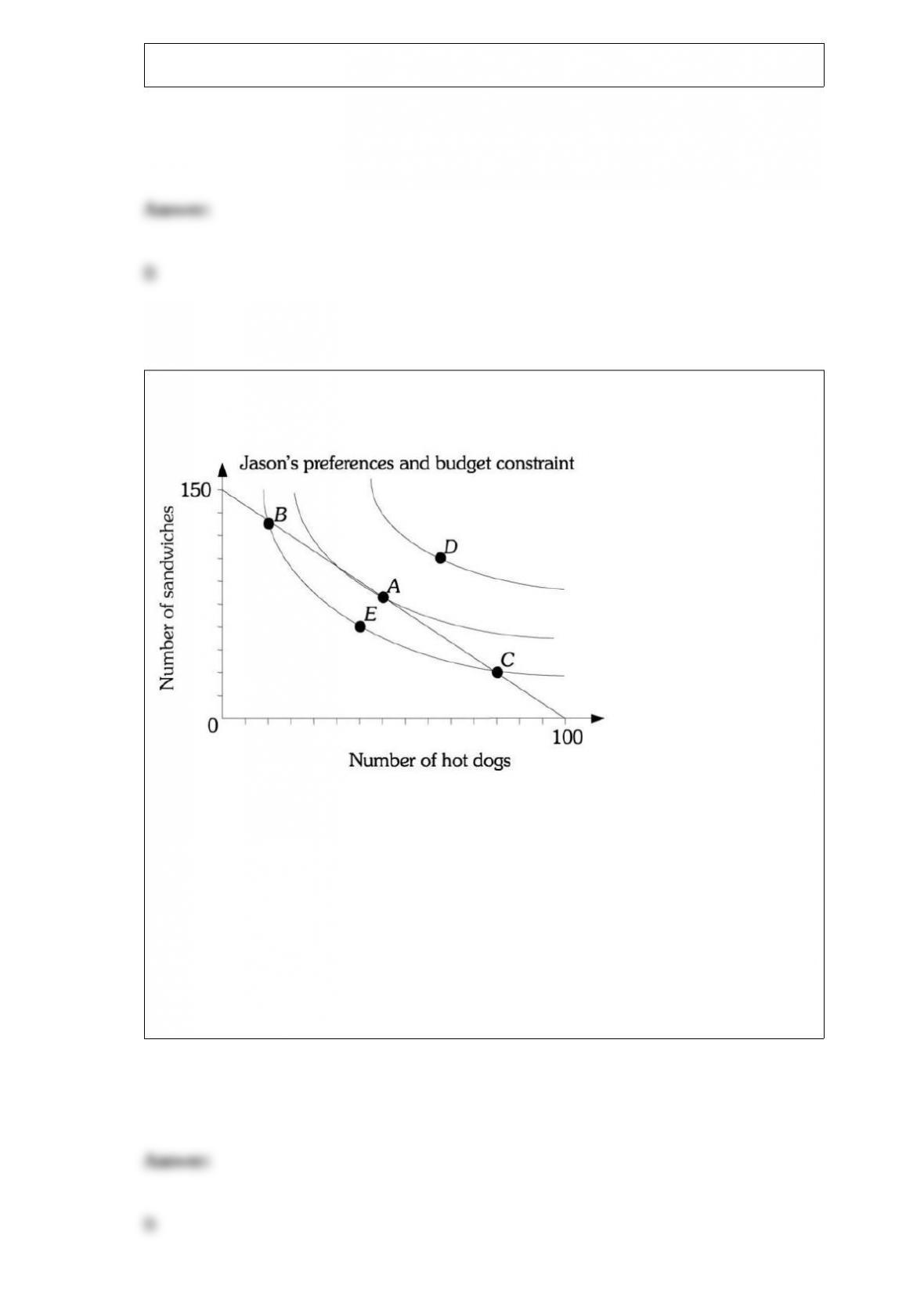
Figure 6.16
Refer to Figure 6.16. If the price of a hot dog is $4, Jason’s income is
A) $50.
B) $400.
C) $600.
D) indeterminate because the price of sandwiches is not given.

A government is considering levying a tobacco tax to raise revenue to finance health
care benefits. People for the tax argue that tobacco demand is price inelastic. Which of
the following statements is true?
A) The tobacco tax may not raise as much revenue as anticipated in the years to come
because tobacco demand is likely to become more elastic over time.
B) This is a very good way to raise revenue both in the short term and in the long term
because there are no close substitutes for tobacco.
C) This tax will not raise much revenue either in the short term or the long term because
demand is price inelastic.
D) No tax revenue can be raised in this way because tobacco sellers will just lower their
price by the amount of the tax, and therefore the consumer price of tobacco will not
change.
The field of ________ is concerned with externalities.
A) environmental economics
B) macroeconomics
C) game theory
D) econometric modeling

Suppose that Paraguay and Guyana are both engaged in the production of soybeans and
grapefruit, and that Paraguay has an absolute advantage in the production of both
goods. If Guyana has a comparative advantage in the production of soybeans, then
Guyana
A) has a higher opportunity cost for soybeans, which means it should specialize in the
production of grapefruit and engage in trade.
B) has a lower opportunity cost for producing soybeans, but specialization is not
feasible because Paraguay has a lower monetary cost of soybean production.
C) has a lower opportunity cost for soybeans, which means that it should specialize in
production of soybeans and engage in trade.
D) should continue to produce soybeans, but only for domestic consumption, because
trade is not a viable option.
You value your economics textbook at $15. Someone else values it at $30, and that
person is willing to pay you $20 for your textbook. Would selling your textbook to this
person for $20 be Pareto efficient?
A) No, because you did not receive the maximum amount the other person would have
been willing to pay for the textbook.
B) No, the person paid you $20 for the book so his net benefit was $10, whereas your
net benefit was only $5. For this change to be Pareto efficient, each of you should have
the same net benefit.
C) Yes, because both of you are better off as a result of the trade.
D) Yes, because even though you gain from the trade and he loses, there is the potential
for you to compensate him for his loss.
A ________ occurs if all players in a game play their best strategies given what their
competitors do.
A) dominant strategy
B) Nash equilibrium
C) prisoner’s dilemma
D) tit-for-tat strategy
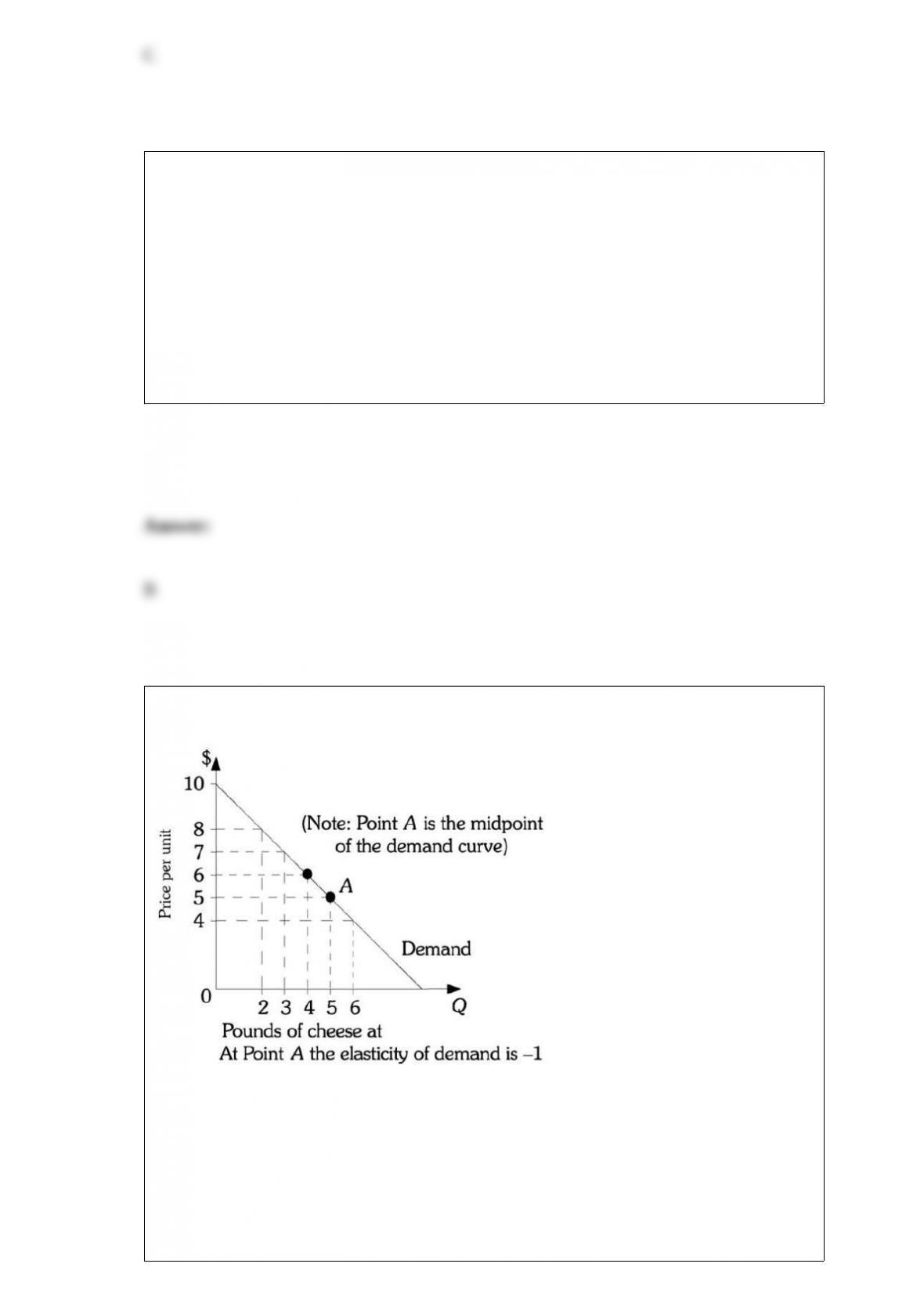
Figure 13.3
Refer to Figure 13.3. The firm’s marginal revenue will be negative at
A) $9.
B) $3.

C) all prices.
D) prices between $4 and $8.
In input or factor markets,
A) consumers purchase products.
B) firms supply goods.
C) households supply resources.
D) households demand goods.
After ________, you are left with taxable income.
A) adding all deductions and exemptions to total income
B) subtracting all deductions and exemptions from total income
C) paying income taxes
D) deducting all of your yearly expenses from the income you received
Transfer payments tend to ________ when overall economic growth is ________.
A) rise; high
B) fall; low
C) rise; low
D) rise; either high or low
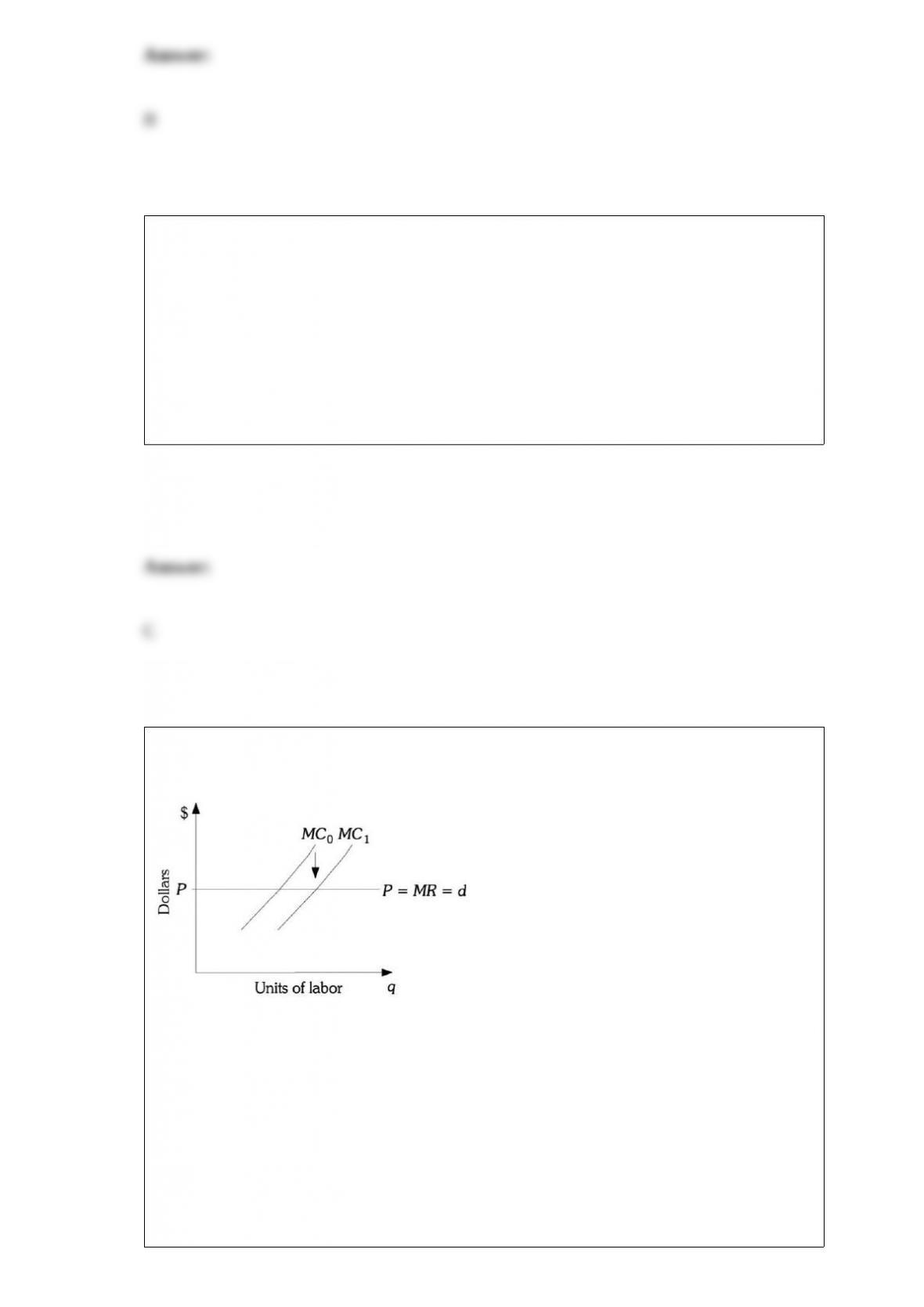
Figure 10.2
Refer to Figure 10.2. This firm’s marginal cost curve has shifted from MC0 to MC1 A
profit-maximizing firm should ________ the amount of output produced and ________
its demand for labor.
A) increase; increase
B) increase; decrease

C) decrease; decrease
D) keep constant; increase
________ refers to the fact that both human and financial capital leave developing
countries in search of a higher rate of return.
A) Urbanization
B) Capital flight
C) Outsourcing
D) Divestiture
Opportunity cost is
A) the additional cost incurred from the consumption of one more unit of output.
B) the cost involved when choosing between alternatives.
C) the cost of production which cannot be recaptured.
D) the total cost incurred from the consumption of additional output.
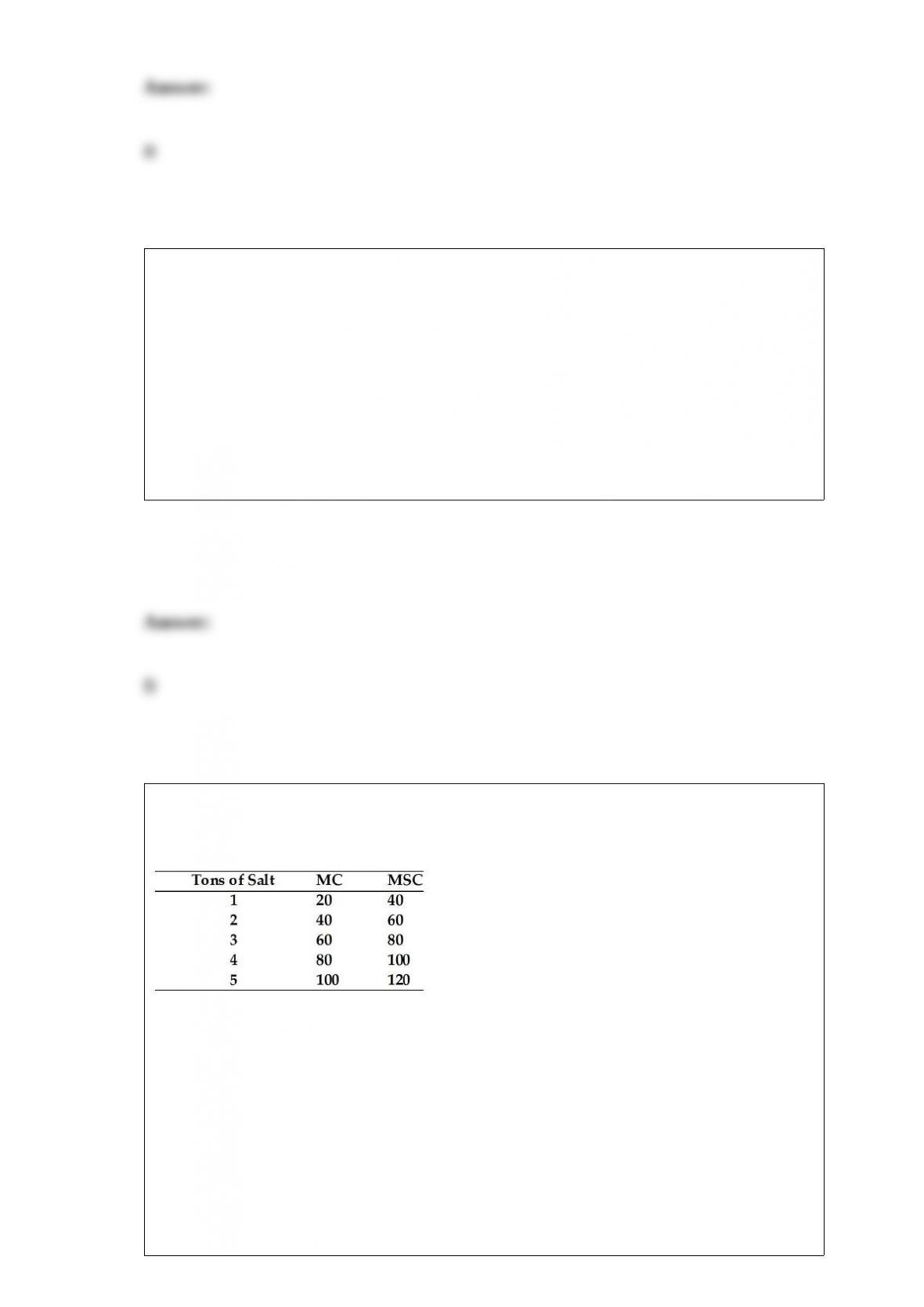
Because marginal cost is always ________ in the short run, total variable cost always
________ when output decreases.
A) positive; increases
B) positive; decreases
C) negative; increases
D) negative; decreases
Table 16.1
Refer to Table 16.1. To force this salt processing firm to produce the efficient level of
output, the government should impose a tax
A) of $20 per ton.
B) of $25 per ton.
C) of $80 per ton.
D) that depends on the level of output that the firm produces to maximize profits.

Which of the following factors has been suggested as an explanation for the lack of
economic growth in many poor nations?
A) insufficient capital formation
B) the supply of human resources is too high.
C) inadequate level of resources
D) a lack of dependence on the already developed nations
Total revenue decreases if price ________ and demand is ________.
A) falls; elastic
B) falls; unit elastic
C) rises; inelastic
D) rises; elastic
What are compensating differentials?
Under what conditions does an oligopoly market result in the same outcome as perfect
competition? What does this imply for the oligopoly’s long-run profits?
Using Table 10.2 above calculate the unit cost of production for each type of
technology assuming that the price of capital is $1 per unit and the price of labor is $2
per unit. Which technology would the firm use and why?
List three characteristics of demand curves. Make sure to explain the shape of the
curve and the meaning of the vertical and horizontal intercepts.
Why do school districts sell bonds to the public when they are financing a new school
building program rather than sell stock?
Explain the factors that influence the ultimate burden of the corporate income tax. What
conclusion did Arnold Harberger draw about the incidence of the corporate income tax?
Explain why a monopolistically competitive firm would not want to reduce its price all
the way to its minimum average total cost even though doing so would allow it to
increase sales?
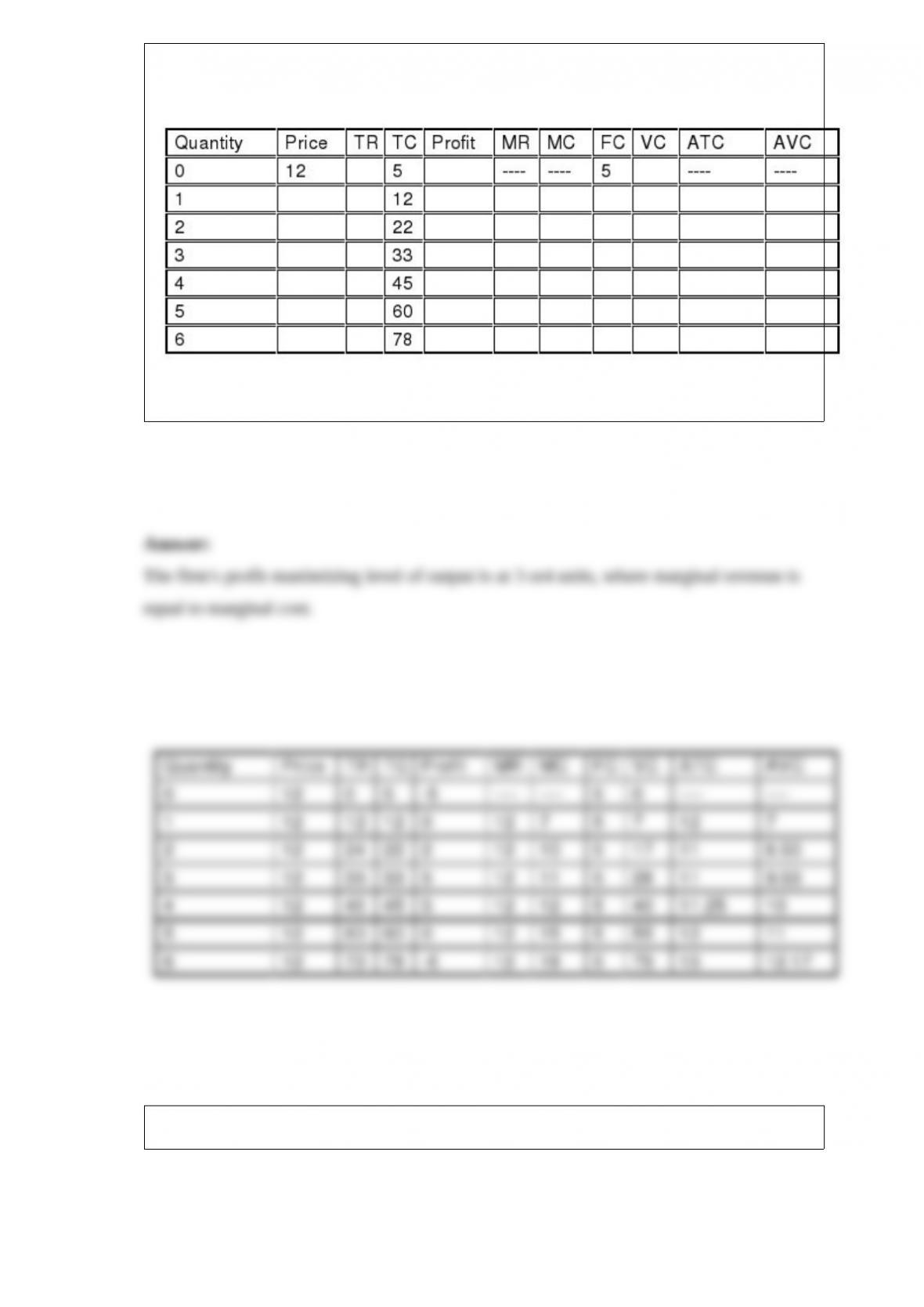
You run a firm that produces T-shirts that are sold in a perfectly competitive market.
Your firm faces the following cost and revenue schedule:
Fill in the table above. What is your firm’s profit maximizing level of output?
Explain the income effect and the substitution effect due to an increase in the wage rate.
Discuss what you believe might be one of the disadvantages of using the Gini
coefficient.
What is price leadership?
What is the marginal product of labor?
What are export subsidies?
Suppose that the equilibrium price of a gallon of gas is $3.75 per gallon. The
government decides to place a price ceiling on gasoline and will not allow sellers to
charge more than $4.00 per gallon. Draw this situation using a graph. Make sure that
you show the original equilibrium and the effect of the price ceiling on the market.
What will happen in this market?
When economists say that mortgages are ‘securitized” what do they mean by this
description?
Explain the factors that determine the incidence of the payroll tax. Illustrate your
answer using graphs. In the United States, who bears most of the payroll tax employers
or workers? Why? (Hint: draw two separate supply and demand curves for labor. Show
one with a relatively elastic supply for labor and one with a relatively inelastic supply).