
Holding other factors constant, technological progress ______ the real wage and
______ employment.
A. increases; increases
B. increases; decreases
C. increases; does not change
D. decreases; increases
If planned aggregate expenditure (PAE) in an economy equals 1,000 + 0.9Y and
potential output (Y*) equals 9,000, then this economy has:
A. an expansionary gap.
B. a recessionary gap.
C. no output gap.
D. no autonomous expenditure.
The defining characteristic of an HMO is:
A. the emphasis on acute medical treatment.
B. that medical treatment is provided for a fixed annual fee.

C. that patients have the freedom to see nonmember physicians.
D. that medical treatment is provided on a fee-for-service basis.
Following an adverse supply shock, people with anchored inflation expectations believe
the Fed will:
A. raise it target inflation rate.
B. lower its target inflation rate.
C. keep its target inflation rate unchanged.
D. accommodate the shock.
You would expect the price elasticity of demand for transportation generally to be:
A. the same as price elasticity of the demand for bus tickets.
B. greater than price elasticity of the demand for bus tickets.
C. less than price elasticity of the demand for bus tickets.
D. greater than price elasticity of the demand for bus tickets when bus tickets are
expensive, but less than price elasticity of the demand for bus tickets when the prices of
bus tickets fall.
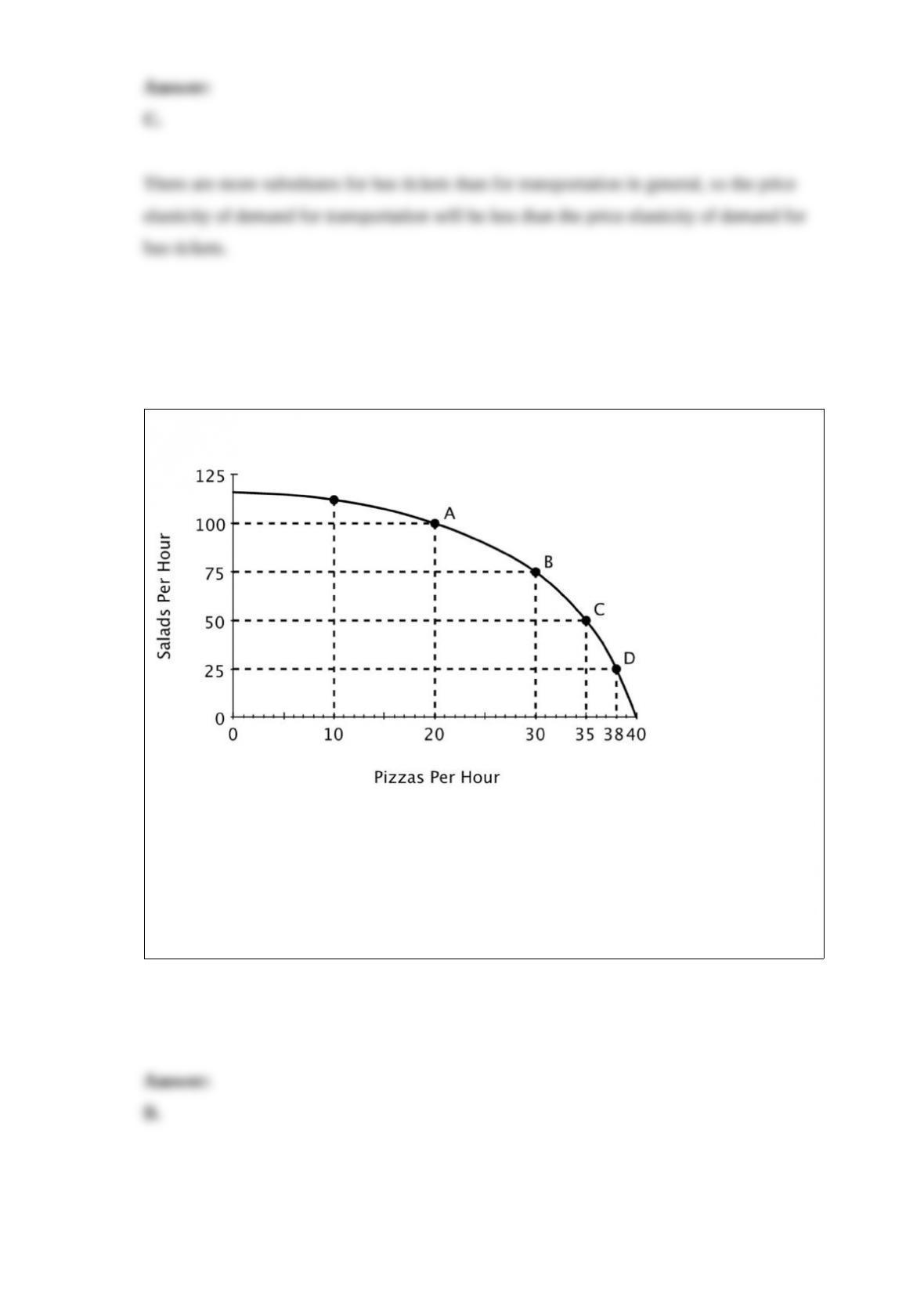
Refer to the figure below. The opportunity cost of making an additional salad:
A. remains constant regardless of how many salads are made.
B. increases as the number of salads increases.
C. decreases as the number of pizzas decreases.
D. decreases as the number of salads increases.

The government can raise tax revenue and increase total economic surplus by taxing:
A. goods that generate positive externalities.
B. goods that generate negative externalities.
C. luxury goods that are primarily consumed by wealthy individuals.
D. goods whose supply and demand curves are highly elastic.
In Econoland in 2005, people with incomes between $20,000 and $30,000 paid 12% of
their income in taxes and people with incomes between $30,001 and $40,000 paid 15%.
In 2005, the CPI in Econoland equaled 1.20, and it increased to 1.26 in 2006. If the
government of Econoland wants to keep households with a given real income from
being pushed up into a higher tax bracket by inflation, the $20,000-to-$30,000 bracket
will be changed in 2006to:
A. $15,873-to-$23,810
B. $21,000-to-$31,500
C. $24,000-to-$37,800
D. $25,200-to-$37,800
A monopolistically competitive firm:
A. sells products that are perfect substitutes for its competitors’ products, so must
compete on the basis of location.
B. sells products that are close substitutes for its competitors’ products, so will locate as
far away from its competitors as possible.
C. sometimes distinguishes its output from that of its competitors by locating in a more
convenient place.
D. will be more successful the more similar its output is to its competitors’ output.
A crowded beach without an entrance fee is a ______ good.
A. public
B. private
C. pure public
D. commons
If an individual producer is willing to produce one unit of a good for $2.50 but is able to
sell it for $7.50, then his or her producer surplus from the sale of that unit would be:
A. $10
B. $7.50
C. $5
D. $6.25
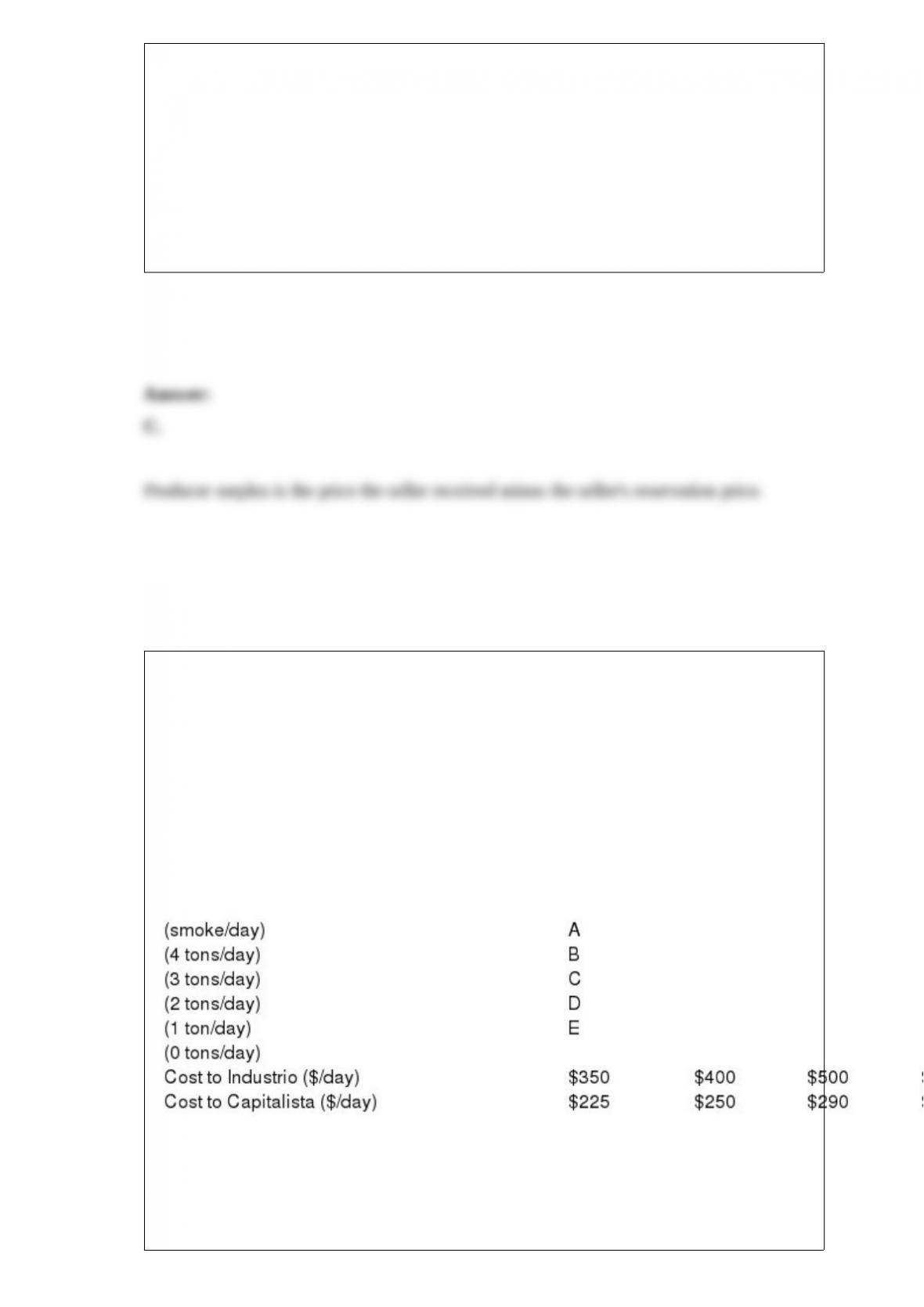
Two firms, Industrio and Capitalista, have access to five production processes, each of
which has a different cost and gives off a different amount of pollution. The daily costs
of the processes and the corresponding number of tons of smoke emitted are shown in
the table below. Both firms currently use process A, and each emits 4 tons of smoke per
day. The government is considering two plans to reduce pollution: requiring both firms
to reduce pollution by 25 percent or auctioning pollution permits. Each permit would
entitle the owner to emit one ton of smoke per day. Without a permit, no smoke can be
emitted.
process
Suppose a permit system has been adopted and each firm has already purchased one
permit. Industrio would be willing to pay up to ______ for the right to emit a second
ton of smoke, and Capitalista would be willing to pay up to ______ for the right to emit
a second ton of smoke.
A. $200; $300

B. $200; $110
C. $100; $40
D. $500; $290
Providing a fixed number of workers with additional capital will ______ average labor
productivity at a ______ rate.
A. increase; increasing
B. increase; constant
C. increase; decreasing
D. decrease; decreasing
As the price of cookies increases, firms that produce cookies will:
A. increase the supply of cookies.
B. increase the quantity supplied of cookies.
C. decrease the supply of cookies.
D. decrease the quantity supplied of cookies.

One justification for the creation of a federal level of government is:
A. the ability to deficit spend.
B. economies of scale in the provision of military defense.
C. to encourage local diversity in the types of public goods provided.
D. greater responsiveness to the will of the voters.
The wage paid to workers measured in terms of real purchasing power is called the:
A. nominal wage.
B. cost of living.
C. minimum wage.
D. real wage.

A benefit of an activity received by people not participating in the activity is called a(n):
A. winner’s curse.
B. positive externality.
C. external cost.
D. negative externality.
Leo is a welfare recipient who qualifies for two means-tested cash benefit programs. If
he does not earn any income, he receives $225 from each program. For each dollar he
earns (which his employer is required to report to the welfare agency), his benefit from
each program is reduced by 75 cents until the benefit equals zero.If Leo earns $150,
then he will receive ______ in total benefits from the two programs.
A. $75.
B. $325.
C. $225.
D. 0.
Assume that Dusty has $30 in income, the price of a loaf of bread is $1.50, and the
price of a jar of peanut butter is $3. If Dusty’s income rises to $45, Dusty can now buy a
maximum of ______ loaves of bread or a maximum of ______ jars of peanut butter.
A. 5; 25
B. 10; 40
C. 15; 30
D. 30; 15
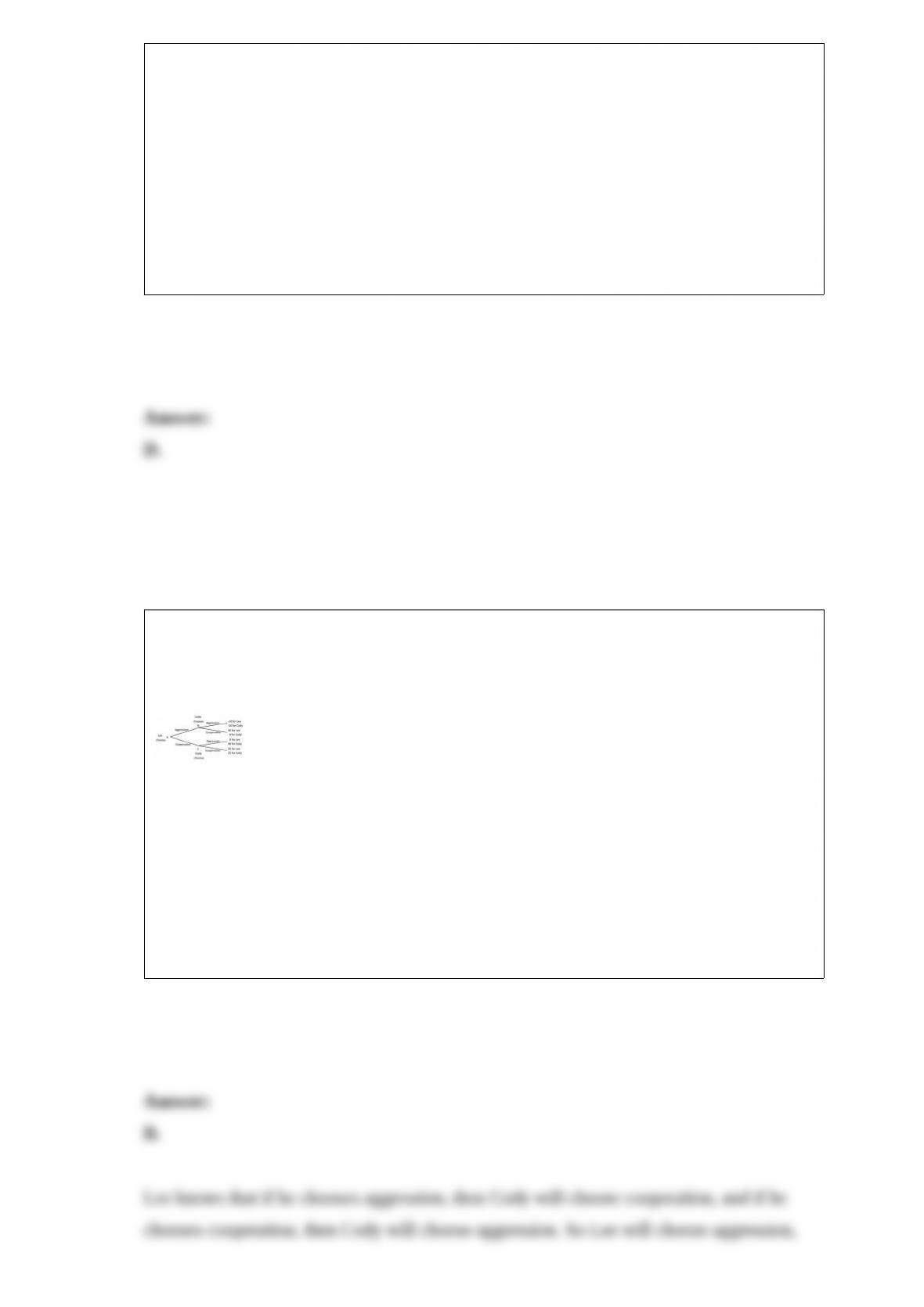
Lee and Cody are playing a game in which Lee has the first move at A in the decision
tree shown below. Once Lee has chosen either aggression or cooperation, Cody, who
can see what Lee has chosen, must choose either aggression or cooperation at B or C.
Both players know the payoffs at the end of each branch.
In the equilibrium of this game, Lee chooses ______, and then Cody chooses ______.
A. aggression; aggression
B. aggression; cooperation
C. cooperation; aggression
D. cooperation; cooperation

Real GDP measures the ______ of production; nominal GDP measures the ______ of
production.
A. current dollar value; physical volume
B. current dollar value; current dollar value
C. current dollar value; market value
D. physical volume; current dollar value
When actual output exceeds potential output, there is ______ output gap and the
inflation rate will ____.
A. an expansionary; exceed the expected rate of inflation
B. an expansionary; be lower than the expected rate of inflation
C. no; be equal to the expected rate of inflation
D. a recessionary; exceed the expected rate of inflation

Refer to the figure above. Assume that column A and column B are the initial demand
and supply curves. At a price of $50, the market would experience:
A. an equilibrium.
B. excess demand of 5 units.
C. excess supply of 70 units.
D. excess supply of 5 units.
Refer to the figure below. If the market for doughnuts is perfectly competitive, and the
price of a doughnut is 10 cents, then this firm:
A. should shut down.
B. should produce 50 doughnuts.
C. should shut down in the long run.
D. will earn an economic loss.
From society’s standpoint, positional arms races lead to outcomes that are ______.
A. dominant
B. desirable
C. inefficient
D. efficient
Suppose it is observed that the equilibrium wage and employment level have both
risenin a competitive labor market. One can inferthat:
A. the supply of labor has increased.
B. the demand for labor has decreased.
C. the demand for labor has increased.
D. the supply of labor has decreased.
An expansion occurs when ______, when _______, or when both of these occur.
A. potential output grows rapidly; actual output rises above potential output.

B. potential output grows slowly; actual output rises above potential output
C. potential output grows rapidly; actual output equals potential output
D. potential output grows slowly; actual output equals potential output
The fact that output gaps will not last indefinitely, but will be closed by rising or falling
prices is the economy’s:
A. short-run equilibrium property.
B. self-correcting property.
C. income-expenditure multiplier.
D. long-run equilibrium property.
Rationally, search should continue until:
A. all search options have been explored.
B. the marginal benefit of search equals the marginal cost of search.
C. the marginal benefit of search is zero.
D. the marginal cost of search is zero.
For the Fall semester, you had to pay a nonrefundable fee of $600 for your meal plan,
which gives you up to 150 meals. If you eat all of the meals, your average cost for a
meal is:
A. $6.
B. $5.
C. $4.
D. $0.25.