
1) the law of diminishing marginal utility states that:
a.total utility is maximized when consumers obtain the same amount of utility per unit
of each product consumed.
b.beyond some point additional units of a product will yield less and less extra
satisfaction to a consumer.
c.price must be lowered to induce firms to supply more of a product.
d.it will take larger and larger amounts of resources beyond some point to produce
successive units of a product.
2) Under the managed floating system of exchange rates:
A.all exchange rates vary with changes in the free-market prices of gold.
B.industrialized nations meet once each year to negotiate readjustments in their
exchange rates.
C.exchange rates are essentially flexible, but governments intervene to offset disorderly
fluctuations in rates.
D.exchange rates are adjusted at the discretion of the IMF.
3) The lowest quintile of households in the income distribution receives about:
A.2.2 percent of the total income.
B.3.4 percent of the total income.
C.8.5 percent of the total income.
D.10 percent of the total income.
4) If the economy were encountering a severe recession, proper monetary and fiscal
policies would call for:
A.selling government securities, raising the reserve ratio, lowering the discount rate,
increasing reserves available through the term auction facility, and a budgetary surplus.
B.buying government securities, reducing the reserve ratio, reducing the discount rate,
increasing reserves available through the term auction facility, and a budgetary deficit.
C.buying government securities, raising the reserve ratio, raising the discount rate,
reducing reserves available through the term auction facility, and a budgetary surplus.
D.buying government securities, reducing the reserve ratio, raising the discount rate,
reducing reserves available through the term auction facility, and a budgetary deficit.
5) The real-business-cycle theory holds that business fluctuations are caused by:
A.factors affecting aggregate demand.
B.incorrectly anticipated government stabilization policies.
C.significant changes in technology and resource availability.
D.’stop-and-go” monetary policies.
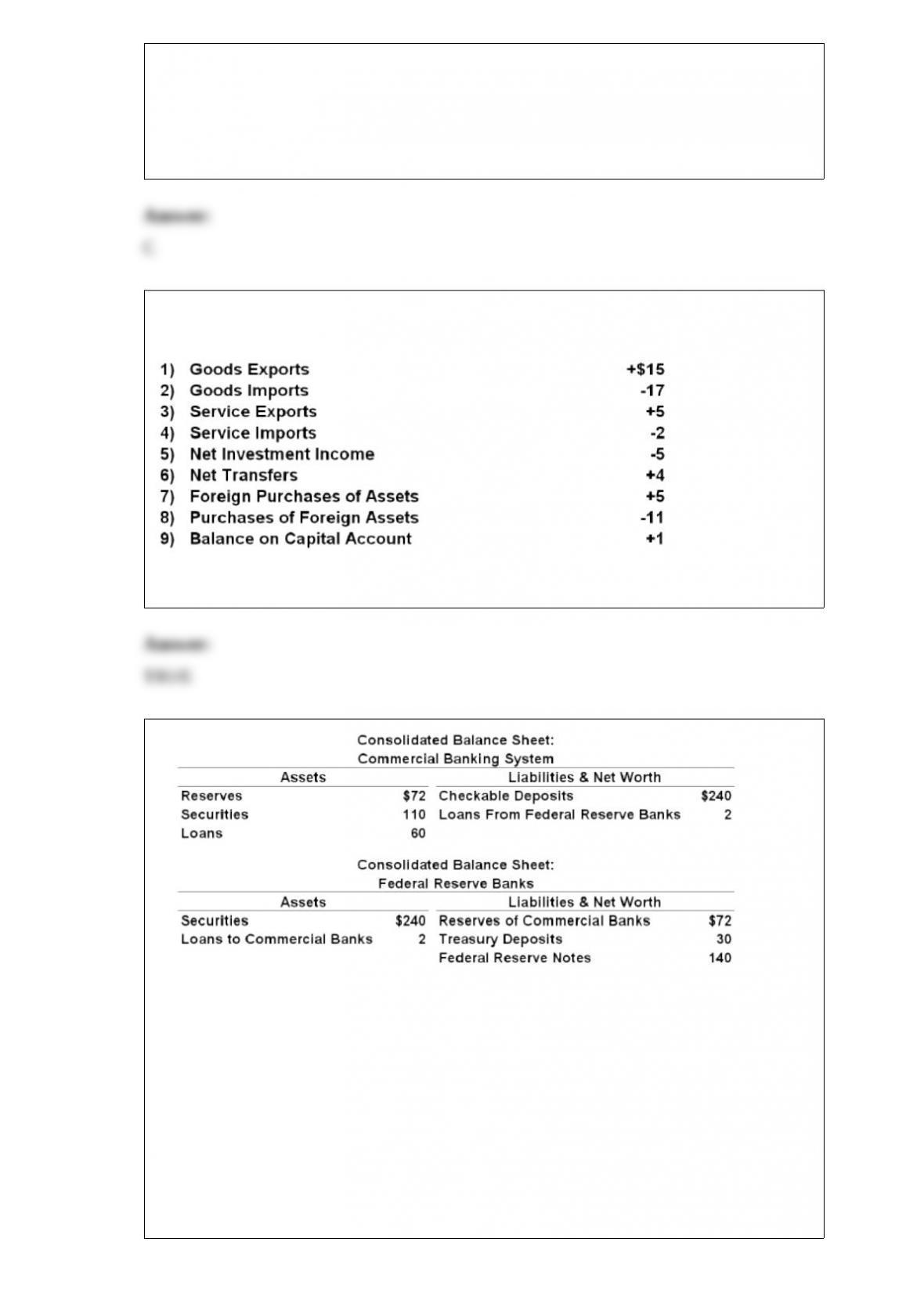
6) The following 2008 balance of payments statement for Transylvania. All figures are
in billions of dollars.
Refer to the above data. In 2008 Transylvania realized a $1 billion surplus on goods and
services.
7)
Refer to the above balance sheets and assume the reserve ratio is 25%. Suppose the
Federal Reserve Banks sell $2 in securities directly to the commercial banks. As a result
of this transaction the supply of money:
A.will decrease by $2, but the money-creating potential of the commercial banking
system will not be affected.
B.is not directly affected, but the money-creating potential of the commercial banking
system will decrease by $8.
C.will directly increase by $2 and the money-creating potential of the commercial
banking system will decrease by an additional $8.
D.will directly increase by $2 and the money-creating potential of the commercial
banking system will increase by an additional $8.
8) For a private closed economy, an unintended decline in inventories suggests that:
A.aggregate expenditures are less than the business sector expected them to be.
B.aggregate expenditures exceed production.
C.actual investment exceeds saving.
D.planned investment is greater than consumption.
9) (Consider This) The story about artist Pablo Picasso illustrates the point that:
A.the demand for labor is a derived demand.
B.geographical immobility impedes an efficient allocation of labor resources.
C.principal-agent problems can occur in unusual settings.
D.present skills reflect past accumulations of human capital.
10) if a purely competitive firm is producing at some level less than the
profit-maximizing output, then:
a.price is necessarily greater than average total cost.
b.fixed costs are large relative to variable costs.
c.price exceeds marginal revenue.
d.marginal revenue exceeds marginal cost.
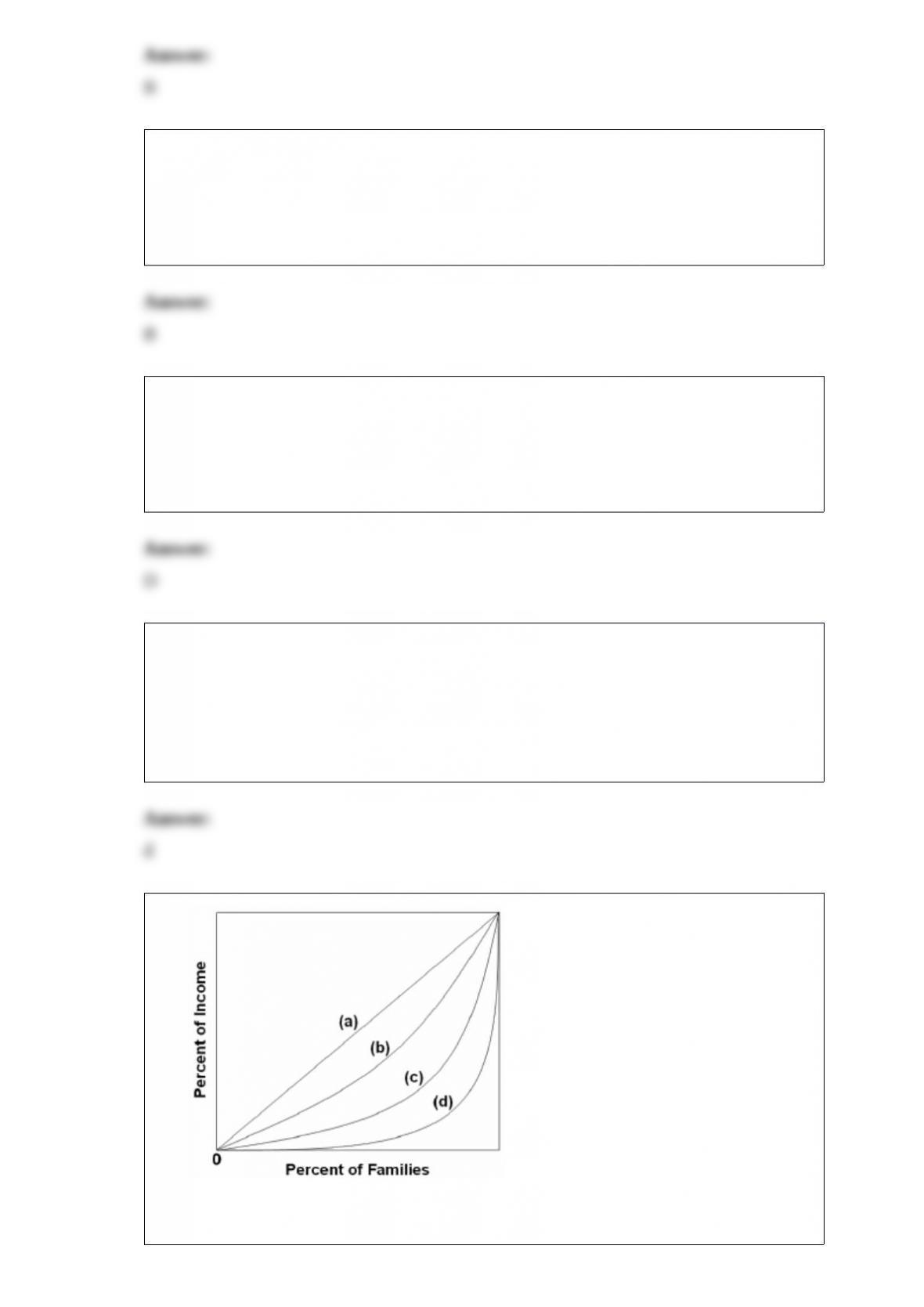
11)
Refer to the above diagram. If line b represents the pretax and transfer distribution of
income in the United States, we would expect the post-tax and transfer distribution to

be:
A.line a.
B.line b, because taxes and transfers have no effect on income distribution.
C.line c.
D.line d.
12) an economic hypothesis:
a.has the same meaning as an economic principal or economic law.
b.is usually a normative statement.
c.is a possible explanation of cause and effect.
d.is a stronger generalization than an economic law.
13) Which of the following statements is correct?
A.Economic profits can properly be regarded as the salaries received by the hired
managers of corporations.
B.Economic rent is a price paid for productive land resources whose supply is perfectly
inelastic.
C.Economic profits would be nonexistent in a dynamic, purely competitive economy.
D.Economic or pure profit is the minimum return which entrepreneurs must receive to
continue in a particular line of production.
14) which of the following will cause the demand curve for product a to shift to the
left?
a.population growth that causes an expansion in the number of persons consuming a.
b.an increase in money income if a is a normal good.
c.a decrease in the price of complementary product c.
d.an increase in money income if a is an inferior good.