The “voluntary bumping plan” used by airlines to resolve the problem of overbooked
flights was developed by economist
a. Adam Smith.
b. John Maynard Keynes.
c. Alan Greenspan.
d. Julian Simon.
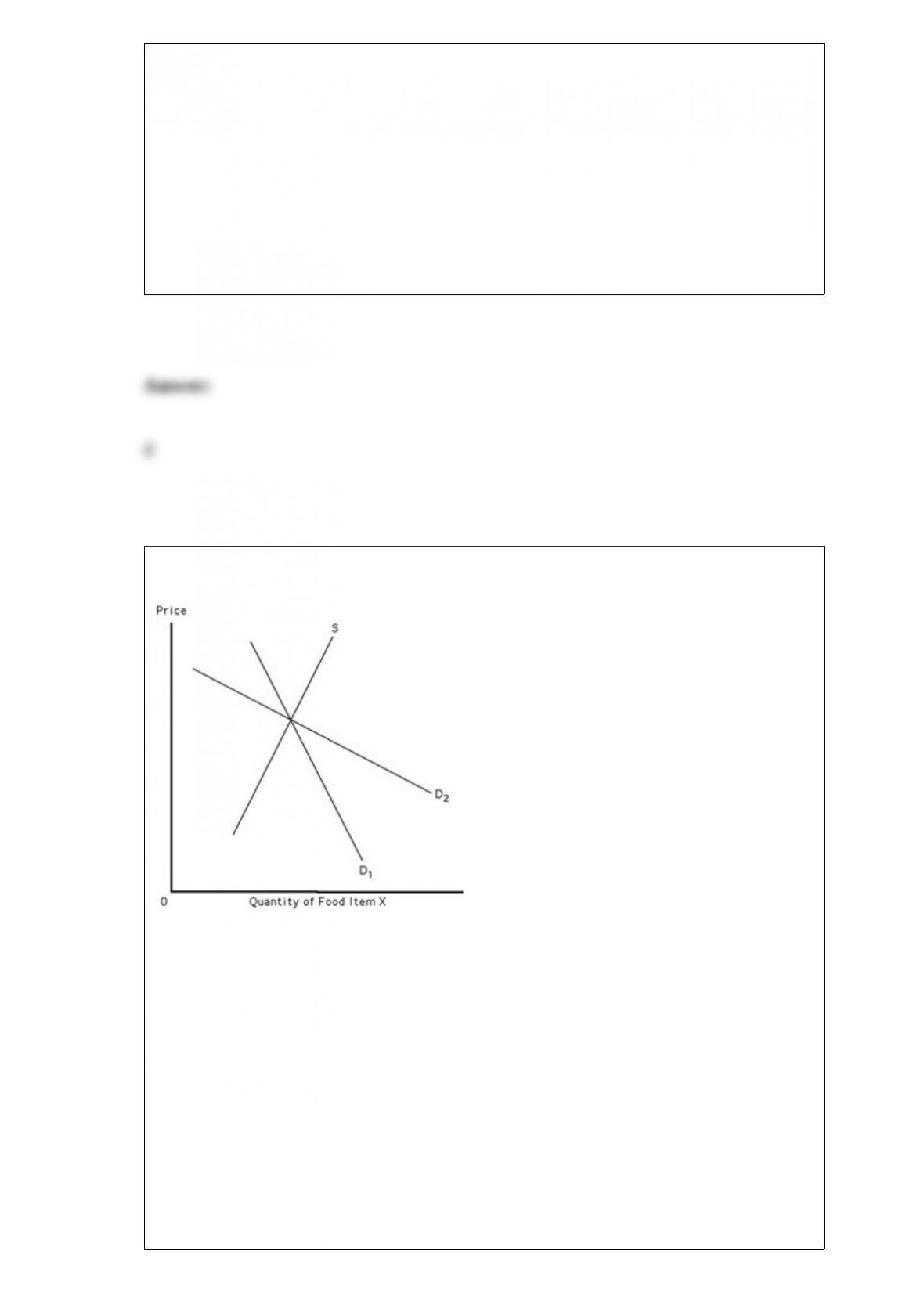
Exhibit 39-6
A major change in weather conditions favorable to the production of X will shift the
supply curve for X from its original position. The consequent change in price and total
revenue would be less sharp if the demand curve for X is __________ because it is
__________ over the relevant region.
a. D1; more elastic than D2
b. D1; more inelastic than D2
c. D2; more elastic than D1
d. D2; more inelastic than D1
Suppose that a television studio has two shows, X and Z, and that tickets for viewing
the taping of each show is free.The equilibrium price for a ticket to view the taping of
show X is $25 and the equilibrium price for a ticket to view the taping of show B is
-$20.It is likely that tickets to show ________ will need to be rationed on a
first-come-first-served basis, while the producers of show ________ will have a much
more difficult time filling the seats in the studio since the equilibrium price for tickets
to that show is a __________ dollar amount.
a. Z; X; positive
b. Z; X; negative
c. X; Z; positive
d. X; Z; negative
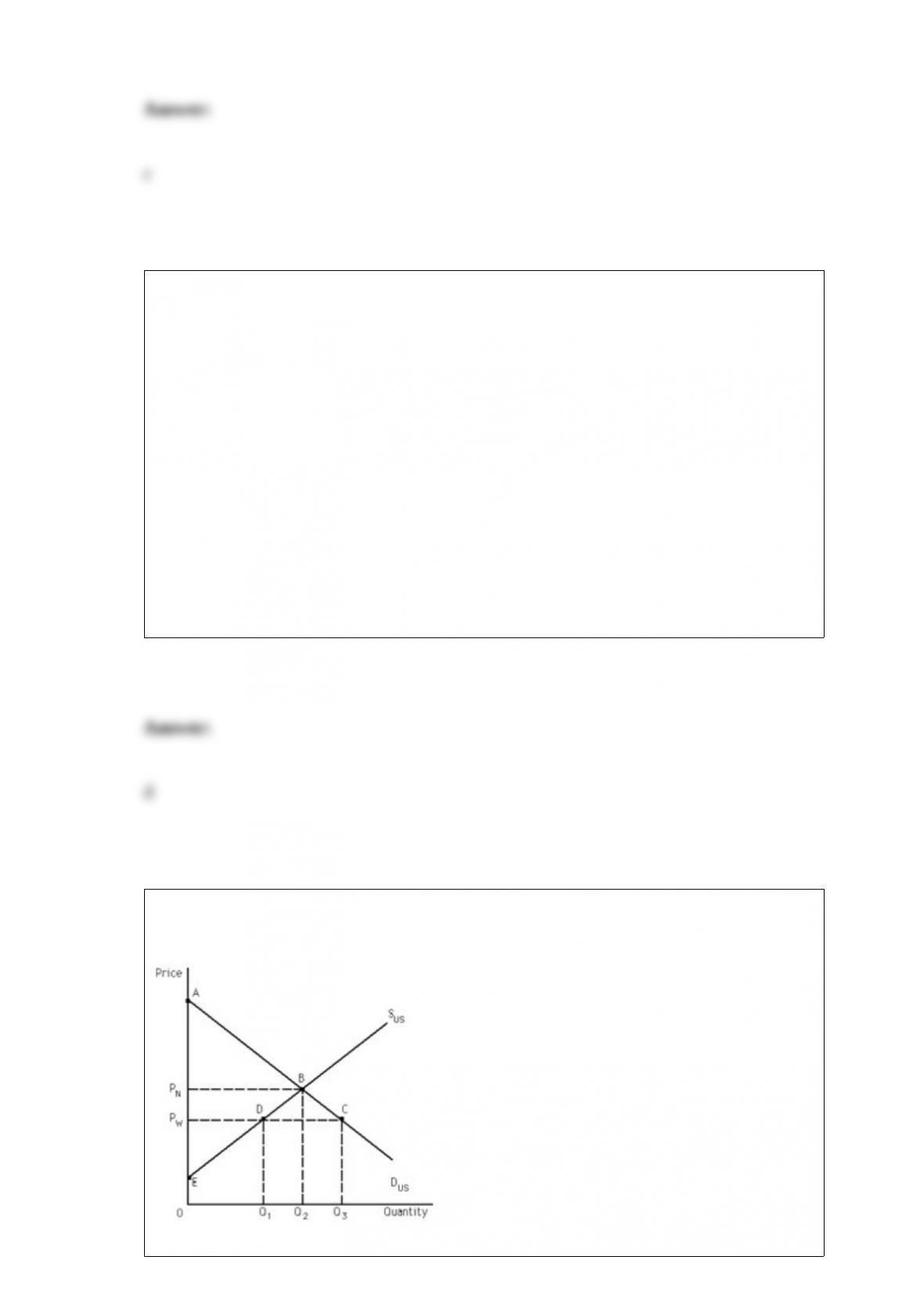
Exhibit 34-2

The U.S. demand and supply for a good are shown. Under a policy of free trade, where
imports are permitted, the world price is PW. If there is a policy change such that
imports are prohibited, the price becomes PN, consumers’ surplus equals __________
and producers’ surplus equals __________.
a. PNAB; PNBE
b. BCD; PNDE
c. PNAD; BCD
d. PNAD; PWBDE
e. none of the above
When a firm produces the quantity of output where price equals marginal cost, it has
achieved resource allocative efficiency.
a. True
b. False
Tobacco production is one of the more heavily subsidized industries in the United
States. Suppose that as a result of intense lobbying from health-related concerns,
Congress repeals the tobacco firms’ subsidies. Which of the following scenarios would
likely occur?
a. The tobacco firms’ supply curve would shift rightward, as it would now be cheaper to

produce each level of output.
b. The tobacco firms’ supply curve would shift leftward, since it would now cost more
to produce each level of output.
c. The tobacco firms would not experience any shift in their supply curves; subsidies
don’t affect output.
d. There would be a movement along the supply curve for tobacco, but the supply curve
would not shift.
The Justice Department most closely examines proposed __________ mergers.
a. horizontal
b. vertical
c. conglomerate
d. international
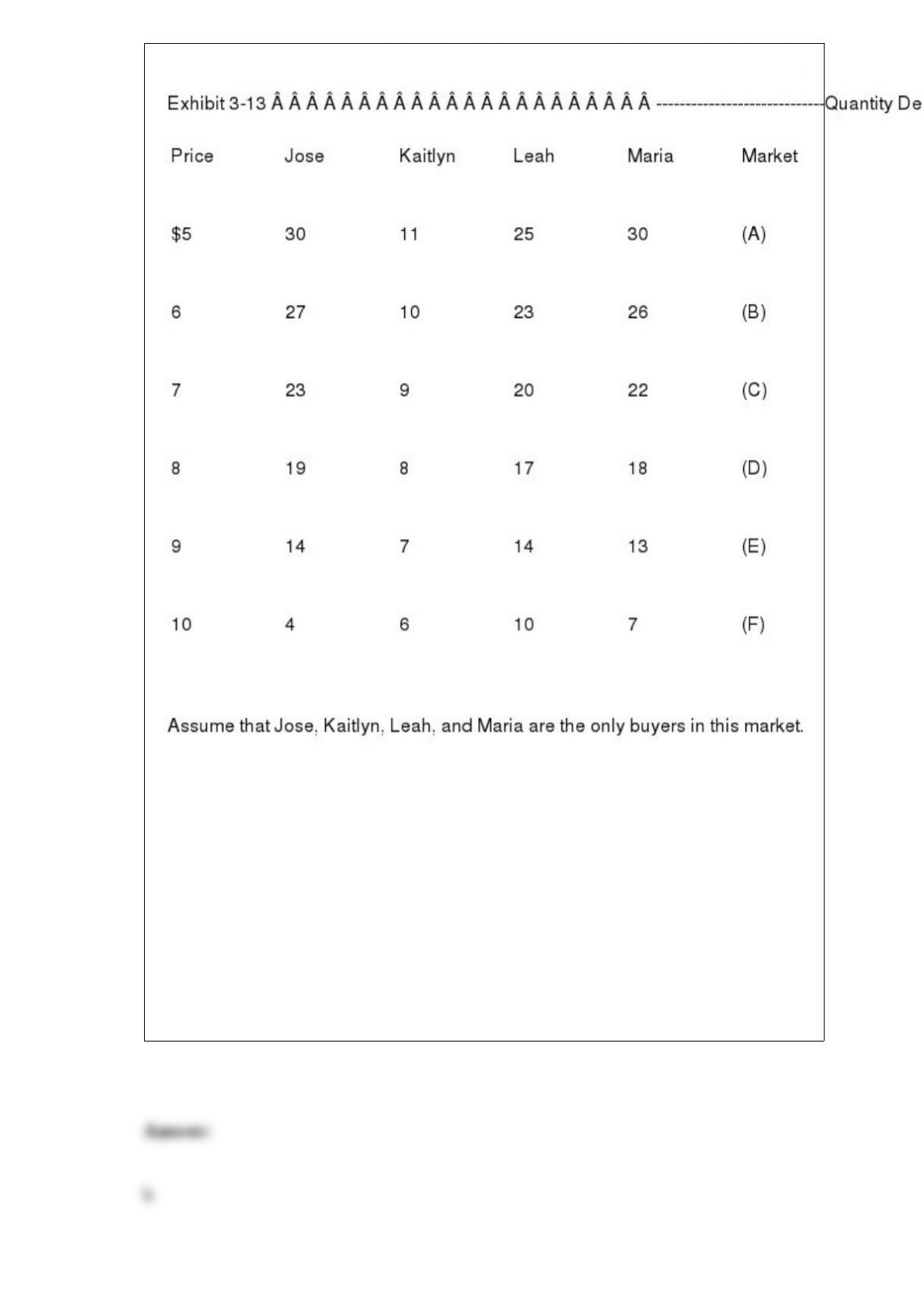
Each individual consumer’s demand curve is ________________ sloping and the
market demand curve is _________________ sloping.
a. upward; also upward
b. downward; also downward
c. upward; downward
d. downward; upward

If MR > MC, then
a. profits are being maximized.
b. the firm is producing too much of the good to be maximizing profits.
c. the firm can increase its profits (or minimize its losses) by increasing output.
d. the firm must be incurring losses.
If the demand curve for agricultural products is elastic and farmers as a group become
more productive, then prices of agricultural goods will __________ and total revenue
earned by farmers will __________.
a. decrease; increase
b. decrease; decrease
c. increase; increase
d. increase; decrease
e. We cannot answer this question without knowing how elastic the demand curve is.
The English economist David Ricardo argued that
a. grain prices were high because land rents were high.
b. land rents were high because grain prices were high.

c. grain prices were high because land rents were low.
d. land rents were high because grain prices were low.
e. none of the above
Jim Smith made his fortune by buying and selling real estate. Which of the following
theories on the source of profits best describes the reason behind his success?
a. Uncertainty is a source of profits.
b. Profit is the reward for alertness to arbitrage opportunities.
c. Profit is the return to the entrepreneur as innovator.
d. Land is always a source of economic rent and profit.
e. If one works hard enough, one will be rewarded.
Most states have instituted mandatory seatbelt laws to reduce traffic fatalities. An
economist may point out that an unintended effect of these laws is
a. an increase in the price of automobiles, further reducing fatalities.
b. an increase in driving speed, reducing the number of accidents.
c. a decrease in driving speed, further reducing fatalities.
d. an increase in risky driving behavior, increasing fatalities.

Which of the following will not shift a supply curve?
a. a change in the price of relevant resources
b. a change in the good’s own price
c. a change in the number of sellers
d. a change in per-unit costs brought about by a change in taxes
The simple majority decision rule may generate results that are
a. efficient, because the projects undertaken are the ones desired by more than 50
percent of the people.
b. efficient, because projects are undertaken only if total benefits exceed total costs.
c. efficient, because the intensity of individuals’ preferences are considered.
d. inefficient when the total benefits of projects undertaken are less than the total costs.
e. inefficient when the intensity of individuals’ preferences are considered.

In the theory of the firm (as put forth by Alchian and Demsetz), trade or exchange pops
up in the following situation:
a. when individuals choose to form a team
b. when the monitor fires an employee
c. when individuals in a team shirk
d. a and c
The two white rats in the “buying” behavior study conducted at Texas A & M acted in a
manner that supported the law of demand and the concept of consumer equilibrium.
a. True
b. False
Which of the following statements is consistent with the Coase theorem?
a. In the case of zero transaction costs, a property rights assignment (made by a court)
will be undone if it benefits the relevant parties to undo it.
b. In the case of zero transaction costs, the resource allocative outcome will be the same
no matter who is assigned the property right.
c. Taxes can do what property rights assignments cannot.
d. The market can solve all negative externality problems.
e. a and b
Suppose the governments of Mexico and the United States agree to a fixed exchange
rate.Describe some of the options available to the Mexican government if the peso was
persistently overvalued, creating a surplus of pesos on the foreign exchange market.Be
sure to explain how each of these options would be expected to impact the supply
and/or demand for Mexican pesos.
Explain the difference between total utility and marginal utility.Give a hypothetical
example to help support your answer.
What condition is necessary for a price ceiling to have an impact on a market? Describe
at least three of the effects that a price ceiling can have on a market. Give a hypothetical
numerical example to help support your answer.
Describe some of the findings of behavioral economists presented in the text and
explain how these findings differ from the traditional economic framework.
Discuss three possible solutions for reducing traffic congestion on freeways. Be sure to
explain what effect each would have on the supply and/or demand for freeway space.
Why is the production possibilities frontier (PPF) typically bowed-outward? Under
what circumstances would the PPF be a straight line?
Suppose that the average price of refrigerators has fallen over the past few years, yet the
refrigerator companies have offered more and more of them for sale. Does this mean
that the supply curve for refrigerators is downward sloping? Explain.
Describe the Coase theorem and explain why it is significant in the analysis of
externatility problems.
Explain why the socially optimal output is not always the same as the market output.
Describe the intended effects of the first-time home buyer tax credits granted by
Congress and many state governments in 2009 and 2010. In addition, describe in detail
the unintended effect of this type of legislation.