
1)
The long-run trend of real wages:
A.cannot be determined from available data on nominal wages and the price level.
B.has been downward because the price level has risen faster than nominal wages.
C.has been upward.
D.has been downward because labor’s share of the domestic income has fallen.
2) a budget line shows the:
a.alternative combinations of two goods that a consumer can purchase with a given
money income.
b.alternative combinations of two goods that will yield the same level of total utility to
a consumer.
c.quantities of a particular good that a consumer will buy at various prices.
d.ratio of money income to product price.
3) A coordination failure:
A.is a real-business-cycle event.
B.is a self-fulfilling prophesy.
C.results from the spending-income multiplier.
D.is a direct outcome of inappropriate fiscal policy.
4) which of the following is not an example of pricing based on group differences in
elasticity of demand?
a.senior-citizen discounts at restaurants and motels.
b.cash rebates for purchases of automobiles.
c.child discounts for admission to theme parks.
d.discounted student prices for visits to museums.
5) Which of the following is a tenet of supply-side economics?
A.High marginal tax rates severely discourage work, saving, and investment.
B.Increases in social security taxes and other business taxes shift the aggregate supply
curve to the right.
C.The Federal Reserve should adhere to a monetary rule that limits increases in the
money supply to a 5 percent annual rate.
D.Transfer payments increase incentives to work.
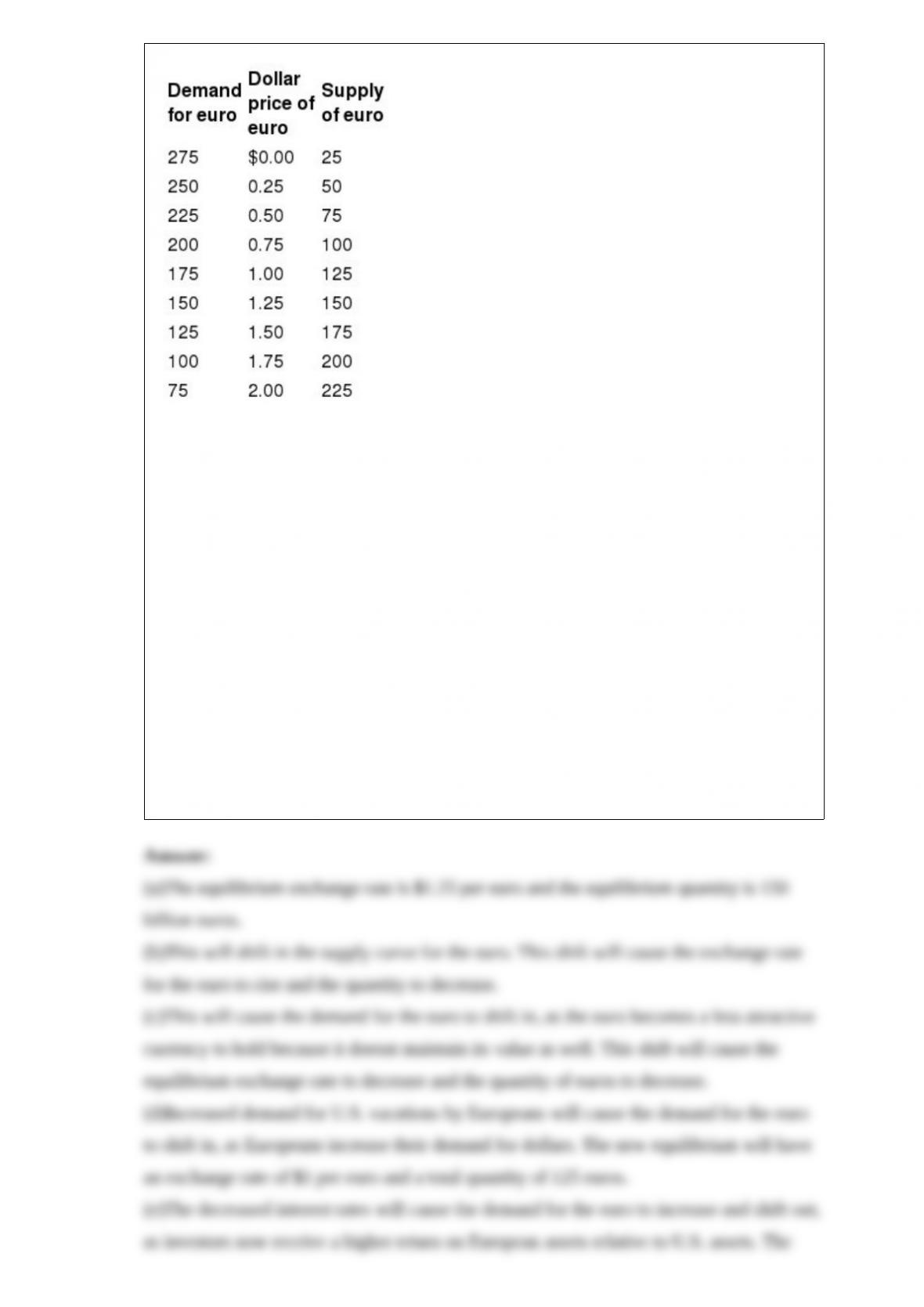
6) answer the next question(s) on the basis of the following data. all figures are in
billions of dollars.
refer to the above data. ndp is:
a.$370.
b.$402.
c.$392.
d.$467.
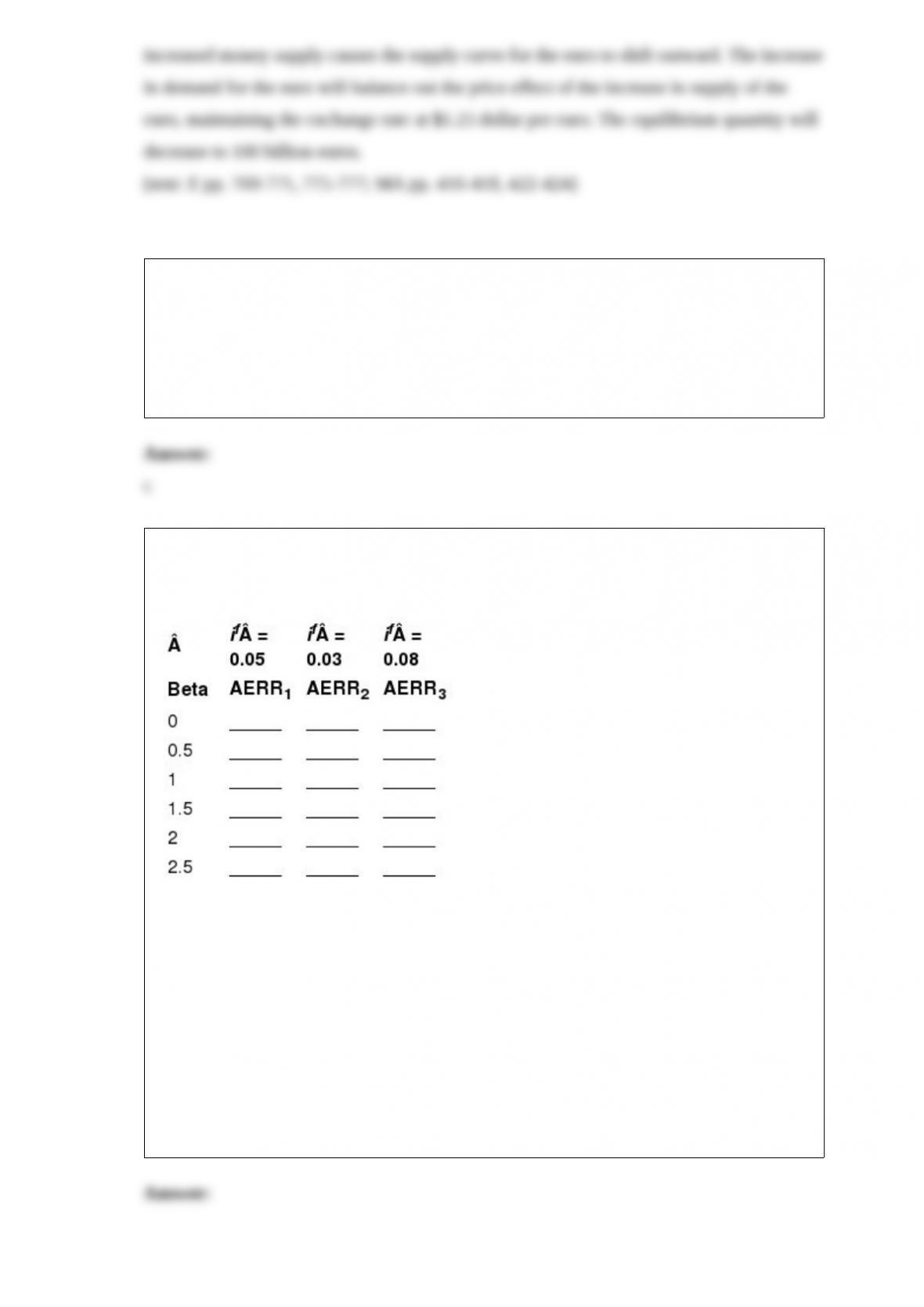
7) The table below summarizes the exchange market for the dollar and euro. Use this
information to answer the following questions.
(a)What is the equilibrium exchange rate and quantity?
(b)Suppose the European Central Bank decides to counter rampant growth by reducing
the money supply to moderate the European economy. How will the supply and demand
situation for the euro change? What likely effect will this have on the equilibrium
exchange rate and quantity?
(c)Suppose that inflation increases in Europe. How will the supply and demand
situation for the euro change? What likely effect will this have on the equilibrium
exchange rate and quantity?
(d)Suppose Europeans decide to take more vacations in the United States. Using the
data in the table above, calculate the new equilibrium. Assume the subsequent shift(s)
(if one or more occur), causes the affected curve(s) to shift by 50 in the appropriate
direction.
(e)Suppose that to pull the U.S. economy out of a recession, the Federal Reserve
decides to reduce interest rates. Facing the same economic conditions, the European
Central Bank decides to increase the money supply. Using the data in the table above,
calculate the new equilibrium. Assume the subsequent shift(s) (if one or more occur),
causes the affected curve(s) to shift by 50 in the appropriate direction.
8) sam decides to join the gigantic state university’s rugby team when he learns that his
health insurance will pay for any subsequent injury. this illustrates:
a.the diagnosis-related-group system.
b.a “pay or play” system.
c.the moral hazard problem.
d.the coase theorem.
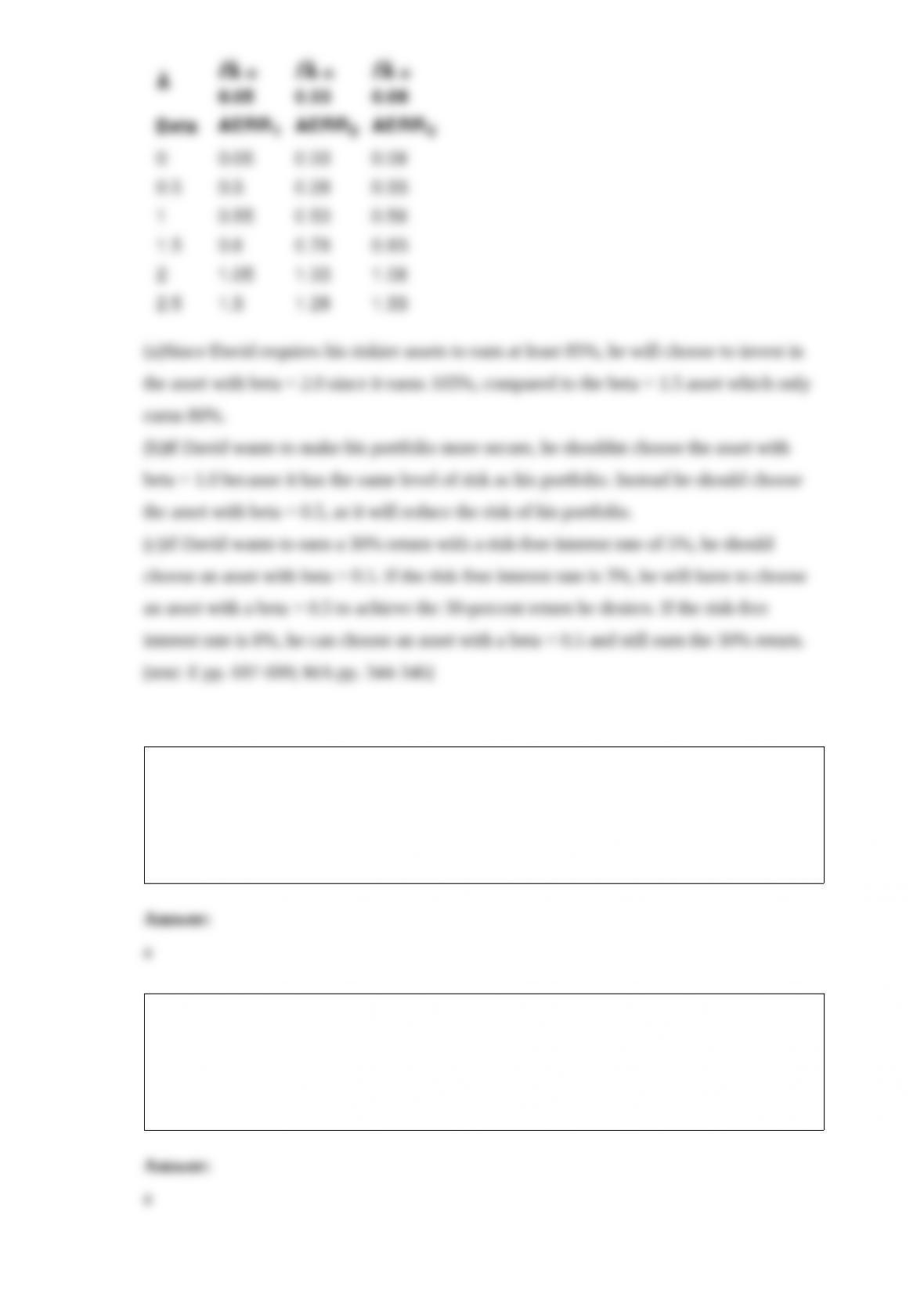
9) Fill in the table below and answer the following questions. Assume the slope of the
SML = 0.5 for all investors.
(a)Suppose David is considering adding a new asset to his portfolio and is deciding
between two different assets. David deviates from the standard SML in that for any
asset riskier than his portfolio, he expects to earn at least 85%. The assets have betas of
1.5 and 2 respectively and the risk-free interest rate at that time is 5%. Which asset
should he choose?
(b)Suppose David is now considering adding some more secure assets to his portfolio.
He is deciding between an asset that has a beta of 1.0 and an asset that has a beta of 0.5.
Which asset should he choose?
(c)Suppose David wants to invest in an asset that earns 30% with the lowest level of
risk possible. What asset should he choose if the risk-free interest rate is 5%? If it is
3%? If it is 8%?
10) in moving along a given budget line:
a.the prices of both products and money income are assumed to be constant.
b.each point on the line will be equally satisfactory to consumers.
c.money income varies, but the prices of the two goods are constant.
d.the prices of both products are assumed to vary, but money income is constant.
11) a productive activity that creates substantial external benefits should be:
a.encouraged by subsidization.
b.discouraged by special taxes or legislation.
c.exempt from governmental intervention.
d.prohibited.
12) Innovation:
A.is the first discovery of a product or process, rather than its first successful
commercial introduction.
B.includes new products, but not new production methods.
C.is also known as diffusion.
D.can either increase or decrease the market share of a large firm, depending on
whether it is introduced by the large firm or one of its competitors.
13) marginal product is:
a.the increase in total output attributable to the employment of one more worker.
b.the increase in total revenue attributable to the employment of one more worker.
c.the increase in total cost attributable to the employment of one more worker.
d.total product divided by the number of workers employed.
14) The total fertility rate necessary to keep the population constant is approximately
equal to:
A.1.0
B.1.5
C.2.1
D.3.0
15)
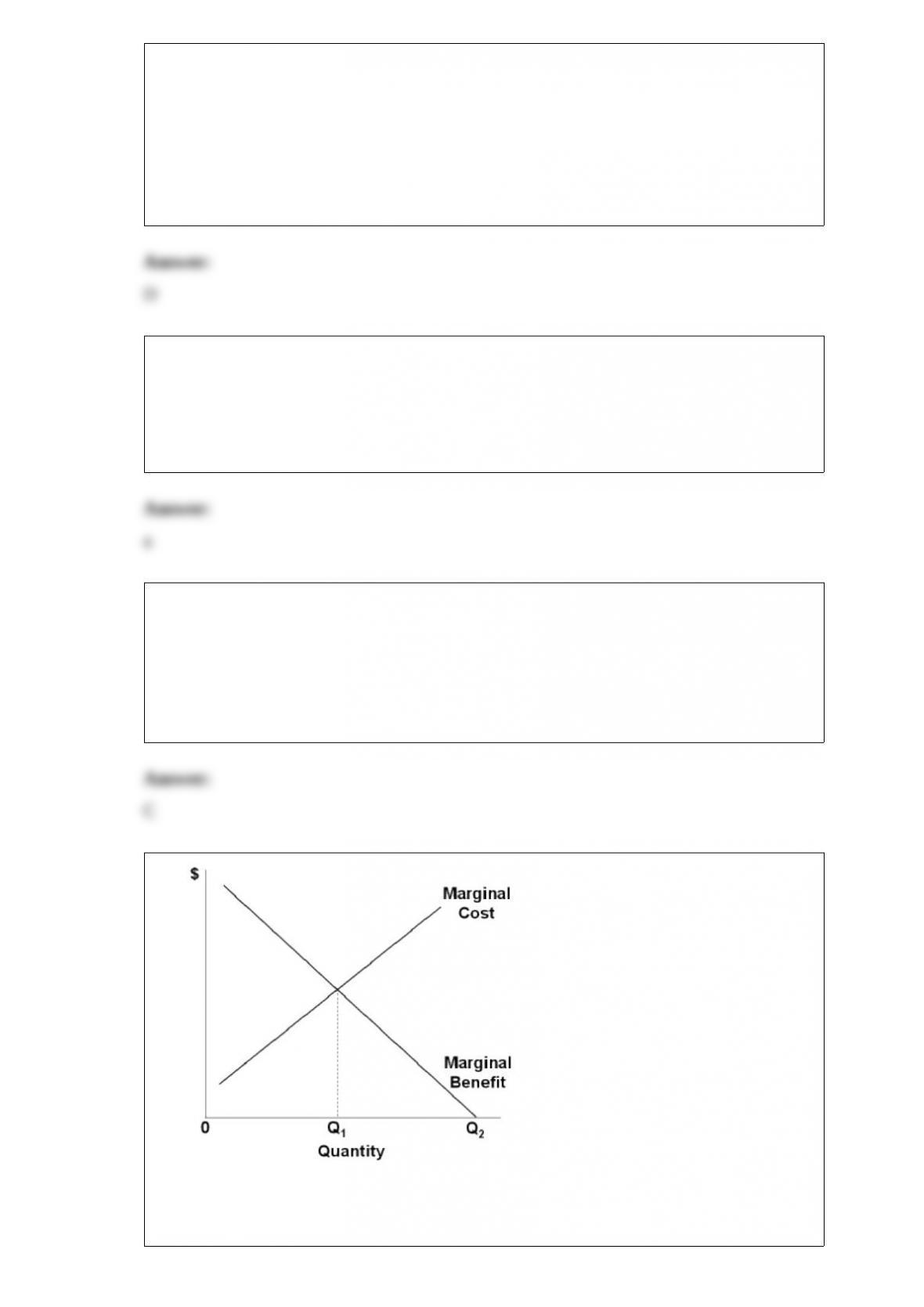
refer to the above diagram. physicians likely would argue that health care should be
provided to patients in:
a.some amount less than q1.
b.amount q1
c.some amount between q1 and q2.
d.amount q2.
16)
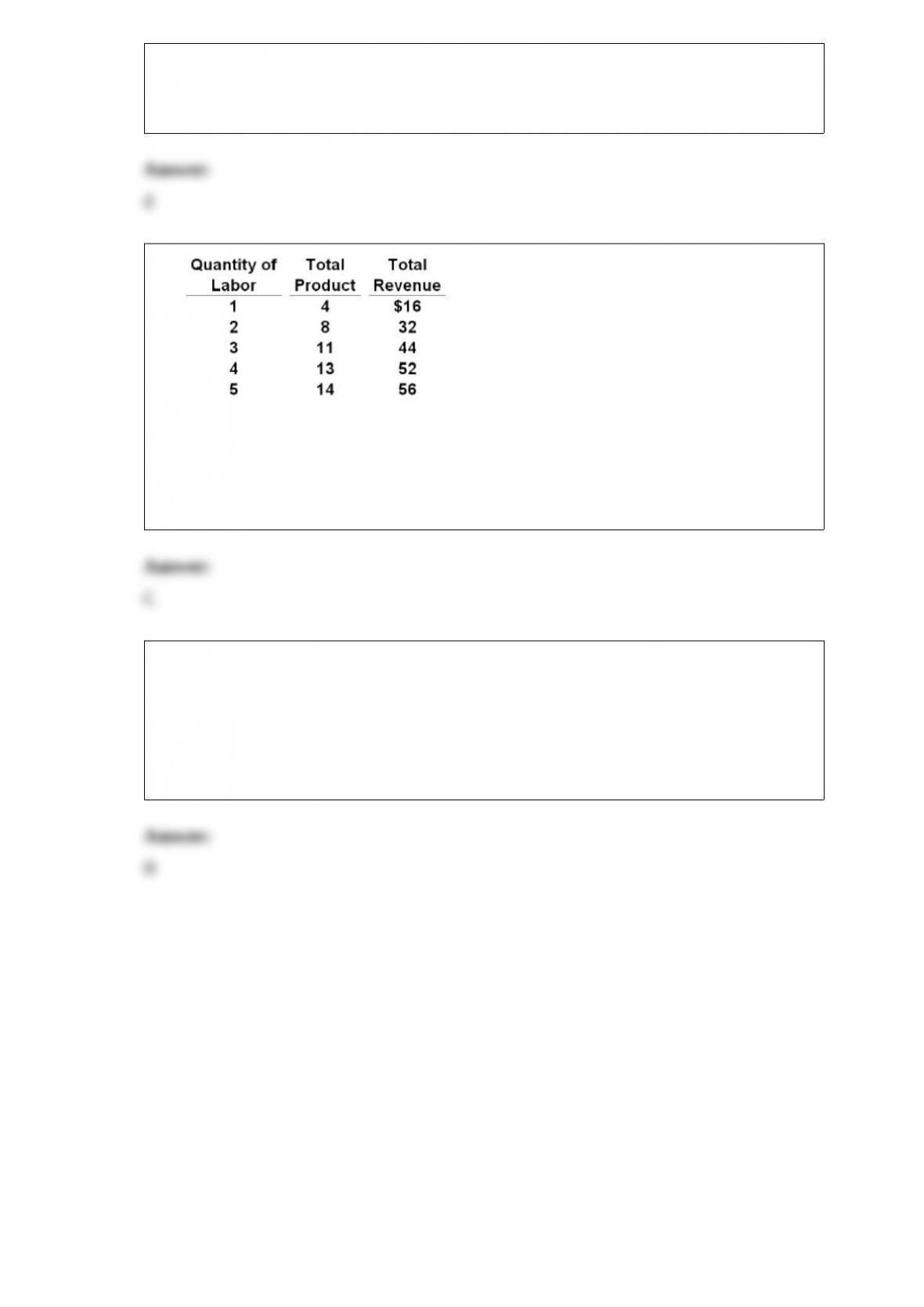
Refer to the above data. If the market wage rate is $8, this firm will employ:
A.2 workers.
B.3 workers.
C.4 workers.
D.5 workers.
17) Farm programs such as those of the United States and the European Union:
A.are consistent with free world trade in agricultural products.
B.cause a misallocation of agricultural resources internationally.
C.cause the United States and the European Union to underproduce, while other nations
overproduce, farm products.
D.raise productivity in developing nations.