
1) The moral hazard problem is the tendency of some parties to a contract to alter their
behavior as a result of the contract in ways which are costly to the other party.
2) changes in the average age of the u.s. population over the past decade have decreased
the demand for health care.
3) The world is losing about 2 percent of its forest coverage every year.
4) The regulation of natural monopolies has been criticized because it creates a
tendency for regulated firms to use too much labor and too little capital in the
production process.
5) Expansionary fiscal policy is so-named because it involves an expansion of the
nation’s money supply.
6) allocative efficiency occurs where the collective sum of consumer and producer
surplus is at a maximum.
7) The supply of money increases when the public buys government securities from
commercial banks.

8) It will be profitable for a firm to hire additional units of any resource up to the point
at which its MRP is equal to its MRC.
9) The Celler-Kefauver Act made vertical mergers legal, provided each firm does not
have more than 30 percent of its relevant market.
10) the united states exports a higher u.s. dollar volume of goods to canada than to any
other nation.
11) Commodity prices are relatively stable from year to year.
12) if a market is competitive, the resulting equilibrium output will always be the
socially efficient output.
13) An increase in the cyclical deficits will automatically increase the standardized
budget deficit.
14) Present value is the amount to which some current amount of money will grow as
interest compounds over time.

15) The greater the elasticity of demand and supply, the greater is the efficiency loss of
a tax.
16) For a new product to be profitable, it must:
A.enable customers to obtain greater total utility from their money income.
B.be less expensive than existing substitute products.
C.have greater marginal utility than existing substitute products.
D.embody process innovation.
17) Adherents of the traditional monetary rule say that the supply of money should be:
A.increased at a constant rate each year.
B.decreased during recession and increased during inflation.
C.held constant over time.
D.increased during recession and decreased during inflation.
18) In terms of aggregate supply, the short run is a period in which:
A.the price level is constant.
B.employment is constant.
C.real output is constant.
D.nominal wages and other resource prices are unresponsive to price-level changes.
19) in the short run a purely competitive firm will maximize profit by producing that
output at which:
a.total revenue exceeds total cost by a maximum amount.
b.total revenue exceeds total cost by a minimum amount.
c.total revenue and total cost are equal.
d.total fixed cost equals total variable cost.
20) Suppose that two firms in an industry that has a Herfindahl index of 1,000
announce a merger. The U.S. Justice Department concludes the merger will boost the
index to 1,050. The antitrust authorities will most likely:
A.ignore this merger because of the relatively small size of, and increase in, the
Herfindahl index.
B.prevent the merger, contending that it violates the Clayton Act.
C.allow the merger if foreign entry to the industry is possible.
D.allow the merger but watch the new firm carefully for future violations of the
antitrust laws.
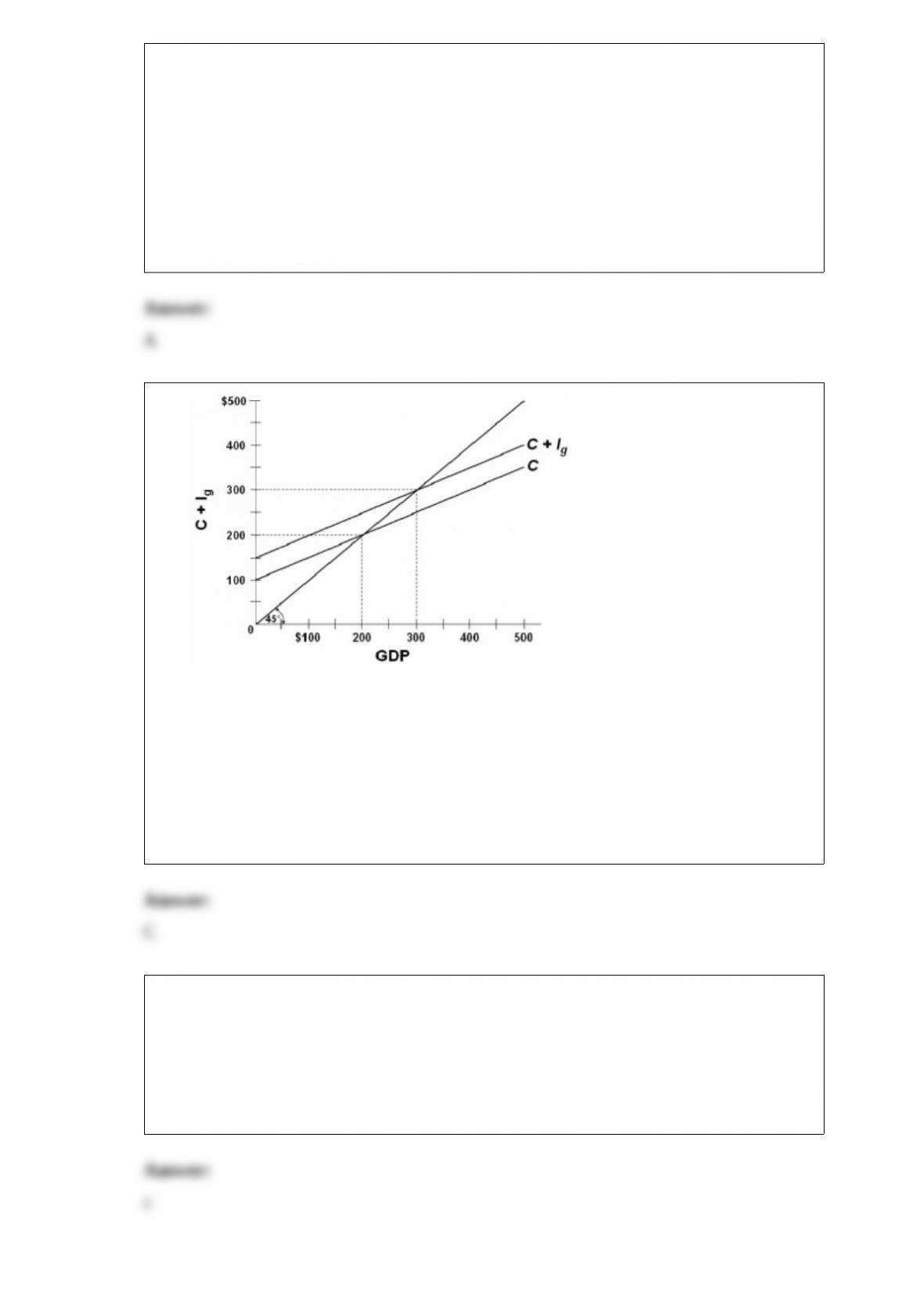
21)
Refer to the above diagram for a private closed economy. At the $400 level of GDP:
A.aggregate expenditures exceed GDP with the result that GDP will rise.
B.consumption is $350 and planned investment is zero so that aggregate expenditures
are $350.
C.consumption is $300 and planned investment is $50 so that aggregate expenditures
are $350.
D.consumption is $300 and actual investment is $100 so that aggregate expenditures are
$400.
22) the basic difference between the short run and the long run is that:
a.all costs are fixed in the short run, but all costs are variable in the long run.
b.the law of diminishing returns applies in the long run, but not in the short run.
c.at least one resource is fixed in the short run, while all resources are variable in the
long run.
d.economies of scale may be present in the short run, but not in the long run.
23) if the demand and supply curves for product x are stable, a government-mandated
increase in the price of x will:
a.increase the supply of x and decrease the demand for x.
b.increase the demand for x and decrease the supply of x.
c.increase the quantity supplied and decrease the quantity demanded of x.
d.decrease the quantity supplied of x and increase the quantity demanded of x.
24) the law of diminishing returns results in:
a.an eventually rising marginal product curve.
b.a total product curve that eventually increases at a decreasing rate.
c.an eventually falling marginal cost curve.
d.a total product curve that rises indefinitely.
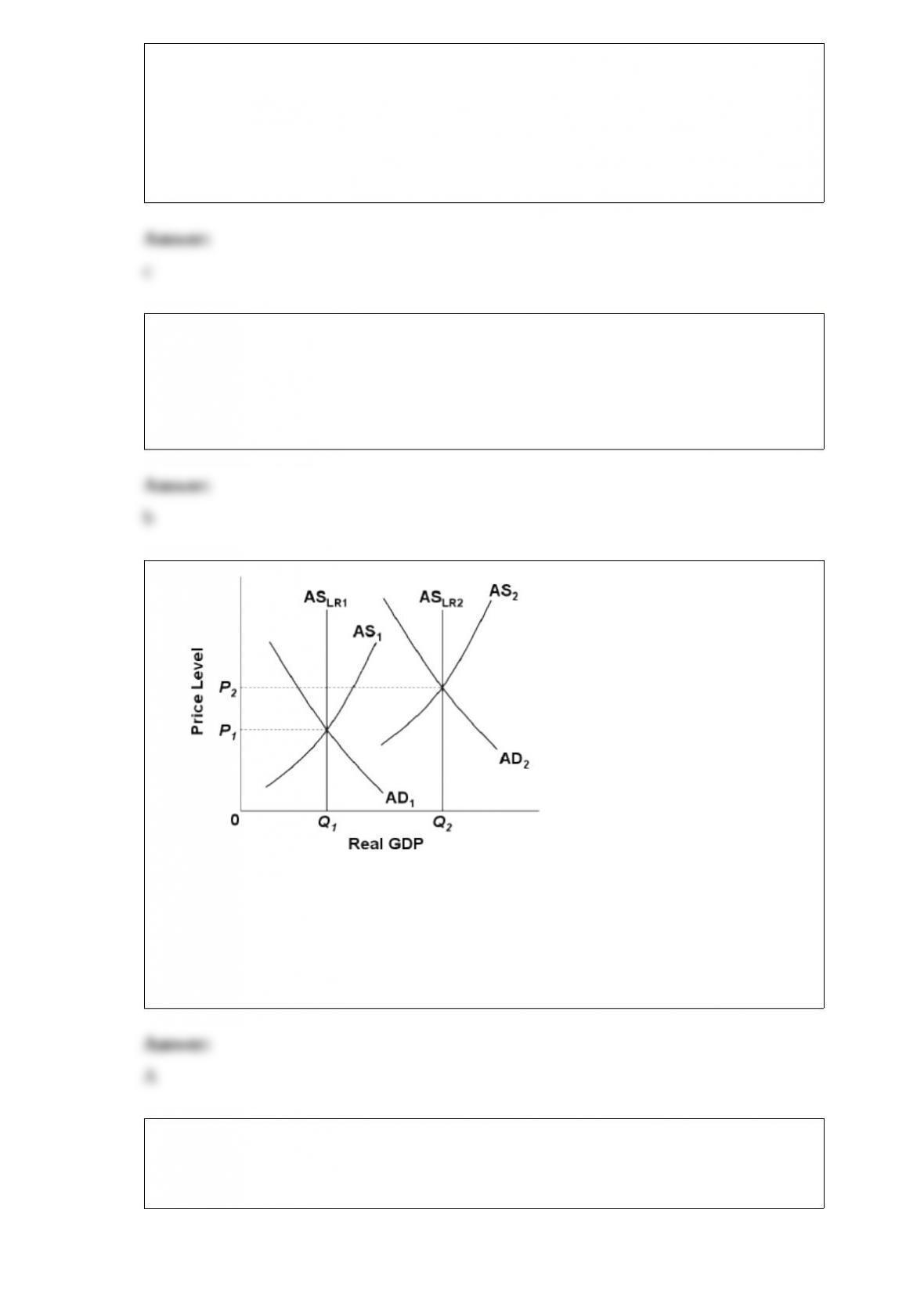
25)
Refer to the above graphs, where the subscripts on the labels denote years 1 and 2. In
year 1 the economy:
A.is in long-run equilibrium at output Q1.
B.is in short-run equilibrium at output Q1, but not in long-run equilibrium.
C.cannot be in long-run equilibrium because output changes in period 2
D.is in a recession, based on output Q1 being below output Q2.
26) the following table applies to a purely competitive industry composed of 100
identical firms.
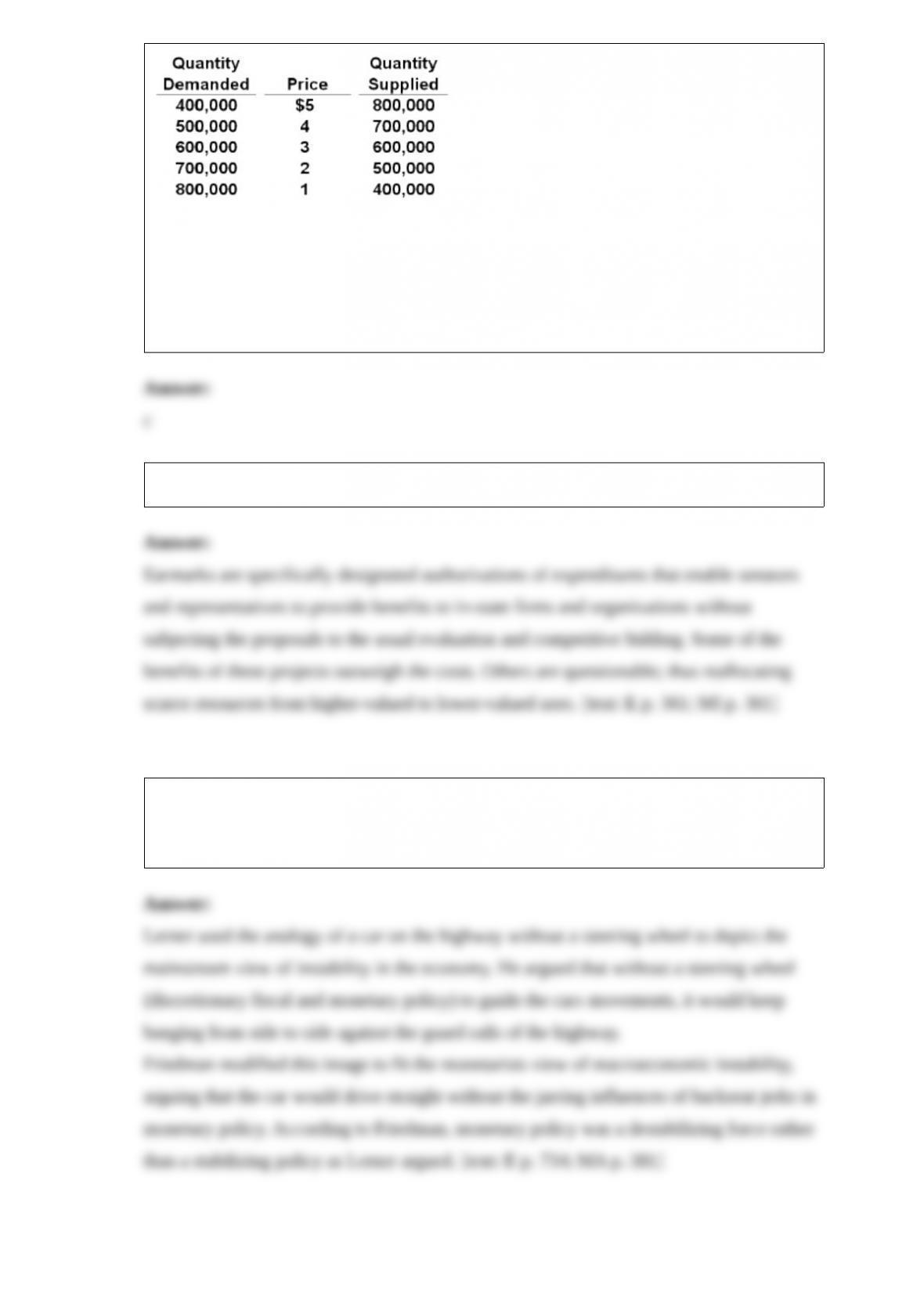
refer to the above table. if each of the 100 firms in the industry is maximizing its profit,
each must have a marginal cost of:
a.$5.
b.$4.
c.$3.
d.$2.
27) Define earmarks and give an example.
28) (Consider This) How did economist Abba Lerner use the analogy of a car on a
highway to depict his view of macroeconomic stability? How did economist Milton
Friedman modify this depiction?
29) Explain what is meant by a built-in stabilizer and give two examples.
30) What are the advantages and disadvantages of the managed float system of
exchange rates?
31) What is the supply-side cause of instability according to the mainstream view?
32) Use an aggregate demandaggregate supply analysis to explain the impact of the
publics expectations of severe inflation on real domestic output and the price level.
33) Contrast supply-side economics with demand-side fiscal policy.
34) What factors might increase the demand for carpenters in a medium-sized town? Be
specific.
35) Explain and evaluate the validity of the military self-sufficiency argument for trade
protection.