
1) The Federal Reserve Banks sell government securities to the public. As a result, the
checkable deposits:
A.of commercial banks are unchanged, but their reserves increase.
B.and reserves of commercial banks both decrease.
C.of commercial banks are unchanged, but their reserves decrease.
D.of commercial banks are both unchanged.
2) suppose that the mr = mc condition cannot be completely met for a firm because
there is no level of output at which mr and mc are equal. in that case the firm should:
a.produce up to and including the last unit for which mr exceeds mc.
b.produce up to and including the last unit for which mc exceeds mr.
c.shut down.
d.continue to produce as long as mr is positive.
3) Suppose aggregate demand in the economy sharply declines. Mainstream economists
say that the price level (at least for a time) will _______ and real output will
_________.
A.decrease; remain constant
B.increase; remain constant
C.remain constant; decrease
D.remain constant; increase
4) The mainstream view of macro instability is that:
A.changes in the money supply directly cause changes in aggregate demand and thus
cause changes in real GDP.
B.changes in investment shift the aggregate demand curve and thus cause changes in
real GDP.
C.bursts of innovation put the economy on an unsustainable growth path, eventually
producing recession.
D.changes in technology and resource availability are the two main sources of
fluctuations of real GDP.
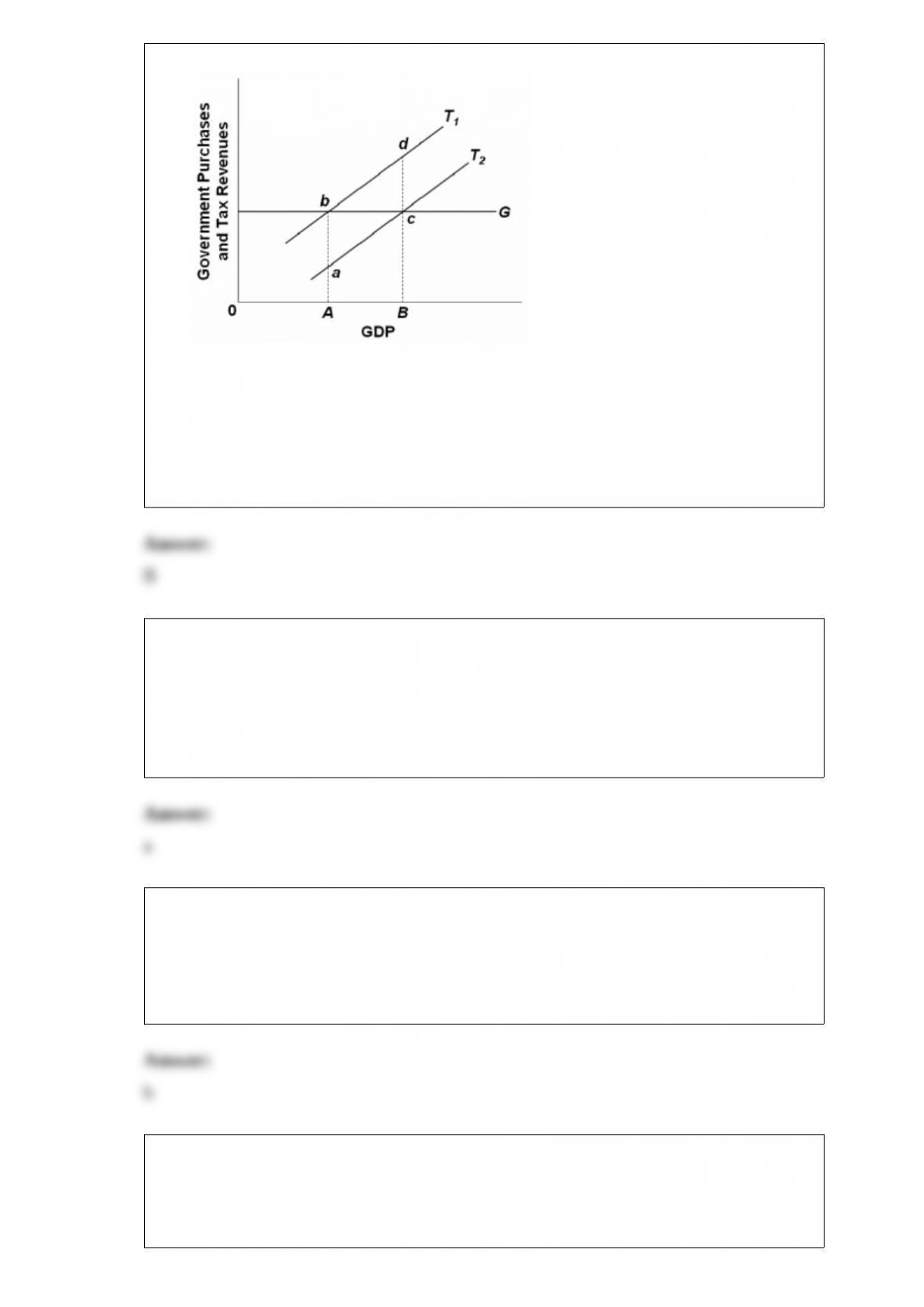
5)
Refer to the above diagram. Discretionary fiscal policy designed to slow the economy is
illustrated by:
A.the shift of curve T1 to T2.
B.the shift of curve T2 to T1.
C.a movement from a to c along curve T2.
D.a movement from d to b along curve T1.
6) one of the criticisms of national health insurance is that the shift from insurance
premiums to taxes in financing health care will:
a.redistribute income toward greater equality.
b.necessarily increase the public debt.
c.redistribute income toward greater inequality.
d.necessarily reduce the growth of real wages.
7) government purchases and transfer payments:
a.differ because the latter absorb resources while the former do not.
b.differ because the former absorb resources while the latter do not.
c.are alike because both are more inflationary than private spending.
d.are alike because both absorb resources.
8) Which of the following is a true statement?
A.innovation normally follows invention and precedes diffusion.
B.invention normally follows diffusion and precedes innovation.
C.diffusion normally follows invention and precedes innovation.
D.innovation normally follows diffusion and precedes invention.
9) Human capital is best defined as:
A.the productive skills and knowledge that workers acquire from education and
training.
B.the substitution of labor for machinery in the production process.
C.any piece of machinery that must be combined with labor to be productive.
D.the exchange of money for real assets.
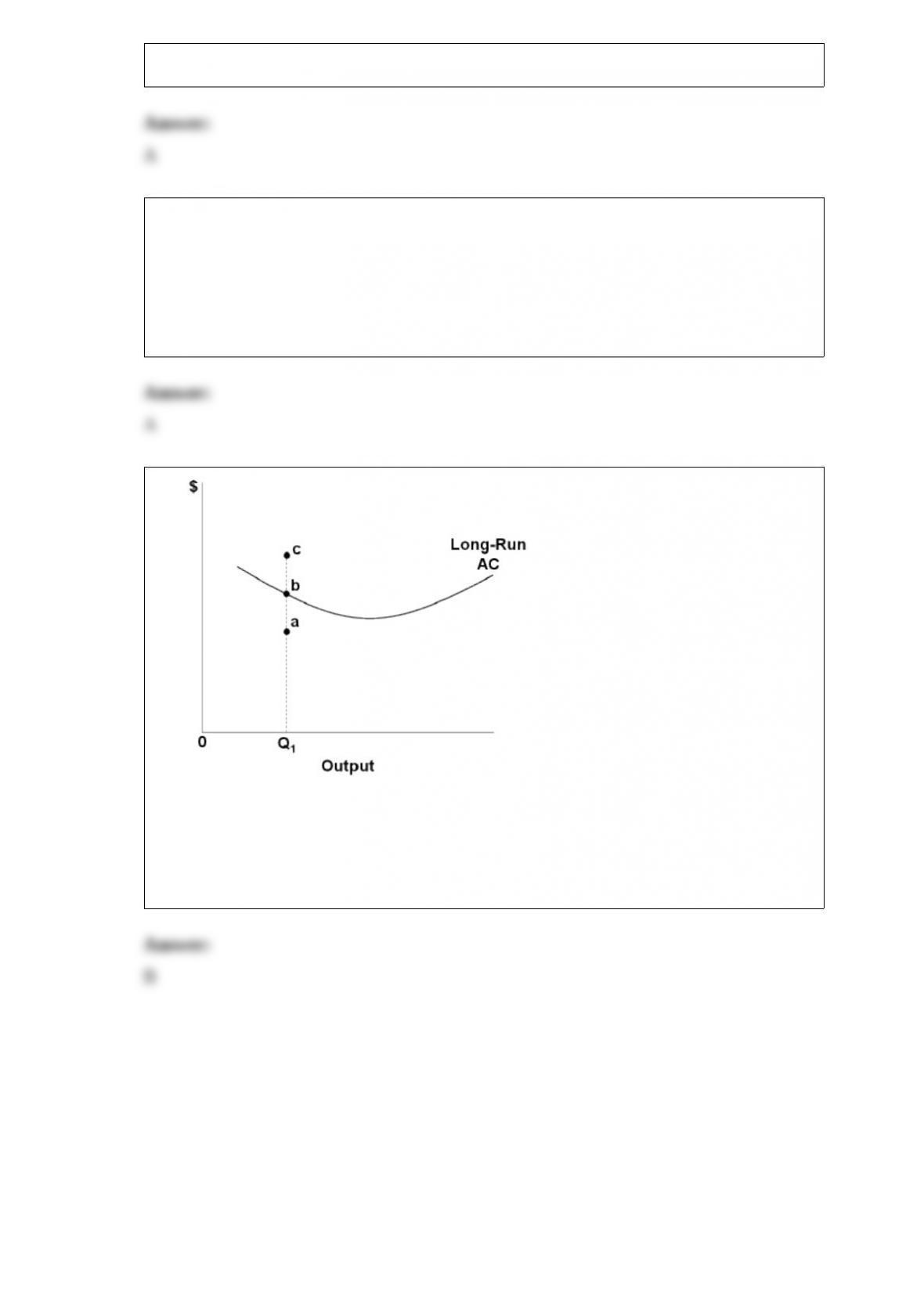
10)
Refer to the above diagram. If a firm produces output Q1 at a unit cost of b, then the:
A.firm is not fulfilling the least-cost rule in employing resources.
B.firm may or may not be maximizing profits.
C.marginal product per dollar’s worth of each resource employed is not the same.
D.firm has achieved minimum efficient scale.
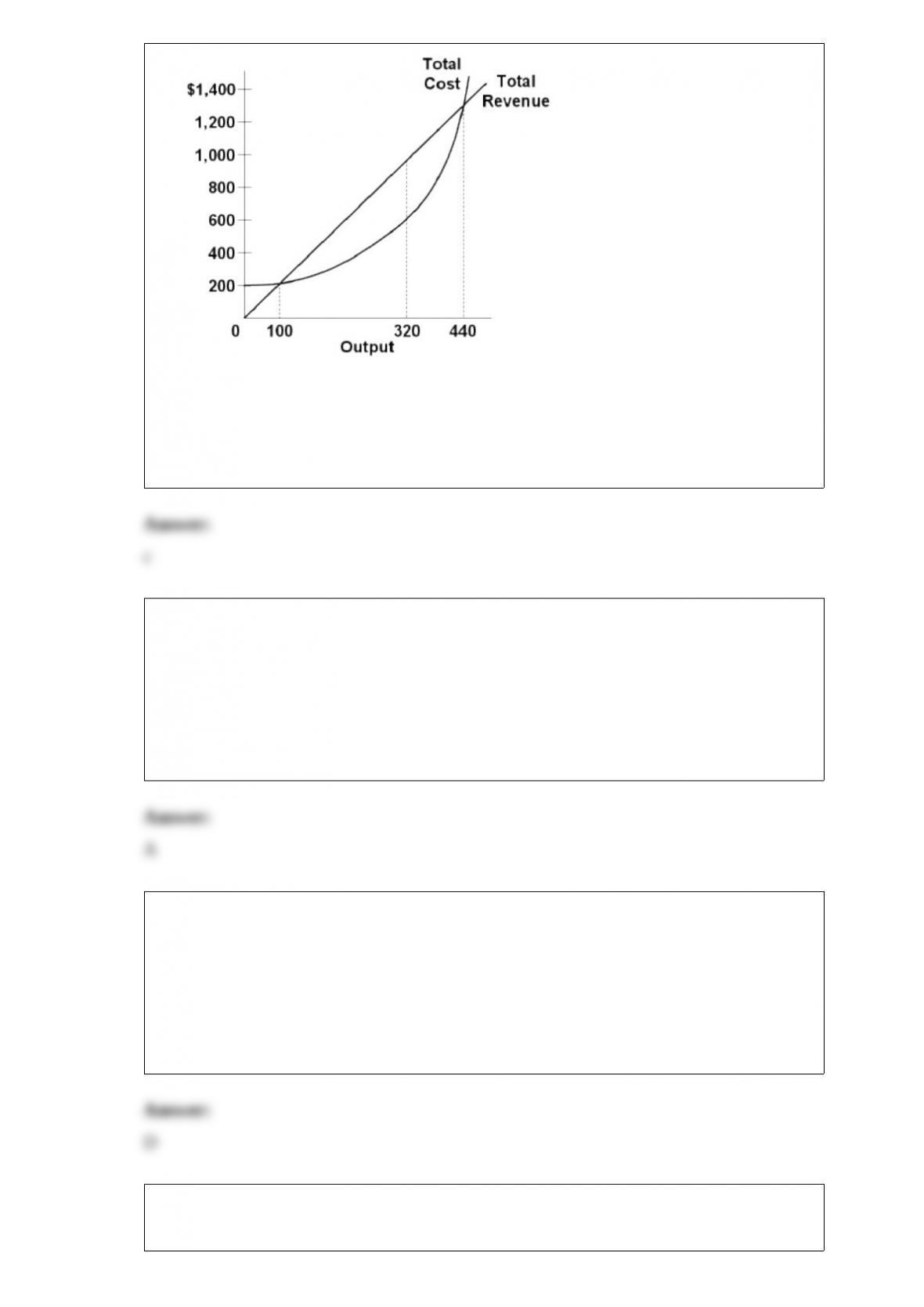
11)
refer to the above short-run data. the shape of the total cost curve reflects:
a.diminishing opportunity costs.
b.the law of rising fixed costs.
c.increasing and diminishing returns.
d.economies and diseconomies of scale.
12) A monopsonistic employer in an unorganized (nonunion) labor market will:
A.pay a wage rate less than labor’s MRP.
B.pay the same wage rate but hire fewer workers than if the market was purely
competitive.
C.hire the number of workers indicated by the intersection of the MRC and the labor
supply curves.
D.pay a wage rate in excess of labor’s MRP.
13) (Advanced analysis) If S = -60 + .25Y and Ig = 60, where S is saving, Ig is gross
investment, and Y is gross domestic product (GDP), then the equilibrium level of GDP
is:
A.$200.
B.$320.
C.$360.
D.$480.
14) Which of the following are included and which are excluded in calculating this
years GDP? Explain in each instance.

(a)Social Security checks received by a retired person
(b)An increase in business inventories
(c)The income of a tax accountant working for a business
(d)Income received from interest on a corporate bond
(e)The cashing in of a U.S. savings bond
15) a pure market economy overallocates resources to the production of goods that:
a.involve negative externalities.
b.involve positive externalities.
c.are public goods.
d.are inexpensive to produce.
16) given the annual rate of inflation, the “rule of 70” allows one to:
a.determine whether the inflation is demand-pull or cost-push.
b.calculate the accompanying rate of unemployment.
c.determine when the value of a real asset will approach zero.
d.calculate the number of years required for the price level to double.
17) Suppose that real domestic output in an economy is 20 units, the quantity of inputs
is 10, and the price of each input is $4. Answer the following question(s) on the basis of
this information.
Refer to the above information. All else being equal, if the price of each input increased
from $4 to $6, productivity would:

A.fall from 2 to 3.
B.fall from .50 to .33.
C.rise from 1 to 2.
D.remain unchanged.
18) Which of the following is correct?
A.The nominal wage may fall, but the real wage can never decline.
B.The real wage may fall, but the nominal wage can never decline.
C.Both the nominal and the real wage must always rise.
D.The nominal and the real wage may both fall.