
The marginal rate of technical substitution of labor for capital (MRTSLK) tends to be
higher
a. the larger the quantity of capital already employed.
b. the lower the quantity of capital already employed.
c. when a firm is choosing baskets that are technologically inefficient.
d. in the short-run compared to the long-run.
The demand curve faced by a competitive firm is
a. perfectly elastic at the established market price.
b. downward sloping, with the same elasticity as the industry demand curve.
c. more inelastic than the demand curve faced by its competitors.
d. nonexistent.
Consider a $4 excise tax that has been levied on suppliers of automobile tires.
Legislators, in the interest of fairness, change the law so that the tax is evenly split
between suppliers and demanders, with each group legally required to pay $2 per tire.
In this situation, we can predict that
a. suppliers will be made better off and demanders will be made worse off.

b. the change will have no economic effect on suppliers and demanders.
c. demanders will “pass back” their share of the tax to the suppliers, so that suppliers
continue to pay $4 per tire.
d. the economic incidence of the tax will be evenly split between suppliers and
demanders.
You have a bond that will pay you one hundred dollars one year from today. If the
prevailing interest rate is r, the bond is currently worth
a. 100/r
b. 100r
c. 100/(1 + r)
d. 100
What is the variable cost of producing three units of output?
a. $20.
b. $130.
c. $230.

d. Cannot be determined with the information available.
If mixed strategies are allowed in the Copycat Game, a Nash equilibrium will result if
a. both players randomly choose their strategies by flipping a fair coin.
b. one player randomly chooses his strategy by flipping a fair coin, while the other
player uses a pure strategy.
c. one player randomly chooses his strategy by flipping an unfair coin, while the other
player uses a pure strategy.
d. both players stick to using pure strategies.
Techniques for estimating demand curves using direct observations from the
marketplace are part of a family of statistical techniques referred to as:
a. legal studies.
b. Econometrics.
c. policy analysis.
d. the expanding realm of Economics.

At the equilibrium point of a market,
a. supply equals demand.
b. neither demanders nor suppliers are satisfied.
c. the quantities supplied and demanded are equal.
d. suppliers will refuse any price increases offered by demanders.
In the Black-Scholes option pricing model, investors are assumed to be not only
rational but also able to do Ito calculus. This model, with its unrealistic assumptions,
a. is valuable only as an abstract curiosity.
b. cannot be robust.
c. still leads to accurate predictions.
d. is rejected by most economists.

Rate of return regulation will
a. always result in the firm producing the quantity that would be produced if the market
were competitive.
b. always result in the firm producing less than the quantity that would be produced if
the market were competitive.
c. always result in the firm producing more than the quantity that would be produced in
a competitive industry.
d. result in a new equilibrium with either more or loss produced in comparison to a
competitive market.
Who wrote the book Progress and Poverty, in which the author argued that the payment
of rent to landlords serves no economic purpose?
a. George Akerlof.
b. Robert Dorfman.
c. Henry George.
d. Friedrich A. Hayek.
Incomplete property rights create transactions costs because

a. any party wanting to use the disputed resource does not have a fixed group with
which to bargain.
b. the use of the disputed resource cannot be fully monitored by the government.
c. no one can prevent people from using the disputed resource for free.
d. others may receive a higher value from the disputed resource that those who own the
property right to it.
If the marginal value to Sue of a fourth soda is $1.00, then
a. Sue would be willing to pay no more than $4.00 for four soda.
b. Sue places a total value of less than $4.00 on four sodas.
c. Sue would pay no more than $1.00 for an additional soda when she has already
consumed 3 soda.
d. Sue would pay no more than $1.00 for any soda.
Abstract economic models whose assumptions and conclusions are essentially
untestable are still useful because they
a. indicate what data should be collected in the future.
b. develop economists’ intuition for more complex situations.
c. can be illustrated using simple graphical techniques.
d. capture the detail of realistic situations without any simplifying hypotheses.
An downward shift in a worker’s budget line is a result of
Which of the following would lead to a rise in demand for recordable DVDs by
students?
a. An increase in the number of DVD manufacturers.
b. A decrease in the price of DVD recording devices.
c. A decrease in the price of the DVD making machinery.
d. A cut in the number of student workers hired by the university, lowering student
incomes.
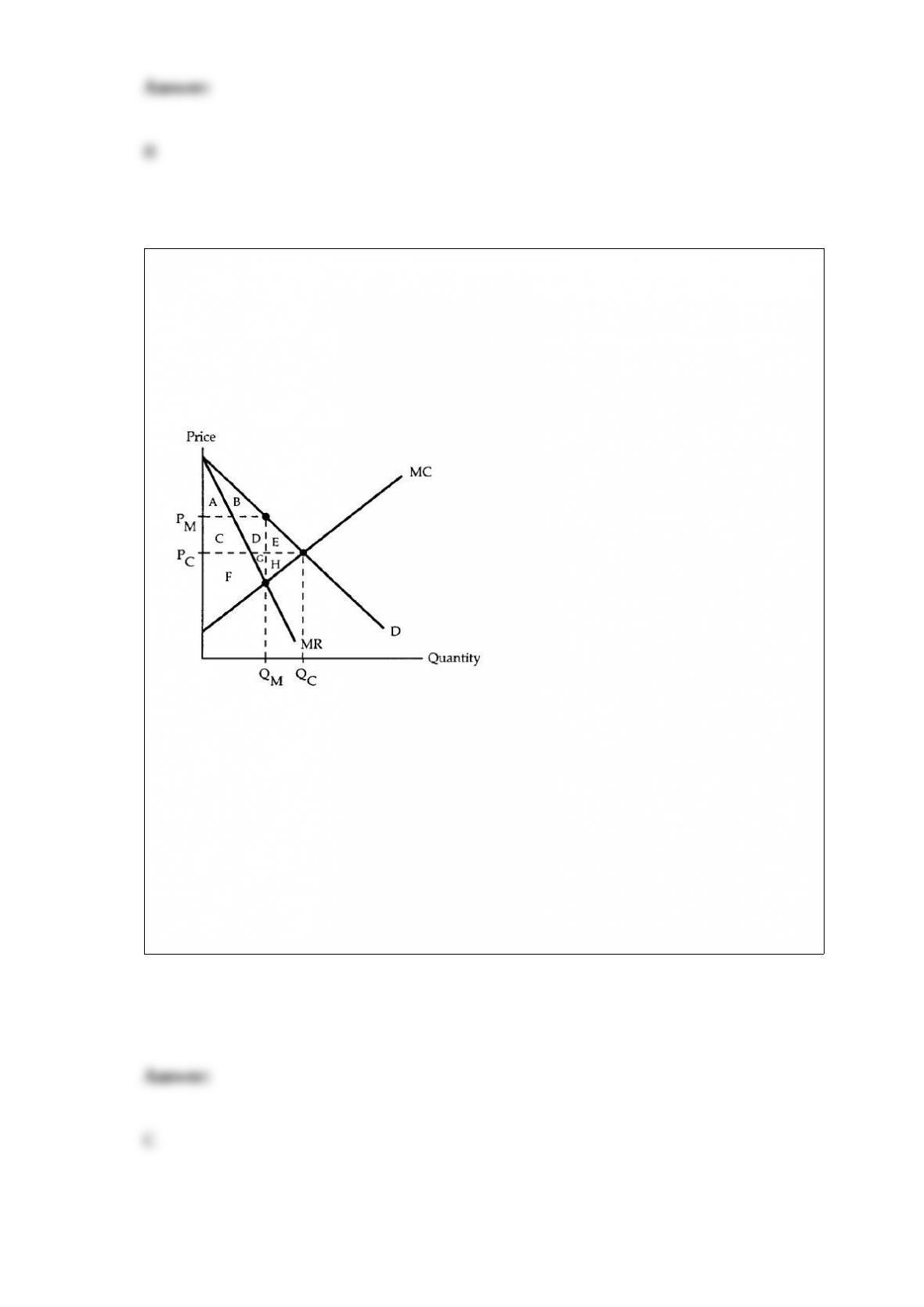
Market Diagram
The following questions refer to the accompanying market diagram. PC and QC are the
equilibrium price and quantity if the firm behaves competitively, and PM and QM are
the equilibrium price and quantity if the firm is a simple monopoly.
What area represents the producer’s surplus earned in the monopoly equilibrium?
a. Area A + C + F.
b. Area C + F.
c. Area C + D + F + G.
d. Area C + D + E.

According to F.A. Hayek, knowledge is lost as statistics are used to convey information.
What type(s) of individual will always choose a risk-free basket when offered a bet at
fair odds?
a. A risk-neutral individual.
b. A risk-averse individual.
c. A risk-preferring individual.
d. Risk-neutral and risk-averse individuals.
The price elasticity of demand for electricity is -0.40. By how much must the price of
the electricity decrease in order for sales to rise by 12%?
a. 3%.
b. 4.8%.
c. 12.4%.
d. 30%.

An increase in the marginal productivity of capital will lead to
a. an increase in current consumption.
b. a rise in the interest rate.
c. a decline in the demand for current consumption.
d. a fall in the demand for capital.
The annual insurance premiums for Michael’s Machine Shop have permanently risen
because of a recent series of thefts by employees, but there is no change in the
premiums paid by Michael’s competitors. If machine shops are a competitive
constant-cost industry, then in the long run
a. Michael’s profit will fall to zero.
b. Michael’s Machibe Shop will be driven out of business.
c. the higher fixed costs will have no effect on Michael’s pricing and production
decisions.
d. the demand for service from Michael’s Machine Shop will fall.

If the marginal product of capital is smaller than the interest rate, then
a. investment in capital will fall.
b. people are earning negative rents from capital.
c. the supply of current consumption will decline.
d. borrowing will increase.
When a firm with market power practices third-degree price discrimination, it charges
the highest price to the group that
a. has the most elastic demand.
b. has the most inelastic demand.
c. purchases the highest quantity.
d. purchases the lowest quantity.
Which of the following would be an economic explanation of how “99¢ pricing” was
developed?
a. It was a sales gimmick that sellers used to try to fool their customers.

b. It was encouraged by a penny newspaper to increase the number of pennies in
circulation.
c. It was a scheme to let firms advertise that their prices were under some round dollar
figure.
d. It was a way of ensuring that sales were recorded on cash registers, thus reducing
employee theft.
Farmer Ken in Kentucky can raise either 80 pounds of tobacco or 40 bushels of cotton
on an acre. Farmer Calvin in California can raise either 150 pounds of tobacco or 50
bushels of cotton on an acre. Which farmer can produce tobacco more efficiently?
a. Farmer Ken in Kentucky.
b. Farmer Calvin in California.
c. The two farmers are equally efficient at growing wheat.
d. More information is needed to determine comparative advantage.
Suppose the price of a good rises. When will the resulting substitution effect reduce the
quantity demanded of the good?
a. Always.

b. Whenever the good is a non-Giffen good.
c. Only when the good is normal.
d. Only when the good is inferior.
Assume that the demand curve for oranges is downward-sloping and the supply curve
for oranges is upward-sloping. If the government imposes an excise tax of 10¢ per
orange, then the total price (including the tax) that demanders must pay for an orange
a. remains unchanged.
b. rises by less than 10¢ per orange.
c. rises by exactly 10¢ per orange.
d. rises by more than 10¢ per orange.
Labor Demand and Labor Supply
The following questions refer to the accompanying diagram, which shows an industry’s
labor demand and labor supply. Labor and capital are the only factors used by the
industry. The industry hires L units of labor at a wage of PL.
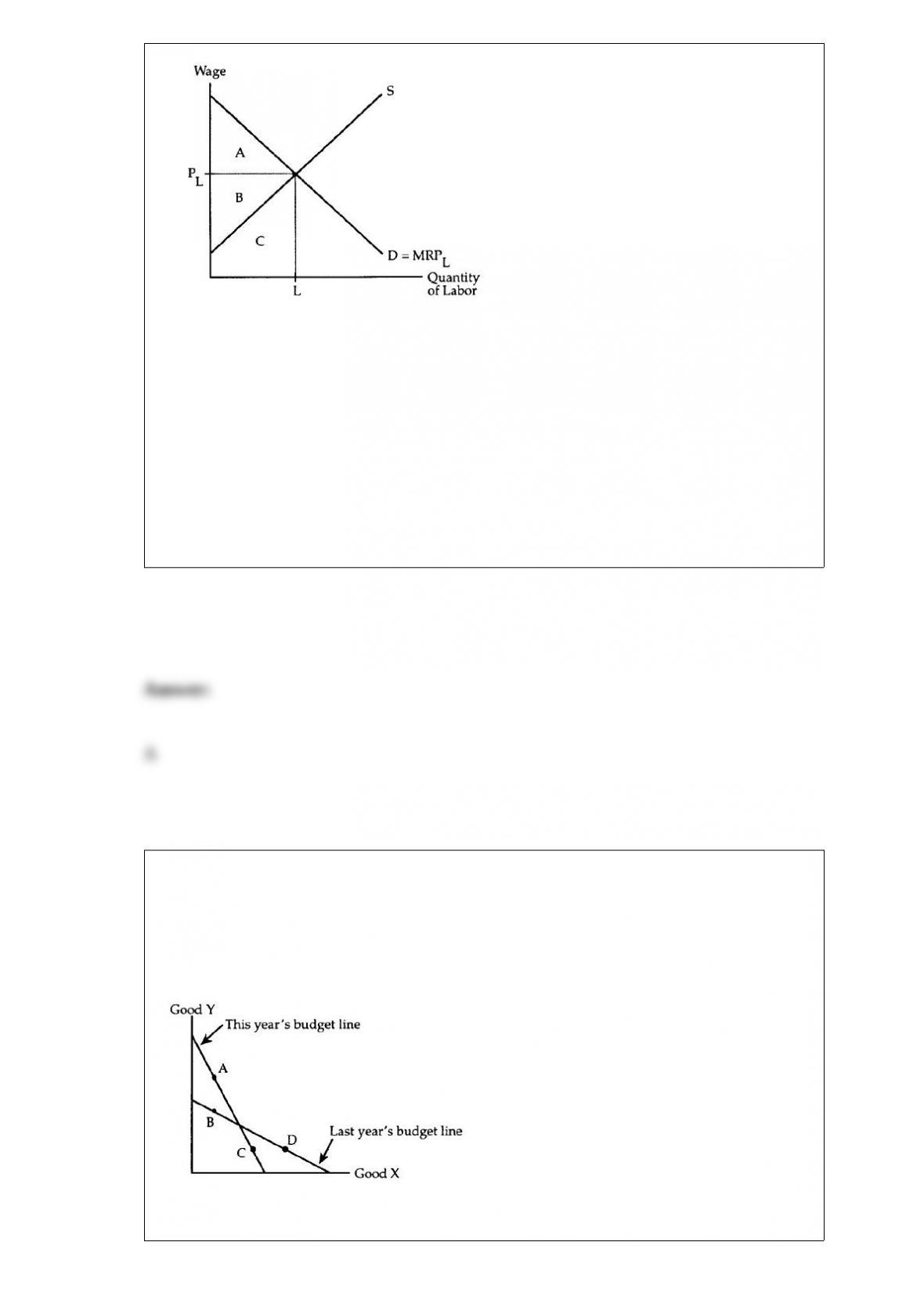
What does area A + B + C represent?
a. The industry’s total revenue.
b. The rent earned by the industry’s laborers.
c. The total wages paid to the industry’s laborers.
d. The rent earned by the industry’s capital.
Budget Lines
The following questions refer to the following diagram, which shows the budget lines
faced by a consumer last year and this year.
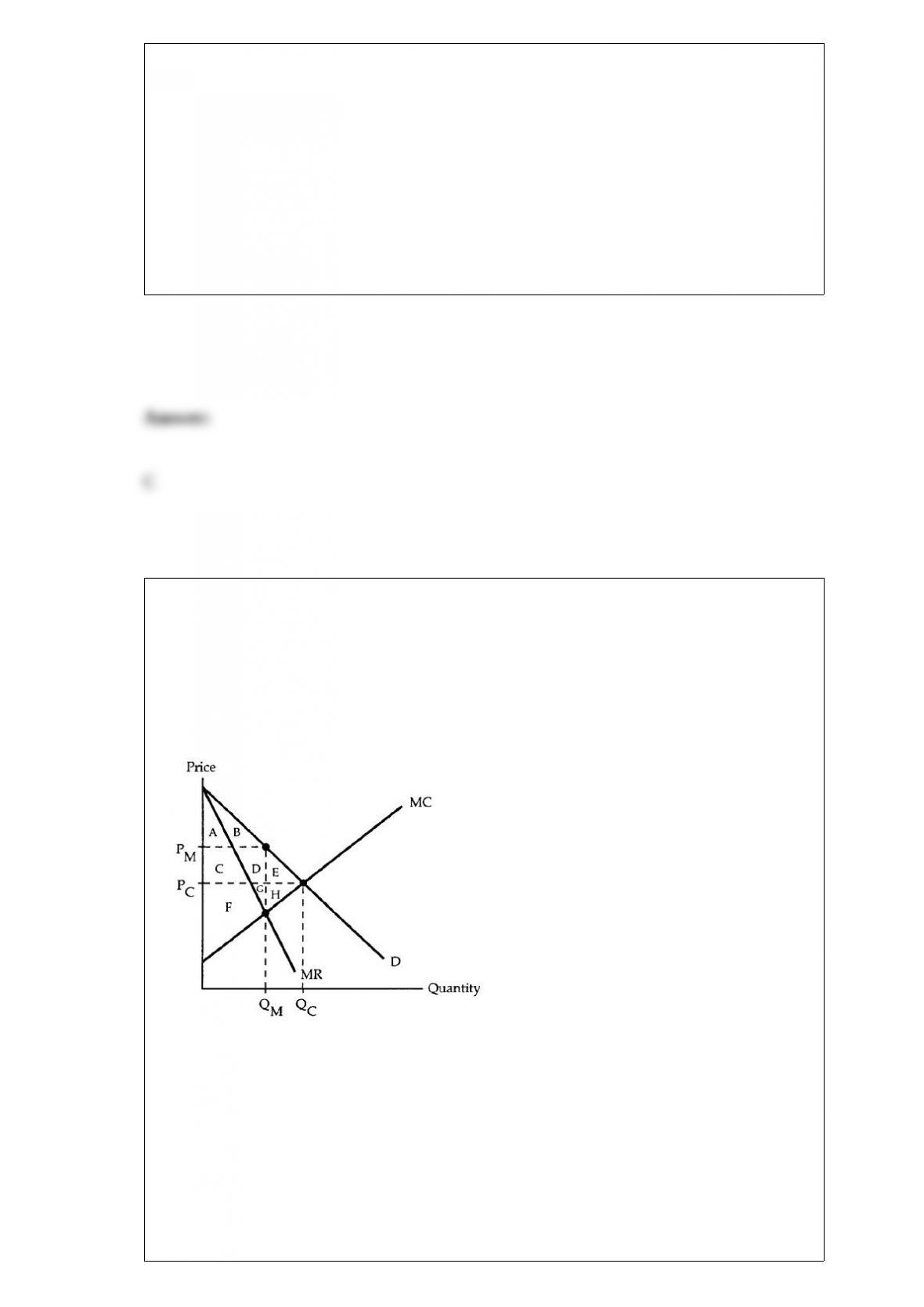
Which of the following changes is consistent with the situation shown in the diagram?
a. The consumer’s income fell.
b. The relative price of good X in terms of good Y fell.
c. The absolute price of good X rose, and the absolute price of good Y fell.
d. The absolute price of both goods rose, with the price of good X rising by the higher
percentage.
Market Diagram
The following questions refer to the accompanying market diagram. PC and QC are the
equilibrium price and quantity if the firm behaves competitively, and PM and QM are
the equilibrium price and quantity if the firm is a simple monopoly.
Relative to the surplus they would receive in a competitive market, consumers lose how
much surplus because there is a monopoly?
a. Area F + G + H
b. Area C + D + E
c. Area E + H

d. Area A + B
Second-degree price discrimination generally takes the form of
a. special prices for students and seniors.
b. membership clubs.
c. quantity discounts.
d. “extras” like free delivery and free customer service.
Demand and Total Cost of Production
The following questions refer to the following tables which show the demand for a
firm’s product and the firm’s total cost of production.
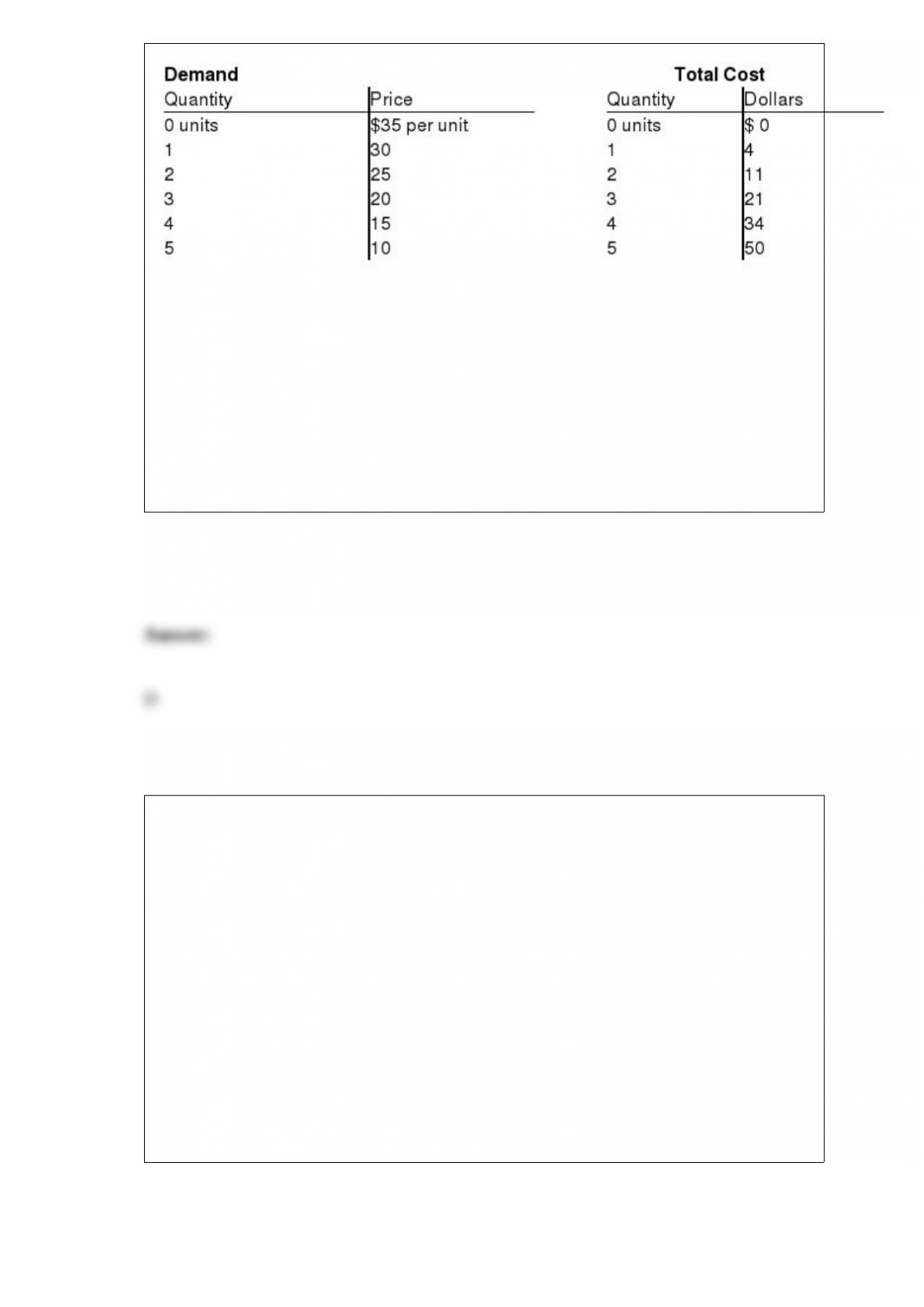
The marginal revenue received from selling the fifth unit is
a. $50 per unit.
b. $10 per unit.
c. $2 per unit.
d. -$10 per unit.
Consider an income tax and a head tax, the sizes of which have been set so that the
government collects the same amount of money under each tax. Which tax does the
consumer prefer?
a. The consumer is indifferent between the two taxes, since he pays the same amount of
money under each tax.
b. The consumer prefers the head tax, because it does not lower the relative wage as
does the income tax.
c. The consumer prefers the income tax, because it can be avoided by increasing the
amount of leisure time consumed.
d. The consumer may prefer either tax, depending on whether the income tax increases
or decreases the number of hours of work at the optimum.

When will an industry’s long-run supply curve be horizontal at firms’ break-even price?
a. When expansion of the industry allows new input markets to develop.
b. When some firms are more efficient than others.
c. When specialized skills play a significant role in production.
d. When firms are identical and there is no factor-price effect.
If an annual tax of $560 per acre is levied on land, then land values will fall by $560 per
acre.
An Engel curve shows the relationship between price and quantity demanded.

Total surplus value would be higher if telephone companies provided free directory
assistance instead of charging for it.
Trading is beneficial whenever people differ in their abilities or differ in their tastes.
Consider a firm with constant marginal cost that behaves competitively. A horizontal
merger lowers the firm’s marginal cost and causes the firm to behave like a monopoly.
How does the merger affect producer’s surplus, consumers’ surplus, and social gain?
Explain.

Consumer’s surplus equals the total value that the consumer places on his purchases
minus the amount he actually paid.
The profit an owner receives is equivalent to the rent received for her entrepreneurial
services.
Consumers will benefit from a tariff, because it helps domestic firms and generates
revenue for the government.

What is required for a market to be considered monopolistically competitive? How does
the equilibrium in a monopolistically competitive market resemble that in a perfectly
competitive market? How are they different?
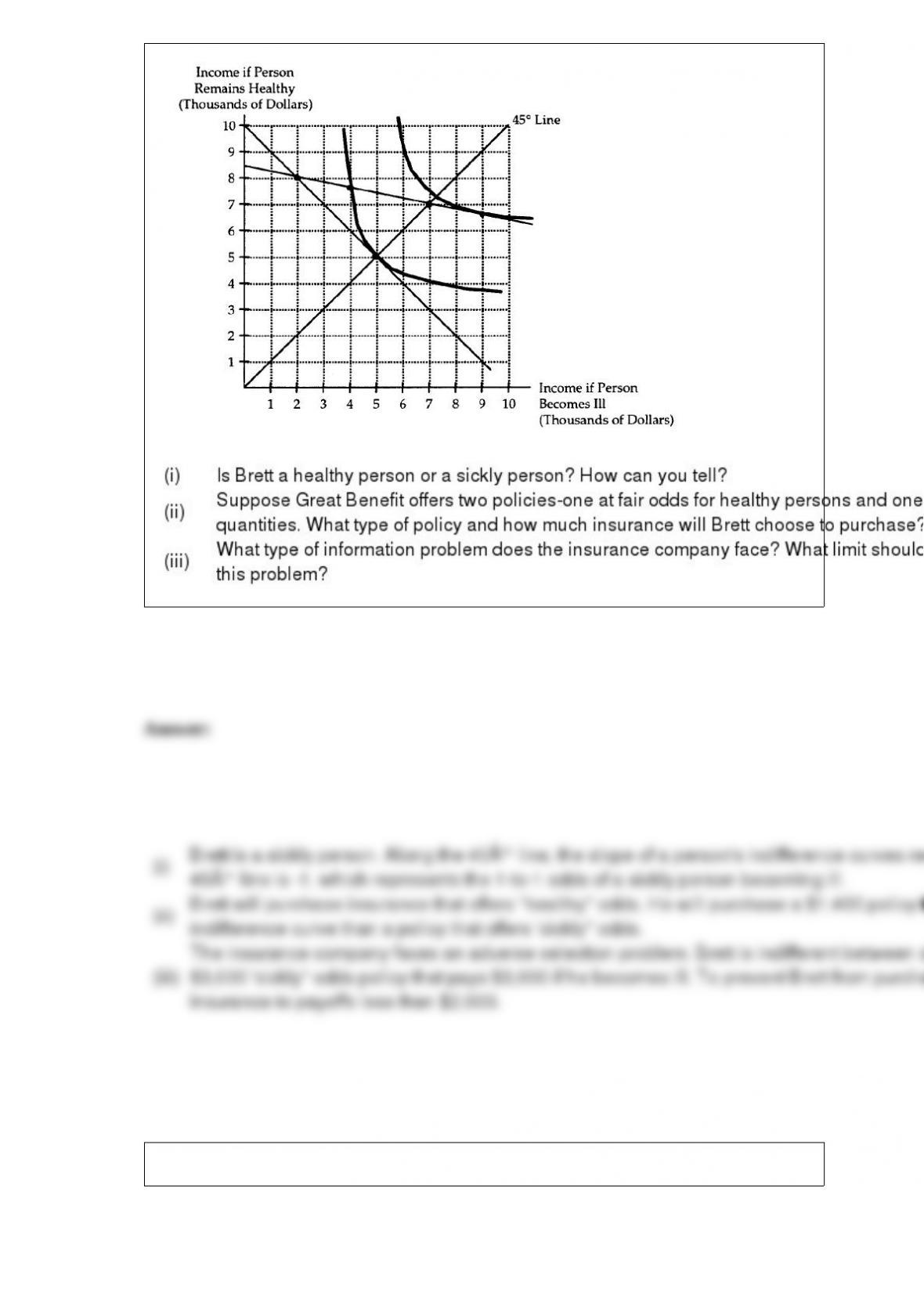
Great Benefit is a health insurance company with two types of customers: healthy
persons and sickly persons. A healthy person has 1-to-5 odds of getting ill, and a sickly
person has 1-to-1 odds of getting ill. However, the insurance company cannot
distinguish between healthy and sickly persons. Brett is a risk-averse person who
purchases health insurance from Great Benefit. Without insurance, Brett’s income will
be $8,000 if he remains healthy and $2,000 if he becomes ill. Brett’s situation is
diagrammed below.
Social gain is lowered when a monopoly begins to practice price discrimination.
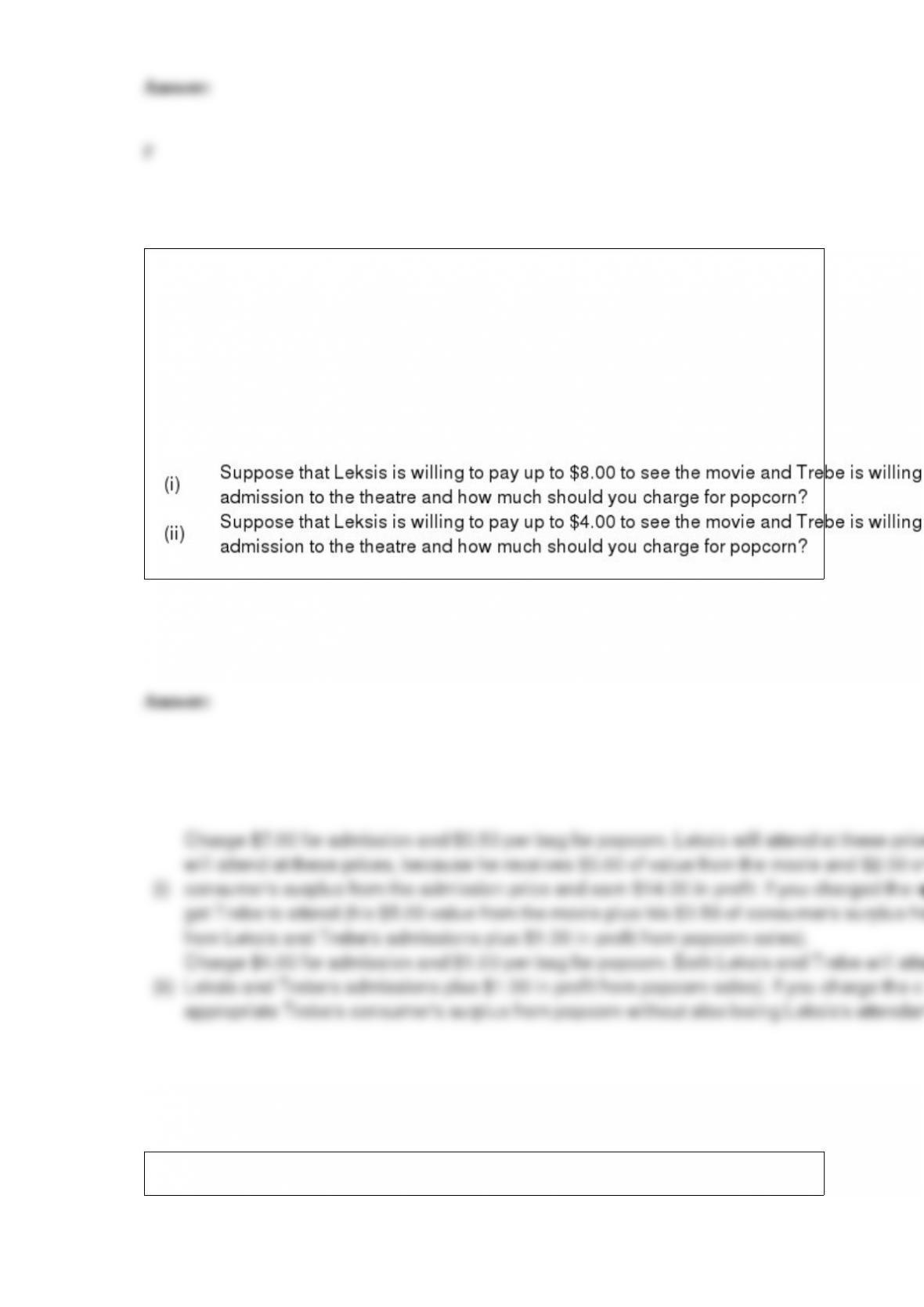
Suppose you are the monopoly owner of a movie theatre. You can allow people to enter
the theatre at zero marginal cost, and you can provide popcorn at a constant marginal
cost of $0.50 per bag. You have two customers, Leksis and Trebe, who are identical
twins. Leksis never buys popcorn under any circumstances. If you charge the monopoly
price of $1.00 per bag for popcorn, Trebe will buy 2 bags of popcorn and earn $0.50 in
consumer’s surplus, and you will earn $1.00 in profit from popcorn sales. If you charge
the competitive price of $0.50 per bag for popcorn, Trebe will buy 4 bags of popcorn
and earn $2.00 in consumer’s surplus, and you will earn no profit from popcorn sales.
Even if an economic model is not detailed enough to give numerical predictions, it
might still be useful if it can indicate the direction of change in economic variables.
When an increase in marginal productivity increases workers’ nonlabor income, the
effect on the quantity of labor supplied is ambiguous.

A utility maximizing person gets marginal utility from consuming their last pencil and
pen of 4 and 10 respectively. If pencils cost 10 cents a piece, the pens must cost 25
cents a piece.
Education is partly investment but also partly consumption.