1) variable costs are costs that vary directly with output.
2) Most of the DVCs of the world are located in Western Europe.
3) if market demand increases and market supply decreases, the change in equilibrium
price is unpredictable without first knowing the exact magnitudes of the demand and
supply changes.
4) exports are subtracted from imports in calculating u.s. gdp because exports are not
available for domestic consumption.
5) programs by state governments to keep milk prices higher than market-determined
prices to protect family dairy farms from bankruptcy promote the efficient allocation of
resources.
6) Mainstream macroeconomics has incorporated some aspects of monetarism and
rational expectations theory.
7) Actual reserves equal required reserves plus excess reserves.
8) the largest source of local government’s revenue is the sales tax.
9) if the coefficient of cross elasticity of demand is positive, the two products are
complementary goods.
10) If the MPC is .9, a $20 billion increase in a lump-sum tax will reduce GDP by $200
billion.
11) Fidelity, Putnam, Dreyfus, and Kemper are examples of mutual fund companies.
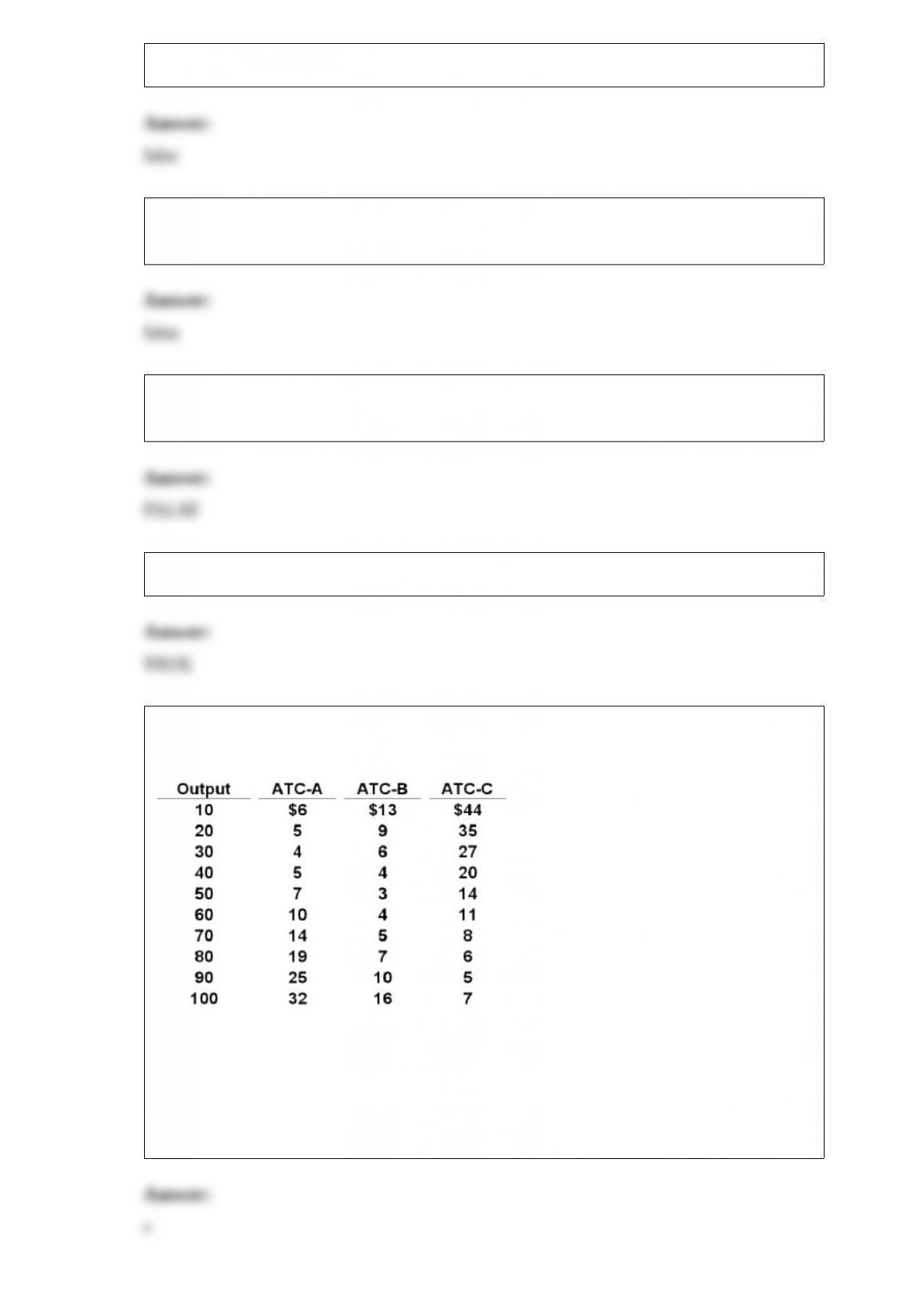
12) the letters a, b, and c designate three successively larger plant sizes.
refer to the above data. economies of scale are realized over the ___ to ___ levels of
output; diseconomies of scale exist over the ___ to ___ levels of output.
a.10, 30; 40, 100
b.10, 40; 80, 100
c.10, 50; 60, 100
d.10, 70; 80, 100
13) A higher wage could result in a lower labor cost per unit of output than a lower
wage if the higher wage:
A.brings forth greater work effort.
B.increases supervision costs.
C.increases job turnover.
D.increases worker absenteeism.
14) John Maynard Keynes created the aggregate expenditures model based primarily on
what historical event?
A.Bank panic of 1907
B.Great Depression
C.Spectacular economic growth during World War II
D.Economic expansion of the 1920s
15) Public choice economists:
A.analyze the incidence of taxes.
B.are also known as Keynesian economists.
C.use the tools of economics to analyze decision making, politics, and elections in the
public sector.
D.are, by definition, economists employed by Federal, state, and local governments.
16) The pure rate of interest refers to the:
A.nominal rate of interest adjusted for inflation.
B.nominal rate of interest.
C.interest rate paid on virtually riskless long-term bonds.
D.rate which large banks charge their corporate borrowers.
17) suppose that salsa manufacturers sell 2 million bottles at $3.50 in one year, and 3
million bottles at $3 in the next year. based on this information we can conclude that
the:
a.law of supply has been violated.
b.law of demand has been violated.
c.demand for salsa has increased.
d.supply of salsa has increased.
18) In 2007, the United States:
A.imported more services than it exported.
B.imported more goods than it exported.
C.traded mainly with developing nations such as Mexico and India.
D.had a small trade surplus in goods and services.
19) Which of the following characterizes the labor sector of most DVCs?
A.educational levels are low
B.a large proportion of the labor force is in agriculture
C.labor productivity is low
D.all of these
20)
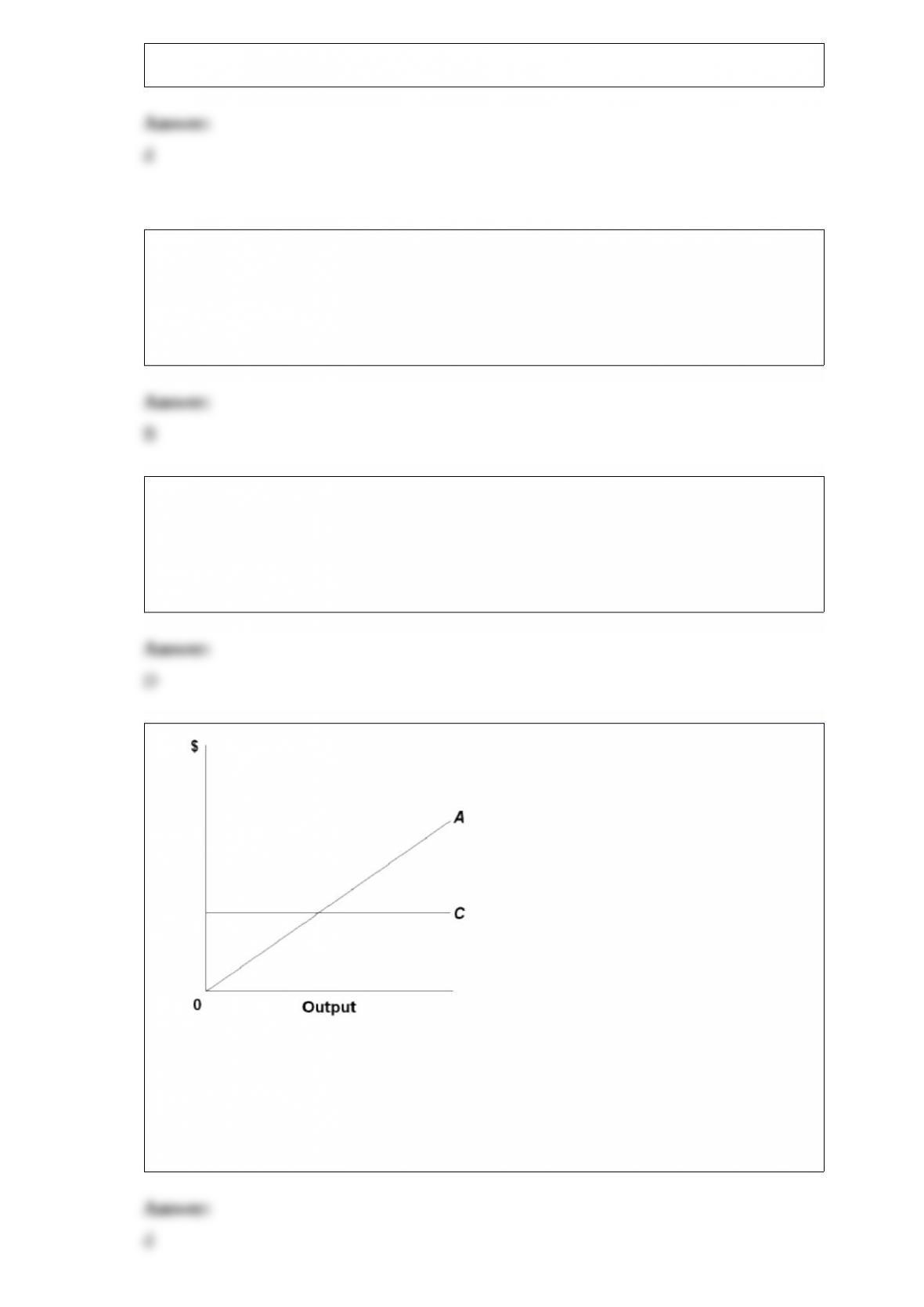
refer to the above diagram, which pertains to a purely competitive firm. curve a
represents:
a.total revenue and marginal revenue.
b.marginal revenue only.
c.total revenue and average revenue.
d.total revenue only.
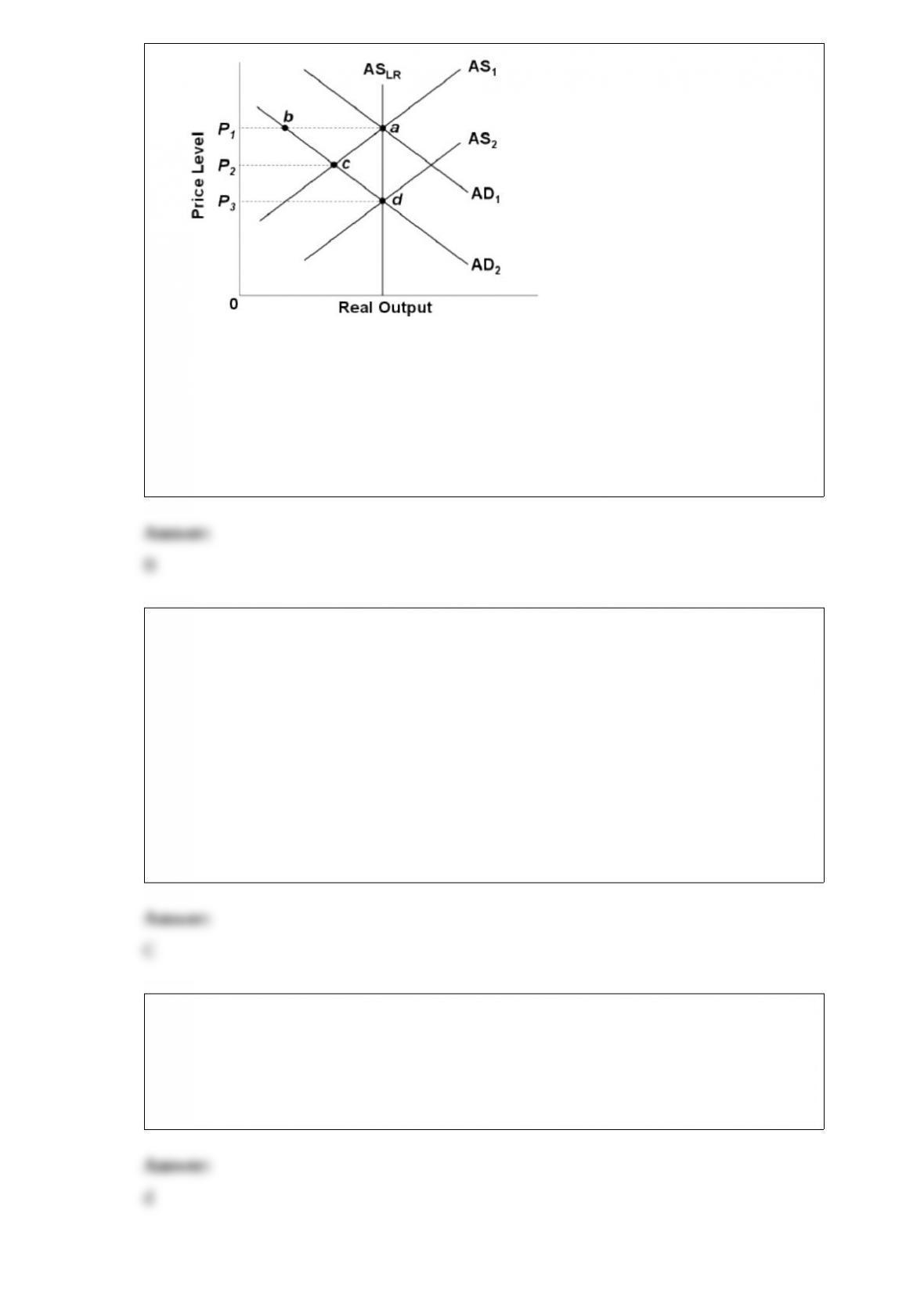
21)
Refer to the above diagram and assume the economy initially is in equilibrium at point
a. In the mainstream view, a decline in aggregate demand from AD1 to AD2 would
likely move the economy:
A.directly from a to d
B.directly from a to b
C.from a to c, then quickly from c to d
D.from a to c, then eventually from c to b
22) Irving Tiller exclusively grew wheat in each of the past three years. Under the Food,
Conservation, and Energy Act of 2008, Tiller:
A.must grow wheat in the current year in order to receive direct payments from the
Federal government.
B.can grow whatever crop he wants to in the current year but will only receive direct
payments from the Federal government if the price of wheat falls below a targeted
price.
C.can grow whatever crop he wants in the current year and will still receive direct
payments from the Federal government based on his previously grown wheat crops.
D.must grow something other than wheat to qualify for direct payments from the
Federal government.
23) the health care market is characterized by:
a.important ethical-equity considerations.
b.asymmetric information between providers and consumers.
c.third-party payment of health care costs.
d.all of these.
24) Alex and Ben are both loggers wanting to harvest timber from the same forest. Alex
prefers to harvest and replant at a sustainable rate; Ben wants to harvest as many trees
as possible to maximize short-run profit, and then move on. They face the same
production costs.
Refer to the information above. If property rights are poorly enforced or non-existent:
A.Ben will choose to harvest as quickly as possible, but Alex will choose to harvest
more slowly and replant.
B.both will harvest trees as quickly as possible, before the other one does.
C.both now have an incentive to harvest and replant in a sustainable manner.
D.we would expect them to form an agreement on harvesting and replanting.
25) Explain the relationship between the price elasticity of demand and price
discrimination. Give two examples.
26) How does a fixed exchange rate system work? How can a nation maintain its fixed
exchange rate?
27) Evaluate and explain: If poverty is defined as an absolute deficiency of income, the
poor are far better off today than they were four decades ago. But if poverty is viewed
as relative deprivation, of being worse off than the people to whom a poor person
compares himself or herself, then poverty today may be more painful than four decades
ago.
28) Assume that M is $500 billion and V is What is the level of nominal GDP according
to the monetarist equation? If V rises by 10%, then according to the monetarist
equation, what will be the new level of nominal GDP?
29) Identify at least four important policy questions about the powers and limits of
government economic policy that macroeconomics models are able to answer.
30) What is the pure rate of interest?
31) What are the problems with government actions in DVCs?