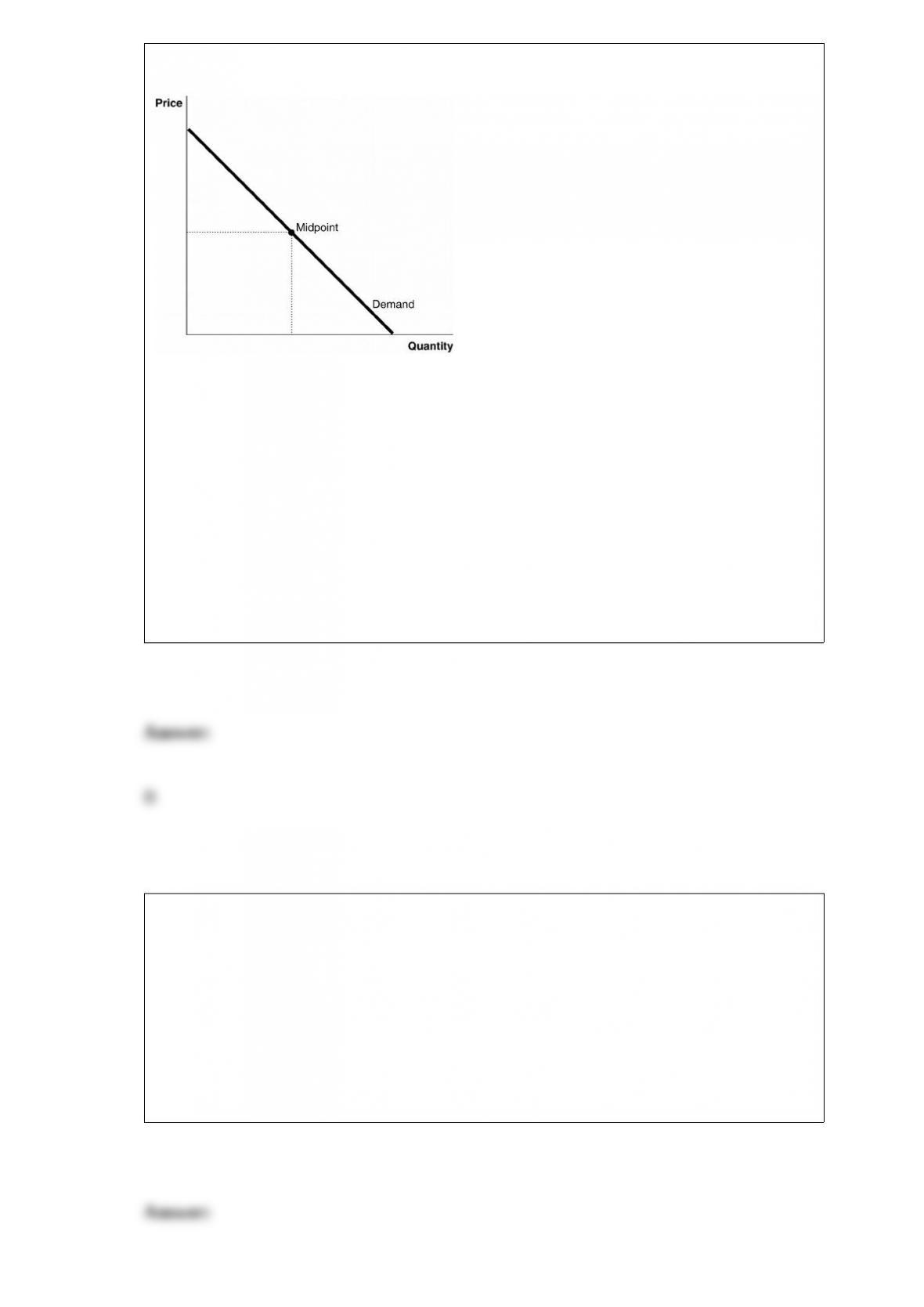
Figure 6-4
Which of the following statements is true about the price elasticity of demand?
A) The elasticity coefficient is constant along the demand curve.
B) The elastic portion of a straight-line downward sloping demand curve corresponds to
the segment above the midpoint.
C) The inelastic portion of the demand curve corresponds to the segment above the
midpoint.
D) At the midpoint of the demand curve, the elasticity coefficient is zero.
Countries with high rates of economic growth tend to have
A) a labor force that is more productive.
B) a lower life expectancy at birth.
C) low rates of technological advancement.
D) a declining incidence of business cycle fluctuations.
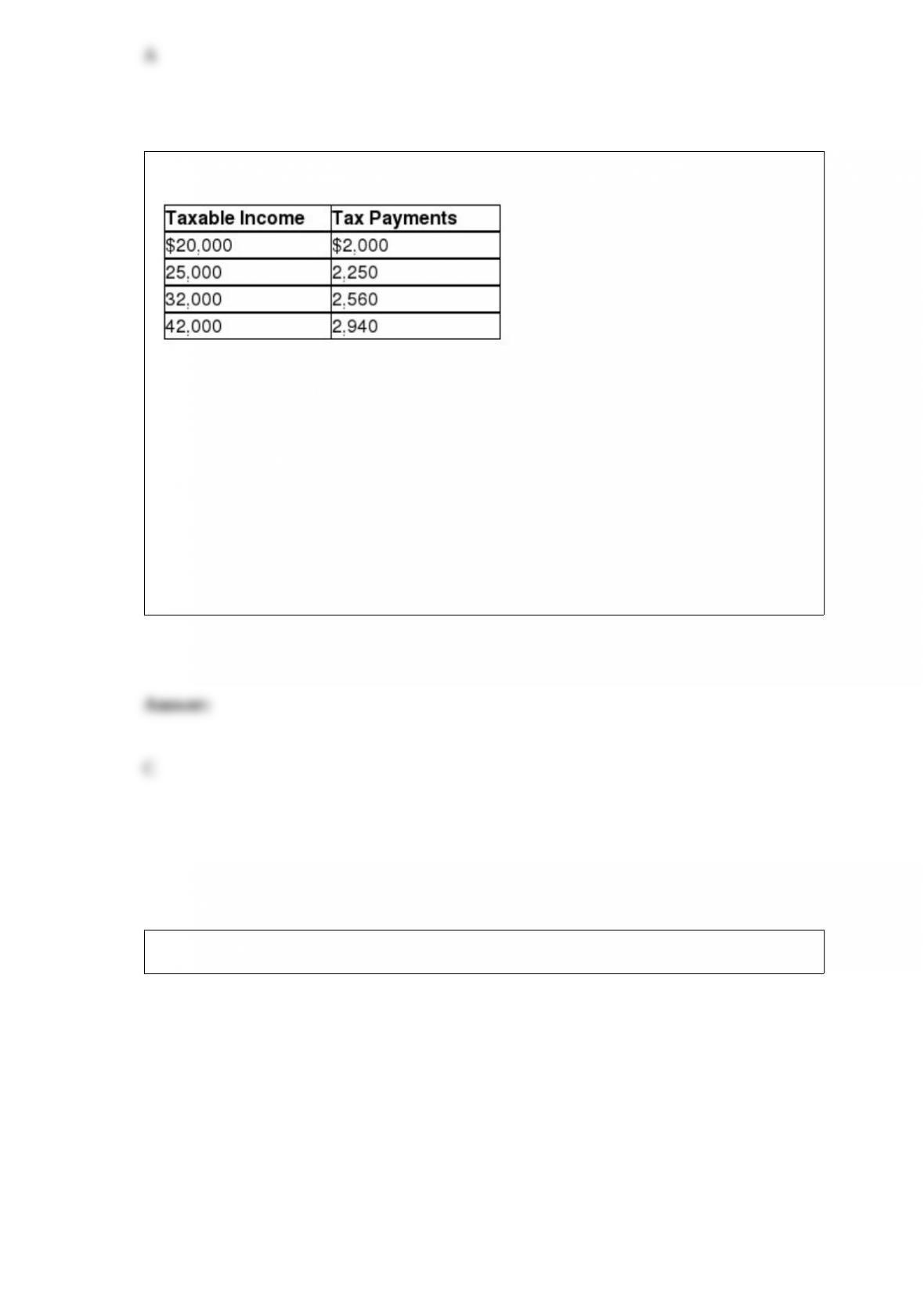
Table 18-5
Table 18-5 shows the amount of taxes paid on various levels of income. The tax system
is
A) progressive throughout all levels of income.
B) proportional throughout all levels of income.
C) regressive throughout all levels of income.
D) regressive between $20,000 and $25,000 of income and progressive between
$32,000 and $42,000.
Table 3-2
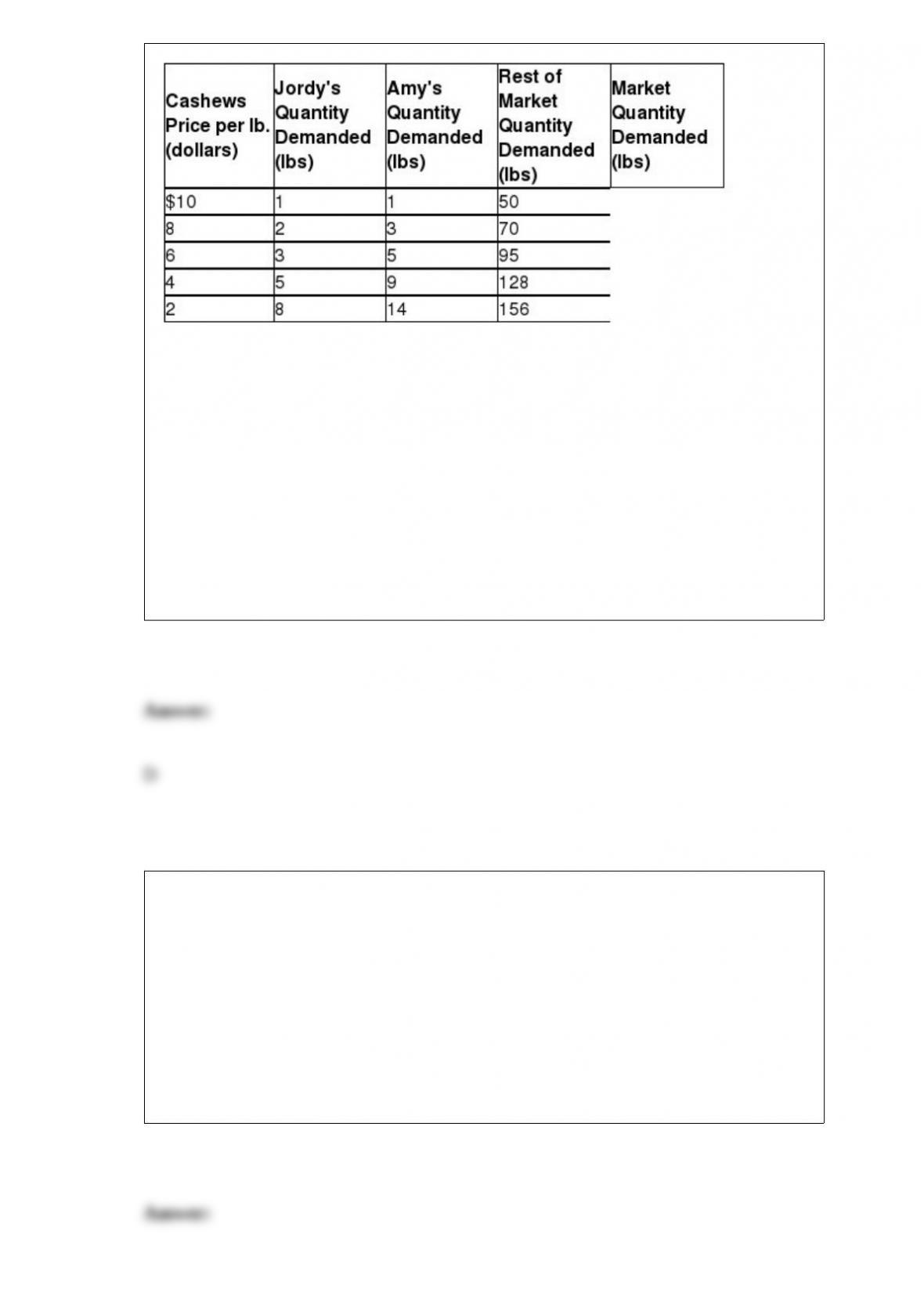
The table above shows the demand schedules for cashews of two individuals (Jordy and
Amy) and the rest of the market. If the price of cashews rises from $4 to $6, the market
quantity demanded would
A) decrease by 33 lbs.
B) increase by 39 lbs.
C) increase by 33 lbs.
D) decrease by 39 lbs.
If we take into account transfer payments (TR) when we derive the saving and
investment relationship, the saving and investment equation becomes
A) S = I + NFI.
B) S + TR = I + NFI.
C) S = I + NFI + TR.
D) S = I + NX – TR.

Assume that air pollution from a copper smelter imposes external costs on people who
live near the smelter. If the victims of the pollution could not legally enforce the right of
their property not to be damaged, the amount of pollution reduction
A) would be significantly less than if the owners of the smelter were legally liable for
damages.
B) would be less than the amount at which the marginal benefit of pollution reduction
equaled the marginal cost.
C) would be the same as if it would be if the owners of the smelter were legally liable.
D) would be too small; the government would have to intervene to bring about an
efficient outcome.
The value you give today to money you will receive in the future is called the future
payment’s
A) time-sensitive value.
B) future value.
C) present value.
D) historical value.
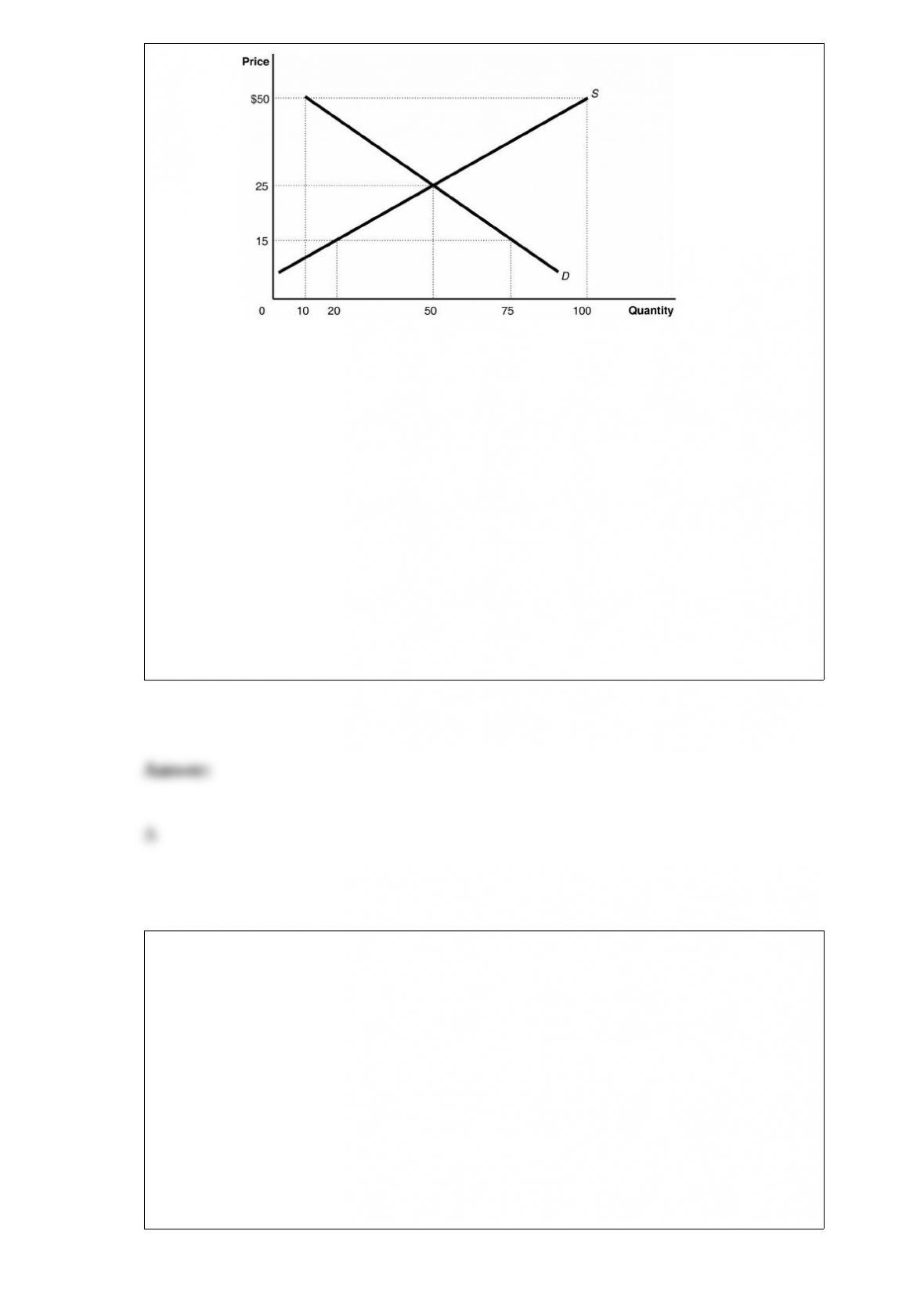
Figure 3-6
The figure above represents the market for coffee grinders. Assume that the market
price is $21. Which of the following statements is true?
A) There is a shortage that will cause the price to increase; quantity demanded will then
decrease and quantity supplied will increase until the price equals $25.
B) There is a shortage that will cause the price to increase; quantity supplied will then
decrease and quantity demanded will increase until the price equals $25.
C) There will be a shortage that will cause the price to increase; demand will then
decrease and supply will increase until the price equals $25.
D) There is a shortage that will cause the price to decrease; quantity demanded will then
increase and quantity supplied will decrease until the price equals $25.
The opportunity cost of going to an outdoor music festival is
A) the enjoyment you receive from going to the festival.
B) the value of the time spent at the festival.
C) equal to the highest value of an alternative use of the time and money spent on the
festival.
D) zero because there is no overhead costs for an outdoor festival.
E) the cost of the festival ticket only.

Both presidents Kennedy and Reagan proposed significant cuts in income taxes.
Opponents of these tax cut proposals argued that
A) the tax cuts would benefit high-income taxpayers.
B) cutting state sales taxes, rather than federal income taxes, would result in greater
economic efficiency.
C) while the tax cuts would result in greater economic efficiency, there was too much
opposition to the tax cuts in Congress. As it turned out, Congress ultimately approved
both tax cut proposals.
D) it would be better to cut taxes on corporate profits.
Suppose the United States decides to go back on the gold standard. This should
A) decrease the Federal Reserve’s ability to pursue active monetary policy.
B) increase the effectiveness of contractionary monetary policy.
C) increase the effectiveness of expansionary monetary policy.
D) improve the Federal Reserve’s ability to target inflation.

Suppose the reserve ratio is RR. Then,
A) required reserves = RR actual reserves.
B) required reserves = RR excess reserves.
C) required reserves = RR deposits.
D) required reserves = RR loans.
For each of the following pairs of products, state which are complements, which are
substitutes, and which are unrelated.
a. Digital camera and memory stick
b. 7Up and Mountain Dew
c. Swimsuits and flip-flops
d. Tylenol and cat food
e. Photocopier and paper

The terms of trade refers to
A) the rules and regulations that countries must adhere to when trading.
B) the ratio at which a country can trade its exports for imports from other countries.
C) the role of the government in overseeing international trade.
D) a legal document that specifies the trade quantities agreed to by two countries.
The ABC Company manufactures routers that are used to provide high-speed Internet
service. ABC sells an average of 1,000 routers each month, but to exhaust economies of
scale in its industry ABC would have to sell 3,000 routers each month. Therefore
A) ABC is experiencing diseconomies of scale.
B) ABC is experiencing diminishing returns.
C) to reach minimum efficient scale ABC would have to sell at least 3,000 routers each
month.
D) ABC will soon go out of business.
If the absolute value of the price elasticity of demand for DVD movies is 0.8, then the
elasticity of demand for the DVD for the movie The Hangover should be
A) less than 0.8 in absolute value.

B) greater than 0.8 in absolute value.
C) equal to 1 in absolute value.
D) equal to zero because the DVD of this movie has been out for several years.
Which of following is the best example of a monopoly if we use a broader definition of
monopoly?
A) Spuds McKenzie, a wealthy potato farmer in Idaho
B) Cheap Gas, one of two gasoline stations in a large rural community
C) Santos Tacos, the only taqueria in the small town of Santosville
D) Zippie Rentals, a sports car rental service in the downtown Boston area