
Carlos can produce the following combinations of X and Y: 10X and 10Y, 5X and 15Y,
and 0X and 20Y. The opportunity cost of one unit of X for Carlos is
a. 1 unit of Y.
b. 2 units of Y.
c. 1/2 unit of Y.
d. 1/4 unit of Y.
e. none of the above
Which of the following statements is false?
a. One of the intended effects of the health-care reform bills passed in March 2010 was
for some people who had health insurance before the reform to choose to become
uninsured after health-care reform.
b. One of the provisions of the health-care reform bills passed in March 2010 is that
individuals will be fined for not buying insurance.
c. Among the provisions in the health-care reform bills passed in March 2010 is that
insurance companies are prohibited from turning down a person with a preexisting
disease.
d. One of the objectives of the health-care reform bills passed in March 2010 was to
bring more people into the pool of insured persons so that insurance policies would
become cheaper.

Which of the following statements is true?
a. The concept of opportunity costs cannot be illustrated within a PPF framework.
b. If scarcity did not exist, neither would a PPF.
c. All PPFs are downward-sloping straight lines.
d. There are more attainable points than unattainable points in every PPF diagram.
In collective bargaining,
a. union members act together as a single unit.
b. each union member represents herself in labor-management negotiations.
c. the objective of the union is to increase its bargaining power with management.
d. a and c
e. b and c
A community of 100 persons wants to redistribute (transfer) some income from

themselves to members of group A.So far, they don’t seem to be able to do what they
say they want to do.This is most likely because each member of the community of 100
persons sees his contribution as __________________ relative to the total (of
contributions) and therefore chooses to be a __________________.
a. large; rent-seeker
b. small; rent-seeker
c. small; free rider
d. large; free rider
e. none of the above
If the consumption of a good by one person reduces the amount of it that can be
consumed by others, the good is
a. excludable.
b. nonexcludable.
c. rivalrous in consumption.
d. nonrivalrous in consumption.
A decrease in the quantity of resources
a. shifts the PPF leftward.

b. shifts the PPF rightward.
c. moves the economy up a given PPF.
d. moves the economy down a given PPF.
The Coase theorem states that
a. positive externalities are directly related to the weather-the better the weather, the
more positive externalities.
b. in the case of trivial or zero transaction costs, negative externalities are more likely to
appear.
c. when transaction costs are high, positive externalities will be minimized.
d. in the case of trivial or zero transaction costs, the property rights assignment does not
matter to the resource-allocative outcome.
As presented in the textbook, research by some economists has shown that even when
there is no difference between options provided to people
a. the way in which the options are framed has no impact on the outcome (i.e. there will
be no preference for one option over another).
b. the preferred option will always be the one that is stated most simplistically.
c. the preferred option will always be the one that sounds more complicated.
d. the way in which the options are framed impacts the outcome (i.e. which option is
preferred).
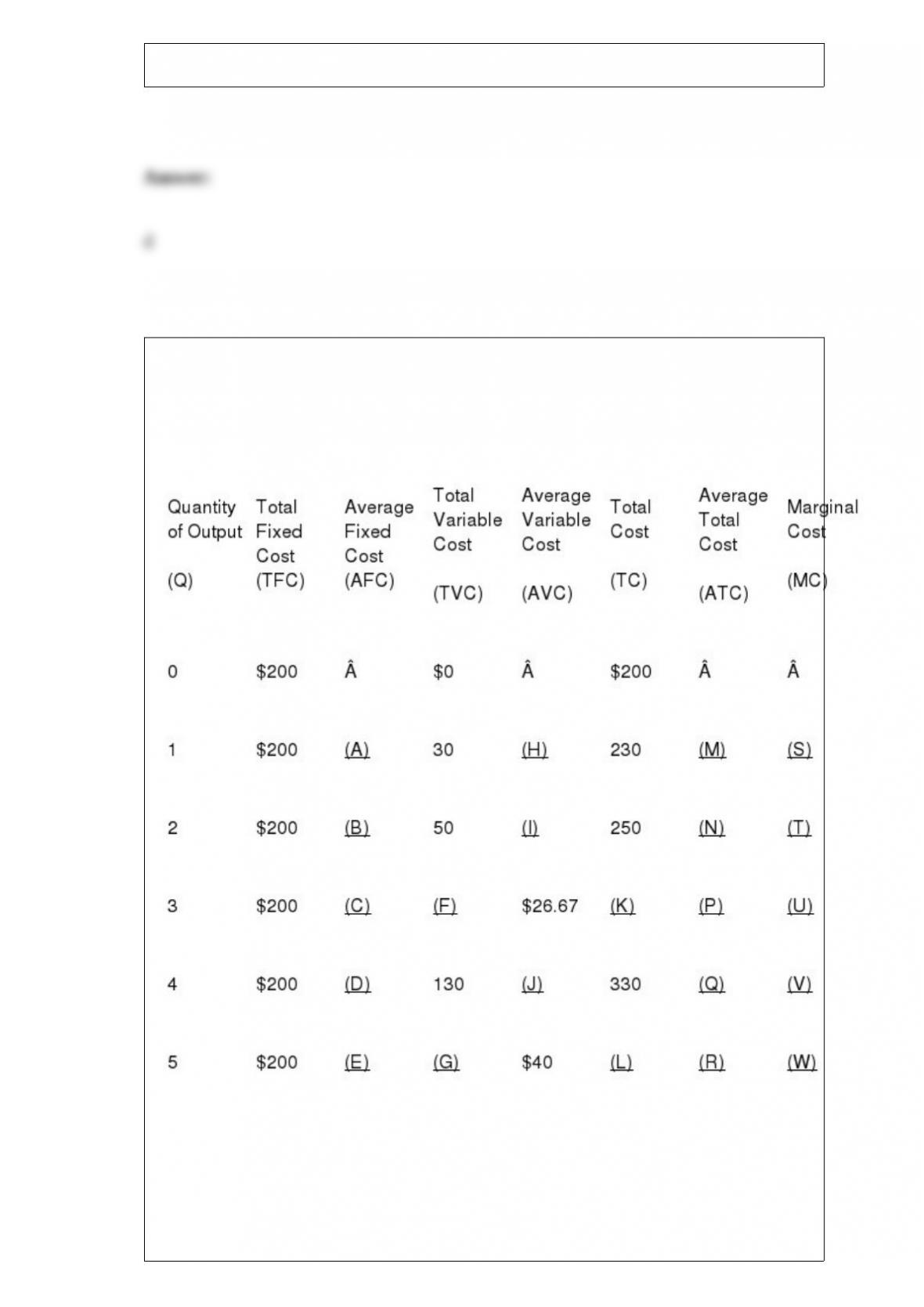
Exhibit 22-13
What dollar amounts go in blanks (G) and (H), respectively?
a. $100; $30
b. $400; $50
c. $200; $30
d. $40; $20
e. There is not enough information to answer this question.
Refer to Exhibit 30-2. The interest and interest rate for loan 3 are, respectively,
a. $500 and 10.5 percent.
b. $10,500 and 5.0 percent.
c. $10,500 and 10.5 percent.
d. $500 and 5.0 percent.
e. none of the above
If Cassandra bought 12 blouses last year when her income was $55,000 and she buys 10
blouses this year when her income is $49,000, then her income elasticity of demand is
a. -1.58.
b. +1.58.
c. -0.63.
d. +0.63.
e. -2.33.
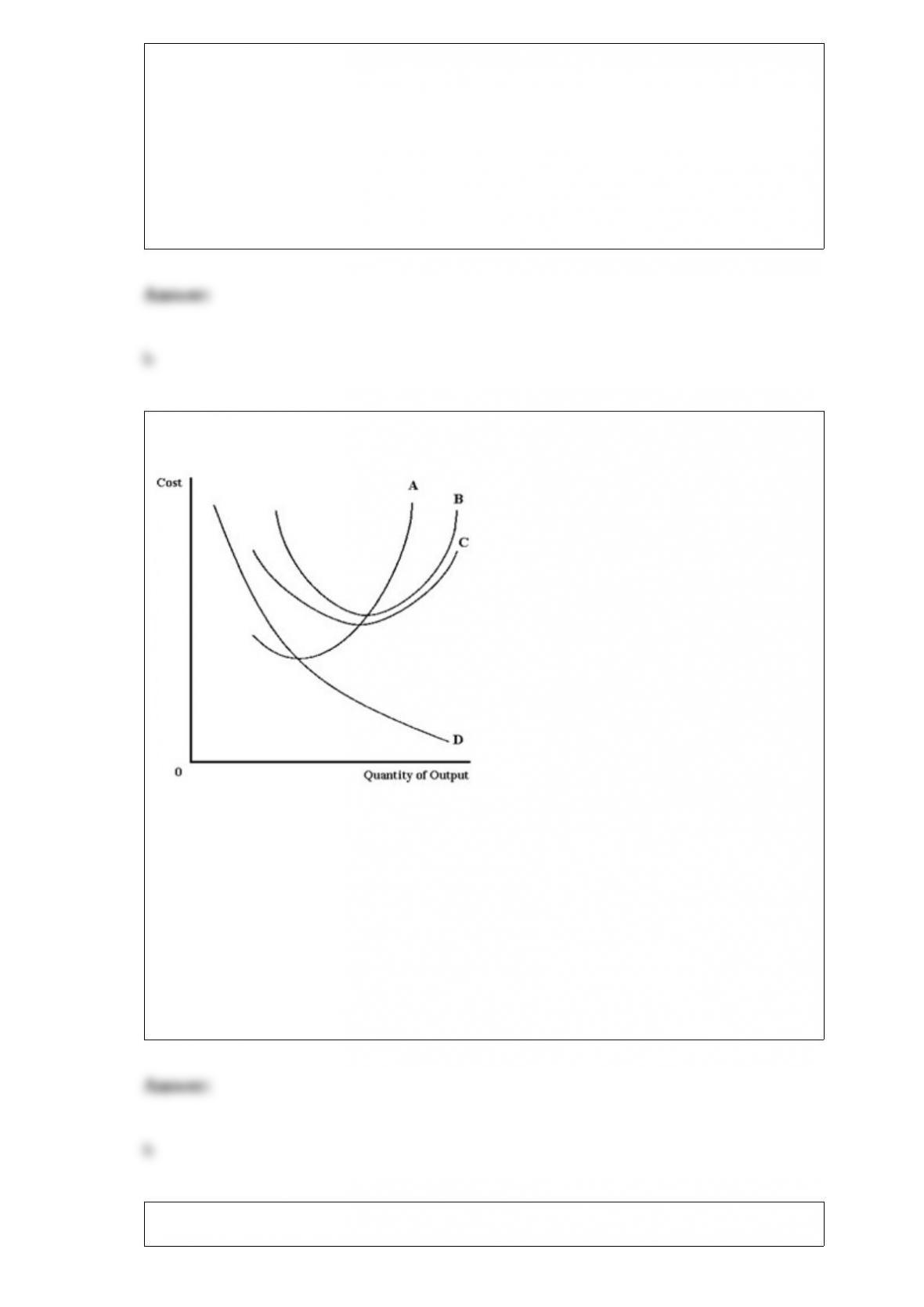
Exhibit 22-4
Curve C is a(n) __________ cost curve.
a. marginal
b. average variable
c. average total
d. average fixed
The coupon rate is the percentage of

a. profits distributed to bondholders.
b. profits distributed to stockholders.
c. the face value of the bond that is paid out regularly to the bondholder.
d. the assets of the corporation that is paid out regularly to each stockholder.
When students arrive late to class and disrupt their classmates
a. a negative externality can arise.
b. a positive externality can arise.
c. a public good (education) becomes rivalrous.
d. a public good (education) becomes nonrivalrous.
The Herfindahl index measures the
a. degree of concentration in an industry.
b. size of a market in terms of total dollar sales.
c. degree to which average variable cost is higher than average fixed cost at every level
of output.
d. the amount of deceptive and false advertising in an industry.
e. none of the above