
1) by an increase in demand we mean that :
a.product price has fallen so consumers move down to a new point on the demand
curve.
b.the quantity demanded at each price in a set of prices is greater.
c.the quantity demanded at each price in a set of prices is smaller.
d.a leftward shift of the demand curve has occurred.
2) economic profits and losses:
a.are both considered by economists to be a part of production costs.
b.are essential to the reallocation of resources from less desired goods to more desired
goods.
c.have no influence on the composition of the domestic output.
d.equalize the distribution of income in the long run.
3) Which of the following is not correct?
A.Other things equal, a monopsonist will pay a lower wage rate than will a firm hiring
labor competitively.
B.A monopsonistic employer will pay workers a wage rate equal to their MRP.
C.A purely competitive seller will pay workers a wage rate equal to their MRP.
D.An imperfectly competitive seller will employ additional workers as long as the MRP
of additional workers exceeds their MRC.
4) assume the demand curve for product x shifts to the right. this might be caused by:
a.a decline in income if x is an inferior good.
b.a decline in the price of z if x and z are substitute goods.
c.a change in consumer tastes that is unfavorable to x.
d.an increase in the price of y if x and y are complementary goods.
5) The assumption that the legal reserve ratio is 20 percent. Suppose that the Fed sells
$500 of government securities to commercial banks (paid for out of commercial bank
reserves) and buys $500 of securities from individuals, who deposit the cash in
checking accounts.
As a result of the above transactions, reserves in the banking system will:

A.remain unchanged.
B.rise by $100.
C.fall by $100.
D.rise by $1,000.
6) if both the real interest rate and the nominal interest rate are 3 percent, then the:
a.inflation premium is zero.
b.real gdp must exceed the nominal gdp.
c.nominal gdp must exceed real gdp.
d.inflation premium also is 3 percent.
7) Over the past decade, total and per capita water use in the United States have:
A.both increased.
B.leveled off and fallen, respectively.
C.fallen and leveled off, respectively.
D.increased and fallen, respectively.
8) The velocity of money may be stated as:
A.PM/V.
B.nominal GDP/M.
C.QM/P.
D.PM/Q.
9) which of the following best defines national income?
a.income received by households less personal taxes
b.the before-tax income received by households
c.incomes earned by u.s. resource suppliers plus taxes on production and imports
d.the market value of the annual output net of consumption of fixed capital
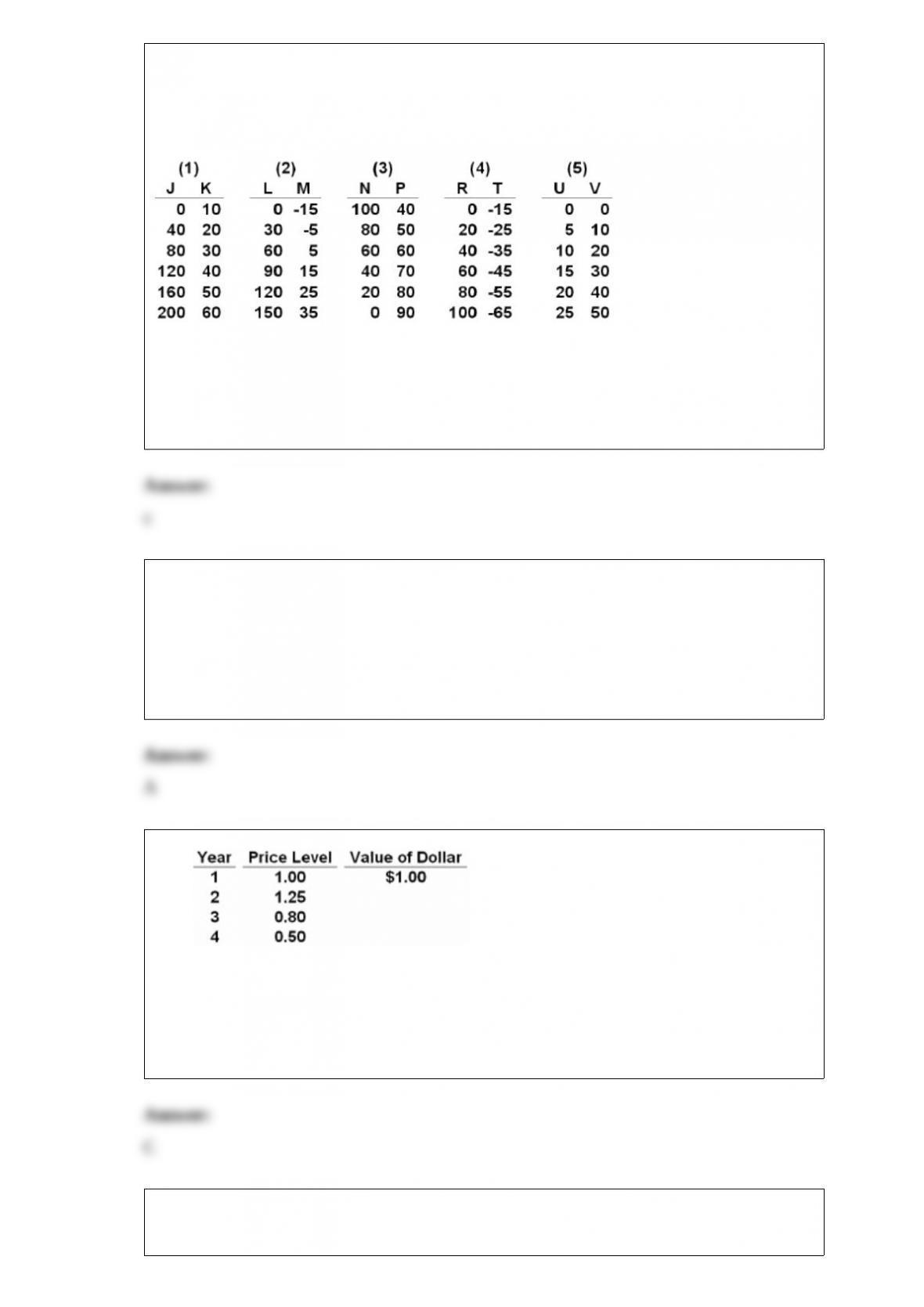
10) answer the next question(s) on the basis of the following five data sets wherein it is
assumed that the variable shown on the left is the independent variable and the one on
the right is the dependent variable. assume in graphing these data that the independent
variable is shown on the horizontal axis and the dependent variable on the vertical axis.
refer to the above data sets. the vertical intercept is negative for:
a.none of the data sets.
b.data sets 1 and 3 only.
c.data sets 2 and 4 only.
d.data sets 1 and 5 only.
11) Assume that you pay $5,000 of tax on a taxable income of $20,000. If your taxable
income were $40,000, your tax payment would be $12,000. This suggests the tax is:
A.progressive.
B.proportional.
C.regressive.
D.discriminatory.
12)
Refer to the above table. The value of the dollar in year 2 is:
A.$1.25.
B.$1.33.
C.$.80.
D.$1.00.
13) between 1980 and 2000 the price level approximately doubled. the average annual
rate of inflation over this 20-year period was about:
a.5.5 percent.
b.4.7 percent.
c.3.5 percent.
d.2.8 percent.
14) Economic or pure rent is:
A.a payment made for the use of housing, factory buildings, or capital goods.
B.a payment for resources used in the production of “free goods.”
C.a payment for the use of those resources whose supply is perfectly elastic.
D.the price paid for the use of land and other nonreproducible resources.
15)
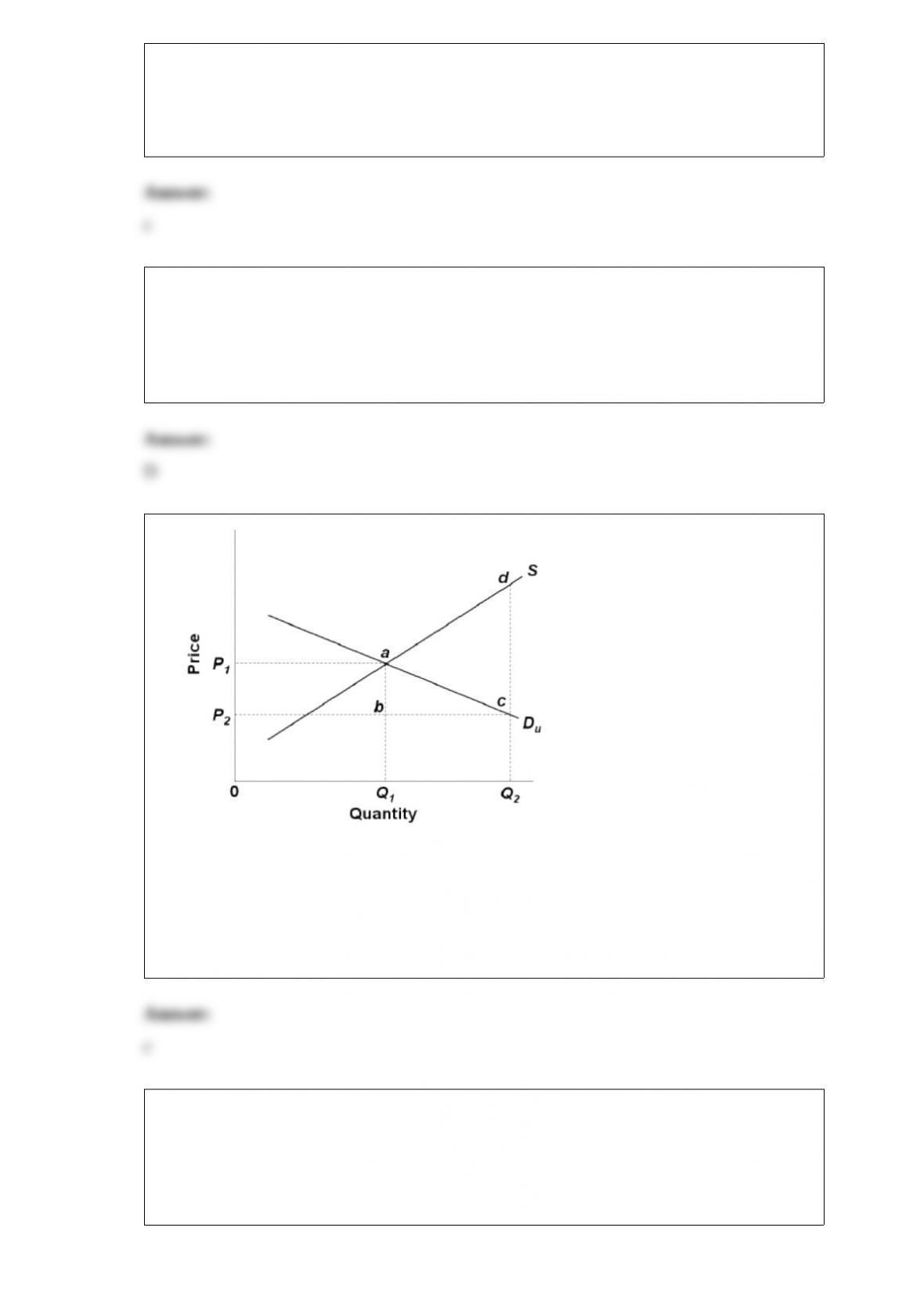
refer to the above demand and supply diagram that relates to the health care market. the
efficiency loss caused by the availability of health insurance is shown by area:
a.p1abp2.
b.abc.
c.adc.
d.q1acq2.
16) when total product is increasing at a decreasing rate, marginal product is:
a.positive and increasing.
b.positive and decreasing.
c.constant.
d.negative.
17)
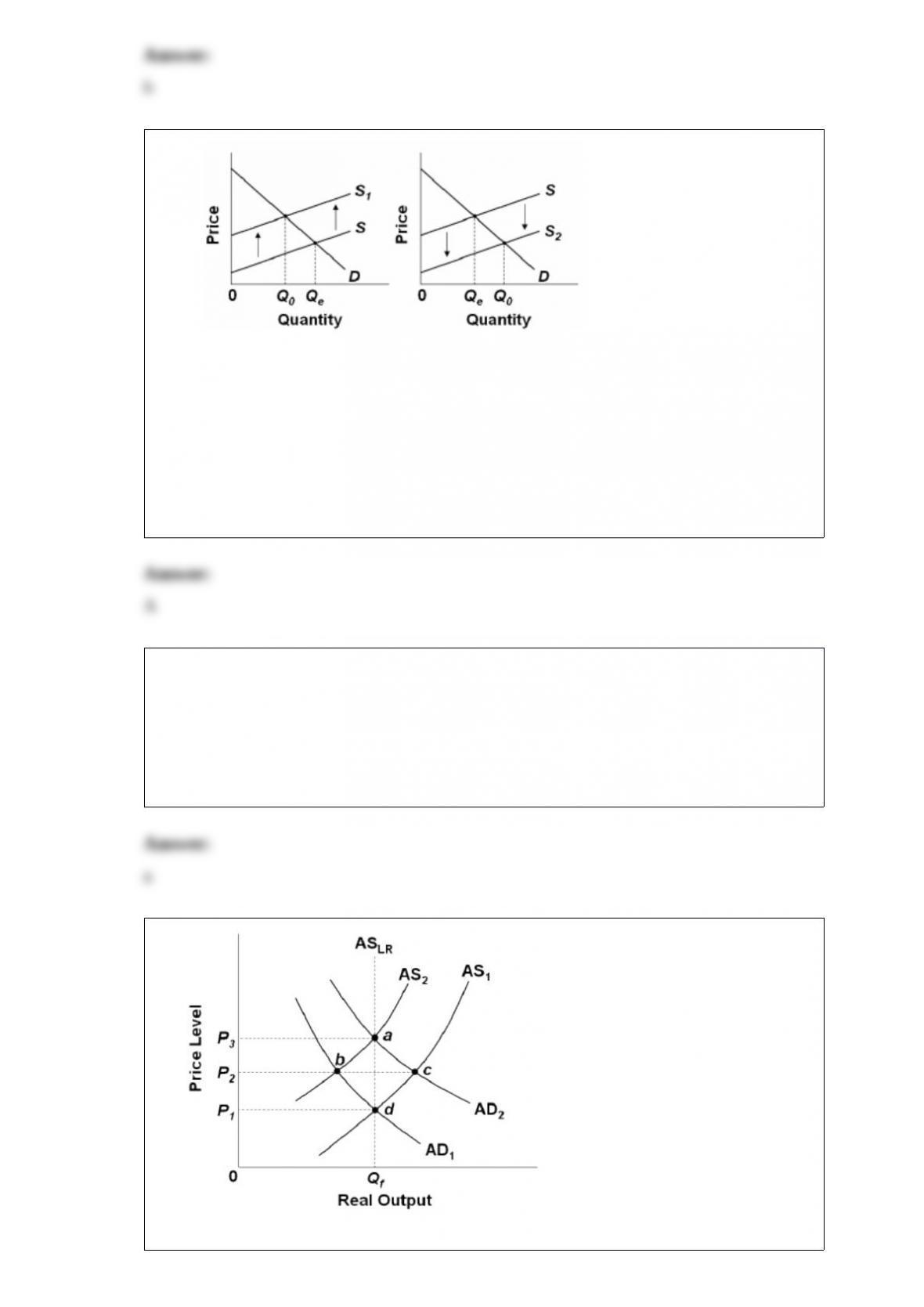
Refer to the above diagrams for two separate product markets. Assume that society’s
optimal level of output in each market is Q0 and that government purposely shifts the
market supply curve from S to S1 in diagram (a) and from S to S2 in diagram (b). The
shift of the supply curve from S to S2 in diagram (b) might be caused by a per unit:
A.subsidy paid to the producers of this product.
B.tax on the producers of this product.
C.subsidy paid to the buyers of this product.
D.tax on the buyers of this product.
18) which of the following statements concerning the relationships between total
product (tp), average product (ap), and marginal product (mp) is not correct?
a.ap continues to rise so long as tp is rising.
b.ap reaches a maximum before tp reaches a maximum.
c.tp reaches a maximum when the mp of the variable input becomes zero.
d.mp cuts ap at the maximum ap.
19)
Refer to the above diagram. The initial aggregate demand curve is AD1 and the initial

aggregate supply curve is AS1. Assuming no change in aggregate demand, the long-run
response to a recession caused by cost-push inflation is best depicted as a:
A.move from a to d along the long-run aggregate supply curve.
B.rightward shift of the aggregate supply curve from AS2 to AS1.
C.move from a to c to d
D.leftward shift of the aggregate supply curve from AS1 to AS2.