Which of the following is true of the per person income of the West (Western Europe
and its offshoots of the United States, Canada, Australia, and New Zealand)
a. It has increased each century and grown steadily since 1500.
b. It is now approximately 20 times greater than the figure of 200 years ago.
c. It rose steadily between 1000 and 1800, but income growth has slowed during the
past 200 years.
d. While income per person has increased since 1800, there has been little change in life
expectancy and other indicators of quality of life during this time period.
Use the figure to answer the following question(s).
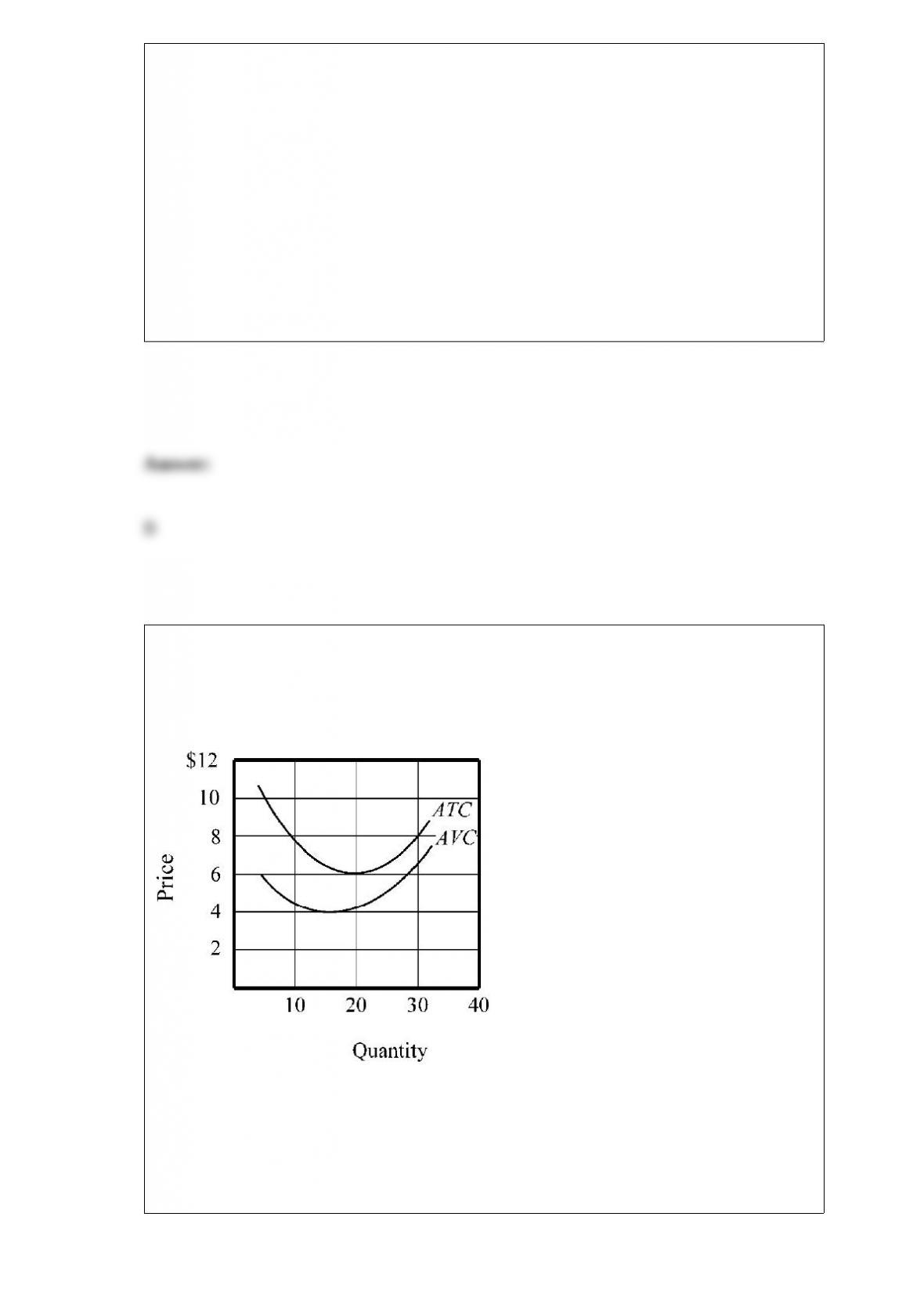
Figure 8-11
The average variable cost (AVC) and average total cost (ATC) for a firm are indicated
in Figure 8-11. The firm’s total cost of producing 20 units is
a. $6.
b. $84.
c. $120.
d. $150.

Which of the following is most likely to be a major source of growth in per capita
GDP?
a. a high investment/GDP ratio
b. a high rate of inflation
c. rapid population growth
d. rapid growth in the money supply
Within the Keynesian model, if the output of an economy is less than the
full-employment level, then
a. a reduction in government expenditures will direct the economy back to
full-employment equilibrium.
b. a reduction in wage rates and resource prices will quickly restore full-employment
equilibrium.
c. a reduction in the real interest rate will soon restore full-employment equilibrium.
d. output will tend to remain below full-employment capacity unless aggregate
expenditures increase.

According to public choice theory, which of the following groups will likely benefit the
most from government income transfers under a system of representative democracy?
a. the poor
b. consumers
c. small businesses
d. concentrated interest groups
“The standard of living is too low for many individuals in the United States. The
government should implement policies designed to achieve a more equal distribution of
income.” The preceding statements are
a. positive economic statements based on cause and effect.
b. normative economic statements based on value judgments.
c. based on the fallacy of composition argument.
d. an empirically validated economic principle.

In recent years, the number of farms has fallen while the average farm size has
increased. What concept may explain this phenomenon?
a. diminishing marginal returns
b. declining productivity
c. diseconomies of scale
d. economies of scale
e. good weather in midwestern states
Competitive markets generally give consumers and producers correct incentives when
a. externalities are present in the market.
b. property rights are well-defined and enforced.
c. the good being produced and consumed is a pure public good.
d. there is a substantial lack of information on the part of either buyers or sellers.
An increase in the long-run aggregate supply curve indicates that
a. the natural rate of unemployment has increased.
b. unemployment has increased.
c. the general level of prices has increased.

d. potential real GDP has increased.
Which of the following about costs is true?
a. The difference between the ATC and AVC curves will decline as output expands.
b. The AFC will remain constant as output increases.
c. If ATC is increasing, then AVC must be greater than ATC.
d. Implicit costs and fixed costs are always the same.
Which of the following is the best example of a supply shock?
a. an increase in the availability of capital and machinery due to normal changes in
business investment
b. a decrease in the productivity of the labor force due to a decline in the average
educational level of workers
c. a decline in agricultural output due to a summer drought
d. an increase in output as a result of an expansion in employment

The term “open market operations” refers to the
a. loan-making activities of commercial banks.
b. effect of expansionary monetary policy on interest rates.
c. operation of competitive markets in the banking industry as the result of deregulation.
d. buying and selling of government securities by the Federal Reserve.
Which of the following is true?
a. Healthcare in Canada and most of the European countries is a socialized industry.
b. Socialization of the healthcare industry eliminates the problem of scarcity in the
healthcare industry.
c. The high-income countries of Europe are able to provide as much healthcare, free of
charge, as their citizens want.
d. All of the above are true.

An unexpected increase in the supply of money will
a. reduce the real rate of interest and, thereby, trigger an increase in current spending by
households and businesses.
b. reduce aggregate demand and real output in the short run.
c. increase only the general level of prices in the short run.
d. lead to a higher rate of unemployment in the short run.
When government imposes price controls in a market,
a. non-price factors become more important in the rationing of the good.
b. efficiency in the market is enhanced.
c. shortages and surpluses are eliminated.
d. buyers and sellers both become better off.
Individual transferable quotas (ITQs) have been shown to
a. increase the value of fisheries but reduce the safety of fishers as the season is
shortened.
b. end overfishing by making the use of efficient technology illegal.
c. increase the safety of fishing but not the value to consumers of the product.

d. increase the value to consumers of the product and raise the price received by fishers.
The larger the marginal propensity to consume,
a. the larger the multiplier.
b. the larger the marginal propensity to save.
c. the higher the income level of the economy.
d. the smaller the change in income derived from a given change in government
spending.
If a reduction in stock prices reduces the real wealth of Americans, the
a. aggregate demand curve will shift to the left.
b. long-run aggregate supply will shift to the left.
c. general price level will increase.
d. aggregate demand curve will shift to the right.
Which of the following is a valid criticism of unregulated monopoly?
a. Monopoly limits the options available to consumers.
b. Relative to a competitive market, a monopolist generally will produce too great an
output.
c. Profit-maximizing monopolists will fail to produce at the lowest possible cost.
d. A monopoly’s output will often be more than if the market were competitive.
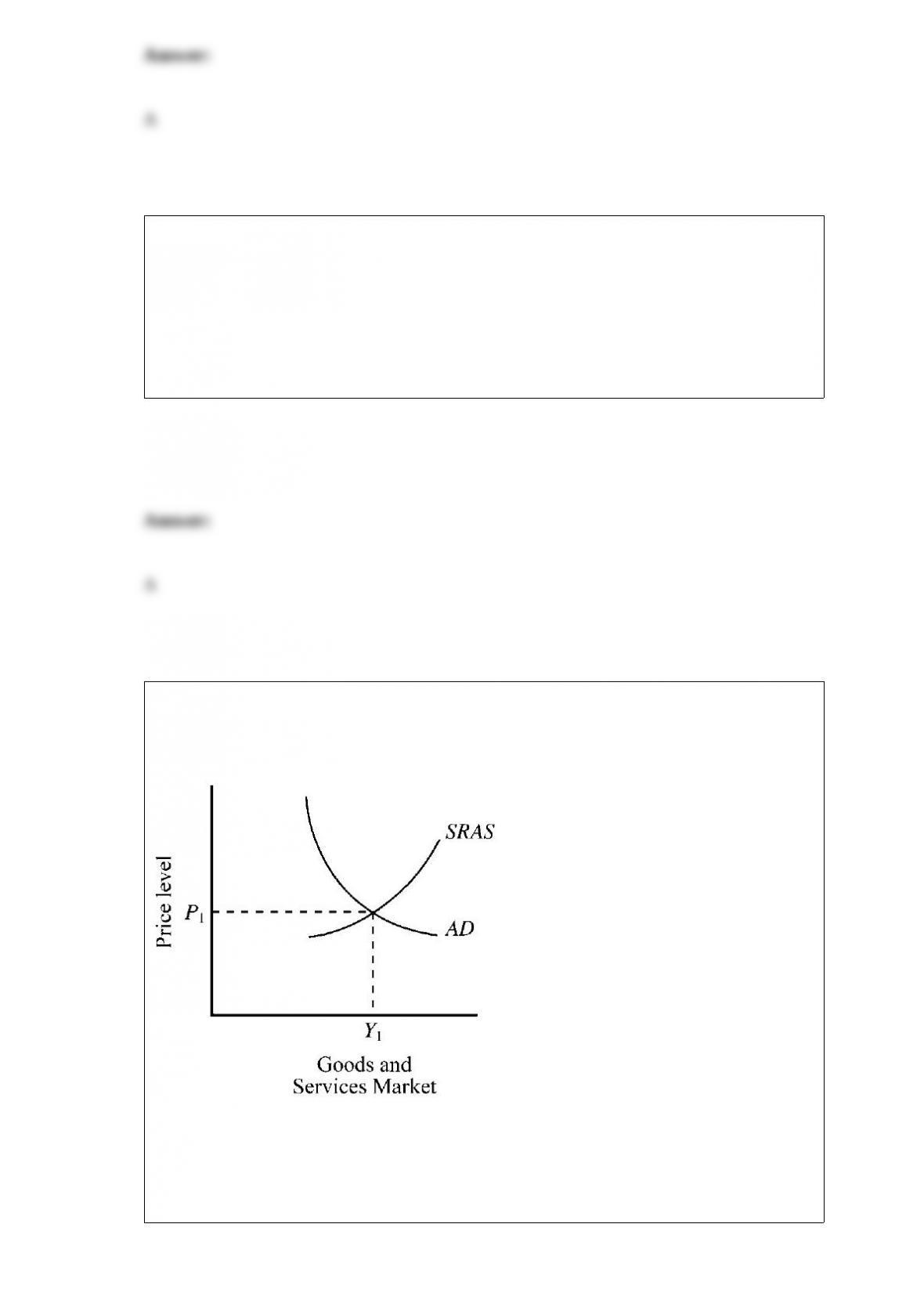
Figure 14-4
In Figure 14-4, an unanticipated shift to a more restrictive monetary policy will shift
a. AD to the right and temporarily increase real GDP.
b. AD to the left and temporarily reduce real GDP.
c. AD to the right and SRAS to the left and lead to higher prices (inflation).
d. both AD and SRAS to the right and lead to an increase in real GDP.

Which of the following is an example of an automatic stabilizer?
a. Congress legislates lower tax rates to increase consumption and investment.
b. Tax rates are increased during a recession to maintain a balanced budget.
c. A regressive income tax system reduces tax revenues (as a share of income) as
income expands.
d. Revenues from the corporate income tax increase sharply during a business boom but
decline substantially during a recession, even though no new tax legislation has been
enacted.
“I like ice cream, but after eating homemade ice cream last night, I want to have
something else for dessert today.” This statement most clearly reflects
a. the budget constraint.
b. consumer irrationality.
c. the second law of demand: price elasticity increases with time.
d. the law of diminishing marginal utility.

Suppose the economy is in long-run equilibrium. In a short span of time, there is a
pessimistic revision of expectations about future business conditions and an unexpected
rise in the value of the dollar. In the short run, we would expect
a. the price level and real GDP both to rise.
b. the price level and real GDP both to fall.
c. the price level and real GDP both to stay the same.
d. All of the above are possible.
Most voters will likely be concerned with
a. most issues since most issues have some impact, however slight, on each citizen.
b. only a few special issues (those that exert the most impact on the voters’ personal
welfare).
c. most issues since information on most issues can be obtained at a low cost.
d. the views of a particular political candidate on all issues.
Middlemen, such as grocers, stockbrokers, and realtors

a. specialize in reducing transactions costs.
b. provide nothing of value to either the buyer or the seller.
c. have no effect on economic output in society.
d. do not exist in capitalist economies.
Adam Smith stated, “The man of system is apt to be very wise in his own conceit. He
seems to imagine that he can arrange the different members of a great society with as
much ease as the hand arranges the different pieces upon a chess-board.” Which is true
of this statement?
a. Keynes would tend to agree with the statement; Heyek would disagree with it.
b. Keynes would tend to disagree with the statement; Hayek would agree with it.
c. As the rap video indicates, both Keynes and Hayek strongly agree with this
statement.
d. As the rap video indicates, both Keynes and Hayek strongly disagree with this
statement.
Over the past century, the growth rate of real GDP in the United States has averaged
approximately
a. 1 percent.

b. 3 percent.
c. 6 percent.
d. 10 percent.
A country with a civilian population of 120,000 (all over age 16) has 100,000 employed
and 10,000 unemployed persons, of which 5,000 are frictionally unemployed and
another 3,000 structurally unemployed.
a. What is the size of the labor force?
b. What is the actual unemployment rate?
c. What is the labor force participation rate?
d. What is the employment/population ratio?
e. What is the natural rate of unemployment?
f. Is this economy in a recession or a boom? Explain.

The typical bundle of goods and services on which the GDP deflator is based
a. is narrower than the one used to calculate the CPI.
b. is updated once every decade.
c. is the same as the one used to calculate the CPI.
d. is updated every year.
If an investment project costing $2,700 was expected to yield $1,000 (to be received at
year end) for each of the next three years, a profit-maximizing entrepreneur would
a. definitely undertake the project.
b. never undertake the project.
c. undertake the project if the interest rate exceeded 12 percent.
d. undertake the project if the interest rate was 5 percent or less.

If the official unemployment rate increases in March from its February level because of
sluggish sales in the auto industry, we can conclude that ____ unemployment is
responsible for the increase.
a. seasonal
b. cyclical
c. structural
d. frictional
e. any one of the causes of
An oligopolistic firm that is deciding the price to charge, the output to produce, or the
quality of product to offer, must consider
a. the regulatory price limits that are always present with oligopoly.
b. the potential reactions of rivals in the market.
c. the fact that per-unit costs will usually increase as the scale of production increases.
d. that entry barriers into oligopolistic markets are low.
John’s demand schedule for pizza is indicated below. If the current price of pizza is
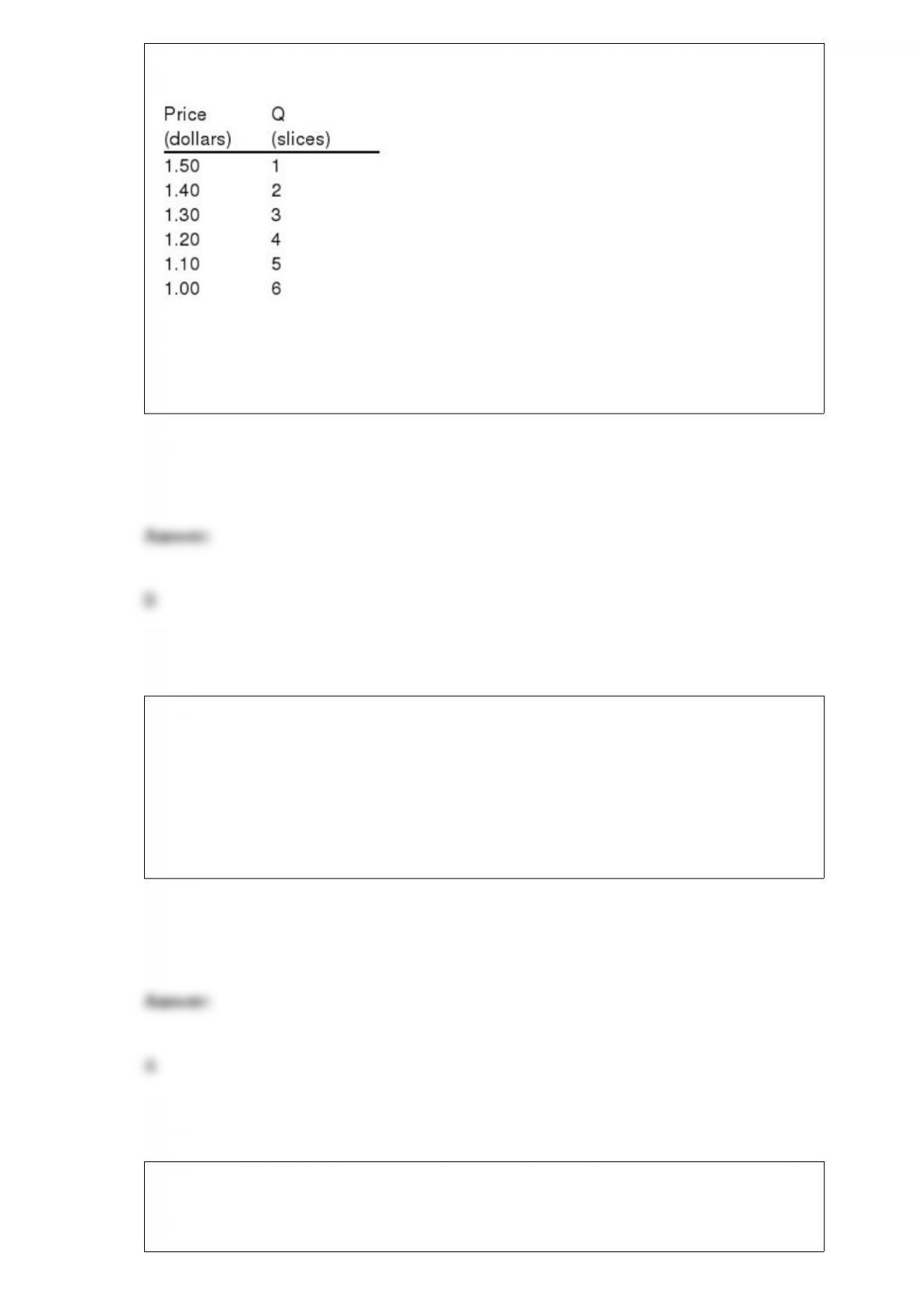
$1.10 per slice, what is John’s consumer surplus if he buys five slices of pizza?
a. $0
b. $1.00
c. $1.10
d. $6.50
According to the quantity theory of money, which one of the following economic
variables would change in response to an increase in the money supply?
a. prices
b. real income
c. velocity
d. employment
People anticipate inflation will be 3 percent during the next several years. If this is true,
when the real interest rate is 4 percent, the money interest rate will be

a. 1 percent.
b. 3 percent.
c. 4 percent.
d. 7 percent.